


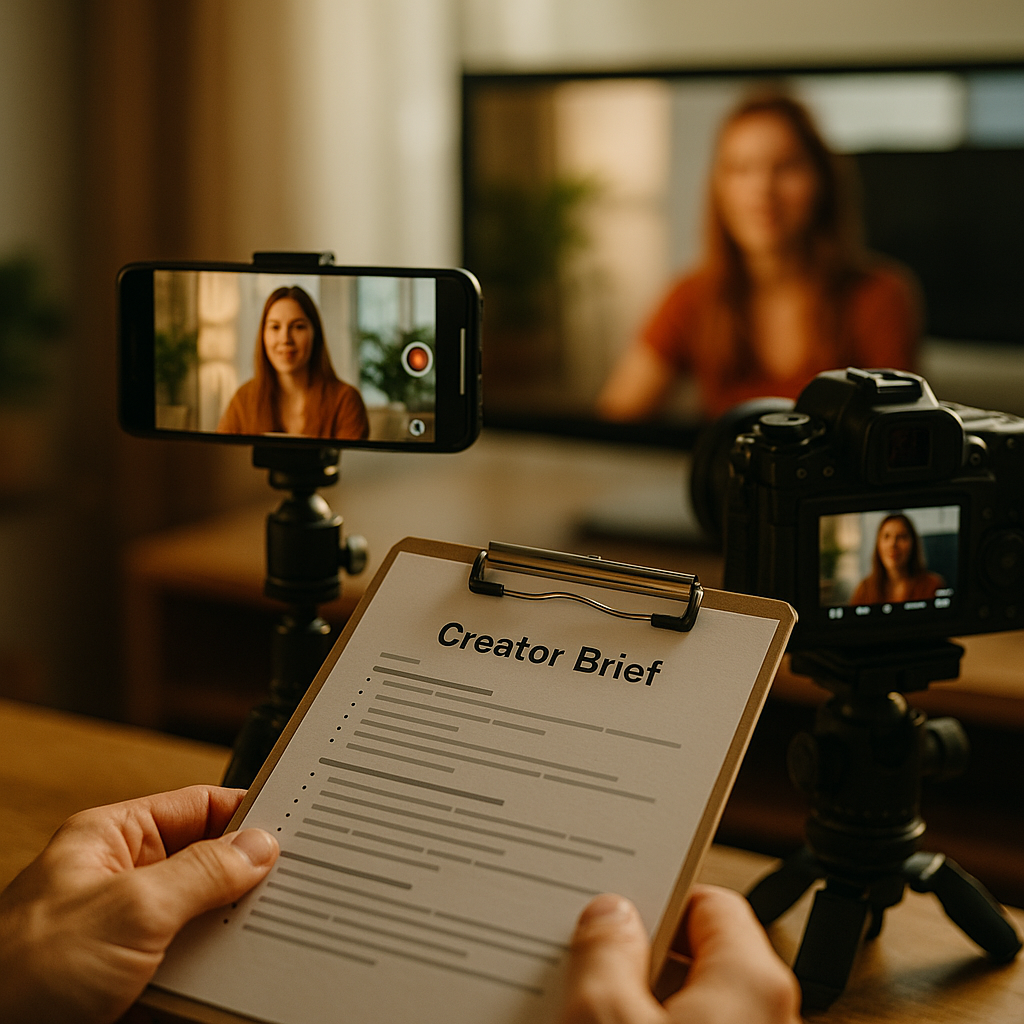
One Shoot. Two Screens. Zero Compromises.
Connected TV ad spend is projected to surpass $40 billion in the U.S. alone, yet most creator briefs are still written exclusively for a 6.1-inch phone screen. That gap is costing brands real inventory reach. The discipline of high-impact video for both mobile and CTV starts with the creative brief, not the edit suite.
Why the “We’ll Adapt It Later” Approach Breaks Down
Here’s the failure mode most teams hit: a creator shoots a vertical TikTok-style video in 1080×1920 at 30fps with ambient room audio. The social team loves it. The programmatic team tries to push it to Roku or Samsung TV Plus inventory and immediately hits a wall. CTV publishers typically require 16:9 or 4:3 aspect ratios, minimum 1920×1080 resolution, stereo or 5.1 audio mixed to broadcast loudness standards (usually -24 LKFS for streaming, -23 LKFS for broadcast), and clean slates with no platform-specific UI elements baked into the frame.
Adapting after the fact means expensive post-production, pillarboxing that looks amateurish on a 65-inch screen, and audio that either clips or sounds hollow against premium CTV content. The fix is upstream: brief it right the first time.
If you’re working through the evolution from short-form to streaming briefs, you already know the structural gap between a social-first and a broadcast-ready deliverable. The question is how to close it without doubling your production budget or killing creator authenticity.
CTV publishers reject a significant share of creator-sourced assets due to technical non-compliance. The rejection almost never happens at the idea level. It happens at the render level — and that’s 100% preventable with a better brief.
The Dual-Screen Production Brief: What It Must Specify
A brief that supports both vertical social and CTV inventory needs to address five non-negotiable technical and creative dimensions. Walk your creators through each one explicitly.
1. Camera and Resolution Requirements
Require capture at 4K (3840×2160) minimum, even if the final deliverable is 1080p. Shooting in 4K gives post-production the headroom to reframe for both 9:16 (vertical) and 16:9 (landscape) without quality loss. iPhone 15 Pro, Sony ZV-E10 II, and Blackmagic Pocket Cinema Camera 6K all meet this standard. Specify ProRes or LOG format where possible; compressed H.264 social-shoot footage doesn’t hold up in color correction for CTV mastering.
2. Frame Rate
Brief creators to shoot at 24fps or 30fps — not 60fps. Sixty frames per second looks clinical on large screens and is associated with behind-the-scenes or documentary content rather than premium advertising. Twenty-four fps carries cinematic weight on CTV while remaining perfectly acceptable in social feeds.
3. Audio Standards
This is where most creator productions fail CTV requirements. Brief your creators to record primary dialogue with a lavalier or shotgun microphone, not phone audio. The deliverable should include a clean audio track (no music) and a mixed track with music at a minimum of -14 LUFS for streaming normalization, with final mastering to -24 LKFS for CTV. Tools like Adobe Audition or iZotope RX handle this in post. If your creator doesn’t have audio post capabilities, build a $200-400 audio finishing line item into the production fee rather than discovering the problem after delivery.
4. Safe Zone Architecture in the Composition
CTV inventory typically renders with no UI overlays. Social platforms stack captions, sticker prompts, profile handles, and CTAs over the bottom 20-30% of the frame. Brief creators to keep critical visual information (faces, product, brand marks) within the center 60% of the frame. This preserves integrity across both environments without requiring a recompose. Some teams use a “broadcast safe zone” overlay in Frame.io or Wipster during review to enforce this before approval.
5. Deliverable Package Specification
Be explicit. Don’t let “send me the files” become a negotiation. The brief should specify: a 9:16 master at 1080×1920 for social, a 16:9 master at 1920×1080 (or 4K if budget permits) for CTV, a 1:1 square cut for display retargeting, a clean plate (no captions, no graphics), a captioned version for social accessibility, and a 15-second cut alongside the full-length version. That’s six to seven files from one shoot session. Reasonable for a creator at mid-to-senior tier; manageable with clear guidance at any level.
Narrative Structure That Works at Both Scale and Speed
Technical specs matter. But the creative architecture of the video determines whether it actually performs on either screen.
CTV viewers are passive. They’re in lean-back mode, often in a dual-screen environment (phone in hand), and they didn’t choose your ad. Social viewers are active but distracted, scrolling at 1.7x speed, deciding in under two seconds whether to stop. These are fundamentally different attention states, and a single asset has to bridge them.
The structure that works for both is a modified problem-solution arc compressed into the first five seconds. Open with a visually arresting image and a single spoken sentence that establishes tension or curiosity. This stops the scroll and holds the passive CTV viewer before they reach for the remote. The middle third delivers the product’s role in resolving the tension, using demonstration rather than description. The final third closes with a brand-credentialing beat (a result, a transformation, a reaction shot) followed by a clean logo card with no animated transitions that would look cheap on a large screen.
For brands managing brand consistency across multiple creators, this structure functions as a modular framework each creator interprets through their own voice, while keeping the narrative arc standardized for CTV compliance.
Rights, Usage, and Distribution Clearance
Running creator content on CTV is a rights minefield that many influencer teams aren’t fully equipped to navigate. Background music cleared for social use (through platforms’ blanket licenses) is almost never cleared for broadcast or streaming distribution. A creator who licenses a track through DistroKid’s social-only tier cannot have that track in a CTV ad without a separate sync license.
Build this into the brief language explicitly: “All music must be cleared for broadcast and streaming distribution, including CTV and OTT inventory. Creator is responsible for providing proof of clearance before delivery.” Alternatively, specify licensed music sources such as Artlist, Musicbed, or Epidemic Sound’s broadcast license tier, which explicitly cover CTV and digital out-of-home use.
On the talent and IP rights side, the FTC compliance and brand safety framework your team already uses for social disclosure should be extended to include CTV-specific disclosure requirements. The FTC’s guidelines on endorsements apply regardless of the screen the ad appears on.
Workflow: From Single-Session Shoot to Dual-Screen Delivery
The operational question brands ask most often is: how do we actually manage this at scale without a production company on retainer?
The answer is a tiered production workflow. For hero campaigns (two to four creators, high media spend), assign a brand-side producer to join each creator’s shoot remotely via a live monitoring feed through Frame.io or Streamyard. This allows real-time direction on framing, audio levels, and pacing without flying anyone anywhere.
For always-on creator programs, use a structured self-certification checklist embedded in your brief. Require the creator to submit a 30-second “technical preview” clip before the full shoot, confirming resolution, audio quality, and framing. Catch problems before they’re baked into two hours of footage.
For distribution, platforms like The Trade Desk and Magnite support creator-sourced CTV inventory programmatically, but both require VAST-compliant video with specific bitrate and codec requirements (typically H.264 or H.265, 15-50 Mbps for CTV). Work these specs into your brief’s technical appendix so creators or their editors aren’t guessing at export settings.
Brands scaling this approach across markets should also look at the UGC-to-CTV distribution pipeline framework, which addresses how to systematize quality and rights clearance at volume. And if you’re coordinating shoots across creator teams in different geographies, the mobile-to-CTV asset pipeline approach consolidates production logistics without requiring separate shoots.
The brands winning on CTV with creator content aren’t spending more per shoot. They’re specifying more per brief. The creative direction investment happens on paper, before anyone picks up a camera.
Measurement Alignment Across Both Environments
One final brief element that most teams leave out: define success metrics for each screen before the asset goes live. CTV performance is measured through reach, frequency, completed view rate (CVR), and brand lift, tracked through providers like iSpot.tv or Nielsen ONE. Social performance is measured through 3-second view rate, saves, shares, and link clicks. These are different signals from different audiences.
Brief creators to deliver content that serves both measurement frameworks. A strong hook that drives 3-second view rate on social also holds a CTV viewer through the first act. A clean product demonstration that drives brand lift on CTV also functions as a save-worthy reference piece on Instagram. Alignment between screens is creative alignment, not just technical alignment.
Start your next creator brief with the CTV technical spec sheet attached. That single decision eliminates the most expensive failure modes before production begins.
Frequently Asked Questions
What resolution should creators shoot at for a dual mobile and CTV asset?
Creators should shoot at 4K (3840×2160) minimum, even if the final deliverable is 1080p. Capturing in 4K provides the post-production headroom needed to reframe for both 9:16 vertical (social) and 16:9 landscape (CTV) without quality degradation. Compressed 1080p social footage typically doesn’t hold up under the color correction and reframing required for CTV mastering.
What audio standard is required for CTV ad inventory?
CTV publishers typically require audio mixed to -24 LKFS (broadcast streaming standard), with a clean dialogue track and a music-mixed track delivered separately. Creators should record primary dialogue with a lavalier or shotgun microphone rather than relying on phone audio. Tools like Adobe Audition or iZotope RX handle LKFS normalization in post-production. Budget for audio finishing as a line item if the creator lacks post-production audio capability.
Can music licensed for social media use be included in CTV ads?
No. Music cleared for social platforms through blanket licensing (such as TikTok’s or Instagram’s built-in music libraries) is not cleared for CTV or OTT distribution. Brands must specify in the brief that all music requires broadcast and streaming clearance. Recommended sources include Artlist, Musicbed, and Epidemic Sound’s broadcast license tier, all of which explicitly cover CTV and digital out-of-home use.
What aspect ratios should the creative brief specify as deliverables?
A complete dual-screen deliverable package should include: a 9:16 master (1080×1920) for vertical social feeds, a 16:9 master (1920×1080 or 4K) for CTV, a 1:1 square cut for display retargeting, a clean plate without captions or graphics, a captioned version for social accessibility compliance, and a 15-second cut alongside the full-length asset. That’s typically six to seven files from a single shoot session.
How does FTC disclosure work when creator content runs on CTV?
FTC endorsement guidelines apply regardless of the screen or platform on which an ad appears. Creator content running as a paid CTV ad must include clear and conspicuous disclosure that it is a paid advertisement. Brands should extend their existing social disclosure language to explicitly cover CTV and OTT distribution in the creator agreement, and ensure the disclosure is visible on screen rather than buried in an audio track or metadata.
What narrative structure performs best across both mobile social and CTV?
A modified problem-solution arc works across both screens. Open with a visually arresting image and a single spoken sentence that establishes tension or curiosity within the first five seconds. The middle third demonstrates the product’s role in resolving that tension. The final third closes with a brand-credentialing beat (a result, transformation, or reaction shot) followed by a clean logo card. This structure stops the social scroll and holds the passive CTV viewer before they reach for a remote.
Top Influencer Marketing Agencies
The leading agencies shaping influencer marketing in 2026
Agencies ranked by campaign performance, client diversity, platform expertise, proven ROI, industry recognition, and client satisfaction. Assessed through verified case studies, reviews, and industry consultations.
Moburst

-
2

The Shelf
Boutique Beauty & Lifestyle Influencer AgencyA data-driven boutique agency specializing exclusively in beauty, wellness, and lifestyle influencer campaigns on Instagram and TikTok. Best for brands already focused on the beauty/personal care space that need curated, aesthetic-driven content.Clients: Pepsi, The Honest Company, Hims, Elf Cosmetics, Pure LeafVisit The Shelf → -
3

Audiencly
Niche Gaming & Esports Influencer AgencyA specialized agency focused exclusively on gaming and esports creators on YouTube, Twitch, and TikTok. Ideal if your campaign is 100% gaming-focused — from game launches to hardware and esports events.Clients: Epic Games, NordVPN, Ubisoft, Wargaming, Tencent GamesVisit Audiencly → -
4

Viral Nation
Global Influencer Marketing & Talent AgencyA dual talent management and marketing agency with proprietary brand safety tools and a global creator network spanning nano-influencers to celebrities across all major platforms.Clients: Meta, Activision Blizzard, Energizer, Aston Martin, WalmartVisit Viral Nation → -
5

The Influencer Marketing Factory
TikTok, Instagram & YouTube CampaignsA full-service agency with strong TikTok expertise, offering end-to-end campaign management from influencer discovery through performance reporting with a focus on platform-native content.Clients: Google, Snapchat, Universal Music, Bumble, YelpVisit TIMF → -
6

NeoReach
Enterprise Analytics & Influencer CampaignsAn enterprise-focused agency combining managed campaigns with a powerful self-service data platform for influencer search, audience analytics, and attribution modeling.Clients: Amazon, Airbnb, Netflix, Honda, The New York TimesVisit NeoReach → -
7

Ubiquitous
Creator-First Marketing PlatformA tech-driven platform combining self-service tools with managed campaign options, emphasizing speed and scalability for brands managing multiple influencer relationships.Clients: Lyft, Disney, Target, American Eagle, NetflixVisit Ubiquitous → -
8

Obviously
Scalable Enterprise Influencer CampaignsA tech-enabled agency built for high-volume campaigns, coordinating hundreds of creators simultaneously with end-to-end logistics, content rights management, and product seeding.Clients: Google, Ulta Beauty, Converse, AmazonVisit Obviously →