


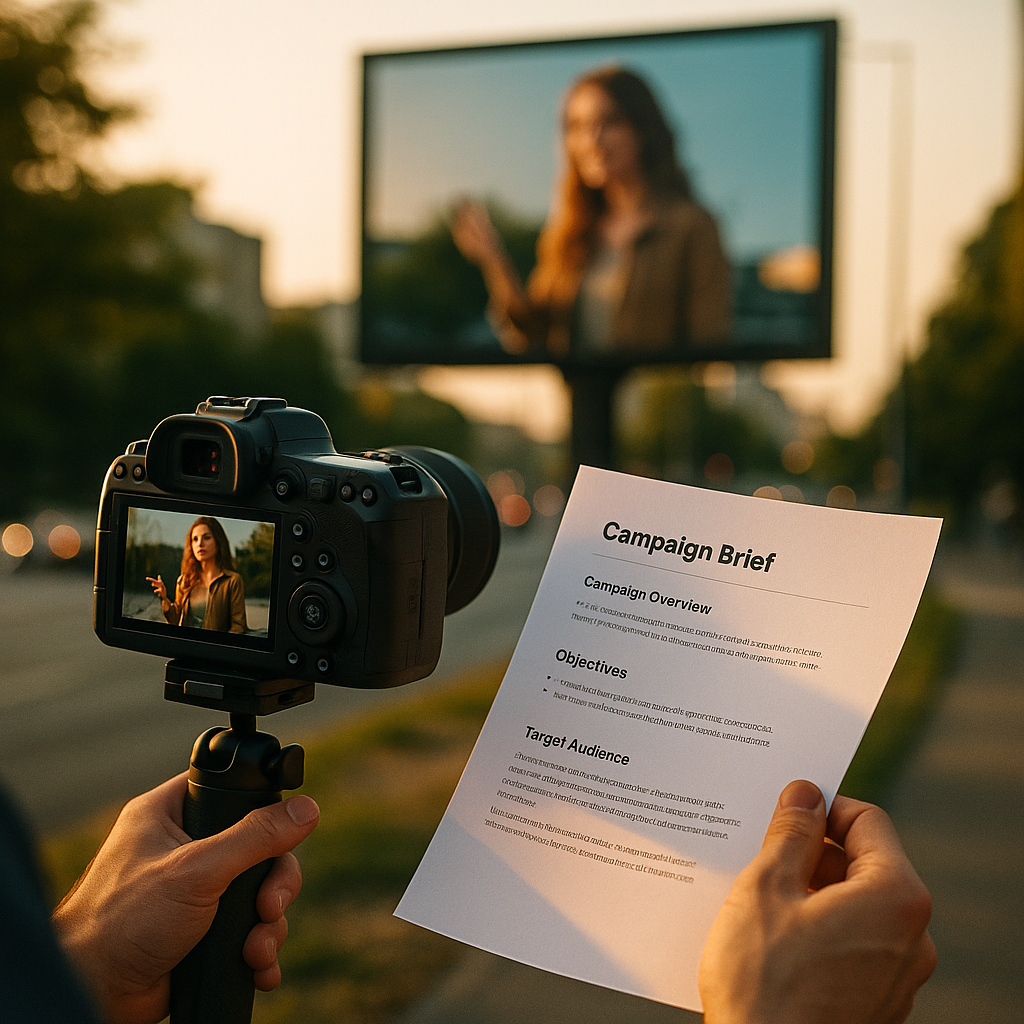
Brands running OOH campaigns alongside influencer programs are spending twice on creative they should be producing once. The OOH and digital creator campaign integration brief solves that — but almost no brand is writing it correctly.
Why Two Briefs for One Campaign Is a Budget Leak
Walk through any mid-sized brand’s campaign folder and you’ll find the same structure: a separate OOH brief sent to a production house, and a separate creator brief sent to influencers. Different art directors. Different timelines. Different asset specs. The billboard goes up and the Instagram Reel drops the same week, but they look like they came from competing agencies. Worse, the creator content rarely gets cleared for OOH use, so the brand pays a production company anyway.
This is an operational and creative failure. Outdoor advertising spend is growing — Statista tracks global OOH ad spend climbing consistently as urban foot traffic normalizes post-pandemic. Creator content, meanwhile, generates assets at a fraction of traditional production cost. The opportunity to merge these two workflows into one unified brief is enormous. Most brands are simply not structured to do it.
A single well-architected creator brief can produce billboard-ready hero images, 9:16 social clips, 16:9 display variants, and algorithm-optimized short-form content from one shoot — eliminating redundant production spend entirely.
What “Integration” Actually Means in a Brief Context
Integration does not mean asking creators to “make something that works everywhere.” That instruction produces nothing usable. Integration means the brief specifies, with precision, the technical and narrative requirements that allow a single creative session to yield assets across surfaces.
There are three layers to get right.
Layer 1: Visual architecture. OOH placements live at a distance. They need high-contrast imagery, minimal text, and a subject that reads clearly at 50 feet. Creator content, by contrast, rewards intimacy and texture. The brief must establish a visual anchor — usually a hero composition — that satisfies both. Think of it as designing for the thumbnail first. If the image works as a billboard crop, it will work as a social thumbnail. If it works as a thumbnail, it will likely perform on paid social placements too.
Layer 2: Message hierarchy. OOH communicates one thing. Social can communicate three, sequentially. Brief your creator on a primary message (the billboard message) and two supporting messages (for the caption, voiceover, or text overlay). The creator’s content then functions as the “extended cut” of the OOH — the billboard creates recognition, the social content creates conversion context.
Layer 3: Rights and usage clearance. This is where most campaigns fall apart. Creator-produced assets cannot anchor OOH placements without explicit rights granted in the contract. The brief must state upfront — before the creator agrees to the engagement — that OOH usage rights are included. Trying to renegotiate post-production is expensive and slow. Build it into your multi-surface brief structure from the start.
The Spec Sheet That Lives Inside the Brief
Most creator briefs mention platform specs as an afterthought. For OOH-integrated campaigns, specs are the foundation. Every creator participating needs to receive — inside the brief document itself — the following:
- OOH safe zone dimensions: The crop area that will be used for large-format print. Typically a centered 4:5 or square composition works across both digital billboard and standard print formats.
- Minimum resolution requirements: OOH vendors typically require 300 DPI at final print size. Brief creators to shoot RAW or at maximum resolution if using photography elements. For video-sourced stills, specify 4K minimum.
- Background constraints: Busy or textured backgrounds destroy legibility at distance. Brief the creator on clean or controlled backgrounds for any shot intended for OOH extraction.
- Logo and brand mark placement: Provide a clear zone guide so creators don’t place on-screen text or props in areas reserved for brand marks in the final OOH composition.
- Social-native deliverables: 9:16 vertical for TikTok and Instagram Stories/Reels, 1:1 for feed, 16:9 for YouTube pre-roll. These should be treated as separate deliverables, not cropped versions of the OOH asset.
Operational teams at brands like Nike and Spotify have been doing versions of this for years inside their in-house content studios. The difference now is that creator-led production has matured enough that independent creators can execute to these standards with the right direction. The brief is the direction.
Writing for the Algorithm Without a Second Brief
Here is where most integrated brief attempts fail. Brand teams understand OOH specs. They often don’t understand social algorithms well enough to write for them. The result: a brief that produces great billboard assets and flat social content that earns no organic distribution.
Algorithm-friendly social content in this context requires three things the OOH asset does not: a hook in the first 1.5 seconds, a reason to watch or engage beyond the visual, and content that rewards the algorithm’s preference for native formats. A static crop of your billboard does none of these. Your creator brief needs to specify these as separate deliverables with separate creative direction, even when they reference the same visual world as the OOH work.
Specifically, the brief should include a “social-native extension” section. This section directs the creator to produce a piece of content that:
- Uses the OOH visual as a reference point, not a direct reproduction
- Opens with the creator’s voice, face, or a native storytelling device
- Includes a platform-specific call to action that aligns with the OOH campaign’s landing page or product URL
- Is shot and edited in the creator’s natural style — not branded down to look like a commercial
For more on building briefs that earn algorithmic reach without over-specifying the creative, the framework outlined in brief architecture for organic growth applies directly here. The principle is identical: constraint on the visual anchors, freedom on the storytelling execution.
Disclosure, Compliance, and the OOH Wrinkle
FTC disclosure requirements for creator-produced content are well-established. What’s less discussed is how those requirements extend to OOH placements featuring creator-produced assets. If a creator’s likeness appears on a billboard as part of a paid brand relationship, disclosure obligations don’t simply disappear because the medium changed.
The FTC’s guidance on endorsements covers any medium where a material connection exists between the endorser and the brand. For OOH specifically, brands need to assess whether the placement context implies an organic endorsement. Including a “paid partnership” or similar disclosure in any associated digital content — and briefing creators to disclose in their social posts that reference the OOH campaign — is the defensible position. Build disclosure language requirements into the brief itself, not as a legal addendum.
The Brief Structure That Handles Both Worlds
A working OOH-integrated creator brief has six components:
- Campaign context: Where the OOH placements will run, what markets, what duration. This isn’t background — it shapes how the creator thinks about audience and geographic relevance.
- Visual anchor requirements: The hero composition specs, safe zone guide, resolution requirements, and background constraints described above.
- Primary message: The single message that the OOH placement will communicate. One sentence. Non-negotiable.
- Social-native extension brief: Separate creative direction for the organic social deliverables, with platform specs and algorithm-friendly guidance. These should reference the principles behind high-engagement briefs rather than over-specifying execution.
- Usage rights statement: Explicit, plain-language statement of all usage rights granted, including OOH, paid social amplification, and owned media. If you’re also planning digital display or CTV usage from the same assets, address it now. The single-shoot multi-surface framework is worth reviewing before you finalize this section.
- Disclosure requirements: Exact language or guidance for disclosure in each format, including any requirements specific to the OOH context.
Brands that front-load usage rights and spec requirements into the brief — rather than negotiating them after creative review — reduce post-production revision cycles by an average of 40%, based on operational benchmarks from leading influencer marketing platforms like Sprout Social and HubSpot’s agency partner research.
Measurement: Holding Both Channels Accountable
OOH has traditionally been measured by impressions and proximity data from providers like eMarketer-tracked location intelligence vendors. Creator content is measured by engagement, views, saves, and downstream conversion. The integration brief needs to align on how both will be evaluated — and how you’ll attribute the halo effect when someone sees the billboard, searches the brand, and converts through a creator’s affiliate link.
The honest answer is that perfect attribution doesn’t exist here. What does exist is a measurement architecture: establish baseline brand search volume in OOH markets before the campaign launches, track lift during the flight, and correlate with creator content engagement in those same geographies. Creators with location-tagged audiences in target markets are worth prioritizing for exactly this reason. Also consider building a real-time content deployment plan so creator posts can be timed to coincide with OOH activation windows, giving you cleaner attribution windows to analyze.
If you’re running this type of campaign, start by auditing your current brief templates for rights language and spec requirements. Those two gaps, addressed before briefing, will eliminate 80% of the production friction that makes OOH and creator campaigns feel like they belong in separate departments.
FAQs
What usage rights should a brand secure when using creator assets for OOH placements?
At minimum, the brand needs a license that explicitly covers large-format print, digital OOH (DOOH) screens, and the specific markets and duration of the OOH campaign. If the same assets will run on paid social, CTV, or owned media, those uses must also be named. Rights should be negotiated before the shoot, not after creative review, and should be written into the brief so creators are informed before they accept the engagement.
How do you write a single creator brief that satisfies both OOH specs and social algorithm requirements?
The key is separating the deliverables within one document. The brief should have a “visual anchor” section with OOH technical specs (resolution, safe zones, background requirements) and a separate “social-native extension” section with platform-specific creative direction. The OOH section constrains the visual. The social section gives the creator narrative freedom. Both reference the same campaign context and primary message.
Do FTC disclosure rules apply to OOH placements featuring creator-produced content?
Yes. If a creator’s likeness or content appears in a paid brand placement, the material connection exists regardless of medium. Brands should ensure that any creator-produced OOH asset is accompanied by disclosure in the creator’s social content referencing the campaign, and that the brief explicitly requires this. Brands should consult the FTC’s endorsement guidance directly and engage legal counsel for format-specific compliance questions.
Can creator-shot content actually meet OOH print resolution requirements?
Yes, with the right direction. Modern mirrorless cameras and even high-end smartphones can produce images that meet standard DOOH resolution requirements. The brief should specify minimum resolution (typically 4K video or RAW photo) and shooting conditions (controlled backgrounds, adequate lighting). Brief the creator explicitly — do not assume they know OOH production standards without guidance.
How should brands measure the performance of an OOH and creator-integrated campaign?
Use a layered measurement approach: track brand search volume lift in OOH markets during the campaign flight, monitor creator content engagement rates in those same geographies, and use creator-specific promo codes or affiliate links to capture downstream conversion. Correlation between OOH proximity data and social engagement in target markets gives the clearest picture of integrated campaign performance, even without perfect attribution.
Top Influencer Marketing Agencies
The leading agencies shaping influencer marketing in 2026
Agencies ranked by campaign performance, client diversity, platform expertise, proven ROI, industry recognition, and client satisfaction. Assessed through verified case studies, reviews, and industry consultations.
Moburst

-
2

The Shelf
Boutique Beauty & Lifestyle Influencer AgencyA data-driven boutique agency specializing exclusively in beauty, wellness, and lifestyle influencer campaigns on Instagram and TikTok. Best for brands already focused on the beauty/personal care space that need curated, aesthetic-driven content.Clients: Pepsi, The Honest Company, Hims, Elf Cosmetics, Pure LeafVisit The Shelf → -
3

Audiencly
Niche Gaming & Esports Influencer AgencyA specialized agency focused exclusively on gaming and esports creators on YouTube, Twitch, and TikTok. Ideal if your campaign is 100% gaming-focused — from game launches to hardware and esports events.Clients: Epic Games, NordVPN, Ubisoft, Wargaming, Tencent GamesVisit Audiencly → -
4

Viral Nation
Global Influencer Marketing & Talent AgencyA dual talent management and marketing agency with proprietary brand safety tools and a global creator network spanning nano-influencers to celebrities across all major platforms.Clients: Meta, Activision Blizzard, Energizer, Aston Martin, WalmartVisit Viral Nation → -
5

The Influencer Marketing Factory
TikTok, Instagram & YouTube CampaignsA full-service agency with strong TikTok expertise, offering end-to-end campaign management from influencer discovery through performance reporting with a focus on platform-native content.Clients: Google, Snapchat, Universal Music, Bumble, YelpVisit TIMF → -
6

NeoReach
Enterprise Analytics & Influencer CampaignsAn enterprise-focused agency combining managed campaigns with a powerful self-service data platform for influencer search, audience analytics, and attribution modeling.Clients: Amazon, Airbnb, Netflix, Honda, The New York TimesVisit NeoReach → -
7

Ubiquitous
Creator-First Marketing PlatformA tech-driven platform combining self-service tools with managed campaign options, emphasizing speed and scalability for brands managing multiple influencer relationships.Clients: Lyft, Disney, Target, American Eagle, NetflixVisit Ubiquitous → -
8

Obviously
Scalable Enterprise Influencer CampaignsA tech-enabled agency built for high-volume campaigns, coordinating hundreds of creators simultaneously with end-to-end logistics, content rights management, and product seeding.Clients: Google, Ulta Beauty, Converse, AmazonVisit Obviously →