


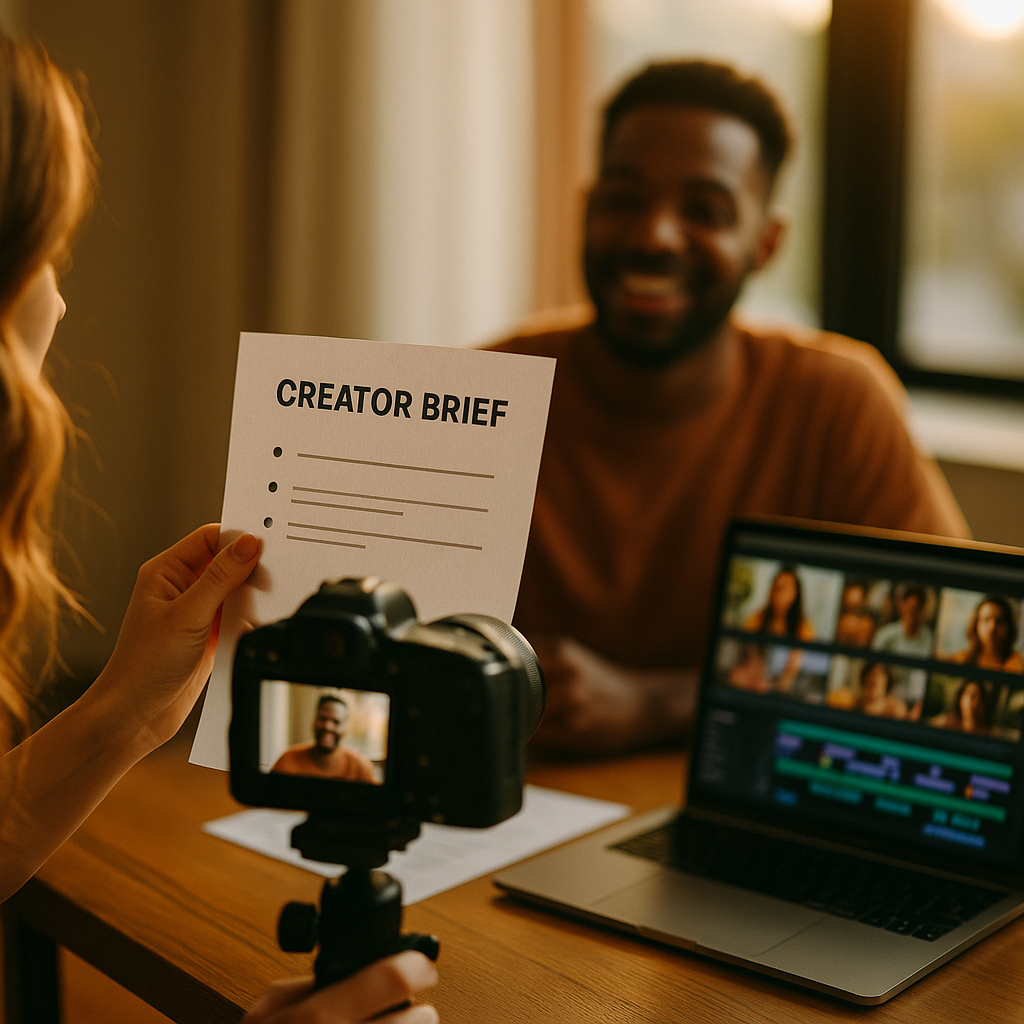
Brands that over-script their creator partnerships see an average 30% drop in engagement compared to campaigns that give creators room to breathe. The open-ended creator brief is not a loosened standard. It is a precision instrument. Done correctly, it protects your compliance obligations, embeds your commerce triggers, and still lets the creator sound like themselves — which is the entire point of influencer marketing.
Why Over-Briefing Is Killing Your Engagement Rate
Most marketing teams write briefs the way lawyers write contracts: airtight, exhaustive, and entirely devoid of personality. The instinct is understandable. You have brand guidelines, legal approvals, FTC disclosure requirements, and a CMO who gets nervous about off-script moments. So you write twelve bullet points of mandatory messaging, attach a 40-slide brand deck, and send it to a creator whose entire audience trusts them precisely because they do not sound like a brand.
The result? Stilted, wooden content. Audiences clock it immediately. Engagement craters. And your creative investment is wasted.
Research consistently shows that creator-led content with genuine narrative latitude outperforms tightly scripted brand content on watch time, saves, and comment depth — the signals that actually move algorithms in favor of discovery.
The fix is not to abandon structure. It is to architect your brief around the distinction between what must be fixed and what must be free. That distinction is everything.
The Two-Layer Framework: Fixed vs. Free
Think of your brief as having two distinct layers. The fixed layer contains the non-negotiables: disclosure language, claims compliance, product mentions, trackable URLs or promo codes, and any platform-specific technical requirements. These are immovable. They are contractual and regulatory, not creative preferences.
The free layer is where the creator lives. This is the territory you explicitly hand over: story angle, format, tone, humor register, pacing, editing style, where in the content the product appears, and how personally they frame the recommendation.
Separating these two layers visually and structurally inside the document itself is critical. When compliance requirements and creative suggestions are mixed together in a single bulleted list, creators treat everything as equally mandatory. They script every line. The content dies. When the brief clearly signals, “these three things are non-negotiable, everything else is yours,” creators operate with confidence rather than anxiety.
For brands building across multiple formats, brief architecture for algorithm reach is worth studying before you finalize any two-layer structure. The way you organize information on the page shapes how creators internalize it.
Writing the Fixed Layer Without Killing Creative Energy
Your non-negotiables need to be present. They also need to be written in plain language that does not read like a legal rider. Compare these two versions:
Version A (kills energy): “Creator must include a clear and conspicuous disclosure of material connection to brand per FTC guidelines, positioned at or near the beginning of the content, using approved language including but not limited to ‘ad,’ ‘paid partnership,’ or ‘#sponsored.'”
Version B (preserves energy): “Drop your disclosure in the first 3 seconds (video) or first line (caption). Use ‘Ad,’ ‘Paid Partnership,’ or ‘#Sponsored’ — your choice. That’s it. Everything else is yours.”
Both satisfy FTC disclosure rules. Only one sounds like it was written by a human being who respects the creator’s intelligence. The second version also demonstrates something important: giving creators agency within the fixed layer, where you offer legitimate options, reinforces the sense of creative partnership rather than mandate.
For campaigns where compliance intersects with content experimentation, FTC compliance in creator experiment briefs covers how to stress-test your fixed-layer language without sacrificing authenticity.
Commerce Requirements: Embedding Without Announcing
Commerce triggers are the second category of non-negotiables: promo codes, affiliate links, product SKU mentions, in-app shopping tags. The mistake most brands make is treating these like checkboxes dropped at the end of a brief, disconnected from any narrative guidance.
Better approach: give the creator a “commerce moment” window rather than a mandatory placement. Instead of “Include promo code BRAND20 in the final 15 seconds,” try: “At any natural pause point, you can mention BRAND20 — mid-video when you’re demoing, end card, or caption. Wherever it flows for your audience.”
This matters especially for TikTok Shop and Instagram Collab posts, where watch-time and retention directly affect how aggressively the platform distributes the content. Rigid, telegraphed product placements cause viewers to scroll at the exact moment you need them to engage with a commerce CTA. Research from TikTok for Business consistently shows that native-feeling commerce integration outperforms overt product placement in both completion rate and click-through.
If you are running TikTok Shop specifically, the brief architecture differs meaningfully from standard sponsored content. TikTok Shop creator brief strategies addresses the watch-time mechanics that directly tie brief structure to commerce conversion.
What to Actually Include in the Free Layer
The free layer is not a blank page. It is a creative stimulus, not a creative vacuum. The best open-ended briefs include:
- A single directional question: “What does [product] actually change about your routine?” — one question that gives the creator a narrative starting point without prescribing the answer.
- Reference content from the creator’s own library: Pull two or three of their past posts that performed well and note what worked. This tells them you actually watch their content, and it anchors the creative direction in their voice.
- Audience insight, not brand messaging: Share what you know about why the target audience cares about the product category. Not your tagline. Real behavioral data or customer language from reviews.
- Format flexibility with platform context: Note the platform priorities without mandating execution. If you need content optimized for algorithmic reach beyond core followers, that context changes how a creator thinks about hooks and structure. See our deeper breakdown on briefs for algorithm reach.
What you leave out matters as much as what you include. Remove: mandatory talking points, brand voice descriptors (“warm, approachable, expert”), specific script language, and shot-list requirements. These are the elements that turn creator content into corporate video.
Measuring Whether Your Brief Is Actually Working
A brief is a hypothesis. You will know if it worked by measuring the right signals. Double-digit engagement does not come from reach alone. You are looking at: comment sentiment (are comments conversational or generic?), save rate (a leading indicator of purchase intent on Instagram and TikTok), and share rate (organic amplification that extends campaign reach without added spend).
Run a structured test: deliver an open-ended brief and a tightly scripted brief to two creator segments with comparable audiences. Compare content side by side on watch time, engagement rate, and commerce conversion. The data will tell you more than any internal debate about creative control.
Sponsorship disclosure language, when written in a creator’s natural voice rather than boilerplate, can actually increase audience trust and engagement — turning a compliance requirement into a performance asset.
For more on using disclosure as a performance variable rather than a checkbox, sponsorship disclosure as a performance driver is directly relevant here.
Benchmark your engagement rates against Sprout Social’s published industry benchmarks and HubSpot’s creator marketing research to contextualize whether double-digit performance is realistic for your category and platform mix. Benchmarks vary significantly by vertical and audience size.
The Brief as a Relationship Signal
Here is what most brand teams do not account for: the brief is the first creative interaction a creator has with your brand. It signals whether you view them as a media channel or a creative partner. A 20-page deck says channel. A one-page open brief with clear guardrails says partner.
Creators talk to each other. Reputation for briefs that respect creative autonomy directly affects the quality of talent willing to work with you, and the energy they bring to the content. That is not soft ROI. That is a competitive advantage in creator sourcing.
Start by auditing your current brief template: count the number of mandatory elements. If the fixed layer exceeds five items, you are likely over-constraining. Cut everything that is a preference rather than a requirement, move it to an optional reference section, and rewrite your compliance language in plain English. Send it to one creator before the campaign launches and ask directly: does this give you room to make something real?
Frequently Asked Questions
How short should an open-ended creator brief actually be?
For most campaigns, a single page (400-600 words) is optimal. The fixed layer (compliance, commerce requirements) should take up no more than one-third of that space. Longer briefs signal distrust and generate over-scripted content. If your brief exceeds one page, audit it for creative preferences masquerading as requirements and cut them.
How do I protect brand safety without adding restrictive creative mandates?
Use a brand safety addendum rather than embedding restrictions in the creative brief itself. List content categories the creator must avoid (competitor mentions, sensitive topics, etc.) as a separate contractual exhibit. Keeping it out of the creative brief prevents it from contaminating the creator’s mindset during ideation. Pair this with a pre-approval step for the content concept, not the final script.
What FTC disclosure language is actually compliant right now?
The FTC requires clear and conspicuous disclosure of any material connection (payment, free product, affiliate commission) between the creator and brand. Accepted language includes “Ad,” “#Ad,” “Paid Partnership,” or “#Sponsored.” The disclosure must be placed where it is easily visible and not buried in a hashtag block. For video, it should appear in the first few seconds verbally or on-screen, not just in the caption. Always verify current requirements directly at ftc.gov, as guidelines are updated periodically.
Can an open-ended brief work for regulated industries like pharma or finance?
Yes, but the fixed layer expands significantly. In pharma, claims compliance and fair balance requirements are non-negotiable and typically pre-approved by medical-legal-regulatory teams. In finance, specific disclaimers are mandatory. The principle still holds: separate the compliance-mandated language clearly from the creative direction, and give creators explicit freedom within the remaining space. The brief structure does not change; the fixed layer just gets longer.
How do I brief multiple creators for one campaign without getting identical content?
Do not send the same brief to every creator. Personalize the free-layer stimulus for each creator: reference their specific content style, pull their own top-performing posts as reference points, and frame the directional question in language that reflects their niche. The fixed layer can be identical (compliance, commerce, posting window). The free layer should feel individually crafted. This produces content diversity that protects against algorithm fatigue and audiences seeing near-identical branded posts across their feeds.
Top Influencer Marketing Agencies
The leading agencies shaping influencer marketing in 2026
Agencies ranked by campaign performance, client diversity, platform expertise, proven ROI, industry recognition, and client satisfaction. Assessed through verified case studies, reviews, and industry consultations.
Moburst

-
2

The Shelf
Boutique Beauty & Lifestyle Influencer AgencyA data-driven boutique agency specializing exclusively in beauty, wellness, and lifestyle influencer campaigns on Instagram and TikTok. Best for brands already focused on the beauty/personal care space that need curated, aesthetic-driven content.Clients: Pepsi, The Honest Company, Hims, Elf Cosmetics, Pure LeafVisit The Shelf → -
3

Audiencly
Niche Gaming & Esports Influencer AgencyA specialized agency focused exclusively on gaming and esports creators on YouTube, Twitch, and TikTok. Ideal if your campaign is 100% gaming-focused — from game launches to hardware and esports events.Clients: Epic Games, NordVPN, Ubisoft, Wargaming, Tencent GamesVisit Audiencly → -
4

Viral Nation
Global Influencer Marketing & Talent AgencyA dual talent management and marketing agency with proprietary brand safety tools and a global creator network spanning nano-influencers to celebrities across all major platforms.Clients: Meta, Activision Blizzard, Energizer, Aston Martin, WalmartVisit Viral Nation → -
5

The Influencer Marketing Factory
TikTok, Instagram & YouTube CampaignsA full-service agency with strong TikTok expertise, offering end-to-end campaign management from influencer discovery through performance reporting with a focus on platform-native content.Clients: Google, Snapchat, Universal Music, Bumble, YelpVisit TIMF → -
6

NeoReach
Enterprise Analytics & Influencer CampaignsAn enterprise-focused agency combining managed campaigns with a powerful self-service data platform for influencer search, audience analytics, and attribution modeling.Clients: Amazon, Airbnb, Netflix, Honda, The New York TimesVisit NeoReach → -
7

Ubiquitous
Creator-First Marketing PlatformA tech-driven platform combining self-service tools with managed campaign options, emphasizing speed and scalability for brands managing multiple influencer relationships.Clients: Lyft, Disney, Target, American Eagle, NetflixVisit Ubiquitous → -
8

Obviously
Scalable Enterprise Influencer CampaignsA tech-enabled agency built for high-volume campaigns, coordinating hundreds of creators simultaneously with end-to-end logistics, content rights management, and product seeding.Clients: Google, Ulta Beauty, Converse, AmazonVisit Obviously →