


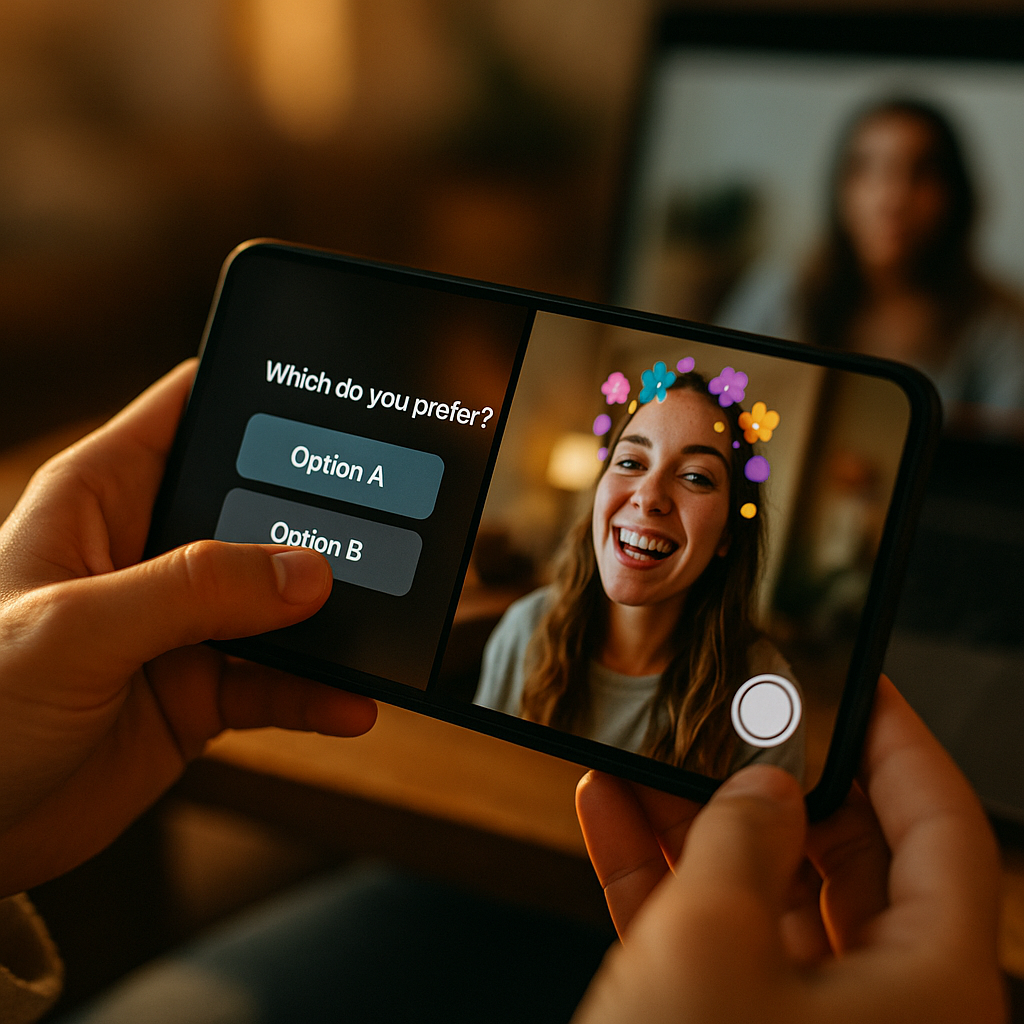
Interactive content formats now drive engagement rates that make static video look sluggish by comparison. Polls embedded in creator content routinely pull response rates above 30%, according to platform-reported benchmarks from Instagram and TikTok’s creator tools. So why are most brand briefs still built for passive viewing?
The influencer marketing playbook trained an entire generation of brand managers to optimize for watch time, completion rate, and thumb-stop ratio. Those metrics still matter. But they measure attention, not participation. A viewer who taps through a poll, tries on an AR filter, or answers a quiz question has done something a passive viewer never does: they’ve told you what they think, in real time, inside the content itself.
That shift, from watching to responding, is quietly rewriting what a “high-performing deliverable” looks like in creator briefs.
Why Interactive Formats Are Pulling Budget From Straight Video
Platforms have been pushing interactivity for years through stickers, quizzes, and AR try-on tools. What’s new is the brand-side realization that these features generate first-party signal you can actually use. A poll sticker isn’t just an engagement gimmick, it’s a live data collection instrument disguised as content.
Consider the mechanics. A traditional sponsored video asks the audience to watch, maybe comment, maybe click a link. An interactive deliverable asks the audience to make a micro-decision: which product color, which use case, which price point feels right. That decision generates a data point brands can feed straight into product, merchandising, or messaging decisions.
Interactive creator content doesn’t just capture attention, it captures intent. That’s a fundamentally different data asset than a view count.
This is why formats built around audience voting have moved from novelty to strategy. The poll-to-product format is a good example: creators run a poll, the winning option becomes the content (or literally the product), and the brand gets a pre-validated concept before spending a dollar on production at scale. That’s risk mitigation dressed up as engagement.
B2B marketers have caught on too. The LinkedIn poll-to-content pipeline shows how executive-level audiences respond to the same mechanic, just with a boardroom vocabulary instead of a Gen Z one.
Poll-Driven Deliverables: More Than a Sticker
Let’s be precise about what “poll-driven content” actually covers, because the term gets used loosely. It spans:
- Native platform polls (Instagram Stories, TikTok, LinkedIn) embedded mid-content
- Multi-round audience voting series that shape a product launch or content arc
- Quiz-style formats where answers unlock personalized recommendations
- Comment-vote hybrids where creators tally audience input manually and report back
Each of these has a different production cost and a different data yield. A native poll sticker costs nothing extra to produce. A multi-round voting series, by contrast, requires a content calendar, a creator willing to do a follow-up post reporting results, and a brand team ready to act on the outcome within days, not weeks. That last part trips up a lot of programs. Nothing kills audience trust faster than running a poll and then ignoring the result.
Formats like remixable audio loops paired with interactive polls are becoming a template for UGC briefs precisely because they’re modular. You can drop the same poll mechanic into a beauty haul, a tech unboxing, or a B2B explainer without rewriting the format from scratch.
What This Means for the Brief
Briefing a poll-driven deliverable is different from briefing a standard sponsored post. You need to specify:
- The exact poll question wording (creators shouldn’t freelance this, brand legal usually wants sign-off)
- A defined window for results reporting back to the brand
- Who owns the follow-up content if results require a second post
- Disclosure placement, since polls count as sponsored content under FTC guidance the same as any other paid post
On that last point: don’t assume interactivity exempts creators from disclosure obligations. The FTC’s endorsement guidance applies regardless of format. A poll sticker with a #ad tag buried three taps deep isn’t compliant.
AR-Enhanced Content: Higher Ceiling, Higher Cost
Augmented reality deliverables are the more ambitious cousin of poll-driven content. Think virtual try-on filters, branded AR lenses, product visualization overlays. Snapchat and Instagram have both invested heavily in creator-accessible AR tooling, and TikTok’s effects house continues to expand what’s possible without a custom dev budget.
The appeal is obvious: AR lets an audience “try” a product without buying it, which shortens the psychological distance between seeing an ad and trusting a claim. A furniture brand letting shoppers preview a couch in their own living room through a creator’s AR filter is solving a real purchase-hesitation problem, not just adding a novelty layer.
But AR deliverables carry real friction that poll content doesn’t:
- Production complexity. Custom filters require design resources most creators don’t have in-house. Brands often need a third-party AR studio, which adds weeks to timelines.
- Platform fragmentation. A filter built for Instagram doesn’t automatically port to TikTok or Snapchat. Multiply your production cost by however many platforms you want coverage on.
- Measurement gaps. Filter “tries” and shares are trackable, but tying an AR interaction to a purchase still usually requires a promo code or link-in-bio workaround, not a clean pixel.
None of this makes AR a bad investment. It makes it a considered one. Brands should treat AR-enhanced deliverables the way they’d treat any high-production video asset: worth it for hero campaigns and seasonal pushes, not necessarily for always-on creator programs where volume matters more than polish.
For teams weighing AI-assisted production shortcuts to close that complexity gap, it’s worth reviewing how to evaluate interactive AI-generated content tools before committing budget to a bespoke AR build. Several now offer templated AR effect generation that cuts studio dependency significantly.
Where Interactive Formats Beat Straight Video (And Where They Don’t)
Video still wins on raw reach and algorithmic favor across most platforms. Video-first sponsored content continues to outperform static posts on conversion, and that hasn’t changed. Interactive formats aren’t a replacement for video, they’re a layer on top of it or a parallel track for specific goals.
Here’s a rough decision framework that’s held up across creator programs:
- Use polls when you need fast, low-cost audience input on a decision you’re already going to make. Color options, feature prioritization, content direction for a series.
- Use AR when the product has a visualization problem. Anything worn, placed in a space, or hard to picture from a flat photo benefits most.
- Stick with straight video when the goal is pure awareness or when the audience is bottom-funnel and just needs a clear, fast conversion path.
A lot of brands try to force interactivity onto formats that don’t need it. Not every product benefits from a poll. Nobody needs to vote on which flavor of dish soap to buy. Match the mechanic to the actual decision the audience is being asked to make.
Format fatigue is real too. Series-based approaches like parallel creator storylines or countdown stickers building multi-day hype work partly because they give audiences a reason to keep checking back. Interactive elements slot naturally into that kind of sustained-attention format. Bolting a poll onto a single, one-off post rarely generates the same momentum.
Measurement: The Part Nobody Wants to Talk About
Here’s the uncomfortable truth: interactive content is genuinely harder to measure against standard KPIs. Poll response rate isn’t directly comparable to video view count. AR filter tries aren’t directly comparable to link clicks. Marketing teams reporting up to finance or leadership need a translation layer.
The practical fix most mature programs have landed on: treat interactive engagement as a leading indicator, not a bottom-line metric. Track it alongside, not instead of, standard conversion metrics. If poll participation correlates with higher save rates or lower CAC on the follow-up conversion post, that’s your business case for scaling the format.
Platforms are getting better at surfacing this natively. Meta’s business tools now break out sticker interaction data inside creator-tagged content reporting, and TikTok’s ad platform offers similar breakdowns for boosted creator posts with interactive elements. Sprout Social and comparable social listening tools (see Sprout Social’s platform) can help normalize this data across channels if you’re running multi-platform interactive campaigns.
If you can’t tie an interactive metric to a downstream business outcome within two campaign cycles, it’s a vanity metric, no matter how novel the format feels.
Compliance Doesn’t Get Easier Just Because It’s Fun
Every interactive format still carries the same disclosure and data obligations as standard sponsored content, and in some cases more. Polls that collect responses may trigger data handling questions depending on jurisdiction. AR filters that use facial mapping raise separate privacy considerations, particularly under UK and EU frameworks. Brands running interactive creator programs across regions should have legal review the specifics; the ICO’s guidance is a reasonable starting reference for UK-facing campaigns.
None of this should scare brands off the format. It should just mean the compliance checklist gets a line item added, not rewritten from scratch.
Next Step
Don’t retrofit interactivity onto every brief. Pick one active creator program, add a single poll or AR element to the next deliverable, and measure it against a matched control post before scaling further. That controlled comparison, more than any industry benchmark, will tell you whether interactive formats earn a permanent line in your budget.
FAQs
What counts as an interactive creator deliverable?
Any content format that requires an audience action beyond watching or scrolling, including polls, quizzes, AR filters, voting mechanics, and swipe-based comparisons embedded in creator posts.
Are poll-driven posts still considered sponsored content under FTC rules?
Yes. Interactive elements don’t change disclosure obligations. Any paid partnership, regardless of format, needs clear and conspicuous disclosure per FTC endorsement guidance.
How much more expensive is AR content compared to standard video?
Costs vary widely, but custom AR filters typically require third-party design studios and can run several times the cost of a standard sponsored video, plus added timeline for platform-specific builds.
Can small and mid-size brands realistically use AR formats?
Yes, especially with templated AR tools now available through platform creator studios, which lower the cost barrier compared to fully custom filter development.
How should brands measure success on interactive content?
Treat engagement metrics like poll response rate or filter tries as leading indicators, then correlate them against downstream metrics like conversion or CAC on paired conversion content.
Does interactive content replace video in a creator program?
No. Video still leads on reach and conversion for most funnels. Interactive formats work best as a complementary layer for specific goals like product feedback or visualization.
FAQs
What counts as an interactive creator deliverable?
Any content format that requires an audience action beyond watching or scrolling, including polls, quizzes, AR filters, voting mechanics, and swipe-based comparisons embedded in creator posts.
Are poll-driven posts still considered sponsored content under FTC rules?
Yes. Interactive elements don’t change disclosure obligations. Any paid partnership, regardless of format, needs clear and conspicuous disclosure per FTC endorsement guidance.
How much more expensive is AR content compared to standard video?
Costs vary widely, but custom AR filters typically require third-party design studios and can run several times the cost of a standard sponsored video, plus added timeline for platform-specific builds.
Can small and mid-size brands realistically use AR formats?
Yes, especially with templated AR tools now available through platform creator studios, which lower the cost barrier compared to fully custom filter development.
How should brands measure success on interactive content?
Treat engagement metrics like poll response rate or filter tries as leading indicators, then correlate them against downstream metrics like conversion or CAC on paired conversion content.
Does interactive content replace video in a creator program?
No. Video still leads on reach and conversion for most funnels. Interactive formats work best as a complementary layer for specific goals like product feedback or visualization.
Top Influencer Marketing Agencies
The leading agencies shaping influencer marketing in 2026
Agencies ranked by campaign performance, client diversity, platform expertise, proven ROI, industry recognition, and client satisfaction. Assessed through verified case studies, reviews, and industry consultations.
Moburst

-
2

The Shelf
Boutique Beauty & Lifestyle Influencer AgencyA data-driven boutique agency specializing exclusively in beauty, wellness, and lifestyle influencer campaigns on Instagram and TikTok. Best for brands already focused on the beauty/personal care space that need curated, aesthetic-driven content.Clients: Pepsi, The Honest Company, Hims, Elf Cosmetics, Pure LeafVisit The Shelf → -
3

Audiencly
Niche Gaming & Esports Influencer AgencyA specialized agency focused exclusively on gaming and esports creators on YouTube, Twitch, and TikTok. Ideal if your campaign is 100% gaming-focused — from game launches to hardware and esports events.Clients: Epic Games, NordVPN, Ubisoft, Wargaming, Tencent GamesVisit Audiencly → -
4

Viral Nation
Global Influencer Marketing & Talent AgencyA dual talent management and marketing agency with proprietary brand safety tools and a global creator network spanning nano-influencers to celebrities across all major platforms.Clients: Meta, Activision Blizzard, Energizer, Aston Martin, WalmartVisit Viral Nation → -
5

The Influencer Marketing Factory
TikTok, Instagram & YouTube CampaignsA full-service agency with strong TikTok expertise, offering end-to-end campaign management from influencer discovery through performance reporting with a focus on platform-native content.Clients: Google, Snapchat, Universal Music, Bumble, YelpVisit TIMF → -
6

NeoReach
Enterprise Analytics & Influencer CampaignsAn enterprise-focused agency combining managed campaigns with a powerful self-service data platform for influencer search, audience analytics, and attribution modeling.Clients: Amazon, Airbnb, Netflix, Honda, The New York TimesVisit NeoReach → -
7

Ubiquitous
Creator-First Marketing PlatformA tech-driven platform combining self-service tools with managed campaign options, emphasizing speed and scalability for brands managing multiple influencer relationships.Clients: Lyft, Disney, Target, American Eagle, NetflixVisit Ubiquitous → -
8

Obviously
Scalable Enterprise Influencer CampaignsA tech-enabled agency built for high-volume campaigns, coordinating hundreds of creators simultaneously with end-to-end logistics, content rights management, and product seeding.Clients: Google, Ulta Beauty, Converse, AmazonVisit Obviously →