


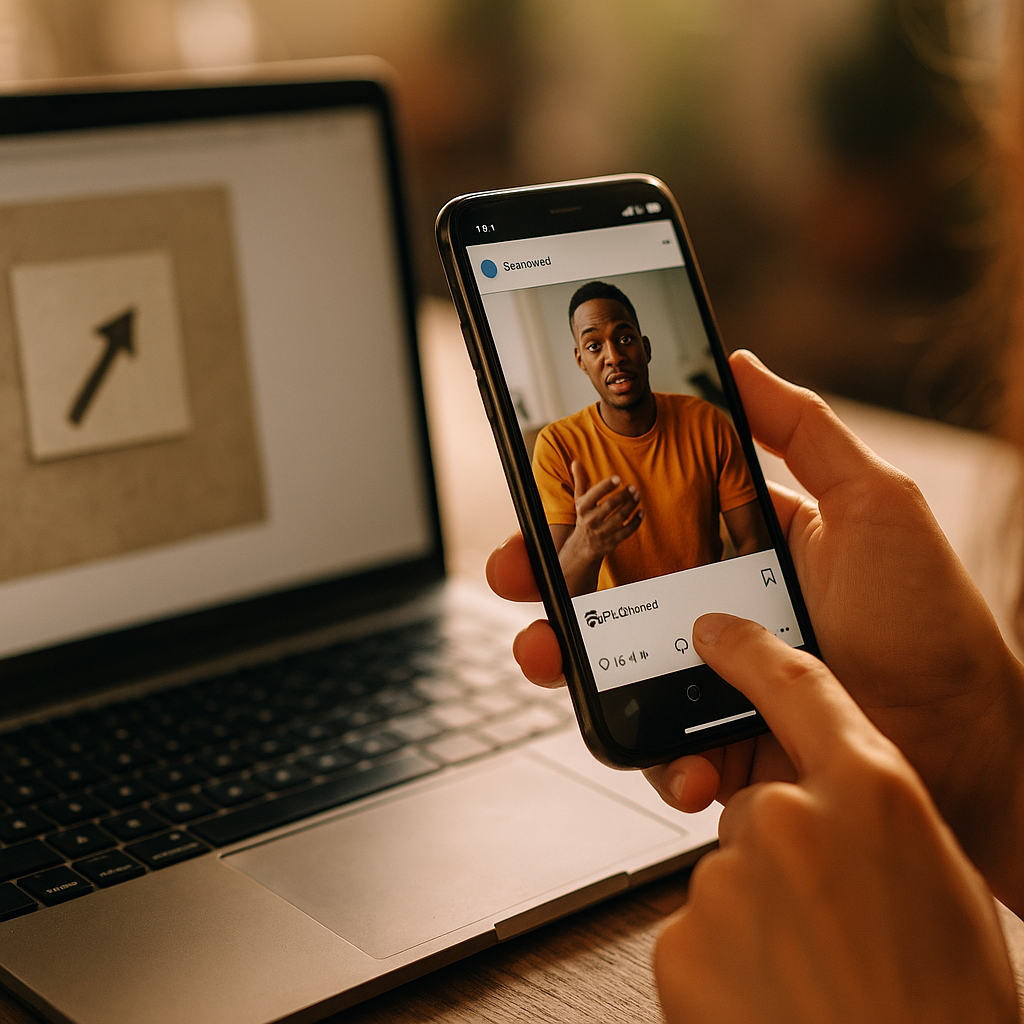
Static feed posts on TikTok Shop convert at a fraction of the rate of native video. On some conversion-focused platforms, brands report video-first sponsored content driving three to five times the click-through of a matching static image ad. If your influencer program still leans on photo carousels for “always-on” sponsored content, you’re paying premium CPMs for underperforming creative.
That’s not a hot take. It’s what the platforms themselves are optimizing for.
The Algorithm Doesn’t Want Your Photo Carousel Anymore
TikTok Shop, Instagram Reels, and YouTube Shorts have quietly restructured their ranking signals around watch time and completion rate. Static posts simply don’t generate the engagement data these systems need to justify distribution. A photo can get a like in half a second. A video demands fifteen, thirty, sixty seconds of attention — and that sustained attention is exactly what feeds recommendation engines and, increasingly, purchase-intent models.
Meta has been public about weighting Reels more heavily in Instagram’s ranking since the platform’s pivot toward short-form video began years ago (see Meta for Business for current ad format guidance). TikTok’s entire commerce infrastructure, meanwhile, was built video-first from day one — there was never a static-post equivalent in TikTok Shop’s core shopping experience. TikTok’s advertising resources now push Spark Ads and Shop video ads as the default format for performance campaigns, not an add-on.
Platforms aren’t just favoring video for engagement reasons — they’re favoring it because video generates richer behavioral data that improves ad targeting for every advertiser on the platform. Static content is a data dead end.
What “Conversion-Focused” Actually Means Here
Worth clarifying terms. “Conversion-focused platforms” means the environments where the platform itself has built shopping, checkout, or lead-gen tooling directly into the feed — TikTok Shop, Instagram Shopping, YouTube Shopping, and increasingly LinkedIn’s lead-gen units. These aren’t awareness channels where a nice static photo can still do a job. They’re transaction environments. And in a transaction environment, format choice is a revenue lever, not a creative preference.
Compare that to a channel like LinkedIn, where static thought-leadership posts and carousels still have a place because the buying cycle is longer and the goal is often visibility, not immediate purchase. If you’re running exec visibility plays, the calculus is different — check our breakdown of executive visibility formats for that context. But on commerce-native platforms, static is losing ground fast.
The Data Behind the Shift
eMarketer’s ongoing tracking of short-form video ad spend shows continued double-digit growth in video’s share of social ad budgets, a trend that’s held for several consecutive years (eMarketer). Sprout Social’s own benchmarking has repeatedly found video posts outperforming images and static carousels on engagement rate across nearly every major platform (Sprout Social). HubSpot’s marketer surveys have found video cited as the highest-ROI content format for several years running (HubSpot research).
None of this is new information, exactly. What’s new in 2026 is the gap widening specifically on conversion metrics, not just engagement vanity metrics. Brands running side-by-side tests — same product, same creator, same offer, video versus static — are seeing add-to-cart rates on video sponsored content outpace static by wide margins on TikTok Shop and Instagram Shopping placements. Engagement was always going to favor video. Conversion favoring video this decisively is the real story.
Why? A few reasons stack together:
- Demonstration beats description. Video shows product-in-use in a way a static image with copy simply can’t replicate. A skincare serum absorbing into skin, a kitchen gadget actually solving a problem, a piece of software mid-workflow — these need motion to land.
- Trust signals compound in motion. A creator’s tone, facial expression, and unscripted reaction read as more authentic on video. Static images with sponsored copy can feel more like an ad, triggering skepticism.
- Shoppable overlays work better on video. Product tags, “shop now” stickers, and countdown elements integrate more naturally into video’s pacing than into a single static frame.
- Sound and captions add a second engagement layer. Even sound-off viewers get information through captions and on-screen text, extending reach without sacrificing comprehension.
Format Innovation Is Doing the Heavy Lifting
It’s not just “shoot video instead of photos.” The brands winning on conversion are using specific video-native formats engineered for the way these platforms actually distribute and monetize content. A few worth studying:
The micro-tutorial loop format exploits TikTok’s rewatch signal directly — short, seamless instructional loops that get watched multiple times, which the algorithm reads as high-value content and rewards with distribution. That’s a video-only mechanic. There’s no static equivalent.
Similarly, the silent skill demo format solves for sound-off feed consumption while still being unmistakably video — visual storytelling that doesn’t need audio to convert, but still generates the watch-time data static content can’t produce.
Live and semi-live formats push this further. Livestream commerce is the extreme end of video-first conversion, compressing discovery and purchase into a single continuous session. You cannot replicate that urgency with a static post and a link in bio.
Even “Simple” UGC Is Going Video-Only
Brands that used to brief creators for a mix of photo and video UGC are increasingly skipping photo entirely. The multi-format UGC shoot template approach still applies — you’re capturing multiple assets from one shoot — but nearly all of those assets are now video-first, repurposed into different cuts rather than split between stills and clips. The remixable asset brief model has adapted accordingly: one video shoot, edited into a 15-second Shop ad, a 60-second YouTube Short, and a vertical Reel, rather than one video plus a set of product photos.
This isn’t just a creative trend. It’s a budget efficiency argument. Paying for a photo shoot that produces assets your top-converting placements can’t fully use is a wasted line item.
Where Static Content Still Has a Job
Let’s not overcorrect. Static posts aren’t dead, and pretending otherwise would be dishonest. They still work well for:
- Top-of-funnel brand awareness where volume and frequency matter more than individual asset performance
- Feed aesthetics on Instagram grid-focused brands, particularly in fashion and lifestyle categories
- Quick-turn announcements — restocks, price drops, event promos — where speed beats production value. The countdown sticker approach to restock hype is a good example of static-adjacent formats still earning their keep
- Formats like cost breakdown content, where an infographic-style static post can communicate information more efficiently than a talking-head video
The distinction that matters: static content still earns its place in awareness and information-delivery contexts. On platforms built for conversion, though, it’s losing the fight because the entire commerce infrastructure — shoppable tags, checkout flows, recommendation algorithms — was designed around video consumption patterns.
What This Means for Budget Allocation
If you’re still splitting influencer budgets 50/50 between static and video deliverables for bottom-funnel, conversion-focused campaigns, that ratio needs revisiting. A more defensible split for platforms like TikTok Shop and Instagram Shopping in 2026 looks closer to 80/20 or 90/10 in favor of video, with static reserved for specific awareness or announcement use cases.
Practically, this changes how you brief creators. Video-first briefs need to specify hook timing (first two to three seconds are make-or-break on TikTok), pacing, caption strategy for sound-off viewing, and a clear call-to-action moment that aligns with shoppable tag placement. Formats like the customer cameo format or first-impressions-only format give you a repeatable brief structure that’s built for video from the ground up, rather than adapting a static-post brief template that was never designed for these mechanics.
It also changes measurement. If you’re still reporting on likes and saves as your primary success metrics for sponsored video, you’re measuring the wrong layer. Watch time, completion rate, and shoppable tag click-through are the metrics that correlate with the conversion outcomes platforms are optimizing distribution around. Align your reporting to those, and your budget conversations with finance get a lot easier.
One more consideration: compliance doesn’t change just because the format does. Video sponsored content still needs clear, conspicuous disclosure under FTC guidelines, and burying a #ad tag in a caption under a fast-paced video is a bigger risk than it was in static posts, where the caption sat right next to the image. Build disclosure into the video itself — verbal mention or on-screen text in the first few seconds — rather than relying on caption real estate alone.
Next Step
Audit your last quarter of sponsored content by format and platform, then map completion rate and shoppable click-through against each. If video is outperforming static by the margins most brands are now seeing, shift next quarter’s creator briefs and budget split accordingly — don’t wait for a full year of data to confirm what the platforms are already telling you through distribution.
FAQs
Why is video-first sponsored content converting better than static posts right now?
Conversion-focused platforms like TikTok Shop and Instagram Shopping have built their ranking and shoppable-tag infrastructure around video consumption. Video also demonstrates product use, builds creator trust through tone and expression, and generates richer engagement data than a single static image can produce.
Does this mean brands should stop using static posts entirely?
No. Static content still performs well for top-of-funnel awareness, feed aesthetics, and quick announcements like restocks or price drops. The shift toward video-first applies specifically to conversion-focused placements where platforms have built shopping tools directly into video formats.
What budget split makes sense for video versus static in sponsored content?
Many brands running conversion campaigns on platforms like TikTok Shop are shifting toward an 80/20 or 90/10 split favoring video, reserving static assets for awareness campaigns or fast-turn announcements rather than bottom-funnel conversion pushes.
How should brands measure video sponsored content success?
Prioritize watch time, completion rate, and shoppable tag click-through over likes and saves. These metrics more closely align with what platform algorithms reward with distribution and correlate more directly with conversion outcomes.
What compliance risks are unique to video sponsored content?
Disclosure needs to be conspicuous within the video itself, not buried in a caption. FTC guidance requires clear and prominent disclosure, so brands should build verbal or on-screen disclosure into the first few seconds of the video rather than relying on caption text.
Top Influencer Marketing Agencies
The leading agencies shaping influencer marketing in 2026
Agencies ranked by campaign performance, client diversity, platform expertise, proven ROI, industry recognition, and client satisfaction. Assessed through verified case studies, reviews, and industry consultations.
Moburst

-
2

The Shelf
Boutique Beauty & Lifestyle Influencer AgencyA data-driven boutique agency specializing exclusively in beauty, wellness, and lifestyle influencer campaigns on Instagram and TikTok. Best for brands already focused on the beauty/personal care space that need curated, aesthetic-driven content.Clients: Pepsi, The Honest Company, Hims, Elf Cosmetics, Pure LeafVisit The Shelf → -
3

Audiencly
Niche Gaming & Esports Influencer AgencyA specialized agency focused exclusively on gaming and esports creators on YouTube, Twitch, and TikTok. Ideal if your campaign is 100% gaming-focused — from game launches to hardware and esports events.Clients: Epic Games, NordVPN, Ubisoft, Wargaming, Tencent GamesVisit Audiencly → -
4

Viral Nation
Global Influencer Marketing & Talent AgencyA dual talent management and marketing agency with proprietary brand safety tools and a global creator network spanning nano-influencers to celebrities across all major platforms.Clients: Meta, Activision Blizzard, Energizer, Aston Martin, WalmartVisit Viral Nation → -
5

The Influencer Marketing Factory
TikTok, Instagram & YouTube CampaignsA full-service agency with strong TikTok expertise, offering end-to-end campaign management from influencer discovery through performance reporting with a focus on platform-native content.Clients: Google, Snapchat, Universal Music, Bumble, YelpVisit TIMF → -
6

NeoReach
Enterprise Analytics & Influencer CampaignsAn enterprise-focused agency combining managed campaigns with a powerful self-service data platform for influencer search, audience analytics, and attribution modeling.Clients: Amazon, Airbnb, Netflix, Honda, The New York TimesVisit NeoReach → -
7

Ubiquitous
Creator-First Marketing PlatformA tech-driven platform combining self-service tools with managed campaign options, emphasizing speed and scalability for brands managing multiple influencer relationships.Clients: Lyft, Disney, Target, American Eagle, NetflixVisit Ubiquitous → -
8

Obviously
Scalable Enterprise Influencer CampaignsA tech-enabled agency built for high-volume campaigns, coordinating hundreds of creators simultaneously with end-to-end logistics, content rights management, and product seeding.Clients: Google, Ulta Beauty, Converse, AmazonVisit Obviously →