


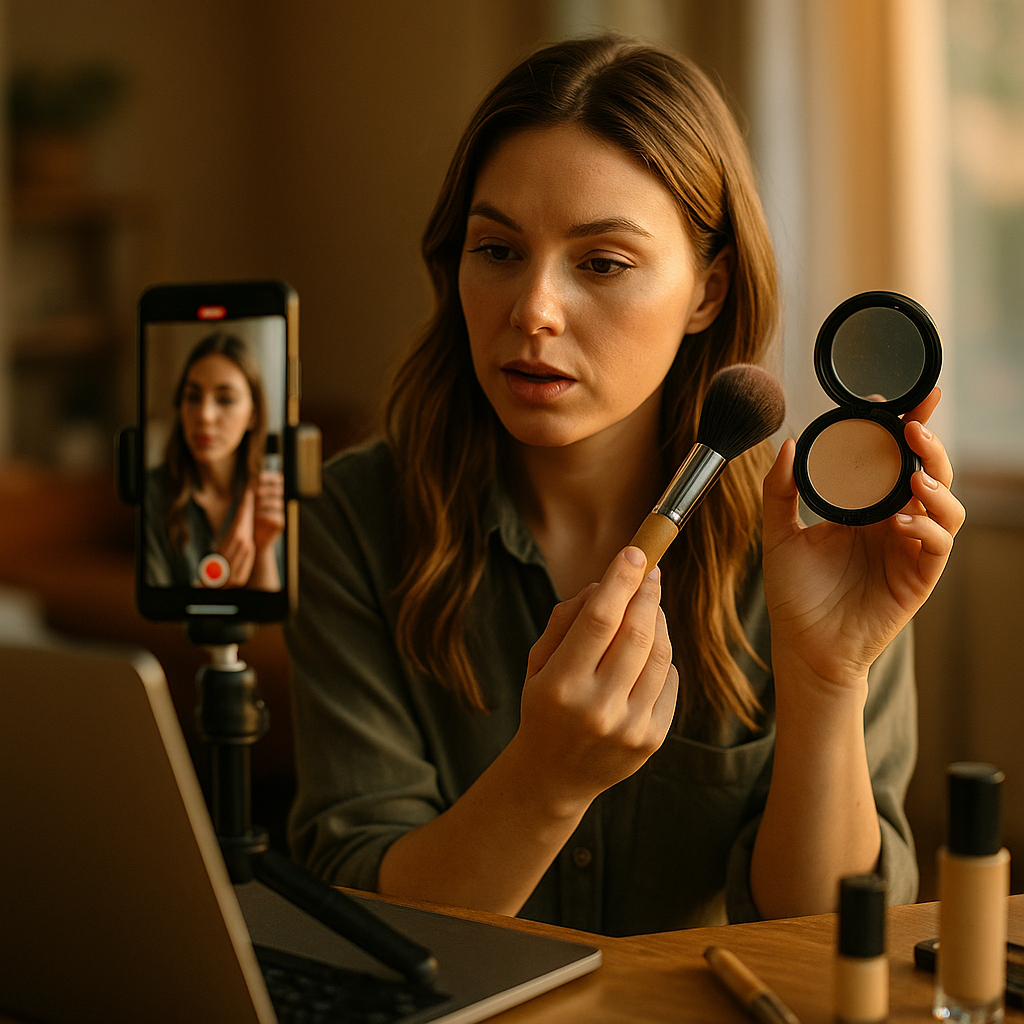
Eighty-five percent of Facebook video is watched without sound, and TikTok’s own creator tools now default captions on for a reason. So why are brands still briefing creators to talk through every feature? The silent skill demo format flips the script: no dialogue, no voiceover, just a creator using your product to complete a real task while the visuals do all the persuading.
Why Silence Sells Harder Than Scripts
Here’s the uncomfortable truth: most product demos fail before the first word is spoken. Viewers scroll past a talking head in under two seconds. But hands doing something — cracking a case open, threading a tool through a tight space, finishing a task faster than expected — that holds attention because it reads as proof, not pitch.
The silent skill demo isolates one task. A creator picks up a product, uses it to solve a specific problem, and the camera just watches. No script. No “hey guys.” No brand-speak layered over b-roll. The task itself becomes the message, and text overlays or captions fill in whatever context is strictly necessary.
When dialogue disappears, the burden of proof shifts entirely to the product’s actual performance — there’s nowhere to hide a weak feature behind enthusiastic narration.
The Sound-Off Reality Brands Keep Ignoring
Meta has reported for years that a majority of video impressions happen with sound off, and Meta’s own ad guidance still recommends designing for muted viewing first. TikTok and Instagram Reels behave the same way in commute-hour scrolling, gym feeds, and office lurking. If your creator brief assumes audio is heard, you’re already losing a chunk of your audience before the CTA even lands.
This isn’t new information. What’s new is how brands are operationalizing it. Instead of just adding captions to a talking-head video after the fact, smart teams are briefing creators to shoot silent from the start — which changes blocking, pacing, and editing decisions in ways caption overlays alone can’t fix. This pairs naturally with what we covered in our sound-off story format playbook — the principle is the same, just applied to a longer-form task demonstration instead of a story sequence.
What “Product-Enabled Task” Actually Means in a Brief
This is where most briefs fall apart. “Show the product in use” is not a task. A task has a start, a friction point, and a resolution. The product has to be the thing that resolves the friction — otherwise you’ve just made ambient footage.
- Define the friction explicitly. A stuck zipper, a burnt pan, a tangled cable, a slow login. The creator needs to know what problem the audience already feels.
- Give one task, not three. Skill demos die when they try to showcase every feature. One task, cleanly executed, beats a feature tour every time.
- Specify the “beat” of resolution. Tell the creator exactly what moment signals success — the lid clicks shut, the stain lifts, the timer stops. That’s the frame your editor builds the whole cut around.
- Ban narration in the brief, not just in editing. If a creator plans dialogue during filming, their body language and pacing change. You want them thinking in gestures from take one.
Compare this to the approach in the silent comparison format, which strips dialogue from side-by-side product tests. The skill demo format borrows the same no-script logic but applies it to a single continuous action rather than a comparison — it’s less “which is better” and more “watch this actually work.”
Casting Matters More Than You Think
Not every creator can carry a video with zero dialogue. Some performers rely entirely on voice and energy to hold attention — remove the mic and the video goes flat. You need creators who understand physical pacing: how to let a beat breathe, how to frame their hands, how to use a reaction shot instead of a reaction line.
Look at creators who already lean into ASMR-adjacent or process-driven content. The overlap with the ingredient-pour and pour-shot niche is instructive — check how the ASMR ingredient pour format briefs sensory-first content without a word of dialogue. That same instinct for texture, sound design (even if it’s later stripped for sound-off cuts), and visual rhythm translates directly into skill demos.
Compliance Gets Easier, Not Harder
Here’s a angle brand legal teams underrate: silent demos reduce disclosure risk. When there’s no scripted claim (“this cured my back pain,” “this doubled my sales”), there’s less surface area for the FTC’s endorsement guidance to flag. A creator physically completing a task doesn’t make a verbal claim — the product either does the thing on camera or it doesn’t.
That said, sponsorship disclosure is still mandatory regardless of dialogue. #ad or #partner tags, on-screen disclosure text, and platform-native paid partnership tools all still apply. Silence isn’t a compliance loophole — it’s a risk-reduction tactic, not risk elimination. Brands that have shifted toward low-script formats for this exact reason should read the return-to-sender trust format, which explores how unscripted honesty (even negative) builds more durable brand trust than polished claims.
A creator’s hands completing a task on camera carry less legal exposure than a creator’s mouth making a claim — but the disclosure requirement never disappears, silent or not.
Directing Without Directing: The Brief Framework
Silent formats require more upfront direction, not less, because you can’t fix a missing verbal cue in post the way you’d fix a missing sentence. Here’s a lean brief structure that’s worked across CPG, tools, tech accessories, and beauty categories:
- The Task Statement. One sentence: what problem does the product solve, physically, in this video?
- The Friction Shot. What does “before” look like? Give the creator a visual reference, not just words.
- The Resolution Shot. What does success look like, and how long should that beat hold on screen?
- Hands and Framing Notes. Close-up on hands, product label visible, steady shot (no shaky vlog-style camera work — this isn’t a reaction video).
- Caption Placement Guide. Where should minimal on-screen text land, if any? Usually just a single line at the top or bottom, never over the action.
- Sound Design Note. Even without dialogue, ambient product sound (clicks, snaps, pours) often stays in. Specify if you want it kept or replaced with music.
Notice what’s missing: a script. That’s intentional. If your brief includes a word-for-word voiceover, you’ve built a talking-head video with the sound removed later — that’s not the same format, and it performs worse. This distinction is exactly what’s explored in rebuilding creator briefs for real product use, where authentic usage context outperforms scripted authenticity every time.
Where This Format Underperforms
Silent skill demos aren’t universal. Complex B2B software, subscription services, or anything requiring explanation of a value proposition beyond “watch it work” struggles here. You can’t silently demo a pricing model or an onboarding flow with the same clarity as a stain remover or a kitchen gadget.
For those categories, formats like second-screen content strategy or narrated walkthroughs still make more sense. Know your category before forcing a format that’s trending. A wrench doesn’t need dialogue. A SaaS dashboard probably does.
Data backs this segmentation. eMarketer’s research on short-form video engagement consistently shows physical, demonstrable products outperform service-based content in muted, sound-off environments — which tracks with what performance teams see in TikTok Shop and Instagram Shopping data.
Measuring What Actually Worked
Track completion rate and rewatch rate before you touch click-through. Silent skill demos live or die on whether people watch the task resolve. If viewers drop off before the resolution beat, the friction wasn’t clear enough, or the task took too long to pay off.
Benchmark against your talking-head content from the same creator. If completion rates jump but conversion stays flat, you’ve got an attention format, not a sales format — still valuable for top-of-funnel awareness, just don’t force it into a hard-sell KPI. For tactical guidance on stitching performance data across formats, Sprout Social’s analytics resources are a solid starting point for benchmarking silent versus narrated variants.
FAQs
Frequently Asked Questions
What is the silent skill demo format in influencer marketing?
It’s a creator briefing approach where a creator completes a specific product-enabled task on camera with zero spoken dialogue, relying on visual pacing and minimal text overlays to communicate value — built specifically for sound-off feed environments.
Why does removing dialogue improve performance on social feeds?
Most short-form video is watched muted. Dialogue-dependent content loses meaning instantly when sound is off, while a clearly demonstrated task communicates value visually regardless of audio settings, improving watch time and completion rates.
Does the silent skill demo format reduce FTC compliance risk?
It reduces exposure to verbal claim violations since no spoken endorsement is made, but sponsorship disclosure requirements still apply in full. Brands must still ensure creators tag partnerships clearly per FTC endorsement guidelines.
What products work best for this format?
Physical, task-oriented products with a clear friction point and visible resolution — tools, kitchen gadgets, cleaning products, beauty devices, and accessories. Complex services or software with abstract value propositions generally underperform in silent formats.
How do you brief a creator for a silent video without sounding robotic?
Give them a task statement, a friction reference, and a resolution beat instead of a script. Let the creator determine pacing and framing naturally rather than dictating exact movements, which keeps the footage authentic rather than stiff.
Should captions be added if there’s no dialogue?
Minimal captions or a single line of on-screen text can help set context, but they shouldn’t narrate the entire task. The goal is visual proof first, text as a light support layer, not a full transcript substitute.
Next step: pull your last three talking-head creator briefs, strip the scripted dialogue lines entirely, and rebuild them around a single friction-to-resolution task. Test the silent cut against the original in the same feed placement before committing budget to a full format shift.
Frequently Asked Questions
What is the silent skill demo format in influencer marketing?
It’s a creator briefing approach where a creator completes a specific product-enabled task on camera with zero spoken dialogue, relying on visual pacing and minimal text overlays to communicate value — built specifically for sound-off feed environments.
Why does removing dialogue improve performance on social feeds?
Most short-form video is watched muted. Dialogue-dependent content loses meaning instantly when sound is off, while a clearly demonstrated task communicates value visually regardless of audio settings, improving watch time and completion rates.
Does the silent skill demo format reduce FTC compliance risk?
It reduces exposure to verbal claim violations since no spoken endorsement is made, but sponsorship disclosure requirements still apply in full. Brands must still ensure creators tag partnerships clearly per FTC endorsement guidelines.
What products work best for this format?
Physical, task-oriented products with a clear friction point and visible resolution — tools, kitchen gadgets, cleaning products, beauty devices, and accessories. Complex services or software with abstract value propositions generally underperform in silent formats.
How do you brief a creator for a silent video without sounding robotic?
Give them a task statement, a friction reference, and a resolution beat instead of a script. Let the creator determine pacing and framing naturally rather than dictating exact movements, which keeps the footage authentic rather than stiff.
Should captions be added if there’s no dialogue?
Minimal captions or a single line of on-screen text can help set context, but they shouldn’t narrate the entire task. The goal is visual proof first, text as a light support layer, not a full transcript substitute.
Top Influencer Marketing Agencies
The leading agencies shaping influencer marketing in 2026
Agencies ranked by campaign performance, client diversity, platform expertise, proven ROI, industry recognition, and client satisfaction. Assessed through verified case studies, reviews, and industry consultations.
Moburst

-
2

The Shelf
Boutique Beauty & Lifestyle Influencer AgencyA data-driven boutique agency specializing exclusively in beauty, wellness, and lifestyle influencer campaigns on Instagram and TikTok. Best for brands already focused on the beauty/personal care space that need curated, aesthetic-driven content.Clients: Pepsi, The Honest Company, Hims, Elf Cosmetics, Pure LeafVisit The Shelf → -
3

Audiencly
Niche Gaming & Esports Influencer AgencyA specialized agency focused exclusively on gaming and esports creators on YouTube, Twitch, and TikTok. Ideal if your campaign is 100% gaming-focused — from game launches to hardware and esports events.Clients: Epic Games, NordVPN, Ubisoft, Wargaming, Tencent GamesVisit Audiencly → -
4

Viral Nation
Global Influencer Marketing & Talent AgencyA dual talent management and marketing agency with proprietary brand safety tools and a global creator network spanning nano-influencers to celebrities across all major platforms.Clients: Meta, Activision Blizzard, Energizer, Aston Martin, WalmartVisit Viral Nation → -
5

The Influencer Marketing Factory
TikTok, Instagram & YouTube CampaignsA full-service agency with strong TikTok expertise, offering end-to-end campaign management from influencer discovery through performance reporting with a focus on platform-native content.Clients: Google, Snapchat, Universal Music, Bumble, YelpVisit TIMF → -
6

NeoReach
Enterprise Analytics & Influencer CampaignsAn enterprise-focused agency combining managed campaigns with a powerful self-service data platform for influencer search, audience analytics, and attribution modeling.Clients: Amazon, Airbnb, Netflix, Honda, The New York TimesVisit NeoReach → -
7

Ubiquitous
Creator-First Marketing PlatformA tech-driven platform combining self-service tools with managed campaign options, emphasizing speed and scalability for brands managing multiple influencer relationships.Clients: Lyft, Disney, Target, American Eagle, NetflixVisit Ubiquitous → -
8

Obviously
Scalable Enterprise Influencer CampaignsA tech-enabled agency built for high-volume campaigns, coordinating hundreds of creators simultaneously with end-to-end logistics, content rights management, and product seeding.Clients: Google, Ulta Beauty, Converse, AmazonVisit Obviously →