


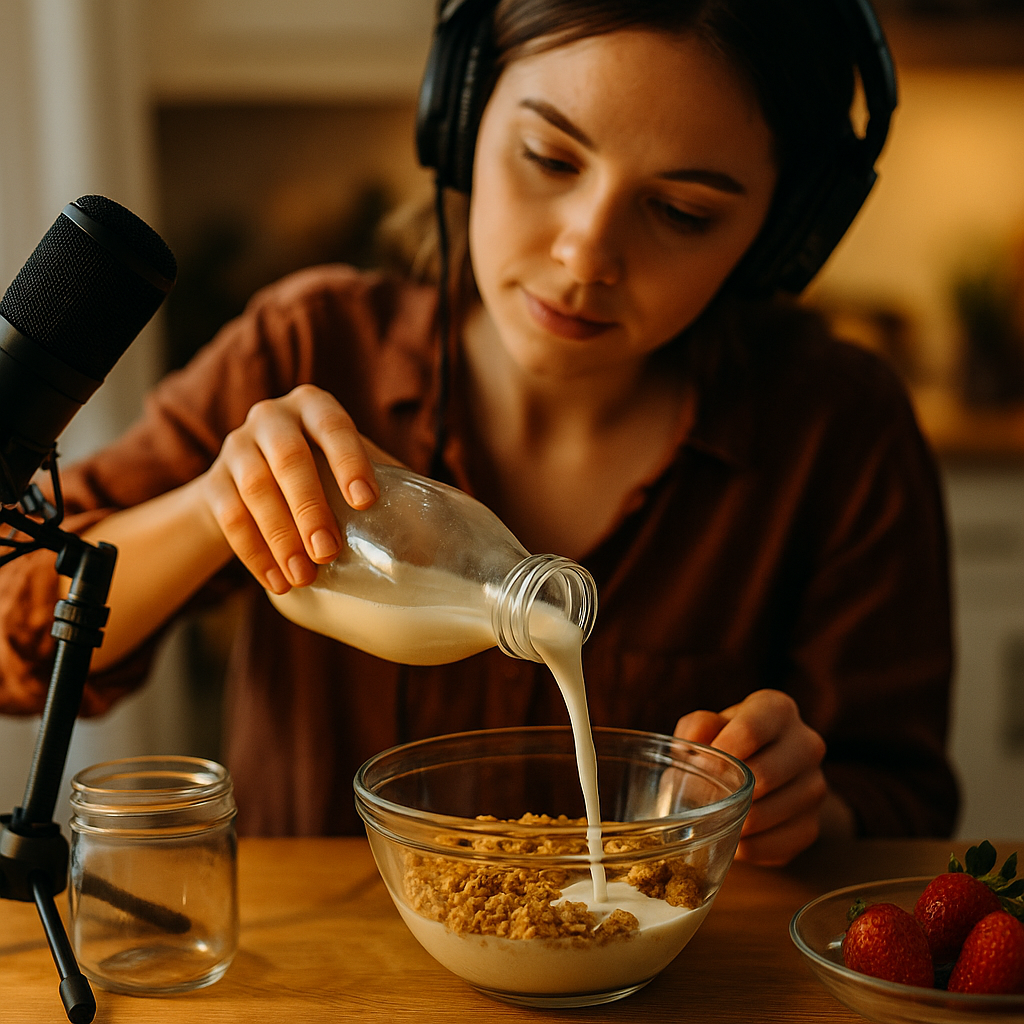
Sound off, phone flat, one ingredient hitting a bowl in slow motion. No music. No hook line. No influencer face at all, sometimes. And yet these clips regularly out-convert polished product shoots by double digits on watch time. The ASMR ingredient pour format has quietly become one of the most reliable trust-building tools in food and beverage creative, and most brands still treat it as a novelty instead of a strategy.
That’s a mistake worth correcting. Here’s why the format works, and how to brief it properly.
Why Sound Beats Story for F&B Trust
Food marketing has a credibility problem. Consumers have been burned by staged “fresh ingredient” claims and over-lit hero shots that bear no resemblance to what arrives in the package. ASMR pour content sidesteps the skepticism entirely because it doesn’t ask viewers to believe anything. It just shows the thing happening, unedited enough to feel real, close enough to hear the texture.
There’s no voiceover selling a benefit. No claim to fact-check. Just oats hitting milk, syrup dragging across a spoon, sauce sizzling into a pan. The sensory data does the persuading.
Sensory-first content converts because it removes the layer of interpretation between the product and the viewer — there’s nothing to distrust when the format’s entire job is to let a sound speak for itself.
This matters more in food and beverage than almost any other category. Taste can’t be transmitted through a screen, but texture and sound are the closest proxy available, and brands that lean into that constraint outperform ones fighting it.
The Format, Deconstructed
Strip away the trend cycle and the ASMR pour format has a consistent skeleton:
- Tight macro framing. Camera close enough that the ingredient fills most of the frame.
- Directional, high-quality audio. A shotgun mic or lav placed near the pour point, not the built-in phone mic.
- Slow, deliberate movement. No rushing the pour. Pacing is the point.
- Minimal or no talking. Text overlays carry any necessary context.
- A clean, controlled surface. Marble, matte ceramic, or dark backgrounds that don’t compete visually.
None of this requires a soundstage. Some of the best-performing versions come from creator kitchens with a $60 lav mic and decent natural light. That’s part of the appeal for brands: production cost is low, but perceived quality is high because the sensory fidelity is what people are actually judging.
What the Data Says About Sensory Content
Short-form video consumption keeps climbing, and platforms keep rewarding content that holds attention past the first few seconds. eMarketer’s research on short-form video consistently points to sound-on, high-retention formats as a growing share of total watch time, and ASMR-adjacent food content sits squarely in that bucket.
Retention is the real story here, not vanity engagement. A pour clip that holds someone for the full eleven seconds it takes to empty a bag of granola into a bowl is doing more algorithmic work than a fast-cut fifteen-second ad that gets skipped at second three. That’s directly relevant if you’re already thinking about engaged view thresholds on Meta, where early drop-off tanks distribution before the message even lands.
Sprout Social’s platform research has also flagged sensory and “satisfying” content categories as some of the stickiest formats on TikTok and Instagram Reels, per Sprout Social’s platform trend coverage. None of this is new for beauty or home goods, where slow-motion product reveals have worked for years. Food and beverage brands are simply late adopters of a proven attention mechanic.
Building the Brief Without Killing the Magic
The fastest way to ruin an ASMR pour video is to over-brief it. Give a creator a script and you get a stiff, self-conscious performance that no longer feels like ASMR at all, it feels like an ad wearing an ASMR costume. Viewers can tell the difference in under two seconds.
Instead, brief the constraints, not the performance:
- Specify the sound moment. Tell the creator exactly which action needs the mic closest — the crack of a seal, the pour, the stir.
- Set the framing rules. Macro lens or phone macro mode, steady hands or a small tripod, no zoom during the shot.
- Define the “quiet” requirement. No background music track in the raw file. Platforms and editors can add ambient sound later, but the core clip needs to be clean.
- Leave room for imperfection. A slightly uneven pour or an audible clink of a spoon against ceramic reads as authentic. Don’t ask for retakes chasing perfection.
This is the same philosophy behind no-script video formats that have outperformed scripted UGC in trust metrics: less direction, more unscripted texture, higher perceived honesty.
Where FTC Compliance Actually Comes In
Sensory-first content still counts as a paid endorsement if there’s a material connection, and the FTC doesn’t grant exemptions for videos with no dialogue. A silent pour clip with a swipe-up link and #ad buried in a description that nobody reads is exactly the kind of disclosure failure the FTC’s endorsement guidance targets.
Disclosure has to be visible in the frame, not just the caption, per current guidance. That means a text overlay (“Paid partnership” or “#ad”) that appears early and stays legible for the duration most viewers will actually watch, not a flash in the first half-second.
If you’re briefing multiple creators for the same campaign, standardize the disclosure placement across every version so nothing gets lost when clips get re-cut for different platforms. Influencers Time has covered this exact tension in more detail in a dedicated breakdown of ASMR ingredient pour briefs and FTC compliance, worth bookmarking before your next production cycle.
A beautifully shot pour video with a hidden disclosure isn’t a compliance risk waiting to happen — it’s already a violation. Fix placement before you fix lighting.
Matching Format to Product Category
Not every product pours well, literally or figuratively. This format overperforms for:
- Liquids and semi-liquids: sauces, syrups, oils, dressings, protein shakes.
- Granular textures: cereal, granola, coffee grounds, spice blends.
- Melt and sizzle moments: butter on a hot pan, cheese pulling, chocolate cracking.
- Carbonation and fizz: sparkling beverages, kombucha, canned cocktails.
It underperforms for products with no meaningful sound or texture signature, dry snack bars, shelf-stable packaged goods with no visible transformation. Forcing the format onto a product that doesn’t have a satisfying sound moment just produces a flat clip that confuses viewers about what they’re supposed to be feeling.
If your product doesn’t lend itself to sensory pour content, that’s a signal to explore adjacent formats instead. A silent comparison format or a blind ranking format might do the trust-building work better for categories where sound isn’t the differentiator.
Measuring Whether It’s Actually Working
Vanity likes won’t tell you if the format is doing its job. Track these instead:
- Full-video completion rate, since the format lives or dies on whether people watch the whole pour.
- Sound-on percentage, available in most platform analytics, to confirm the audio is actually being heard.
- Save and share rate, which tends to run higher for satisfying/sensory content than for talking-head reviews.
- Comment sentiment around texture, sound, and “I need this” language, a strong qualitative signal that the sensory hook landed.
If completion rate is high but conversion is flat, the format is building brand affinity without closing the loop, which usually means you need a follow-up asset (a what’s in my cart format or a price-focused clip) to move viewers from sensory delight to purchase intent.
The Takeaway
The ASMR ingredient pour format works because it asks nothing of the viewer except to listen, and in a category built on broken promises about freshness and flavor, that restraint reads as honesty. Brief the constraints tight, keep disclosure visible in-frame, and let the sound carry the trust your copy can’t.
FAQs
What makes the ASMR ingredient pour format different from a standard product demo?
A standard demo tells viewers why a product is good. The ASMR pour format shows a sensory moment — a texture, a sound, a pour — without narration or claims, letting viewers form their own impression. That absence of persuasive language is exactly what makes it read as more trustworthy.
Do these videos still require FTC disclosure if there’s no talking?
Yes. The FTC’s endorsement rules apply based on material connection, not dialogue. A silent, sound-only video with a brand partnership still needs a visible, legible on-screen disclosure that appears early and stays up long enough to be read.
What products work best for this format?
Liquids, sauces, granular foods like cereal or coffee, melting or sizzling moments, and carbonated beverages all have a natural sound signature that supports the format. Dry, texture-less packaged goods tend to underperform.
How do I brief creators without making the video feel staged?
Brief the technical constraints — framing, mic placement, pacing, disclosure — not the performance. Avoid scripting dialogue or forcing retakes for a “perfect” pour. Small imperfections read as authentic and are part of why the format works.
What metrics actually indicate this format is working?
Full-video completion rate, sound-on percentage, save/share rate, and texture-focused comment sentiment are stronger indicators than likes or impressions. If completion is high but conversion lags, pair the sensory clip with a more direct follow-up asset.
FAQs
What makes the ASMR ingredient pour format different from a standard product demo?
A standard demo tells viewers why a product is good. The ASMR pour format shows a sensory moment — a texture, a sound, a pour — without narration or claims, letting viewers form their own impression. That absence of persuasive language is exactly what makes it read as more trustworthy.
Do these videos still require FTC disclosure if there’s no talking?
Yes. The FTC’s endorsement rules apply based on material connection, not dialogue. A silent, sound-only video with a brand partnership still needs a visible, legible on-screen disclosure that appears early and stays up long enough to be read.
What products work best for this format?
Liquids, sauces, granular foods like cereal or coffee, melting or sizzling moments, and carbonated beverages all have a natural sound signature that supports the format. Dry, texture-less packaged goods tend to underperform.
How do I brief creators without making the video feel staged?
Brief the technical constraints — framing, mic placement, pacing, disclosure — not the performance. Avoid scripting dialogue or forcing retakes for a “perfect” pour. Small imperfections read as authentic and are part of why the format works.
What metrics actually indicate this format is working?
Full-video completion rate, sound-on percentage, save/share rate, and texture-focused comment sentiment are stronger indicators than likes or impressions. If completion is high but conversion lags, pair the sensory clip with a more direct follow-up asset.
Top Influencer Marketing Agencies
The leading agencies shaping influencer marketing in 2026
Agencies ranked by campaign performance, client diversity, platform expertise, proven ROI, industry recognition, and client satisfaction. Assessed through verified case studies, reviews, and industry consultations.
Moburst

-
2

The Shelf
Boutique Beauty & Lifestyle Influencer AgencyA data-driven boutique agency specializing exclusively in beauty, wellness, and lifestyle influencer campaigns on Instagram and TikTok. Best for brands already focused on the beauty/personal care space that need curated, aesthetic-driven content.Clients: Pepsi, The Honest Company, Hims, Elf Cosmetics, Pure LeafVisit The Shelf → -
3

Audiencly
Niche Gaming & Esports Influencer AgencyA specialized agency focused exclusively on gaming and esports creators on YouTube, Twitch, and TikTok. Ideal if your campaign is 100% gaming-focused — from game launches to hardware and esports events.Clients: Epic Games, NordVPN, Ubisoft, Wargaming, Tencent GamesVisit Audiencly → -
4

Viral Nation
Global Influencer Marketing & Talent AgencyA dual talent management and marketing agency with proprietary brand safety tools and a global creator network spanning nano-influencers to celebrities across all major platforms.Clients: Meta, Activision Blizzard, Energizer, Aston Martin, WalmartVisit Viral Nation → -
5

The Influencer Marketing Factory
TikTok, Instagram & YouTube CampaignsA full-service agency with strong TikTok expertise, offering end-to-end campaign management from influencer discovery through performance reporting with a focus on platform-native content.Clients: Google, Snapchat, Universal Music, Bumble, YelpVisit TIMF → -
6

NeoReach
Enterprise Analytics & Influencer CampaignsAn enterprise-focused agency combining managed campaigns with a powerful self-service data platform for influencer search, audience analytics, and attribution modeling.Clients: Amazon, Airbnb, Netflix, Honda, The New York TimesVisit NeoReach → -
7

Ubiquitous
Creator-First Marketing PlatformA tech-driven platform combining self-service tools with managed campaign options, emphasizing speed and scalability for brands managing multiple influencer relationships.Clients: Lyft, Disney, Target, American Eagle, NetflixVisit Ubiquitous → -
8

Obviously
Scalable Enterprise Influencer CampaignsA tech-enabled agency built for high-volume campaigns, coordinating hundreds of creators simultaneously with end-to-end logistics, content rights management, and product seeding.Clients: Google, Ulta Beauty, Converse, AmazonVisit Obviously →