


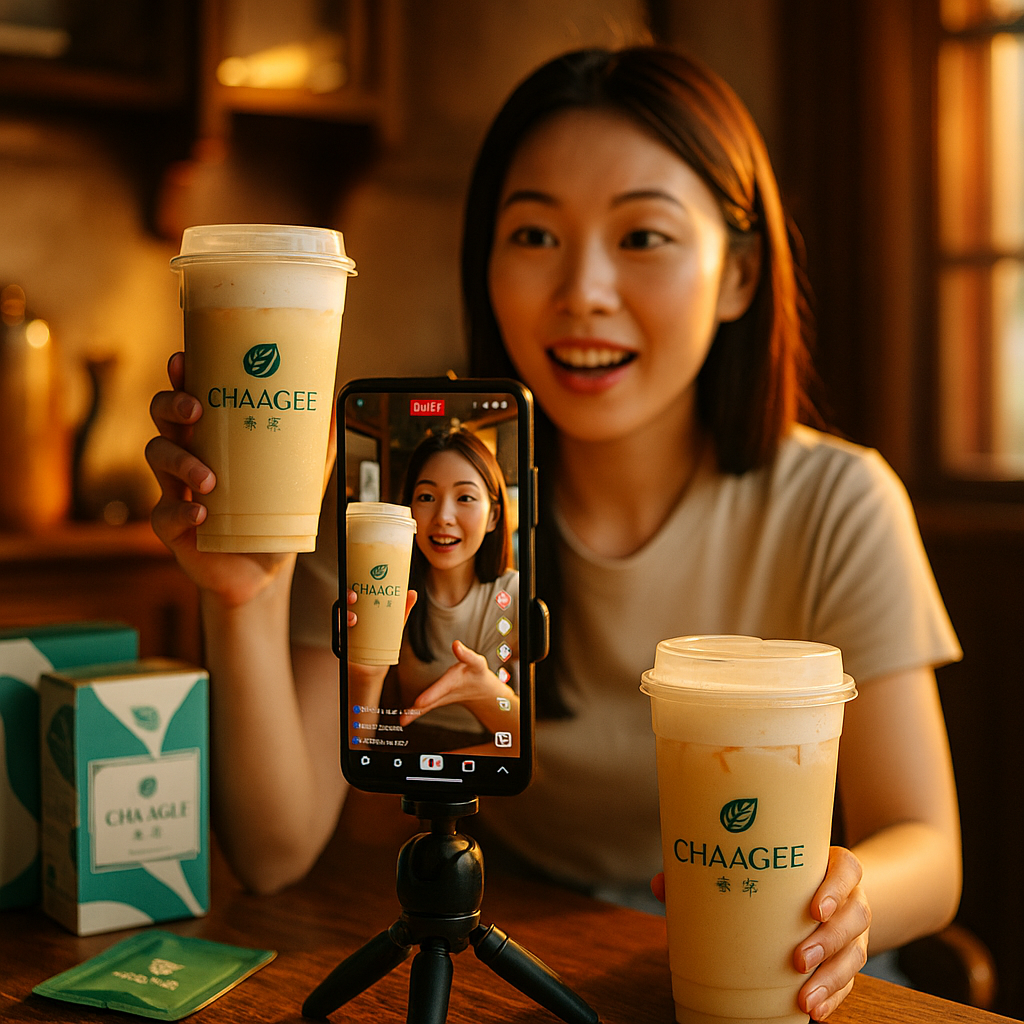
Zero celebrity endorsements. No Super Bowl spot. No A-list ambassador contract. Yet Chagee, the Chinese tea chain that entered the US market with almost no brand recognition, turned TikTok Shop livestream commerce into its primary growth engine — and did it faster than most VC-backed beverage startups manage with eight-figure ad budgets. How?
The short answer: they treated livestream not as a marketing channel, but as a retail floor. The longer answer is worth studying if you’re a brand strategist trying to figure out whether livestream commerce is a fad or a permanent fixture in your channel mix.
Why Chagee Skipped the Celebrity Playbook Entirely
Most beverage brands entering a new market lean on star power. Think Poppi’s early influencer wave or the celebrity-backed tequila boom. Chagee did the opposite. Instead of buying credibility from a famous face, they built it live, in real time, in front of an audience that could ask questions and buy the product in the same breath.
This wasn’t a budget constraint dressed up as strategy — it was deliberate. Celebrity endorsement carries risk: expensive contracts, slow production timelines, and a disconnect between the star’s audience and the actual buyer. Livestream commerce collapses that gap. The host talks directly to shoppers, answers real-time comments about ingredients or caffeine content, and closes the sale before the viewer scrolls away.
Chagee’s approach mirrors what we’ve seen work in adjacent categories. Chagee’s earlier nano-creator push laid the groundwork by seeding authentic product content before the brand ever touched a livestream studio. That sequencing matters: livestream commerce works best when there’s already a layer of organic trust to build on.
Chagee didn’t buy attention with a famous face. It earned trust one livestream sale at a time, converting curiosity into repeat purchase within a single session.
The Mechanics: What a Chagee Livestream Actually Looks Like
Strip away the tea branding and Chagee’s livestreams follow a formula that’s become standard for TikTok Shop’s top-performing sellers.
- Multiple daily sessions. Rather than one flagship event, Chagee runs recurring streams across different time zones and dayparts, maximizing the chance of catching US shoppers when they’re actually scrolling.
- Micro and mid-tier hosts, not celebrities. Hosts are chosen for product knowledge and comfort on camera, not follower count. Some are existing nano-creators graduated into paid livestream roles.
- Bundled SKUs with in-stream discounts. Limited-time pricing during the stream creates urgency without requiring a celebrity-driven halo effect.
- Real-time Q&A on ingredients and customization. Tea is a category with real education needs — caffeine levels, sweetness options, milk alternatives. Livestream lets hosts answer this instantly, something a 15-second UGC clip can’t do.
This is the same operational logic behind Grind Coffee’s livestream playbook, which pushed conversion rates to 30% by treating the stream as a guided shopping experience rather than a broadcast. Beverage categories, it turns out, are unusually well suited to this format because purchase decisions hinge on taste, customization, and reassurance — all things a live host can address that a static product page cannot.
Building a Category, Not Just a Brand
Here’s the part strategists tend to underrate: Chagee wasn’t just selling Chagee. It was introducing an entire category — premium Chinese-style milk tea — to a US audience that had, at best, a vague familiarity with boba shops. That’s a much heavier lift than launching a new SKU in an established category like protein bars or cold brew.
Livestream commerce turned out to be the right tool for category education because it allows for narrative pacing. A 30-second TikTok ad can show a product. A 45-minute livestream can explain what makes a category different, answer skeptical comments live, and let hundreds of viewers self-select into becoming first-time buyers over the course of a single session.
Compare this to how Fly By Jing built category awareness for chili crisp — another example of a brand introducing an unfamiliar-to-Americans product through grassroots content rather than mass advertising. The pattern repeats: category creation favors sustained, authentic explanation over one-off celebrity impact.
The Data Behind the Decision
TikTok Shop’s own merchant data, alongside third-party tracking from firms like eMarketer, has shown livestream shopping growing at rates that outpace static shoppable video by a wide margin in the US market. That’s not a China-only phenomenon anymore — it’s translating, unevenly but measurably, to American consumer behavior.
For Chagee specifically, the appeal was cost efficiency layered on top of reach. A single livestream host costs a fraction of a celebrity retainer, and the content is inherently reusable: clips get cut down into shoppable video for the TikTok Shop feed, extending the value of each session well past its live window.
One livestream session can generate weeks of repurposed shoppable clips — a single production cost feeding multiple discovery surfaces.
This repurposing loop is where a lot of brands leave money on the table. They treat the livestream as disposable, when in reality the highest-converting moments — a host reacting to a flavor, a customer testimonial dropped in the comments, an ingredient breakdown — are exactly the assets that perform well when clipped and pushed back into the algorithmic feed.
Risk Mitigation: What Celebrity Deals Would Have Cost Chagee
It’s worth pausing on the risk side of this decision, because that’s the lens most brand strategists actually operate from when pitching budget internally.
Celebrity endorsement deals carry contractual risk (image rights, exclusivity clauses, morality clauses), timeline risk (approval cycles that can stretch a campaign launch by months), and reputational risk if the celebrity’s public conduct sours mid-contract. None of that disappears with livestream hosts, but the exposure is smaller and more distributed. If one host underperforms or generates a bad moment, the brand simply adjusts casting for the next session. There’s no seven-figure contract sitting on the balance sheet.
This is the same de-risking logic behind Cava’s nano-creator rollout strategy — smaller, distributed bets instead of one large, high-stakes commitment. Livestream hosting is essentially that principle applied to real-time commerce.
There’s also a compliance angle marketers can’t ignore. The FTC’s endorsement guidelines apply to livestream hosts the same way they apply to celebrities or nano-creators — disclosure obligations don’t disappear just because the format is live and fast-moving. Brands running frequent livestream sessions need clear disclosure protocols baked into host briefings, not an afterthought bolted on post-launch.
What This Means for Your Own Category-Entry Strategy
Chagee’s approach won’t map perfectly onto every vertical. Livestream commerce leans hardest into categories with an education gap, a demonstrable product experience, or an impulse-purchase price point. Tea checks all three boxes. So do skincare, cookware, and increasingly, packaged food.
If you’re weighing whether to build a livestream program, ask three questions. Does your product benefit from live explanation? Is there a price point low enough to support impulse buying inside a session? And do you have (or can you train) hosts who know the product cold, even if they have modest followings?
If the answer to those is yes, celebrity endorsement might genuinely be the wrong tool. It’s slower, costlier, and less adaptable than a livestream program you can iterate weekly. That’s a hard pill for brand teams used to measuring success by follower count and cultural cachet, but the conversion data doesn’t lie.
For more on how creator-led strategies are reshaping category creation without traditional celebrity spend, see how Rare Beauty’s tiered creator strategy outperformed celebrity halo in a completely different vertical — the underlying logic is remarkably consistent across categories.
FAQs
Frequently Asked Questions
What made TikTok Shop livestream commerce effective for a new tea category in the US?
Livestream commerce allowed Chagee to educate an unfamiliar audience about the category in real time, answering questions about ingredients, customization, and taste while offering in-stream discounts that drove immediate purchase decisions.
Why did Chagee avoid celebrity endorsement deals?
Celebrity contracts carry higher financial risk, slower approval timelines, and less flexibility than a livestream host program. Chagee prioritized distributed, lower-risk bets on trained hosts over a single high-cost celebrity commitment.
How does livestream commerce differ from standard influencer seeding?
Standard seeding relies on creators posting asynchronous content, while livestream commerce combines real-time explanation, audience interaction, and instant checkout within a single session, often producing higher conversion rates.
Can smaller brands replicate Chagee’s livestream strategy without a large budget?
Yes. Livestream hosting costs significantly less than celebrity endorsement, and brands can start with a small roster of trained micro-creators or staff members before scaling session frequency.
What compliance considerations apply to livestream commerce hosts?
Hosts must follow FTC endorsement disclosure guidelines just like any other paid promoter, and brands should build disclosure protocols into host training to avoid regulatory risk during fast-paced live sessions.
Next step: If you’re evaluating livestream commerce for a category launch, run a four-week pilot with two to three trained hosts before committing to a full content calendar — the data from those early sessions will tell you more about product-market fit than any celebrity casting deck ever could.
Top Influencer Marketing Agencies
The leading agencies shaping influencer marketing in 2026
Agencies ranked by campaign performance, client diversity, platform expertise, proven ROI, industry recognition, and client satisfaction. Assessed through verified case studies, reviews, and industry consultations.
Moburst

-
2

The Shelf
Boutique Beauty & Lifestyle Influencer AgencyA data-driven boutique agency specializing exclusively in beauty, wellness, and lifestyle influencer campaigns on Instagram and TikTok. Best for brands already focused on the beauty/personal care space that need curated, aesthetic-driven content.Clients: Pepsi, The Honest Company, Hims, Elf Cosmetics, Pure LeafVisit The Shelf → -
3

Audiencly
Niche Gaming & Esports Influencer AgencyA specialized agency focused exclusively on gaming and esports creators on YouTube, Twitch, and TikTok. Ideal if your campaign is 100% gaming-focused — from game launches to hardware and esports events.Clients: Epic Games, NordVPN, Ubisoft, Wargaming, Tencent GamesVisit Audiencly → -
4

Viral Nation
Global Influencer Marketing & Talent AgencyA dual talent management and marketing agency with proprietary brand safety tools and a global creator network spanning nano-influencers to celebrities across all major platforms.Clients: Meta, Activision Blizzard, Energizer, Aston Martin, WalmartVisit Viral Nation → -
5

The Influencer Marketing Factory
TikTok, Instagram & YouTube CampaignsA full-service agency with strong TikTok expertise, offering end-to-end campaign management from influencer discovery through performance reporting with a focus on platform-native content.Clients: Google, Snapchat, Universal Music, Bumble, YelpVisit TIMF → -
6

NeoReach
Enterprise Analytics & Influencer CampaignsAn enterprise-focused agency combining managed campaigns with a powerful self-service data platform for influencer search, audience analytics, and attribution modeling.Clients: Amazon, Airbnb, Netflix, Honda, The New York TimesVisit NeoReach → -
7

Ubiquitous
Creator-First Marketing PlatformA tech-driven platform combining self-service tools with managed campaign options, emphasizing speed and scalability for brands managing multiple influencer relationships.Clients: Lyft, Disney, Target, American Eagle, NetflixVisit Ubiquitous → -
8

Obviously
Scalable Enterprise Influencer CampaignsA tech-enabled agency built for high-volume campaigns, coordinating hundreds of creators simultaneously with end-to-end logistics, content rights management, and product seeding.Clients: Google, Ulta Beauty, Converse, AmazonVisit Obviously →