


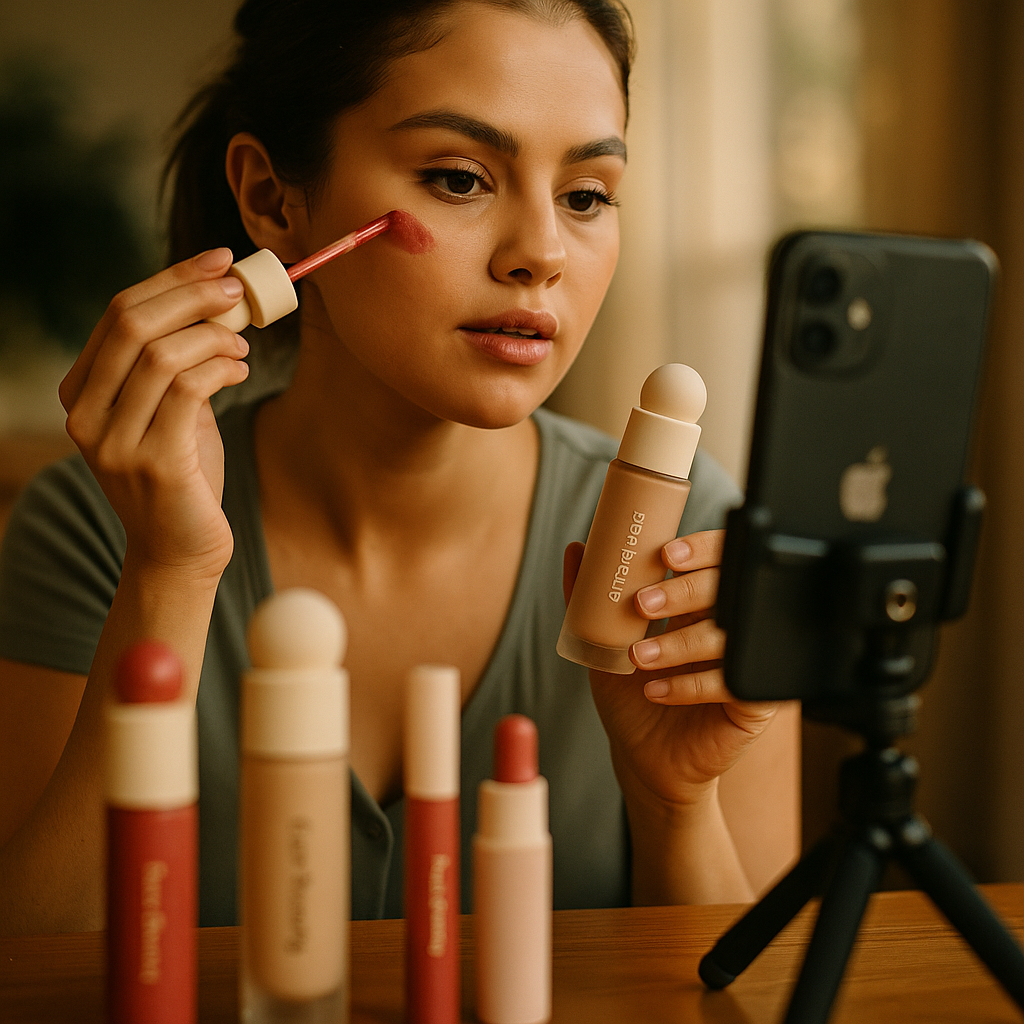
One founder-fronted brand, zero paid celebrity ambassadors outside its own founder, and a top-5 ranking in prestige beauty. How? Rare Beauty’s tiered creator strategy didn’t choose between celebrity reach and nano-creator trust — it stacked them, deliberately, at every stage of the funnel.
Most brands treat celebrity partnerships and grassroots creator seeding as separate budget lines, run by separate teams, reporting to separate KPIs. Rare Beauty ran them as one system. That’s the part competitors keep missing.
The Problem With Choosing One Lane
Prestige beauty has a trust problem. Consumers know the polished campaign is paid for. They also know the “authentic” micro-influencer post might be paid for too. Skepticism is the default setting, and it’s earned. According to eMarketer, trust in traditional celebrity endorsements has been declining for years, even as celebrity-founded brands keep launching.
So why does Selena Gomez’s brand keep growing when so many other celebrity beauty lines stall out after year two? Because Rare Beauty never relied on Gomez alone to do the selling. Her role was to open the door. Everything after that was built by a much wider, much less famous creator base doing the actual convincing.
Celebrity founders generate awareness. Nano and micro-creators generate the trust that converts awareness into repeat purchase. Rare Beauty’s entire growth model depends on not confusing the two.
What the Tiered Structure Actually Looks Like
Break down Rare Beauty’s creator ecosystem and you find three distinct layers, each doing a job the others can’t do as well.
- Tier 1 — Founder halo: Selena Gomez’s personal platform (400M+ followers across channels) drives top-of-funnel awareness and press coverage no paid campaign could buy at that scale.
- Tier 2 — Mid-tier and macro creators: Established beauty creators with engaged, niche audiences validate product claims with tutorials, comparisons, and “get ready with me” content that ranks well on TikTok and YouTube search.
- Tier 3 — Nano and micro-creators: Everyday users, often unpaid or gifted product, post unscripted reviews, dupes comparisons, and skin-type-specific content that reads as genuine because it is.
The mistake most brands make is over-investing in tier one and treating tiers two and three as an afterthought. Rare Beauty inverted the spend. Gomez’s presence is essentially free media (she’s the founder, it’s organic to her feed). The actual paid and gifted budget skews heavily toward mid-tier and nano creators, because that’s where purchase intent gets built.
Why Nano-Creators Close What Celebrity Can’t
A celebrity founder can make you aware a product exists. She can’t tell you whether the Soft Pinch Liquid Blush oxidizes on deeper skin tones, or whether the Positive Light Liquid Luminizer clogs pores if you have combination skin. That’s a job for someone with your exact skin type, posting from a bathroom, not a studio.
This is the same mechanic brands across categories have been quietly exploiting for years. Wyze used nano-creators to build category trust in a crowded smart-home market. Warby Parker’s nano-creator try-on videos outperformed paid search on CAC for the exact same reason: specificity beats polish when the buyer is trying to de-risk a purchase.
Beauty has an added wrinkle (pun intended): shade matching, skin type, and texture concerns. A single celebrity face, however beloved, cannot represent that range. Hundreds of nano-creators, collectively, can.
The Data Behind the Halo Effect
Rare Beauty crossed $300 million in estimated retail sales within a few years of launch and has consistently ranked among the top prestige color cosmetics brands at Sephora, per retail industry estimates and Statista beauty market tracking. That kind of velocity doesn’t come from a single celebrity founder’s follower count. Kylie Cosmetics had a bigger initial following and a faster initial spike, and it plateaued harder.
The difference is durability. Celebrity halo effect produces a launch spike. Nano-creator seeding produces a long tail of search-driven, intent-heavy content that keeps showing up in “is [product] worth it” searches for years after launch. That long tail is what actually protects lifetime value.
A celebrity launch gets you a great week one. A distributed nano-creator base gets you a great year three, four, and five — because that content keeps surfacing in organic search long after the paid push ends.
Blush, Not Just Brand: The Product-Level Play
Rare Beauty didn’t just seed the brand broadly. It seeded specific hero products — the Soft Pinch Blush stick, in particular — to waves of creators across tiers simultaneously. This mirrors a pattern documented in Aritzia’s tiered pant seeding strategy, where a single hero SKU gets pushed through nano, micro, and macro layers at once rather than sequentially. The effect compounds: a shopper sees the blush from a celebrity-adjacent creator, then again from a mid-tier makeup artist, then again from a nano-creator with their exact undertone. Three touches, three different trust signals, one purchase decision.
Rare Beauty’s own marketing team has publicly discussed running structured creator programs rather than one-off gifting, treating it as a repeatable operational system rather than a campaign. That’s the operational discipline other beauty brands often skip.
What Brands Get Wrong When They Try to Copy This
Plenty of beauty brands have tried the celebrity-plus-creator playbook and gotten mediocre results. A few recurring mistakes:
- Treating nano-creator seeding as a PR afterthought instead of a budgeted, measured channel with its own KPIs and content briefs.
- Failing to brief for authenticity. Over-scripted gifting campaigns kill the exact trust signal nano-creators are supposed to provide. Compare this to how L’Oréal’s tiered creator roster deliberately loosens creative control at the lower tiers.
- Not building measurement infrastructure to connect nano-creator content to actual sales, relying instead on vanity metrics like impressions or follower counts.
- Assuming celebrity halo transfers automatically. It doesn’t. Halo effect has to be actively channeled into product-specific proof points, or it evaporates as generic brand awareness with no conversion mechanism.
Compliance is another underrated risk area. When you’re running hundreds or thousands of nano-creator relationships alongside a celebrity founder, disclosure consistency becomes a real operational burden. The FTC’s endorsement guidelines apply just as strictly to a 3,000-follower nano-creator as they do to a celebrity founder, and enforcement attention on unpaid or gifted-product influencer relationships has only increased. Brands running tiered programs at scale need a disclosure and contracting process that doesn’t rely on individually managing every relationship by hand.
For a household name like Gomez, disclosure is baked into every post by necessity. For a nano-creator posting a gifted blush, disclosure often gets forgotten, and that’s a brand risk, not a creator risk, in the eyes of regulators.
The Operational Blueprint, Simplified
If you’re a brand strategist trying to reverse-engineer this for your own portfolio, the structure is replicable even without a celebrity founder:
- Use your top-tier partner (celebrity, founder, or macro-influencer) to drive category-level awareness, not product-level conversion.
- Deploy mid-tier creators to produce the comparison, tutorial, and search-optimized content that ranks and educates.
- Seed nano-creators at volume for the specific, granular trust signals (shade match, skin type, use case) that no single face can provide.
- Measure each tier against a different KPI: awareness lift for tier one, engagement and search visibility for tier two, conversion and UGC volume for tier three.
- Build a disclosure and briefing system that scales, because the FTC doesn’t grade on a curve for gifted product.
This isn’t unique to beauty. The same tiered logic shows up in Vuori’s nano-to-macro creator ladder and in Gap’s tiered denim seeding rollout. Different category, same architecture: big name opens the door, mid-tier creators build the case, nano-creators close it.
Next step: audit your current creator program by tier, not by total spend. If more than 60% of budget sits with a single celebrity or macro partner and less than 20% reaches nano-creators, you’re running a halo effect with no closer, and that’s a growth ceiling, not a growth strategy.
FAQs
What is a tiered creator strategy in influencer marketing?
A tiered creator strategy deliberately combines creators of different sizes, celebrity, macro, mid-tier, and nano, into one coordinated program, assigning each tier a distinct role in the funnel rather than treating all influencer partnerships the same way.
Why did Rare Beauty succeed where other celebrity beauty brands stalled?
Rare Beauty used its celebrity founder for awareness but invested the bulk of its creator budget in mid-tier and nano-creators who produced product-specific, trust-building content. This gave the brand a long tail of organic, search-visible proof that pure celebrity-driven brands typically lack.
How much budget should go to nano-creators versus celebrity partnerships?
There’s no universal ratio, but brands seeing the strongest retention typically direct the majority of paid and gifted budget toward mid-tier and nano-creators, reserving celebrity or macro spend for top-of-funnel awareness rather than conversion.
What are the compliance risks in running large nano-creator programs?
Disclosure consistency is the biggest risk. FTC endorsement guidelines apply equally to nano-creators receiving free product and to paid celebrity partners, so brands need standardized contracting and disclosure workflows to manage risk at scale.
Can this tiered model work outside of beauty?
Yes. The same structure has been used in apparel, food and beverage, and consumer electronics, wherever a brand needs both broad awareness and category-specific, trust-driven proof points to convert.
Top Influencer Marketing Agencies
The leading agencies shaping influencer marketing in 2026
Agencies ranked by campaign performance, client diversity, platform expertise, proven ROI, industry recognition, and client satisfaction. Assessed through verified case studies, reviews, and industry consultations.
Moburst

-
2

The Shelf
Boutique Beauty & Lifestyle Influencer AgencyA data-driven boutique agency specializing exclusively in beauty, wellness, and lifestyle influencer campaigns on Instagram and TikTok. Best for brands already focused on the beauty/personal care space that need curated, aesthetic-driven content.Clients: Pepsi, The Honest Company, Hims, Elf Cosmetics, Pure LeafVisit The Shelf → -
3

Audiencly
Niche Gaming & Esports Influencer AgencyA specialized agency focused exclusively on gaming and esports creators on YouTube, Twitch, and TikTok. Ideal if your campaign is 100% gaming-focused — from game launches to hardware and esports events.Clients: Epic Games, NordVPN, Ubisoft, Wargaming, Tencent GamesVisit Audiencly → -
4

Viral Nation
Global Influencer Marketing & Talent AgencyA dual talent management and marketing agency with proprietary brand safety tools and a global creator network spanning nano-influencers to celebrities across all major platforms.Clients: Meta, Activision Blizzard, Energizer, Aston Martin, WalmartVisit Viral Nation → -
5

The Influencer Marketing Factory
TikTok, Instagram & YouTube CampaignsA full-service agency with strong TikTok expertise, offering end-to-end campaign management from influencer discovery through performance reporting with a focus on platform-native content.Clients: Google, Snapchat, Universal Music, Bumble, YelpVisit TIMF → -
6

NeoReach
Enterprise Analytics & Influencer CampaignsAn enterprise-focused agency combining managed campaigns with a powerful self-service data platform for influencer search, audience analytics, and attribution modeling.Clients: Amazon, Airbnb, Netflix, Honda, The New York TimesVisit NeoReach → -
7

Ubiquitous
Creator-First Marketing PlatformA tech-driven platform combining self-service tools with managed campaign options, emphasizing speed and scalability for brands managing multiple influencer relationships.Clients: Lyft, Disney, Target, American Eagle, NetflixVisit Ubiquitous → -
8

Obviously
Scalable Enterprise Influencer CampaignsA tech-enabled agency built for high-volume campaigns, coordinating hundreds of creators simultaneously with end-to-end logistics, content rights management, and product seeding.Clients: Google, Ulta Beauty, Converse, AmazonVisit Obviously →