


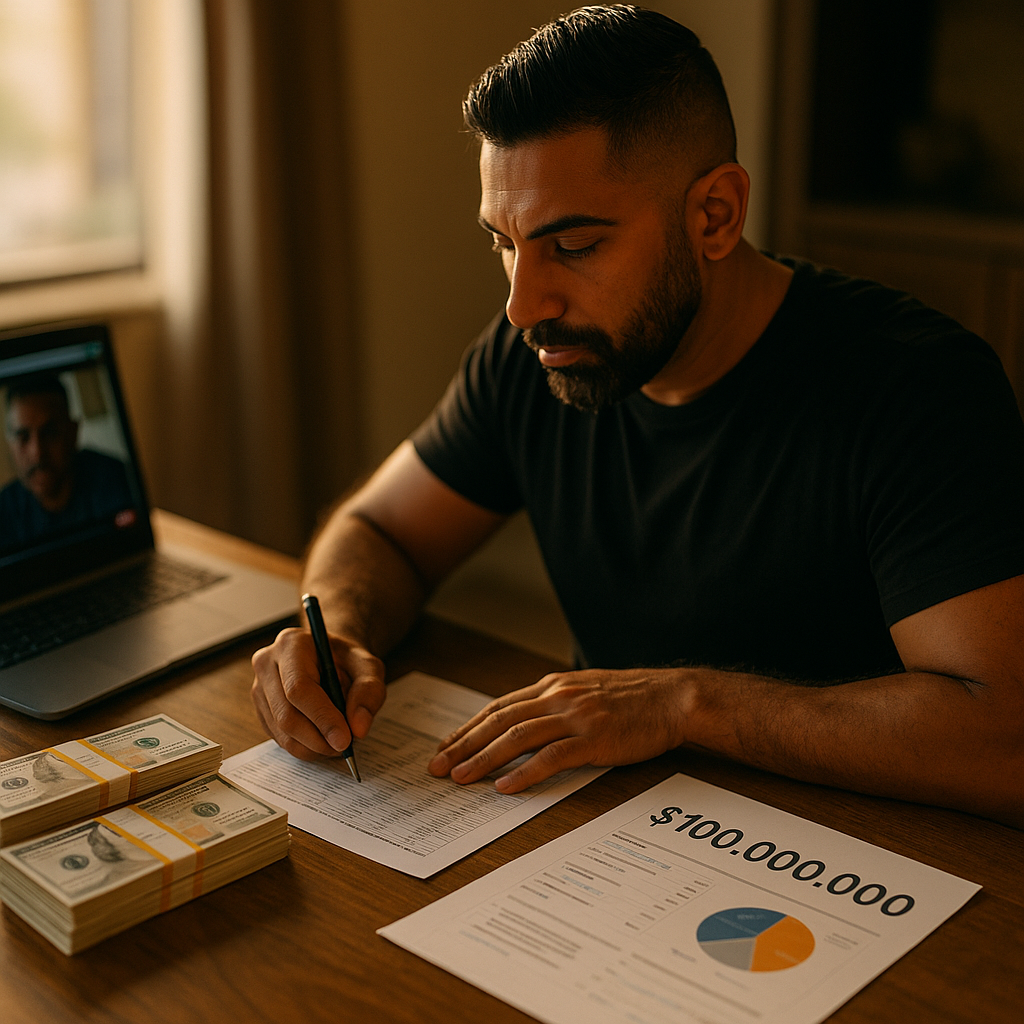
What does it actually cost to buy a piece of the most-watched morality-tale factory on the internet? Advertising Week has reportedly floated a $100 million valuation target tied to a Dhar Mann creator deal, and the number has sparked more confusion than clarity among brand strategists. Is that a licensing fee, an equity stake, or a media buy dressed up as a headline? The primary keyword in this conversation, the Dhar Mann creator deal, deserves a harder look at the arithmetic behind it before anyone treats it as a benchmark for their own creator budget.
What the $100 Million Figure Actually Represents
Let’s be precise about what’s being discussed. Reports suggest the $100 million target isn’t a single check written to Dhar Mann himself. It’s a blended valuation combining content licensing rights, ongoing brand integration revenue, and a multi-year distribution partnership across streaming and social platforms. That distinction matters enormously for anyone trying to reverse-engineer the deal structure for their own influencer program.
Dhar Mann Studios produces roughly a dozen short-form moral-lesson videos daily across a network of channels, generating billions of cumulative views. That volume is the real asset here, not any single viral moment. Advertising Week’s interest looks less like a sponsorship and more like an infrastructure play: buying predictable, brand-safe reach at scale.
A $100 million target only makes sense when you stop thinking of it as payment for content and start thinking of it as payment for distribution predictability at scale.
The Studio Model: Why Dhar Mann Isn’t a Typical Creator
Most influencer deals fail to hit nine figures because they’re tied to one person’s face and one person’s schedule. Dhar Mann built something closer to a television studio than a personal brand. He employs writers, editors, and a rotating cast of actors who deliver formulaic, high-retention narratives designed for algorithmic replay value.
That operational structure is exactly why the math starts to resemble media licensing rather than influencer marketing. Compare it to how production tech investment drives revenue growth at scale creator studios. When a creator brand runs like a content factory, valuation models shift from CPM-based influencer rate cards to enterprise media multiples, similar to how streaming platforms value a back catalog.
This is the part brand strategists often miss. You’re not negotiating with a person. You’re negotiating with a production pipeline that happens to have a person’s name on the door.
Breaking Down the Math: CPMs, Licensing, and Brand Integration Revenue
So where does $100 million actually come from? Industry estimates for top-tier YouTube and TikTok creators put CPMs anywhere from $10 to $30 depending on niche and audience quality, according to benchmarking data tracked by eMarketer. Dhar Mann’s channels reportedly generate tens of billions of annual views across platforms. Run that volume through even a conservative blended CPM, and ad revenue alone starts stacking into eight figures before licensing or brand integrations enter the picture.
Then layer in the parts that don’t show up in a simple views-times-CPM formula:
- Brand integration slots, where sponsors pay a premium to have products woven into moral-lesson narratives rather than run as pre-roll ads.
- Licensing rights for streaming platforms or international distributors who want the back catalog for their own audiences.
- Merchandise and IP extensions, including potential television or film development that trades on brand recognition already built through short-form content.
- Data and audience insight value, since a studio producing daily content at this volume generates enormous first-party engagement data that’s attractive to any acquirer thinking about future targeting.
Add those revenue lines together and a $100 million target stops looking speculative. It starts looking like a fairly standard media asset valuation, just wrapped in creator economy language.
Is This a Bubble or a Blueprint?
Here’s the uncomfortable question every CMO should be asking: does this deal prove the creator economy has matured into legitimate media infrastructure, or does it prove that a handful of outlier creators are getting valued like Hollywood studios while the median influencer still struggles to book a five-figure brand partnership?
Both things are true simultaneously. The Statista creator economy market data consistently shows a widening gap between top-tier creators and everyone else. Deals like this one accelerate that gap rather than close it. For brands, that means the lessons from a $100 million outlier don’t automatically translate to a $50,000 micro-influencer campaign, and treating them as comparable is a fast way to misallocate budget.
What does translate, though, is the underlying principle: predictable, brand-safe, high-frequency content beats sporadic viral bets almost every time when you’re trying to justify a marketing spend to finance. That’s the same logic behind systemized content strategies that manufacture virality rather than chasing it.
What Brands Should Take From This Deal
Nobody reading this is about to write a nine-figure check to a creator studio. But the operational logic behind the Dhar Mann valuation is worth stealing at any budget size.
First, prioritize creators who run repeatable production systems over creators who rely on individual viral moments. A creator who publishes consistent, formulaic content is easier to forecast, easier to insure against brand-safety risk, and easier to defend in a budget review. Second, ask for licensing terms, not just posting rights. If a creator’s content performs well organically, negotiating rights to repurpose it across paid channels multiplies your ROI without additional production spend, a strategy already proven by brands using UGC whitelisting for paid amplification.
The real takeaway isn’t the $100 million number. It’s that brand-safe, high-volume, formulaic content now commands studio-level valuations, and that changes how you should be pricing every creator negotiation on your desk.
Third, model the deal in tiers rather than a single lump payment. Programmatic matching approaches, like those detailed in Chipotle’s 700-plus creator tier system, show how brands can scale influencer investment across performance bands instead of betting everything on one flagship name. Diversification reduces the risk that a single creator dispute, platform algorithm change, or reputational hiccup tanks your entire campaign budget.
Compliance and Disclosure Still Apply
Whatever the deal size, endorsement disclosure rules don’t scale down. Any brand integration inside Dhar Mann’s content, or any creator content you license for paid use, still needs to meet FTC endorsement guidelines. Bigger valuations attract more regulatory scrutiny, not less. Build disclosure review into your contract terms now rather than after a compliance audit forces the issue.
Where This Leaves Mid-Market Brands
If you’re running a mid-market brand without a $100 million line item, the honest answer is that this deal isn’t for you, and it was never meant to be. What’s useful is the pricing framework underneath it. Look at how consolidation and acquisition activity, like platform acquisitions building unified creator infrastructure, are compressing the gap between traditional media buying and influencer marketing. That compression is where smart mid-market budgets should be watching closely, because the tools and negotiation leverage once reserved for nine-figure deals are trickling down into standard creator marketplace platforms.
Track your own creator relationships the way a studio would track a content slate: cost per view, retention rate, licensing value, and brand-safety score. That’s the actual math behind the Dhar Mann number, just scaled to whatever budget you’re working with.
Frequently Asked Questions
What is the Dhar Mann creator deal actually worth?
Reports place the target valuation at $100 million, but this figure reportedly combines content licensing, brand integration revenue, and distribution rights rather than a single upfront payment.
Why is Dhar Mann’s content valued like a media studio instead of a typical influencer deal?
Dhar Mann Studios operates with writers, editors, and a repeatable production system that generates consistent daily output, which allows valuation models closer to television or streaming media rather than standard creator rate cards.
Can smaller brands apply this valuation model to their own creator partnerships?
The exact dollar figures don’t scale down, but the underlying framework does. Prioritizing creators with repeatable production systems, negotiating licensing rights for paid amplification, and diversifying spend across creator tiers are all tactics smaller brands can apply immediately.
Does a deal like this affect FTC disclosure requirements?
No. Regardless of deal size, any brand integration or sponsored content still must comply with FTC endorsement and disclosure guidelines, and larger valuations typically attract more regulatory attention, not less.
Is the creator economy overvalued because of deals like this?
Not necessarily overvalued, but increasingly uneven. Top-tier creators with studio-level operations are pulling further ahead of median creators, meaning brands should benchmark deals against comparable production models rather than treating outlier valuations as industry norms.
Top Influencer Marketing Agencies
The leading agencies shaping influencer marketing in 2026
Agencies ranked by campaign performance, client diversity, platform expertise, proven ROI, industry recognition, and client satisfaction. Assessed through verified case studies, reviews, and industry consultations.
Moburst

-
2

The Shelf
Boutique Beauty & Lifestyle Influencer AgencyA data-driven boutique agency specializing exclusively in beauty, wellness, and lifestyle influencer campaigns on Instagram and TikTok. Best for brands already focused on the beauty/personal care space that need curated, aesthetic-driven content.Clients: Pepsi, The Honest Company, Hims, Elf Cosmetics, Pure LeafVisit The Shelf → -
3

Audiencly
Niche Gaming & Esports Influencer AgencyA specialized agency focused exclusively on gaming and esports creators on YouTube, Twitch, and TikTok. Ideal if your campaign is 100% gaming-focused — from game launches to hardware and esports events.Clients: Epic Games, NordVPN, Ubisoft, Wargaming, Tencent GamesVisit Audiencly → -
4

Viral Nation
Global Influencer Marketing & Talent AgencyA dual talent management and marketing agency with proprietary brand safety tools and a global creator network spanning nano-influencers to celebrities across all major platforms.Clients: Meta, Activision Blizzard, Energizer, Aston Martin, WalmartVisit Viral Nation → -
5

The Influencer Marketing Factory
TikTok, Instagram & YouTube CampaignsA full-service agency with strong TikTok expertise, offering end-to-end campaign management from influencer discovery through performance reporting with a focus on platform-native content.Clients: Google, Snapchat, Universal Music, Bumble, YelpVisit TIMF → -
6

NeoReach
Enterprise Analytics & Influencer CampaignsAn enterprise-focused agency combining managed campaigns with a powerful self-service data platform for influencer search, audience analytics, and attribution modeling.Clients: Amazon, Airbnb, Netflix, Honda, The New York TimesVisit NeoReach → -
7

Ubiquitous
Creator-First Marketing PlatformA tech-driven platform combining self-service tools with managed campaign options, emphasizing speed and scalability for brands managing multiple influencer relationships.Clients: Lyft, Disney, Target, American Eagle, NetflixVisit Ubiquitous → -
8

Obviously
Scalable Enterprise Influencer CampaignsA tech-enabled agency built for high-volume campaigns, coordinating hundreds of creators simultaneously with end-to-end logistics, content rights management, and product seeding.Clients: Google, Ulta Beauty, Converse, AmazonVisit Obviously →