


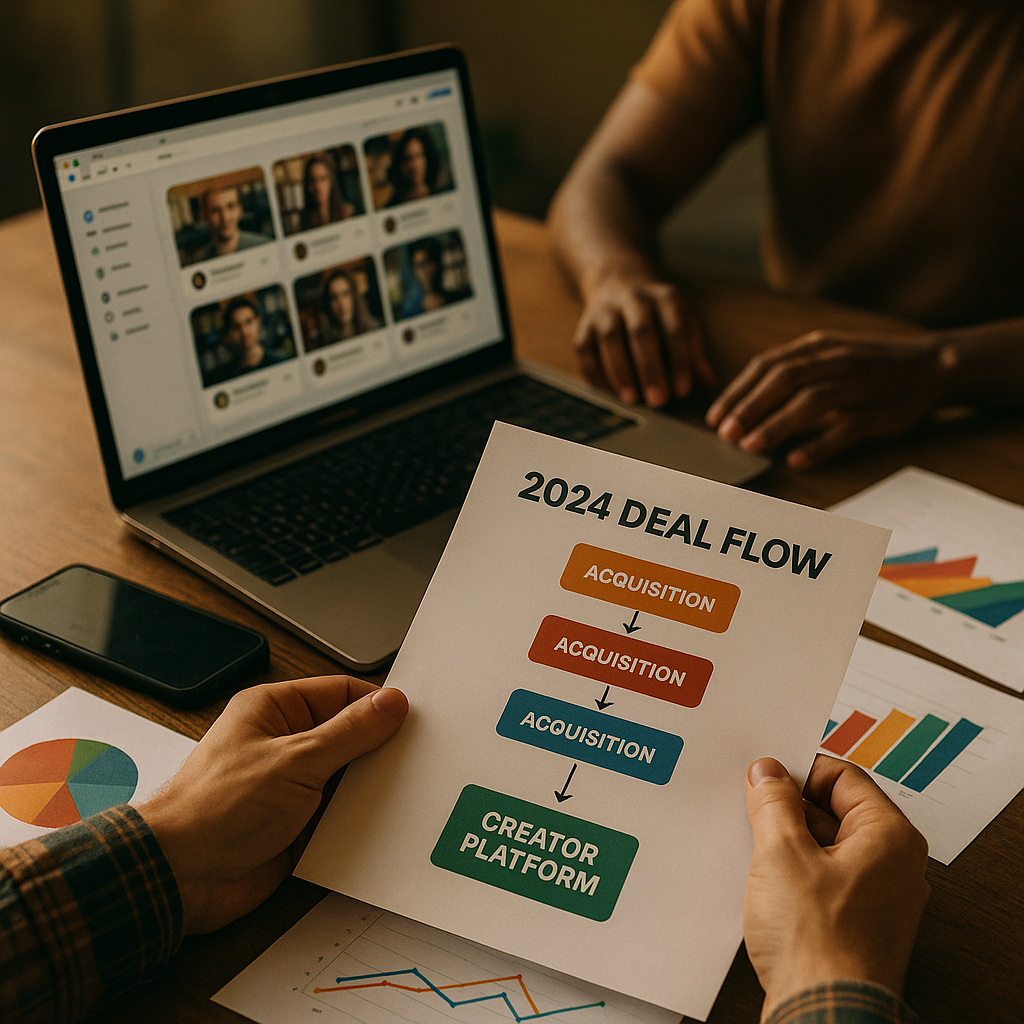
Most brands still run influencer marketing through four or five disconnected vendors: one for discovery, one for payments, one for content rights, one for analytics. New Engen bet that this fragmentation was the actual bottleneck, not creator supply. Over five years, the company acquired Acorn, LT Partners, Donut Digital, and Grapevine to build a single connected creator-to-conversion platform. The result is a case study every CMO evaluating platform consolidation should study closely.
The Problem Nobody Wants to Admit They Have
Ask any brand marketer how many tools touch their influencer program and you’ll usually get a pause before the answer. Discovery software here. A separate contract and payment system there. A third tool for whitelisting and paid amplification. A fourth spreadsheet, because there’s always a fourth spreadsheet, for reporting up to finance.
This isn’t a minor inefficiency. It’s a structural drag on ROI measurement, campaign speed, and compliance. When creator data lives in five places, nobody can answer a simple question: which creators actually drove revenue last quarter? New Engen’s leadership recognized this early and decided the fix wasn’t another point solution. It was vertical integration across the entire creator lifecycle, from sourcing to spend to sales attribution.
Why Acquisition Instead of Building In-House?
Building discovery, payments, content licensing, and attribution infrastructure from scratch takes years and burns capital most agencies don’t have. New Engen chose a faster path: buy proven capability in each layer of the stack, then integrate.
Acorn brought creator discovery and relationship management, the front end of the funnel where brands identify who to work with. LT Partners contributed data and media buying infrastructure, critical for the paid amplification layer that turns organic content into scaled reach. Donut Digital added creative production and content operations, the connective tissue between a creator’s raw content and a brand-ready asset. Grapevine rounded things out with influencer marketplace and campaign management capabilities that had already proven themselves with consumer brands.
Four acquisitions across five years wasn’t about adding logos to a press release. It was about closing the gaps between discovery, production, media, and measurement that force most brands to stitch together workarounds.
Each deal targeted a specific seam in the creator-to-conversion journey. That’s the detail competitors miss when they acquire for market share instead of architecture.
Acorn: Fixing the Discovery Problem First
Discovery is where most influencer programs start, and where most inefficiency compounds. Brands routinely overpay for reach that doesn’t convert because they’re matching on follower count instead of audience quality or historical performance.
Acorn’s technology gave New Engen a structured way to evaluate creators against brand-specific criteria before a single dollar moved. That’s a meaningfully different approach than the spray-and-pray seeding model still common across the industry, something Feastables and Stanley both had to move away from as their programs matured (see how nano-creator seeding reshaped Feastables’ distribution, and how nano-creator seeding helped Stanley escape a viral trap that wasn’t converting).
Folding Acorn’s discovery layer into a broader platform meant that data collected at the top of the funnel could flow directly into media planning and measurement further downstream. No re-entering creator data across three systems. No losing historical performance context every time a campaign restarts.
LT Partners and the Media Layer Nobody Talks About Enough
Organic creator content only goes so far. The real leverage, and the thing most brands underinvest in, is paid amplification: whitelisting, spark ads, boosted posts that push proven organic winners in front of cold audiences.
LT Partners brought media buying discipline into the stack, letting New Engen treat creator content as a media asset class rather than a one-off deliverable. This mirrors a pattern showing up across the industry: brands like Chipotle scaling programmatic creator matching to hundreds of tiers, and Duo Home Insurance turning livestream content into policy leads by treating creator output as a paid media pipeline instead of a PR exercise.
According to eMarketer, spending on influencer content amplified through paid media has grown faster than organic-only influencer budgets for several consecutive years. That trend alone justifies why a media buying acquisition made sense as step two in the roadmap.
Donut Digital: Solving the Content Bottleneck
Here’s an underappreciated truth: even when brands find the right creators and buy the right media, campaigns stall because content production can’t keep pace. Briefs take too long. Revisions drag. Turnaround from concept to publish-ready asset often stretches past what a fast-moving social calendar can tolerate.
Donut Digital’s acquisition addressed exactly this choke point, embedding creative production directly into the platform rather than treating it as an external agency function. That’s consistent with a broader industry shift toward compressed production cycles, the same shift that let one QSR chain cut turnaround time to 48 hours using AI-assisted storyboarding.
Speed matters more than most brands admit. A creator trend has a shelf life measured in days, sometimes hours. If your production pipeline can’t turn a brief into a shippable asset within that window, you’ve already lost the moment.
Grapevine and the Final Piece: Marketplace Scale
The last acquisition in the roadmap, Grapevine, brought marketplace infrastructure and campaign management tooling that had already been battle-tested with consumer brands. This wasn’t about adding another discovery tool on top of Acorn’s. It was about scaling campaign operations, managing hundreds or thousands of creator relationships simultaneously without linear headcount growth.
This is the layer that determines whether a platform can serve an enterprise brand running fifty campaigns a quarter versus a boutique agency running five. HubSpot’s research on marketing operations consistently shows that scale failures happen at the operational layer, not the strategy layer. Brands don’t fail to conceive good campaigns. They fail to execute them at volume without the system falling apart.
Grapevine’s marketplace scale gave New Engen the final connective piece: a platform where discovery, media, production, and campaign operations all draw from the same data layer instead of four disconnected silos.
What This Means for Brands Evaluating Platforms Today
The lesson here isn’t “go acquire four companies.” Most brands don’t have that option. The lesson is architectural: evaluate influencer platforms on whether they connect discovery, content, media, and measurement, not on whether each individual feature looks good in a demo.
- Ask vendors directly whether creator data flows automatically between discovery, payment, and reporting modules, or whether it requires manual export and re-import.
- Push for unified attribution. If a platform can’t tie a specific creator’s content to downstream conversion, you’re buying a directory, not a growth engine, similar to how a skincare brand used a lakehouse architecture to prove creator ROI when disconnected tools couldn’t.
- Check compliance tooling. Disclosure tracking and FTC compliance shouldn’t be an afterthought bolted onto a discovery tool, especially after high-profile enforcement actions like the one that forced Poppi to rebuild influencer trust post-settlement.
- Test cross-border payout speed. Fragmented platforms routinely stumble here, and it’s a documented bottleneck for brands scaling creator programs internationally, as detailed in reporting on cross-border payout friction.
The FTC’s endorsement guidelines aren’t going away, and neither is regulatory scrutiny in other markets, including guidance from the ICO on data handling in influencer campaigns. A connected platform makes compliance a byproduct of good architecture instead of a separate, brittle process.
The Real Competitive Advantage Is Speed to Insight
Here’s what a five-year acquisition roadmap actually buys a company like New Engen: the ability to answer “what’s working right now” in near real time, across creator selection, production, paid amplification, and sales conversion, without waiting on three separate teams to reconcile spreadsheets.
Compare that to a brand running influencer marketing through four disconnected vendors. Every quarterly review becomes a data reconciliation project before it becomes a strategy conversation. That’s time and headcount that should be going toward creative testing and creator relationship depth, not spreadsheet archaeology.
Sprout Social’s research on social media ROI measurement backs this up: brands citing measurement as their top influencer marketing challenge are almost always the ones running fragmented tool stacks, not the ones lacking creator relationships. Fragmentation is the disease. Integration is the cure, and New Engen’s roadmap is a working example of what that cure looks like when executed deliberately over years rather than assembled in a rush.
Frequently Asked Questions
FAQs
What is New Engen’s acquisition strategy?
New Engen executed a five-year roadmap acquiring Acorn (creator discovery), LT Partners (media buying and data), Donut Digital (creative production), and Grapevine (marketplace and campaign management) to build one connected creator-to-conversion platform instead of relying on separate vendors for each function.
Why did New Engen choose acquisitions over building tools internally?
Building discovery, media, production, and attribution infrastructure from scratch would have taken years longer and required significant capital. Acquiring proven capability in each layer let New Engen integrate faster while avoiding the risk of building unproven technology.
What problem does a connected creator-to-conversion platform solve for brands?
It eliminates the need to manually reconcile data across separate discovery, payment, production, and reporting tools. This speeds up attribution, reduces compliance risk, and lets marketing teams answer performance questions in near real time instead of after weeks of manual reconciliation.
How should brands evaluate influencer platforms based on this case study?
Brands should ask whether creator data flows automatically between modules, whether attribution ties directly to conversion, whether compliance tooling is built in rather than bolted on, and how quickly the platform handles cross-border payouts.
Is platform consolidation only relevant for large enterprise brands?
No. Mid-market brands face the same fragmentation problem at smaller scale. Even a lean influencer program benefits from unified discovery, media, production, and measurement, since manual reconciliation costs time regardless of program size.
The takeaway for brand teams isn’t to copy New Engen’s cap table, it’s to audit your own stack this quarter and identify where creator data stops flowing between systems. Fix that seam first, and the ROI conversation gets a lot easier to have.
Top Influencer Marketing Agencies
The leading agencies shaping influencer marketing in 2026
Agencies ranked by campaign performance, client diversity, platform expertise, proven ROI, industry recognition, and client satisfaction. Assessed through verified case studies, reviews, and industry consultations.
Moburst

-
2

The Shelf
Boutique Beauty & Lifestyle Influencer AgencyA data-driven boutique agency specializing exclusively in beauty, wellness, and lifestyle influencer campaigns on Instagram and TikTok. Best for brands already focused on the beauty/personal care space that need curated, aesthetic-driven content.Clients: Pepsi, The Honest Company, Hims, Elf Cosmetics, Pure LeafVisit The Shelf → -
3

Audiencly
Niche Gaming & Esports Influencer AgencyA specialized agency focused exclusively on gaming and esports creators on YouTube, Twitch, and TikTok. Ideal if your campaign is 100% gaming-focused — from game launches to hardware and esports events.Clients: Epic Games, NordVPN, Ubisoft, Wargaming, Tencent GamesVisit Audiencly → -
4

Viral Nation
Global Influencer Marketing & Talent AgencyA dual talent management and marketing agency with proprietary brand safety tools and a global creator network spanning nano-influencers to celebrities across all major platforms.Clients: Meta, Activision Blizzard, Energizer, Aston Martin, WalmartVisit Viral Nation → -
5

The Influencer Marketing Factory
TikTok, Instagram & YouTube CampaignsA full-service agency with strong TikTok expertise, offering end-to-end campaign management from influencer discovery through performance reporting with a focus on platform-native content.Clients: Google, Snapchat, Universal Music, Bumble, YelpVisit TIMF → -
6

NeoReach
Enterprise Analytics & Influencer CampaignsAn enterprise-focused agency combining managed campaigns with a powerful self-service data platform for influencer search, audience analytics, and attribution modeling.Clients: Amazon, Airbnb, Netflix, Honda, The New York TimesVisit NeoReach → -
7

Ubiquitous
Creator-First Marketing PlatformA tech-driven platform combining self-service tools with managed campaign options, emphasizing speed and scalability for brands managing multiple influencer relationships.Clients: Lyft, Disney, Target, American Eagle, NetflixVisit Ubiquitous → -
8

Obviously
Scalable Enterprise Influencer CampaignsA tech-enabled agency built for high-volume campaigns, coordinating hundreds of creators simultaneously with end-to-end logistics, content rights management, and product seeding.Clients: Google, Ulta Beauty, Converse, AmazonVisit Obviously →