


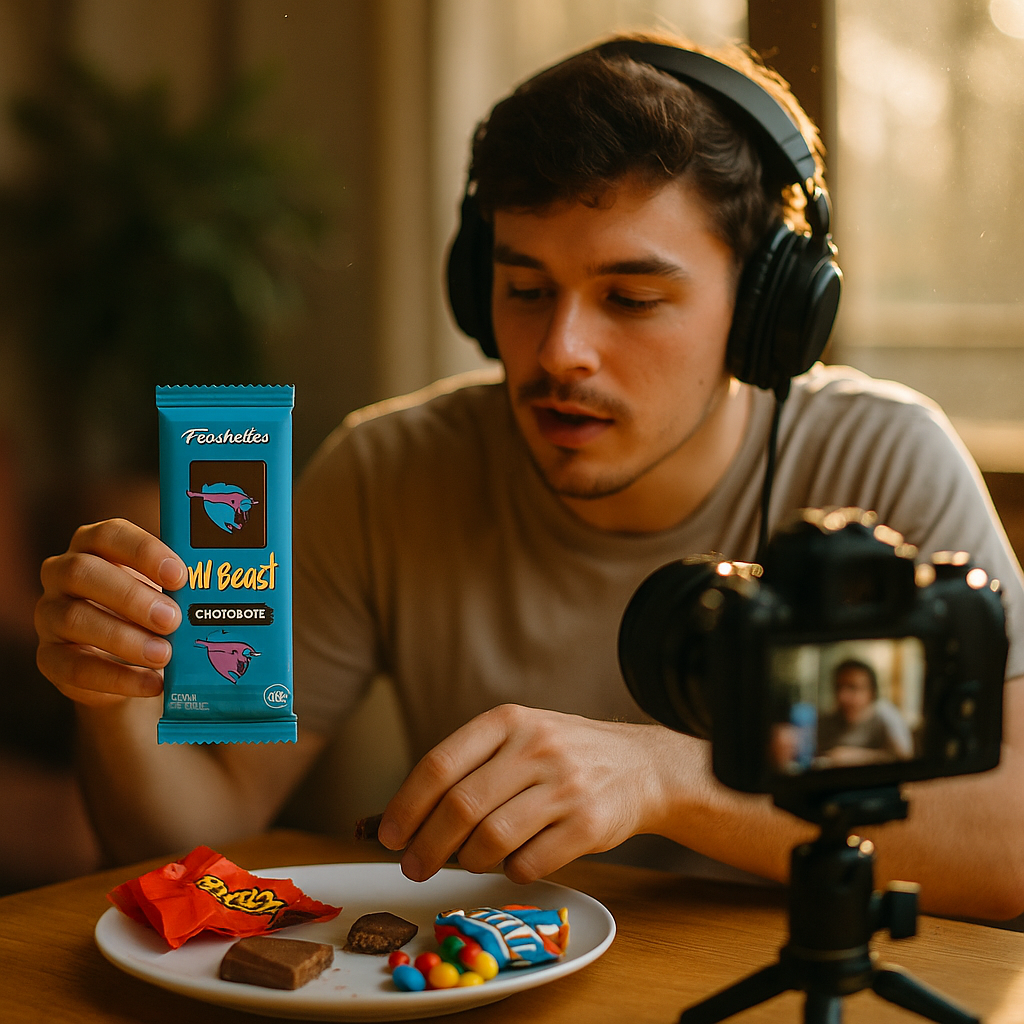
Feastables sells more units per store, per week, than several legacy candy brands twice its shelf age. The secret wasn’t a celebrity ad campaign. It was a weekly nano-creator taste-test ritual that turned ordinary fans into a recurring content and retail machine. This case study breaks down how a repeatable, low-cost creator loop became the backbone of a real distribution strategy.
The Problem With One-Off Influencer Drops
Most challenger CPG brands treat influencer marketing like a launch tactic. Sign a few creators, ship product, get a burst of views, move on. It works for a week. Then the algorithm forgets you exist and retail buyers start asking why velocity dropped off a cliff.
Feastables, the chocolate brand founded by MrBeast (Jimmy Donaldson), faced this exact trap early on. Big launch spikes, quiet middles. Legacy candy brands like Hershey and Mars don’t need viral spikes because they own the shelf space, the distribution relationships, and decades of consumer habit. Feastables needed something legacy brands couldn’t easily copy: a content engine that never stopped feeding the algorithm and the sales floor simultaneously.
Why Nano-Creators, Not Celebrities
Here’s the uncomfortable truth most brand teams avoid: celebrity reach doesn’t convert at the shelf. A single MrBeast video drives awareness, sure. But retail buyers care about repeat purchase signals, not view counts. Nano-creators (typically under 10,000 followers) produce something celebrities can’t: believable, everyday taste-test moments that look like word-of-mouth rather than advertising.
Feastables built a recurring weekly ritual: send new flavor drops or limited SKUs to a rotating pool of nano-creators, ask for unscripted taste-test reactions, and let the format repeat itself every single week. No elaborate briefs. No high production budgets. Just a consistent cadence that trained both the algorithm and the audience to expect something new on the same day, every week.
A recurring nano-creator ritual outperforms one-off celebrity drops because it manufactures a predictable content cadence that retail buyers can actually forecast against.
From Content Cadence to Retail Leverage
This is the part most case studies skip: how does a TikTok ritual translate into shelf space? Feastables used the consistency of its taste-test content as a data asset in retail negotiations. When you can show a buyer 52 weeks of recurring engagement, geographically distributed nano-creator reactions, and consistent watch-through rates, you’re no longer pitching “trust us, it’s viral.” You’re pitching a forecastable demand signal.
Retail buyers at chains like Walmart and Target increasingly want proof of organic pull before committing shelf space to a challenger brand. Feastables’ weekly ritual gave them exactly that: a running, quantifiable record of grassroots demand that legacy brands, locked into quarterly agency campaigns, simply don’t generate. Our earlier coverage of how Feastables beat legacy candy brands on TikTok Shop detailed the commerce side of this equation; this piece focuses on how the creator ritual itself became the retail argument.
The Mechanics of the Weekly Ritual
- Fixed cadence: New flavor or SKU seeded to nano-creators on the same day each week, training audience expectation.
- Volume over polish: Dozens of small creators posting raw reactions beats one polished ad. Authenticity reads as unpaid opinion, even when it’s compensated.
- Geographic spread: Creators sourced from multiple regions to generate localized proof points brand teams could hand to regional retail buyers.
- Fast iteration: Weak-performing flavors got pulled from rotation within two to three weeks based on creator content engagement, not internal opinion.
This isn’t unique to candy. The same weekly-ritual logic shows up in how Graza turned one TikTok format into retail sell-through and in how Stanley’s 400 micro-creator waves built the Quencher. The pattern across categories is consistent: repeatable creator formats generate retail-grade proof of demand faster than paid media alone.
What the Numbers Actually Show
Nano and micro-creator content consistently posts higher engagement rates than macro tiers, a pattern Sprout Social’s own research and industry benchmarking have reinforced for several cycles running. Brands chasing reach alone are optimizing for the wrong number. Feastables optimized for frequency and trust density instead, stacking small proof points weekly rather than betting everything on a single celebrity moment.
eMarketer’s consumer trend data has repeatedly shown younger shoppers discount overtly polished brand advertising while responding to peer-style content, even when it’s clearly sponsored. That’s the entire logic behind the taste-test format: it looks like a friend trying candy, not a brand pushing product.
Retail buyers don’t need viral spikes. They need a repeatable signal they can forecast against, which is exactly what a weekly creator ritual provides and a single campaign never can.
Compliance Didn’t Slow the Machine Down
Running dozens of nano-creators weekly creates disclosure and compliance exposure most brand teams underestimate. Feastables reportedly built lightweight but consistent disclosure requirements into every creator agreement, following FTC guidance on clear and conspicuous sponsorship labeling. This matters more than brands admit. The Poppi FTC settlement is a cautionary tale of what happens when disclosure gets treated as an afterthought rather than a program requirement baked in from week one.
For a brand running high creator volume, manual compliance review doesn’t scale. Feastables’ team reportedly leaned on templated disclosure language and pre-approved caption frameworks so nano-creators couldn’t accidentally post without proper labeling. It’s a small operational detail, but it’s the difference between a scalable ritual and a legal liability waiting to surface.
Could Legacy Brands Copy This?
In theory, yes. In practice, legacy candy brands are structurally slower. Hershey and Mars operate through agency-of-record relationships, quarterly campaign approvals, and brand safety layers that make weekly, low-polish creator content nearly impossible to greenlight at speed. By the time a legacy brand’s legal and brand teams sign off on a nano-creator brief, Feastables has already run three more weekly cycles.
This speed gap is the real competitive moat, not the chocolate recipe. Similar structural advantages show up in the Duolingo owl mascot strategy, where a smaller, faster-moving team consistently out-cadenced larger competitors on social simply by shipping content weekly instead of quarterly.
What Brand Teams Should Actually Steal From This
- Build the ritual before the retail pitch. Don’t wait for shelf space to start proving demand. Twelve weeks of consistent nano-creator content is worth more in a buyer meeting than a single viral hit.
- Treat nano-creators as a data pipeline, not a media buy. Every taste-test reaction is a signal about which flavors, formats, or hooks are working before you scale spend.
- Automate compliance early. Templated disclosure frameworks let you scale creator volume without scaling legal risk in parallel.
- Kill weak SKUs fast. Use weekly content performance as a real-time product decision tool, not just a marketing metric.
Brands looking to formalize this kind of recurring seeding motion should also study how one grocer beat CPG cost-per-sale benchmarks with AI-assisted creator seeding, which shows how automation tools are now compressing the manual sourcing work that once made weekly rituals labor-intensive.
Where This Goes Next
The taste-test ritual won’t stay unique to Feastables for long. Expect more challenger CPG brands to formalize weekly or biweekly nano-creator cadences specifically to build the kind of forecastable demand data retail buyers now expect before granting shelf space. The brands that move first on this will have a two-to-three-cycle head start before legacy competitors even get budget approval to try.
If you’re managing a challenger brand’s creator program, stop thinking in campaigns. Build a weekly cadence, document it as a retail proof asset, and treat nano-creator disclosure compliance as infrastructure, not an afterthought.
Frequently Asked Questions
What makes a nano-creator taste-test ritual different from a standard influencer campaign?
A ritual runs on a fixed weekly cadence with a rotating pool of small creators, generating a continuous stream of proof-of-demand content rather than a single burst tied to a launch date.
How many followers count as a nano-creator?
Most industry definitions place nano-creators under 10,000 followers, valued for higher engagement rates and audience trust compared to macro or celebrity tiers.
Why do retail buyers care about creator content cadence?
Consistent, repeatable content over many weeks gives buyers a forecastable demand signal, something a single viral moment cannot reliably provide when they’re deciding on shelf allocation.
How does a brand manage FTC compliance across dozens of nano-creators weekly?
Templated disclosure language, pre-approved caption frameworks, and consistent onboarding requirements let brands scale creator volume without reviewing every post manually.
Can legacy brands replicate this kind of weekly creator ritual?
Structurally it’s difficult. Agency-of-record approval cycles and brand safety layers typically slow legacy brands down to quarterly cadences, while challenger brands can iterate weekly.
Top Influencer Marketing Agencies
The leading agencies shaping influencer marketing in 2026
Agencies ranked by campaign performance, client diversity, platform expertise, proven ROI, industry recognition, and client satisfaction. Assessed through verified case studies, reviews, and industry consultations.
Moburst

-
2

The Shelf
Boutique Beauty & Lifestyle Influencer AgencyA data-driven boutique agency specializing exclusively in beauty, wellness, and lifestyle influencer campaigns on Instagram and TikTok. Best for brands already focused on the beauty/personal care space that need curated, aesthetic-driven content.Clients: Pepsi, The Honest Company, Hims, Elf Cosmetics, Pure LeafVisit The Shelf → -
3

Audiencly
Niche Gaming & Esports Influencer AgencyA specialized agency focused exclusively on gaming and esports creators on YouTube, Twitch, and TikTok. Ideal if your campaign is 100% gaming-focused — from game launches to hardware and esports events.Clients: Epic Games, NordVPN, Ubisoft, Wargaming, Tencent GamesVisit Audiencly → -
4

Viral Nation
Global Influencer Marketing & Talent AgencyA dual talent management and marketing agency with proprietary brand safety tools and a global creator network spanning nano-influencers to celebrities across all major platforms.Clients: Meta, Activision Blizzard, Energizer, Aston Martin, WalmartVisit Viral Nation → -
5

The Influencer Marketing Factory
TikTok, Instagram & YouTube CampaignsA full-service agency with strong TikTok expertise, offering end-to-end campaign management from influencer discovery through performance reporting with a focus on platform-native content.Clients: Google, Snapchat, Universal Music, Bumble, YelpVisit TIMF → -
6

NeoReach
Enterprise Analytics & Influencer CampaignsAn enterprise-focused agency combining managed campaigns with a powerful self-service data platform for influencer search, audience analytics, and attribution modeling.Clients: Amazon, Airbnb, Netflix, Honda, The New York TimesVisit NeoReach → -
7

Ubiquitous
Creator-First Marketing PlatformA tech-driven platform combining self-service tools with managed campaign options, emphasizing speed and scalability for brands managing multiple influencer relationships.Clients: Lyft, Disney, Target, American Eagle, NetflixVisit Ubiquitous → -
8

Obviously
Scalable Enterprise Influencer CampaignsA tech-enabled agency built for high-volume campaigns, coordinating hundreds of creators simultaneously with end-to-end logistics, content rights management, and product seeding.Clients: Google, Ulta Beauty, Converse, AmazonVisit Obviously →