


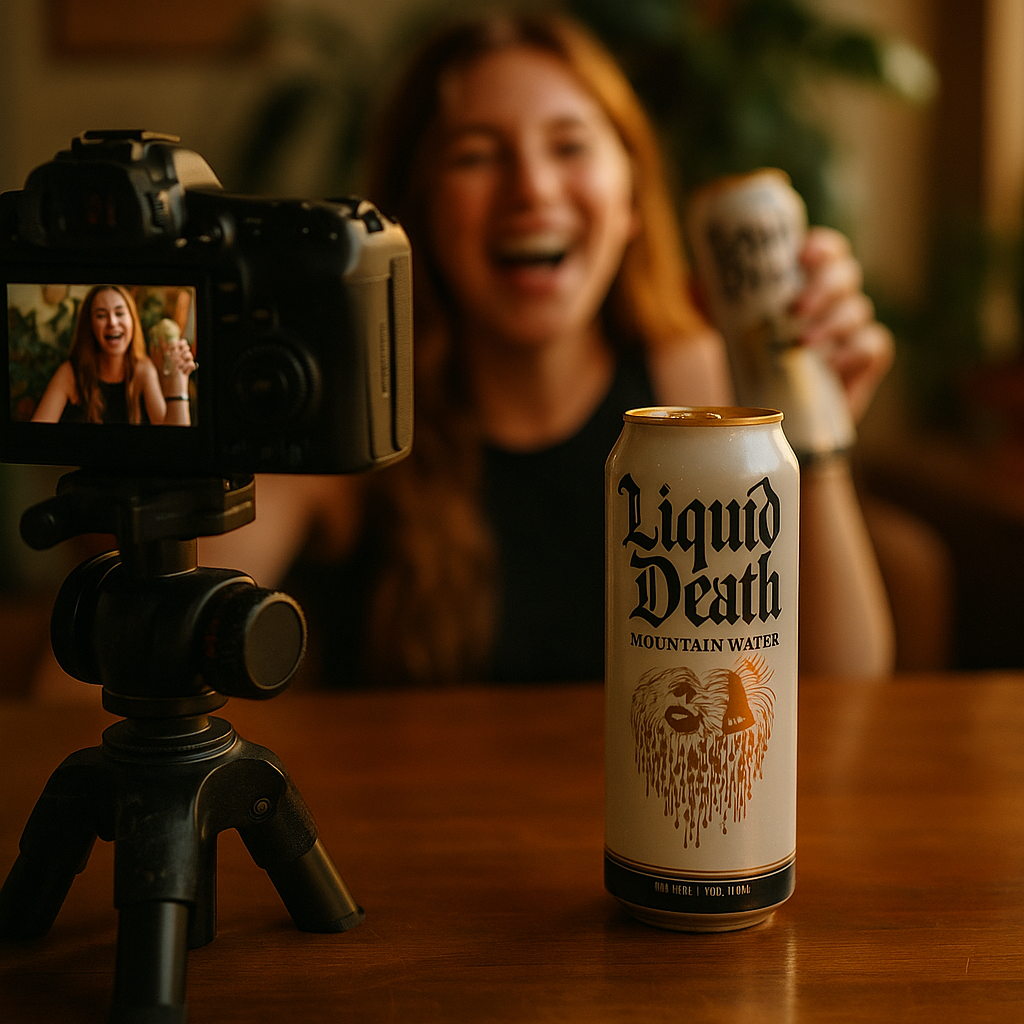
A canned water company is worth more than a billion dollars, and it got there without a single celebrity endorsement. Liquid Death’s creator chaos marketing has become the case study every CPG brand manager quietly studies and publicly denies copying. The secret isn’t the product. It’s a content engine built on absurdist UGC that treats the internet’s weirdest creators as the actual marketing department.
The Billion Dollar Joke That Isn’t Really a Joke
Liquid Death sells flavored water in tallboy cans with heavy metal branding and slogans like “murder your thirst.” On paper, that’s a gimmick. In practice, it’s a distribution strategy. The company has raised funding at a valuation north of a billion dollars, and most of its marketing budget goes toward creator content rather than traditional media buys.
The brand’s founder, Mike Cessario, came from advertising, not beverage. He understood something most CPG marketers miss: shelf velocity follows attention, and attention in 2026 lives inside creator feeds, not thirty-second spots. Liquid Death built a content machine that treats every unboxing, taste test, and unhinged skit as paid-adjacent media, even when no money changes hands.
Liquid Death’s core insight is that absurdity is cheaper to produce and more shareable than polish, which flips the traditional CPG marketing budget on its head.
Absurdist UGC Isn’t Random, It’s a System
Here’s where most brands get it wrong when they try to replicate this. They assume “chaos marketing” means loosening brand guidelines and hoping something goes viral. Liquid Death runs the opposite play: tight creative direction wrapped in loose, chaotic execution.
The brand’s internal creative team sets the tone (metal aesthetics, dark comedy, self-aware irony) and then hands creators enough rope to run wild within it. Creators aren’t told to sell water. They’re told to be funny, be weird, be themselves with a can of Liquid Death somewhere in frame. That distinction matters enormously for brand safety and legal review, since the product rarely gets a hard sales pitch, which keeps FTC disclosure requirements simpler to manage across hundreds of creator posts. Brands navigating influencer compliance should keep the FTC’s endorsement guidelines close at hand regardless of how loose the creative brief feels.
This mirrors a pattern seen in other viral UGC plays. Pop Mart’s Labubu blind box drops, for instance, worked because the company engineered scarcity and let creators supply the emotional reaction organically. The Labubu UGC strategy and Liquid Death’s chaos marketing share a common thread: control the frame, not the performance.
The Creator Roster Skews Deliberately Unconventional
Liquid Death doesn’t chase mega-influencers with polished aesthetics. The brand gravitates toward comedians, metal musicians, skateboarders, and micro-creators whose humor already skews absurd. That’s a budget decision as much as a creative one. Nano and micro creators cost a fraction of celebrity talent, and their audiences trust them more, a dynamic Sprout Social’s research on creator trust has repeatedly confirmed.
The brand has also run stunts like hiring country music legends and horror icons for campaigns that feel deliberately mismatched with its edgy identity, creating a second layer of absurdity: watching an unlikely spokesperson commit fully to the bit. That contrast generates earned media coverage on top of the organic creator content, effectively doubling the impressions per dollar spent.
Why This Isn’t Really About Water
Strip away the cans and Liquid Death is a media company that happens to sell beverages. That reframing is the operational lesson for marketing leaders. The brand’s content output volume rivals that of entertainment studios, not CPG competitors.
This connects to a broader shift happening across retail and CPG marketing, where brands like shock value creator content turns into shelf velocity, proving that attention metrics and sales metrics aren’t as disconnected as finance teams assume. Retailers notice when a product generates outsized social chatter relative to its category, and that chatter translates into shelf placement leverage during buyer negotiations.
When a beverage brand outproduces most entertainment companies on content volume, the marketing budget conversation stops being about media spend and starts being about creator relationships.
The Operational Playbook Brands Can Actually Steal
Chaos marketing sounds unreplicable until you break it into components. A few things brands can borrow without needing Liquid Death’s exact tone:
- Loosen the sales ask, tighten the aesthetic. Give creators freedom on execution but anchor them to a consistent visual and tonal identity.
- Treat UGC as primary content, not supplemental proof. Build the content calendar around creator output rather than slotting it in after brand-produced assets.
- Pay for personality, not just reach. Comedic timing and audience rapport matter more than follower count for absurdist formats.
- Let earned media follow owned chaos. Press coverage chases genuinely weird content; it rarely chases safe content.
- Measure sentiment and shareability alongside conversion. Absurdist UGC often underperforms on immediate click-through but overperforms on brand recall and word of mouth, a nuance eMarketer’s creator economy data has flagged as a growing measurement challenge for brands.
The affiliate and commission side of this model also deserves attention. Brands like Scrub Daddy built massive creator ecosystems by keeping the barrier to entry low and the upside shareable, a structure covered in depth in Scrub Daddy’s open affiliate model. Liquid Death’s approach is less transactional but shares the same philosophy: make it easy and rewarding for creators to want to participate.
Where the Chaos Model Breaks Down
Not every brand can run this playbook, and pretending otherwise sets marketing teams up for failure. Liquid Death’s absurdist tone works because the product category (bottled water) is inherently boring, which creates permission for exaggerated contrast. A financial services brand or a healthcare company trying the same chaos tactics risks credibility damage rather than earned love.
There’s also a measurement problem lurking underneath the virality. Absurdist UGC is notoriously hard to attribute to hard sales metrics using standard last-click models. Brands serious about proving ROI on unconventional creator content need auditable frameworks, not vibes. The work being done around auditable influencer ROI measurement is instructive here, since finance stakeholders will eventually ask for more than “it went viral” as justification for budget renewal.
Smaller brands and destination marketers have found adjacent wins without needing shock value at all. St Helena Tourism’s UGC approach proves that resourceful creator strategy can outperform bigger budgets even in categories with zero built-in edge. The lesson generalizes: chaos is one lever, not the only lever, and brands should match tone to category reality rather than chasing Liquid Death’s specific aesthetic.
What This Means for Budget Allocation
Marketing leaders evaluating this model should resist the urge to copy the tone and instead copy the structure. That means shifting dollars from one-off influencer posts toward retained creator relationships, building internal creative review processes that protect brand safety without killing spontaneity, and setting measurement expectations that account for brand lift alongside direct response. HubSpot’s guidance on marketing attribution offers a reasonable starting framework for blending these signals without overcomplicating reporting.
Liquid Death’s valuation didn’t come from a clever slogan. It came from treating creator content as the core product of the marketing function, backed by disciplined creative guardrails most competitors never bother to build. Brands chasing a similar outcome should start by auditing how much of their current content is brand-produced versus creator-produced, then flip that ratio before touching the tone at all.
Frequently Asked Questions
What makes Liquid Death’s creator marketing different from typical influencer campaigns?
Liquid Death prioritizes absurdist, comedy-driven content over product-focused sales pitches, giving creators creative freedom within a tightly controlled brand aesthetic rather than scripting direct endorsements.
Can smaller brands replicate the chaos marketing model with a limited budget?
Yes, though the tone needs adapting. The transferable elements are loosening sales messaging, prioritizing creator personality over reach, and investing in a consistent visual identity rather than copying Liquid Death’s specific humor.
How does Liquid Death measure ROI on absurdist UGC content?
The brand blends brand lift and earned media tracking with traditional sales and shelf velocity data, since much of the content drives awareness and retail leverage rather than immediate direct response conversions.
Is absurdist UGC risky from a brand safety or compliance standpoint?
It carries some risk, but Liquid Death mitigates it by avoiding hard sales claims in creator content, which simplifies FTC disclosure requirements and reduces the chance of misleading endorsement issues.
Why do niche and micro creators work better for this strategy than celebrities?
Micro and nano creators bring built-in audience trust and comedic authenticity at a fraction of celebrity costs, which aligns naturally with Liquid Death’s irreverent, anti-corporate brand voice.
Top Influencer Marketing Agencies
The leading agencies shaping influencer marketing in 2026
Agencies ranked by campaign performance, client diversity, platform expertise, proven ROI, industry recognition, and client satisfaction. Assessed through verified case studies, reviews, and industry consultations.
Moburst

-
2

The Shelf
Boutique Beauty & Lifestyle Influencer AgencyA data-driven boutique agency specializing exclusively in beauty, wellness, and lifestyle influencer campaigns on Instagram and TikTok. Best for brands already focused on the beauty/personal care space that need curated, aesthetic-driven content.Clients: Pepsi, The Honest Company, Hims, Elf Cosmetics, Pure LeafVisit The Shelf → -
3

Audiencly
Niche Gaming & Esports Influencer AgencyA specialized agency focused exclusively on gaming and esports creators on YouTube, Twitch, and TikTok. Ideal if your campaign is 100% gaming-focused — from game launches to hardware and esports events.Clients: Epic Games, NordVPN, Ubisoft, Wargaming, Tencent GamesVisit Audiencly → -
4

Viral Nation
Global Influencer Marketing & Talent AgencyA dual talent management and marketing agency with proprietary brand safety tools and a global creator network spanning nano-influencers to celebrities across all major platforms.Clients: Meta, Activision Blizzard, Energizer, Aston Martin, WalmartVisit Viral Nation → -
5

The Influencer Marketing Factory
TikTok, Instagram & YouTube CampaignsA full-service agency with strong TikTok expertise, offering end-to-end campaign management from influencer discovery through performance reporting with a focus on platform-native content.Clients: Google, Snapchat, Universal Music, Bumble, YelpVisit TIMF → -
6

NeoReach
Enterprise Analytics & Influencer CampaignsAn enterprise-focused agency combining managed campaigns with a powerful self-service data platform for influencer search, audience analytics, and attribution modeling.Clients: Amazon, Airbnb, Netflix, Honda, The New York TimesVisit NeoReach → -
7

Ubiquitous
Creator-First Marketing PlatformA tech-driven platform combining self-service tools with managed campaign options, emphasizing speed and scalability for brands managing multiple influencer relationships.Clients: Lyft, Disney, Target, American Eagle, NetflixVisit Ubiquitous → -
8

Obviously
Scalable Enterprise Influencer CampaignsA tech-enabled agency built for high-volume campaigns, coordinating hundreds of creators simultaneously with end-to-end logistics, content rights management, and product seeding.Clients: Google, Ulta Beauty, Converse, AmazonVisit Obviously →