


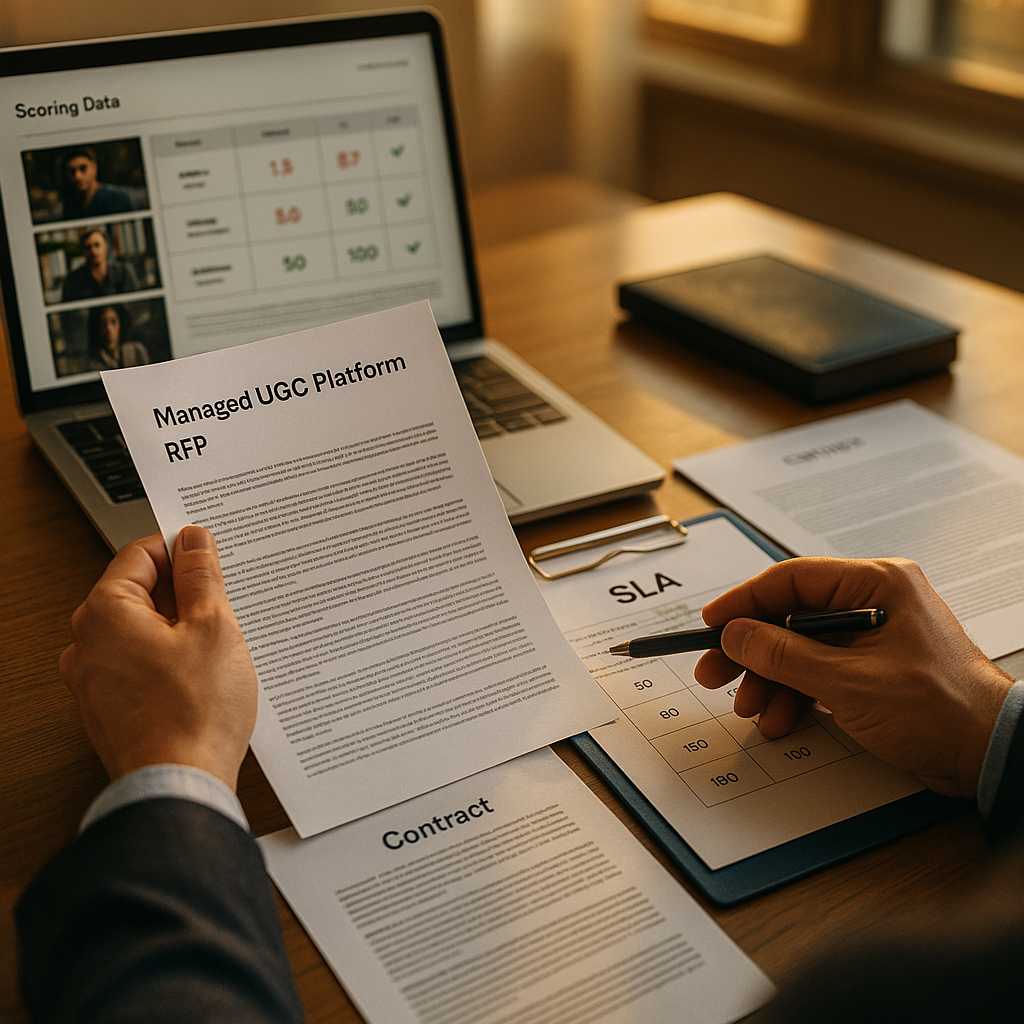
Here’s an uncomfortable number: most brands spend more time vetting a $40,000 media buy than a $400,000 annual UGC platform contract. That math is backwards. A solid RFP framework for managed UGC platforms isn’t bureaucratic overhead, it’s the difference between owning a scalable content engine and renting someone else’s spreadsheet with a slick login screen.
Platforms modeled on “TokPortal style” marketplaces (bundled creator sourcing, content licensing, and campaign management in one dashboard) have multiplied fast. Some are genuine infrastructure. Others are three contractors and a Notion board wearing a SaaS costume. Your RFP has to tell the difference before you sign, not after your creator pipeline stalls mid-quarter.
Why a Generic Vendor Checklist Won’t Cut It
Procurement teams love reusable RFP templates. Fine for office furniture, dangerous for managed UGC platforms. These vendors sit at the intersection of media, data processing, and labor arrangement, three categories with wildly different risk profiles. A template built for SaaS seat licenses will miss the questions that actually matter: who owns the content after the contract ends, how creators get paid, and what happens when the platform’s AI matching engine misfires on brand safety.
Treat this more like vetting an agency than buying software. If you’ve already built a scorecard for full cycle agency vendors, borrow its bones but rebuild the muscle. Platform vendors need technical diligence that agencies don’t, and agencies need creative judgment that platforms often can’t replicate.
If a UGC platform can’t produce a sample data processing agreement during the RFP stage, it won’t produce one during a crisis either.
The Core RFP Categories You Can’t Skip
Break your RFP into five weighted sections. Each should carry a documented scoring rubric, not a gut-feel checkbox.
- Content and usage rights. Ask explicitly whether licenses are perpetual, whole-media, or time-boxed. Many managed platforms default to 6 or 12 month usage windows unless you negotiate otherwise.
- Creator vetting and compliance. How does the platform screen for FTC disclosure compliance, age verification, and conflict-of-interest with competitor brands?
- Data handling and portability. Where does creator and campaign performance data live, and can you export it in a usable format if you leave?
- SLAs and turnaround guarantees. What’s the contractual remedy if content delivery slips past the committed window?
- Pricing transparency. Is the vendor marking up creator payouts without disclosure, or charging a clean platform fee on top of pass-through rates?
Score each category on a 1 to 5 scale, weight compliance and data portability highest (they carry the most downside risk), and require vendors to answer in writing. Verbal assurances during a sales call are not contract terms.
Vetting TokPortal Style Vendors: Spotting Real Infrastructure vs. Rebranded Spreadsheets
The “TokPortal style” label has become shorthand for a specific pitch: one dashboard, thousands of vetted creators, AI-assisted matching, instant licensing. Some platforms genuinely built this. Others stitched together a Zapier workflow, a Google Sheet of freelancers, and a marketing deck.
How do you tell them apart in an RFP?
Ask for a live demo using your actual brand category, not a canned walkthrough. Request three reference clients in your industry vertical who’ve been on the platform for at least a year, not just launch-quarter testimonials. And ask the blunt question: what percentage of listed creators have posted through the platform in the last 90 days? A platform with 50,000 “available creators” and 400 active ones in a given quarter is a database, not a program.
Pricing model matters here too. Review how the platform’s rate structure compares to market benchmarks before you negotiate anything. If you haven’t audited creator rate cards recently, UGC rate card benchmarking is worth doing in parallel with your RFP so you know what “fair” actually looks like before a vendor tells you.
Scoring Responses: A Weighted Framework That Survives Finance Review
Finance teams will ask how you chose a vendor. “They seemed good in the demo” is not an answer that survives an audit. Build a weighted scorecard with categories, point allocations, and a minimum threshold score for advancement to final negotiations.
A workable split looks like this: compliance and data governance (30%), content quality and creator pool depth (25%), pricing transparency and total cost of ownership (20%), platform reliability and SLA terms (15%), integration and reporting capability (10%).
Run at least three vendors through identical questions. Comparing apples to apples is the entire point of an RFP; skip it and you’re just collecting sales pitches. If your internal stakeholders include legal and data privacy, loop them in before scoring, not after a finalist is chosen. Retrofitting compliance review onto a near-signed deal rarely ends well.
Red Flags That Should End the Conversation
- Vendor won’t disclose how creator payouts are structured relative to your platform fee.
- No documented process for handling FTC disclosure violations or creator content takedowns.
- Content licensing terms are vague on whether usage rights survive contract termination.
- Platform can’t name a data processing agreement or point to a privacy policy aligned with UK and EU data protection standards if you operate internationally.
- Reference clients all started within the last two quarters, suggesting high churn beyond that point.
Any single red flag isn’t necessarily disqualifying. Two or more should trigger a hard conversation with procurement before you proceed.
Negotiating the Fine Print Before Anyone Signs
This is where most brands under-invest. The RFP gets the attention; the contract gets a rubber stamp. Don’t let that happen with a managed UGC platform, because the fine print is where exit costs, drift penalties, and data ownership actually live.
If the platform embeds any AI-driven creator matching or content scoring, make sure your legal team reviews the AI platform SLA and exit terms language specifically. Model drift and black-box matching logic can quietly degrade content quality over a contract term if there’s no accountability clause.
Standardize your contract review against the same template you’d use for any creator agreement, covering MSAs, SOWs and usage rights. Platforms love to bury usage rights in an appendix that nobody reads until a dispute arises.
The contract clause that determines who owns your content after cancellation is worth more scrutiny than the dashboard demo that sold you in the first place.
Platform vs. Agency: Make Sure You’re Even Buying the Right Thing
Before finalizing any RFP, sanity-check whether a managed platform is actually the right model for your program size and complexity. Some brands run a full RFP process only to realize an agency relationship, or a hybrid in-house team, would serve them better. The platforms versus agencies scorecard is a useful gut-check to run before you commit budget to an RFP cycle at all.
Market data backs up the caution here. eMarketer’s creator economy research consistently shows brands underestimate management overhead when they move from ad hoc UGC sourcing to platform-managed programs, and Statista’s influencer marketing data shows spend growth outpacing the maturity of vendor vetting practices industry-wide. Translation: the market is moving faster than most procurement teams’ diligence processes.
Sprout Social and other social management platforms publish annual benchmarks worth cross-referencing too, via Sprout Social’s industry reports, particularly on response times and content turnaround expectations that your SLA negotiations should reflect.
FAQs
Frequently Asked Questions
What should an RFP for a managed UGC platform include at minimum?
At minimum, it should cover content licensing terms, creator vetting and compliance processes, data portability and ownership, SLA commitments on turnaround time, and full pricing transparency including how creator payouts are structured relative to platform fees.
How is vetting a UGC platform different from vetting a traditional influencer agency?
Platform vendors require deeper technical and data governance diligence because they process creator payments, content rights, and personal data at scale through automated systems. Agencies typically involve more manual relationship management, so the risk profile shifts toward creative quality and account service rather than data infrastructure.
What’s a reasonable timeline for a UGC platform RFP process?
Most mid-sized brands should budget six to ten weeks: two weeks to build the RFP and scorecard, three to four weeks for vendor responses and demos, and two to four weeks for legal and finance review before final selection.
How many vendors should be included in the RFP process?
Three to five vendors is typically enough to create meaningful comparison without overwhelming internal stakeholders. Fewer than three makes scoring unreliable; more than five slows decision making without adding proportional insight.
What contract terms are most commonly overlooked when signing with a UGC platform?
Usage rights survival after contract termination, data export formats and timelines, and accountability clauses for AI-driven creator matching or content scoring are the three most frequently overlooked terms, often because they sit in appendices rather than the main contract body.
Next step: Before you send a single RFP, build your weighted scorecard and run it against your current vendor (even if you’re happy with them) to establish a baseline. If they can’t clear their own bar, that tells you something an RFP alone never will.
Top Influencer Marketing Agencies
The leading agencies shaping influencer marketing in 2026
Agencies ranked by campaign performance, client diversity, platform expertise, proven ROI, industry recognition, and client satisfaction. Assessed through verified case studies, reviews, and industry consultations.
Moburst

-
2

The Shelf
Boutique Beauty & Lifestyle Influencer AgencyA data-driven boutique agency specializing exclusively in beauty, wellness, and lifestyle influencer campaigns on Instagram and TikTok. Best for brands already focused on the beauty/personal care space that need curated, aesthetic-driven content.Clients: Pepsi, The Honest Company, Hims, Elf Cosmetics, Pure LeafVisit The Shelf → -
3

Audiencly
Niche Gaming & Esports Influencer AgencyA specialized agency focused exclusively on gaming and esports creators on YouTube, Twitch, and TikTok. Ideal if your campaign is 100% gaming-focused — from game launches to hardware and esports events.Clients: Epic Games, NordVPN, Ubisoft, Wargaming, Tencent GamesVisit Audiencly → -
4

Viral Nation
Global Influencer Marketing & Talent AgencyA dual talent management and marketing agency with proprietary brand safety tools and a global creator network spanning nano-influencers to celebrities across all major platforms.Clients: Meta, Activision Blizzard, Energizer, Aston Martin, WalmartVisit Viral Nation → -
5

The Influencer Marketing Factory
TikTok, Instagram & YouTube CampaignsA full-service agency with strong TikTok expertise, offering end-to-end campaign management from influencer discovery through performance reporting with a focus on platform-native content.Clients: Google, Snapchat, Universal Music, Bumble, YelpVisit TIMF → -
6

NeoReach
Enterprise Analytics & Influencer CampaignsAn enterprise-focused agency combining managed campaigns with a powerful self-service data platform for influencer search, audience analytics, and attribution modeling.Clients: Amazon, Airbnb, Netflix, Honda, The New York TimesVisit NeoReach → -
7

Ubiquitous
Creator-First Marketing PlatformA tech-driven platform combining self-service tools with managed campaign options, emphasizing speed and scalability for brands managing multiple influencer relationships.Clients: Lyft, Disney, Target, American Eagle, NetflixVisit Ubiquitous → -
8

Obviously
Scalable Enterprise Influencer CampaignsA tech-enabled agency built for high-volume campaigns, coordinating hundreds of creators simultaneously with end-to-end logistics, content rights management, and product seeding.Clients: Google, Ulta Beauty, Converse, AmazonVisit Obviously →