


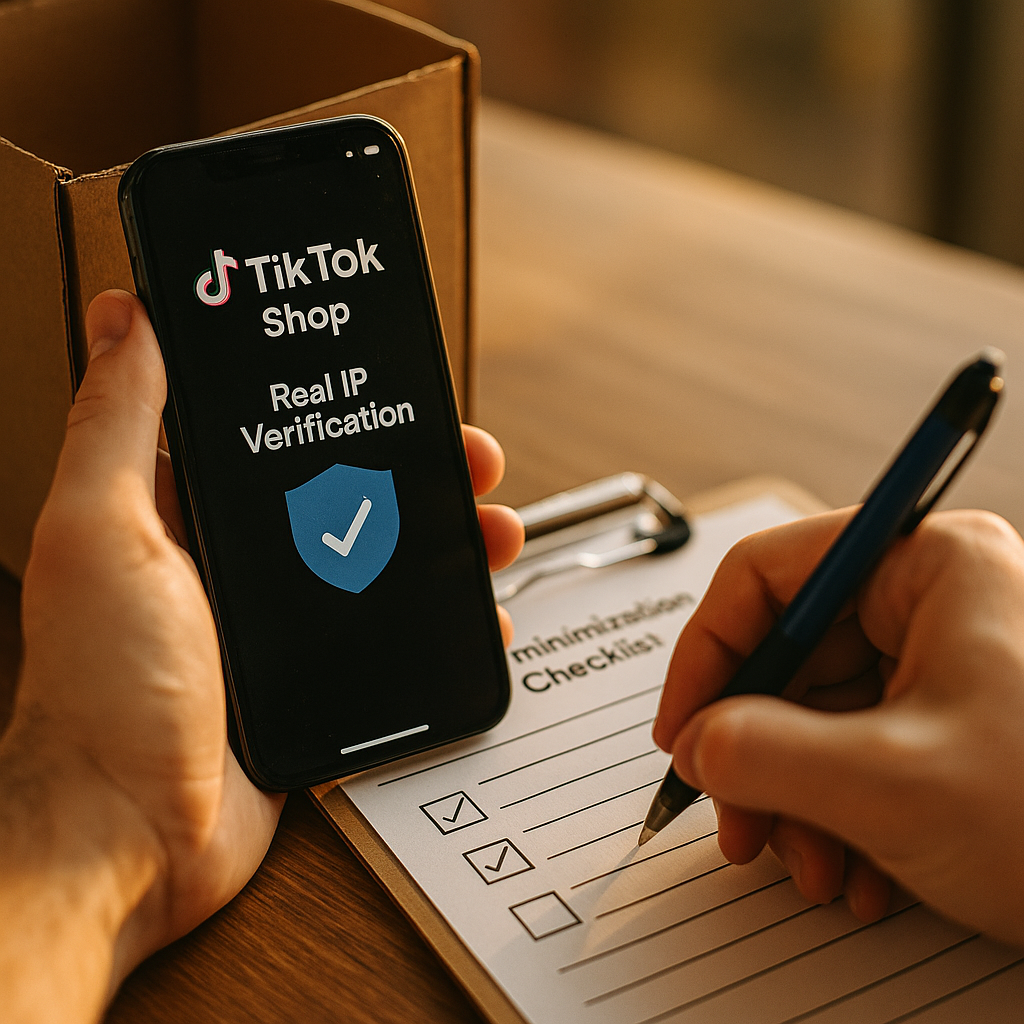
Here’s an uncomfortable number: every seller onboarded through TikTok Shop’s Real IP Verification Program generates a fresh trail of government ID scans, geolocation pings, and biometric matches, most of which brands have no documented plan to delete. A data minimization checklist isn’t a nice-to-have anymore. It’s the difference between a clean audit and a regulator’s opening exhibit.
Brands rushed to comply with TikTok’s identity verification mandate without asking the harder question: what happens to all that data after verification clears? If your answer is “IT is handling it,” you don’t have an answer.
Why Real IP Verification Data Is Riskier Than It Looks
Real IP Verification wasn’t built as a marketing tool. It’s an anti-fraud and compliance mechanism, designed to confirm that sellers and, increasingly, affiliated creators are who they claim to be and are operating from where they claim to be operating. That means the data flowing through it is dense: IP geolocation logs, device fingerprints, government-issued ID uploads, and in some cases facial verification scans matched against those IDs.
None of that is typical marketing data. It’s regulated-category personal information in most US states and squarely within scope of GDPR-style frameworks elsewhere. Brands that treat it like just another CRM field are setting themselves up for exposure they didn’t sign up for.
We already covered the operational deadlines tied to this rollout in TikTok Real IP Verification: Deadlines Merchants Can’t Miss. This piece picks up where that one left off: once you’re verified, what’s your retention and minimization plan?
Verification data has a shelf life. If your brand can’t answer how long you keep it, who can access it, and when it gets purged, you don’t have a compliance program, you have a liability waiting for a subpoena.
What “Data Minimization” Actually Means Here
Data minimization is a core principle under GDPR and increasingly referenced in US state privacy laws (California, Colorado, Connecticut, and others): collect only what’s necessary for the stated purpose, and don’t keep it longer than that purpose requires. Applied to TikTok Shop’s verification flow, this means brands need to separate two categories of data that often get commingled:
- Verification-only data: ID scans, biometric matches, IP geolocation logs used solely to confirm identity and eligibility to sell.
- Operational data: order history, customer service logs, marketing engagement data that has a legitimate ongoing business use.
The mistake most brands make is letting verification data sit in the same database, with the same retention rules, as operational data. That’s how a fraud-check IP address ends up sitting in a marketing analytics warehouse two years after it served its purpose.
The Checklist: Seven Controls Every Brand Needs
This isn’t theoretical. Here’s the actual working checklist, built for legal, ops, and marketing teams who need to move fast without creating regulatory exposure.
- Map the data flow first. Before writing a single policy line, document exactly where Real IP Verification data enters your systems, whether that’s directly through TikTok Shop’s seller dashboard, a third-party verification vendor, or an in-house integration. You cannot minimize what you haven’t mapped.
- Separate verification data from marketing data at the schema level. Don’t just label fields differently, physically segregate them into different databases or access-controlled tables. This makes automated deletion and access audits dramatically easier.
- Set a hard retention ceiling tied to purpose, not convenience. If the verification’s purpose is confirming seller eligibility at onboarding, the data’s useful life ends when that confirmation is complete, plus whatever window TikTok’s terms or your jurisdiction’s fraud-liability rules require. Thirty to ninety days post-verification is a reasonable default for most brands, though regulated categories like financial or health-adjacent products may need longer for audit trail purposes.
- Restrict access on a strict need-to-know basis. Marketing teams should never have direct query access to raw ID scans or biometric matches. Full stop. If a campaign manager can pull up a creator’s driver’s license photo to check a shipping address, that’s a control failure, not a workflow feature.
- Log every access event. Every time verification data is viewed, exported, or modified, that action needs a timestamp and an identity attached to it. This is what turns “we think we’re compliant” into “here’s the audit trail proving it.”
- Build automated purge triggers, not manual reminders. Calendar reminders get ignored. Automated deletion jobs tied to retention ceilings don’t. If your engineering team can’t build this into the current stack, that’s a budget conversation worth having now, not after an incident.
- Document the legal basis for every data category you retain. If you’re keeping IP logs for ninety days to satisfy a fraud-liability window, write down which regulation or contractual obligation requires that. Regulators respond far better to documented reasoning than to “we’ve always done it this way.”
Every one of these controls should live in a written policy, not tribal knowledge. We built a similar framework for checkout-adjacent data flows in Data Minimization Policy for TikTok Shop and Instagram Checkout, and the same logic scaffolds directly onto verification data. Different data type, same governance skeleton.
Where Brands Get This Wrong (And It’s Not Where You’d Expect)
The most common failure isn’t malicious data hoarding. It’s vendor sprawl. Brands hire a third-party identity verification provider to handle the Real IP Verification integration, and that vendor’s default retention setting is “indefinite” because that’s easier for their infrastructure. Nobody checks the box to change it.
Ask your verification vendor directly: what’s the default retention period, and who owns the deletion trigger, you or them? If they can’t answer clearly, that’s your answer about whether to keep working with them.
Another blind spot: creators who sell through affiliate or creator marketplace features tied to TikTok Shop often go through their own identity verification, separate from merchant verification. Brands running affiliate programs need to know whether they’re receiving copies of creator verification data, and if so, why. In most cases, there’s no legitimate marketing reason to hold onto a creator’s ID scan once their eligibility is confirmed. If your affiliate management platform is passing that data downstream to your CRM, shut that pipe off.
The riskiest data in your stack is often the data nobody remembers collecting. Verification logs from a vendor integration set up eighteen months ago rarely make it onto anyone’s active risk register.
How This Connects to Broader FTC and State Privacy Exposure
Data minimization failures rarely show up as their own enforcement action. They show up as an aggravating factor in a bigger case: a data breach that exposes more than it should have, a COPPA violation where age-verification data was retained past its purpose, or an FTC complaint about deceptive data practices. The FTC has been explicit that “reasonable data security” includes not retaining data beyond its business need. TikTok’s own $400M COPPA settlement is a useful reference point here: regulators increasingly treat over-retention as its own species of harm, independent of whether a breach ever occurs.
State privacy laws are converging on similar language. California’s CPPA, Colorado’s Privacy Act, and Connecticut’s Data Privacy Act all include minimization or purpose-limitation requirements that would apply to verification data collected from residents of those states, regardless of where your brand is headquartered.
If your brand operates across multiple states, treat the strictest applicable standard as your floor, not your ceiling. It’s simpler to run one policy than fifty.
Age-related identity checks add another wrinkle. If your Real IP Verification flow intersects with age-gating for livestream sales, the retention rules get stricter, not looser. We covered the overlap in Age-Verification Laws Meet TikTok Shop Livestream Sales, and the short version is: age verification data tied to minors carries heightened retention scrutiny under COPPA and several state laws, so don’t apply your standard ninety-day rule blindly to that category.
Building the Cross-Functional Owner Model
A checklist without an owner is a wish list. Data minimization for verification data needs a named owner, typically someone sitting between legal, security, and marketing ops, who signs off quarterly on:
- Whether retention windows are being honored in practice, not just in policy.
- Whether new vendor integrations have been reviewed for default retention settings.
- Whether access logs show any anomalies (marketing staff querying ID data, for example).
- Whether documentation matches actual system behavior, a gap that shows up constantly in audits.
This overlaps heavily with broader influencer compliance auditing work. If your team already runs a process like the one outlined in Influencer Compliance Audit: Catch Undisclosed Gifting First, add verification data retention as a standing line item rather than building a separate audit track from scratch. Consolidation reduces the chance something falls through.
Tools that help operationalize this: most brands already use a customer data platform (Segment, mParticle) or a dedicated privacy management tool (OneTrust, Osano) that supports automated retention rules. If yours doesn’t, that’s worth flagging in the next budget cycle, because manual retention enforcement doesn’t survive contact with a busy quarter. For broader benchmarking on how brands are structuring privacy operations, eMarketer and the HubSpot research library both publish useful data on adoption rates for these tools.
The Takeaway
Don’t wait for a regulator or a breach to force this conversation. Pull your Real IP Verification data flow map this week, assign an owner, and set a hard purge date on anything past its purpose. A one-page policy that’s actually enforced beats a fifty-page policy that lives in a shared drive nobody opens.
Frequently Asked Questions
What is data minimization in the context of TikTok Shop’s Real IP Verification Program?
It means collecting only the identity and location data strictly needed to verify a seller’s eligibility, and deleting that data once verification is complete, rather than retaining it indefinitely alongside marketing or operational data.
How long should brands retain Real IP Verification data?
Most brands can justify a retention window of thirty to ninety days post-verification, tied to fraud-liability or audit needs. Categories involving minors or heightened regulatory scrutiny may require different handling, and any retention period should be documented with a clear legal basis.
Who is responsible for verification data collected by a third-party vendor?
Brands generally remain responsible even when a vendor handles the technical integration. Contracts should specify default retention settings, deletion triggers, and audit rights so the brand isn’t relying on the vendor’s default configuration.
Does data minimization apply to creators as well as merchants?
Yes. Creators verified through affiliate or creator marketplace features tied to TikTok Shop generate similar identity data. Brands running affiliate programs should confirm whether they receive copies of that data and remove any unnecessary downstream access.
What happens if a brand fails to minimize verification data?
Over-retention rarely triggers standalone enforcement but frequently becomes an aggravating factor in breach investigations or broader privacy complaints, particularly under FTC data security expectations and state privacy laws with purpose-limitation requirements.
Visible FAQ (HTML)
Top Influencer Marketing Agencies
The leading agencies shaping influencer marketing in 2026
Agencies ranked by campaign performance, client diversity, platform expertise, proven ROI, industry recognition, and client satisfaction. Assessed through verified case studies, reviews, and industry consultations.
Moburst

-
2

The Shelf
Boutique Beauty & Lifestyle Influencer AgencyA data-driven boutique agency specializing exclusively in beauty, wellness, and lifestyle influencer campaigns on Instagram and TikTok. Best for brands already focused on the beauty/personal care space that need curated, aesthetic-driven content.Clients: Pepsi, The Honest Company, Hims, Elf Cosmetics, Pure LeafVisit The Shelf → -
3

Audiencly
Niche Gaming & Esports Influencer AgencyA specialized agency focused exclusively on gaming and esports creators on YouTube, Twitch, and TikTok. Ideal if your campaign is 100% gaming-focused — from game launches to hardware and esports events.Clients: Epic Games, NordVPN, Ubisoft, Wargaming, Tencent GamesVisit Audiencly → -
4

Viral Nation
Global Influencer Marketing & Talent AgencyA dual talent management and marketing agency with proprietary brand safety tools and a global creator network spanning nano-influencers to celebrities across all major platforms.Clients: Meta, Activision Blizzard, Energizer, Aston Martin, WalmartVisit Viral Nation → -
5

The Influencer Marketing Factory
TikTok, Instagram & YouTube CampaignsA full-service agency with strong TikTok expertise, offering end-to-end campaign management from influencer discovery through performance reporting with a focus on platform-native content.Clients: Google, Snapchat, Universal Music, Bumble, YelpVisit TIMF → -
6

NeoReach
Enterprise Analytics & Influencer CampaignsAn enterprise-focused agency combining managed campaigns with a powerful self-service data platform for influencer search, audience analytics, and attribution modeling.Clients: Amazon, Airbnb, Netflix, Honda, The New York TimesVisit NeoReach → -
7

Ubiquitous
Creator-First Marketing PlatformA tech-driven platform combining self-service tools with managed campaign options, emphasizing speed and scalability for brands managing multiple influencer relationships.Clients: Lyft, Disney, Target, American Eagle, NetflixVisit Ubiquitous → -
8

Obviously
Scalable Enterprise Influencer CampaignsA tech-enabled agency built for high-volume campaigns, coordinating hundreds of creators simultaneously with end-to-end logistics, content rights management, and product seeding.Clients: Google, Ulta Beauty, Converse, AmazonVisit Obviously →