


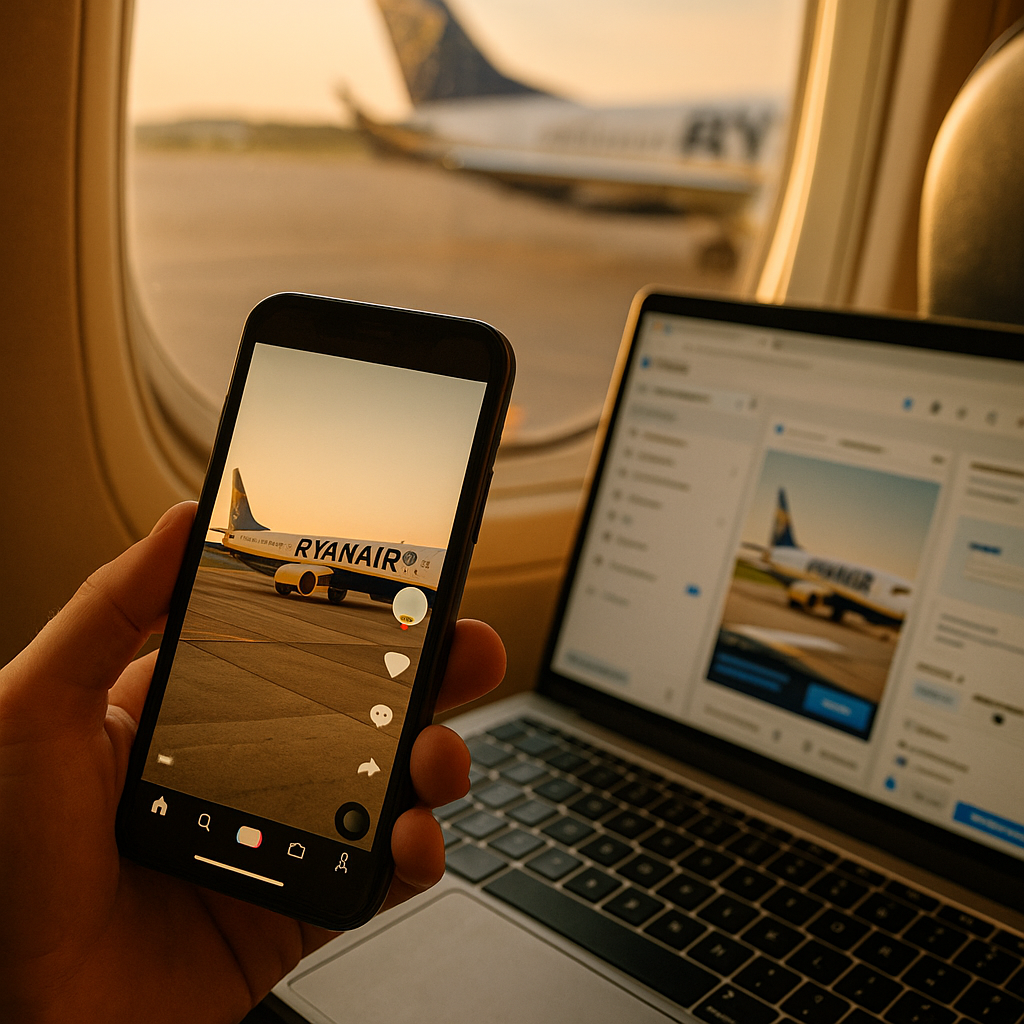
Ryanair spends almost nothing on traditional TikTok production, yet it runs one of the most efficient paid social operations in European travel. The airline’s secret is not a bigger budget or a flashier agency. It is a TikTok Creator Program that takes organic, unscripted creator content and converts it directly into paid performance ads, often within days of the original post going live.
That shift, from treating creator content as brand awareness fluff to treating it as a direct response asset, is forcing marketers across every vertical to rethink how they budget for creators.
Why Ryanair’s Approach Breaks the Old UGC Playbook
For most of the last decade, user generated content and paid media lived in separate lanes. Creators made content, brands “boosted” a few favorites, and performance teams ran their own separately produced ad creative. Ryanair collapsed that separation entirely.
Its in-house social team, already known for operating with a fraction of the headcount of a typical airline marketing department, treats TikTok’s Creator Program less like an influencer relations tool and more like a creative testing engine. Every piece of organic UGC is a potential ad candidate. The team watches engagement signals in real time, and when a creator’s video starts outperforming benchmarks organically, it gets pulled into the paid pipeline through TikTok’s Spark Ads format, which lets brands boost a creator’s existing post using the creator’s own handle and comment section.
This matters because Spark Ads preserve social proof. Viewers see the original likes, comments, and shares, not a sanitized version of the clip stripped into a generic ad unit. That authenticity signal is doing real work on conversion rate, not just vanity metrics.
Ryanair’s team doesn’t brief creators to “make an ad.” It lets creators make content, then applies paid spend only to the clips that already prove they resonate organically.
The Mechanics: From Organic Clip to Paid Performance Asset
The workflow itself is deceptively simple, and that simplicity is the point. Overengineered creator pipelines collapse under their own process weight. Ryanair’s does not.
- Sourcing: Creators are recruited through TikTok’s Creator Marketplace and direct outreach, often nano and mid-tier travel and lifestyle accounts rather than mega influencers.
- Organic first: Creators post content under their own handle, with minimal brand interference. No heavy scripting, no brand-safe sterilization.
- Signal detection: The social team monitors watch time, completion rate, and comment sentiment within the first 24 to 48 hours.
- Whitelisting: High performing clips get converted into Spark Ads, with the brand running paid spend behind the creator’s original post.
- Iteration: Winning hooks and formats get fed back into creator briefs, tightening the loop between what performs organically and what gets commissioned next.
The result is a feedback loop where organic performance de-risks paid spend. Instead of guessing which creative will convert, the brand already has proof of audience resonance before a single euro of media budget touches the content.
What the CPA Numbers Actually Show
Ryanair has previously demonstrated how this creator-led approach to paid media translates into hard efficiency gains. The airline’s broader push into creator hosted ad formats delivered a roughly 30 percent reduction in cost per acquisition across European markets, a figure that should make any performance marketer pay attention. That is not a brand lift number dressed up to look like performance. That is a direct response metric improving because the creative itself changed.
The TikTok Creator Program extension of this strategy pushes the same logic further downstream. Rather than commissioning creator content as a one-off campaign tactic, it becomes a continuous sourcing mechanism for paid creative, which matters enormously for an airline that needs fresh, geographically relevant ad variations across dozens of European route markets simultaneously.
Performance marketers know creative fatigue is one of the biggest silent killers of CPA efficiency on platforms like TikTok and Meta. HubSpot’s research on paid social benchmarks and various industry reports consistently point to creative refresh rate as a leading driver of CPM stability. Ryanair effectively solved its creative fatigue problem by outsourcing content ideation to hundreds of creators instead of a single internal production team.
Lean Teams, Fast Decisions
None of this works without an operating model built for speed. Ryanair’s social function has become something of a case study in its own right for how lean internal teams can outperform agencies on speed, and the Creator Program is a direct extension of that philosophy.
Agencies, by structural design, add approval layers. A creative brief goes to an account manager, then a strategist, then a creative lead, then back to the client for sign-off. Ryanair’s in-house team compresses that cycle into same-day or next-day decisions because the people spotting the opportunity are the same people with budget authority to act on it.
That operational compression is arguably the bigger competitive advantage here, even more than the TikTok tooling itself. Any brand can access Spark Ads. Few brands have built the internal decision speed to actually exploit the format’s full potential.
Is This Repeatable Outside Travel?
A fair question. Ryanair benefits from near-constant content opportunity (flight deals, destination content, seasonal travel trends) and a brand voice that tolerates irreverence most corporate marketing teams would reject outright. Not every category gets that creative latitude.
That said, the underlying mechanic, letting organic performance data select which content earns paid spend, is category agnostic. CPG brands have run similar plays. e.l.f. Beauty’s approach to reusable Spark Ads built on viral sounds mirrors the same logic: identify what’s already working organically, then apply media dollars behind proof rather than prediction. Liquid Death has run a comparable playbook too, turning its absurdist UGC content into shelf velocity by amplifying creator clips that already demonstrated organic traction.
The common thread across all three brands is a refusal to separate “creator marketing” from “performance marketing” as distinct budget lines. They are the same budget line now, or they should be.
If your paid social team and your creator team still report into different budgets with different KPIs, you are almost certainly leaving performance gains on the table.
Risk and Compliance: What Brands Need to Watch
Converting organic UGC into paid ads is not without friction. Brands need explicit usage rights baked into creator agreements before any Spark Ads conversion happens, and disclosure requirements don’t disappear just because the content started as organic. The FTC’s endorsement guidelines apply whether a brand pays for the original post or simply boosts it later, and UK marketers need to keep the ICO’s guidance on data and advertising practices in view as well, particularly around targeting and consent when paid spend enters the picture.
There is also a creative governance question. Letting organic performance dictate paid spend means less control over message consistency. For a regulated category like airlines (pricing disclaimers, baggage policy accuracy, fare condition language) that creates real legal exposure if creators aren’t briefed clearly on what they can and cannot claim. Ryanair manages this with tight creator guidelines around factual claims while leaving tone and format almost entirely open, a balance other regulated industries (finance, healthcare, insurance) would do well to study before attempting a similar model.
Measurement rigor matters here too. Brands that can’t cleanly attribute which Spark Ads conversions came from which original creator post will struggle to prove the model’s ROI to finance stakeholders. Platforms like Sprout Social and TikTok’s native analytics suite both offer attribution layers worth building into the workflow from day one, not bolting on after the fact.
What This Means for Your Next Budget Cycle
If you’re still allocating creator budget and performance media budget separately, Ryanair’s results suggest that’s a structural inefficiency, not a governance best practice. The brands winning on CPA right now are the ones treating creator content as a live creative testing ground, then funding the winners with real media dollars rather than waiting for a quarterly campaign refresh to decide what’s “ad-ready.”
Start smaller than Ryanair if you need to. Pick five creators, run organic first, track engagement velocity for 48 hours, and whitelist only the top performer into a Spark Ads test against your current control creative. The data will tell you fast whether this model fits your category.
Frequently Asked Questions
What is TikTok’s Creator Program and how does it differ from influencer marketing?
TikTok’s Creator Program refers to the ecosystem of tools, including the Creator Marketplace and Spark Ads, that let brands discover creators, commission organic content, and then boost that content with paid media while preserving the creator’s original handle and engagement. Traditional influencer marketing typically stops at the organic post. The Creator Program extends the relationship into paid performance media.
What are Spark Ads and why does Ryanair use them?
Spark Ads is TikTok’s native ad format that allows brands to run paid promotion behind an existing organic post, keeping the original creator’s username, likes, and comments visible. Ryanair uses the format because it preserves authenticity signals that typically improve click-through and conversion rates compared to standard, brand-produced ad creative.
How much did Ryanair reduce its cost per acquisition using this approach?
Ryanair’s broader creator-led ad strategy, which includes converting organic TikTok content into paid Spark Ads, contributed to roughly a 30 percent reduction in cost per acquisition across its European markets, according to the airline’s own performance reporting.
Can smaller brands replicate this model without an in-house team the size of Ryanair’s?
Yes, though the speed advantage shrinks. Smaller brands can still run organic-first creator tests, monitor early engagement signals, and whitelist top performers into Spark Ads. The key constraint is decision speed, so brands should streamline approval workflows even if they rely on an agency partner.
What compliance risks should brands consider before converting UGC into paid ads?
Brands need explicit usage rights in creator contracts, clear disclosure practices that satisfy FTC and ICO guidance, and factual accuracy checks on any claims made in content before it receives paid media spend, particularly in regulated industries.
Top Influencer Marketing Agencies
The leading agencies shaping influencer marketing in 2026
Agencies ranked by campaign performance, client diversity, platform expertise, proven ROI, industry recognition, and client satisfaction. Assessed through verified case studies, reviews, and industry consultations.
Moburst

-
2

The Shelf
Boutique Beauty & Lifestyle Influencer AgencyA data-driven boutique agency specializing exclusively in beauty, wellness, and lifestyle influencer campaigns on Instagram and TikTok. Best for brands already focused on the beauty/personal care space that need curated, aesthetic-driven content.Clients: Pepsi, The Honest Company, Hims, Elf Cosmetics, Pure LeafVisit The Shelf → -
3

Audiencly
Niche Gaming & Esports Influencer AgencyA specialized agency focused exclusively on gaming and esports creators on YouTube, Twitch, and TikTok. Ideal if your campaign is 100% gaming-focused — from game launches to hardware and esports events.Clients: Epic Games, NordVPN, Ubisoft, Wargaming, Tencent GamesVisit Audiencly → -
4

Viral Nation
Global Influencer Marketing & Talent AgencyA dual talent management and marketing agency with proprietary brand safety tools and a global creator network spanning nano-influencers to celebrities across all major platforms.Clients: Meta, Activision Blizzard, Energizer, Aston Martin, WalmartVisit Viral Nation → -
5

The Influencer Marketing Factory
TikTok, Instagram & YouTube CampaignsA full-service agency with strong TikTok expertise, offering end-to-end campaign management from influencer discovery through performance reporting with a focus on platform-native content.Clients: Google, Snapchat, Universal Music, Bumble, YelpVisit TIMF → -
6

NeoReach
Enterprise Analytics & Influencer CampaignsAn enterprise-focused agency combining managed campaigns with a powerful self-service data platform for influencer search, audience analytics, and attribution modeling.Clients: Amazon, Airbnb, Netflix, Honda, The New York TimesVisit NeoReach → -
7

Ubiquitous
Creator-First Marketing PlatformA tech-driven platform combining self-service tools with managed campaign options, emphasizing speed and scalability for brands managing multiple influencer relationships.Clients: Lyft, Disney, Target, American Eagle, NetflixVisit Ubiquitous → -
8

Obviously
Scalable Enterprise Influencer CampaignsA tech-enabled agency built for high-volume campaigns, coordinating hundreds of creators simultaneously with end-to-end logistics, content rights management, and product seeding.Clients: Google, Ulta Beauty, Converse, AmazonVisit Obviously →