


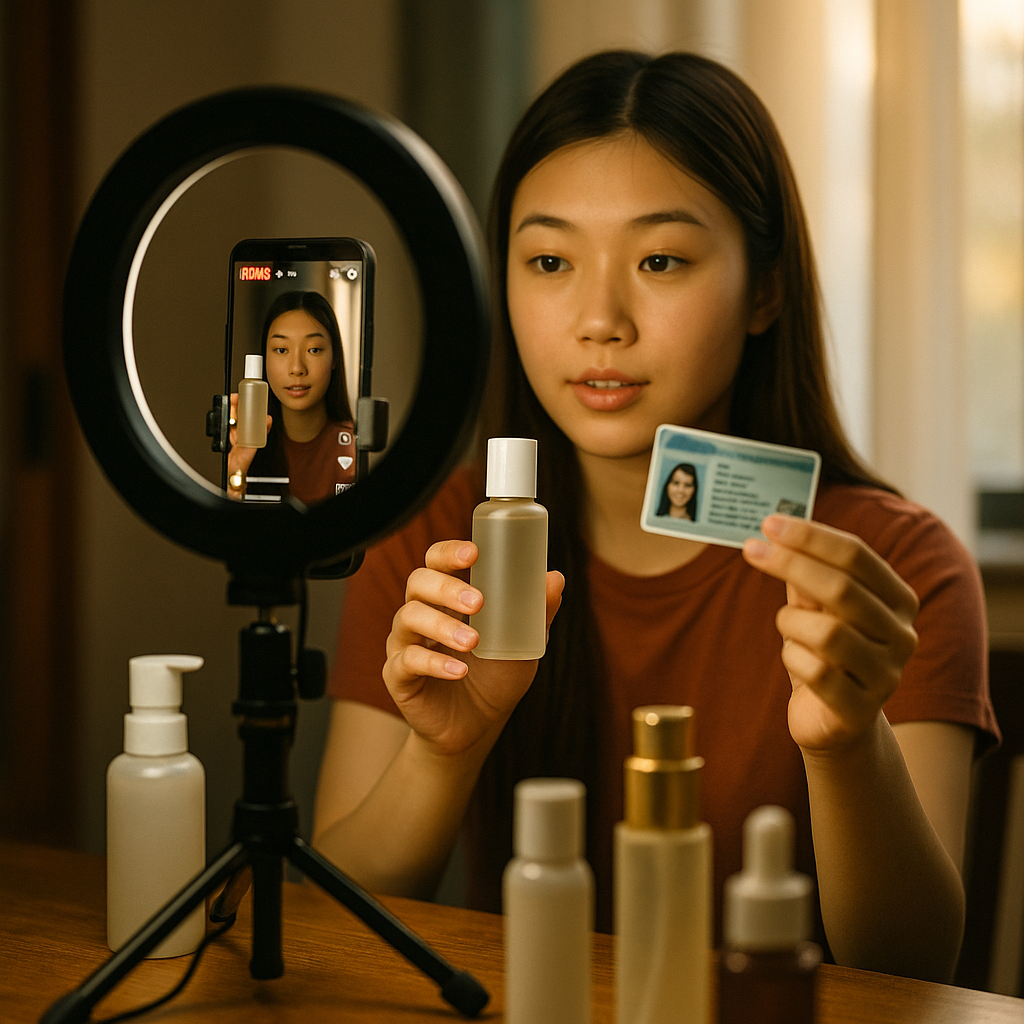
Fourteen states now have age-verification statutes on the books, and at least a dozen more are drafting their own versions. Meanwhile, TikTok Shop livestreams are pushing vape accessories, kratom, CBD, and knives to audiences that skew younger than almost any other commerce channel. If your brand sells anything in a regulated category and hasn’t mapped these two forces against each other, you’re one viral clip away from a state AG inquiry. State age-verification statutes weren’t written with livestream commerce in mind — but regulators are applying them anyway.
The Collision Nobody Planned For
Age-verification laws were drafted for websites: gated login screens, ID uploads, credit card checks. Lawmakers in Louisiana, Texas, Utah, and a growing list of other states pictured a porn site or a gambling platform when they wrote these bills. They did not picture a 22-year-old creator holding up a THC seltzer during a live TikTok Shop event, tapping a yellow basket icon while 40,000 viewers watch in real time.
That mismatch is the whole problem. TikTok Shop’s checkout flow is built for speed. Age-verification statutes are built for friction. Every regulated-category brand selling through livestream is now stuck reconciling two systems that were never designed to talk to each other.
Livestream commerce converts on impulse and immediacy. Age-verification law demands friction and proof. Selling regulated goods on TikTok Shop means engineering compliance into a format built to eliminate every possible pause.
Which Categories Are Actually at Risk?
Not every product triggers this. But the list is longer than most brand teams assume:
- Vape and nicotine accessories — even non-nicotine hardware often falls under state definitions of “tobacco-related products.”
- Kratom and CBD/THC-adjacent goods — patchwork state rules mean a product legal to sell in Colorado may require age gating in Arkansas.
- Knives, airsoft, and certain sporting goods — several states classify these as age-restricted regardless of federal status.
- Energy drinks and supplements with stimulant warnings — a smaller but growing category as states like Louisiana expand statutory definitions.
- Adult novelty and lingerie-adjacent categories — frequently swept into broader “harmful to minors” statutes even when not explicitly sexual.
If your SKU list touches any of these, your livestream hosts need more than a disclaimer slide. They need a documented verification workflow tied to the actual transaction.
What the Statutes Actually Require (and What They Don’t)
Here’s the part that trips up legal teams: most state age-verification statutes target access to content, not e-commerce transactions. Texas’s HB 1181 and similar laws focus on adult content sites. They don’t explicitly mention livestream shopping carts. So does that mean TikTok Shop sellers are in the clear?
Not quite. Several states have separate, older statutes governing the sale of age-restricted products — tobacco control laws, knife sale statutes, kratom acts — that apply regardless of the sales channel. A livestream sale of a vape accessory is still a retail sale. If your state requires ID verification at point of sale for that category, the fact that the “store” is a phone screen doesn’t change your obligation.
This is where brands get burned. They treat the newer content-focused age-verification laws as the only relevant framework, ignore the older product-specific statutes, and end up non-compliant on both fronts simultaneously.
TikTok’s Own Age Controls Aren’t a Legal Shield
TikTok requires users to be 18+ to access TikTok Shop at all, and the platform has invested heavily in age-assurance signals following its $400M COPPA settlement. That sounds reassuring. It isn’t a substitute for your own compliance obligations.
Platform-level age gates verify the account, not necessarily the person completing the purchase. Shared devices, borrowed logins, and simple underreporting mean TikTok’s 18+ gate for Shop access doesn’t guarantee the buyer of your kratom capsules is actually of legal age in their state. Brands that rely entirely on TikTok’s account-level controls are outsourcing a legal obligation to a system that wasn’t designed to satisfy state statutes in the first place.
This mirrors the exposure brands faced around TikTok’s age verification gaps more broadly — the platform’s compliance posture and your brand’s regulatory exposure are not the same thing, and regulators know it.
Building a Reconciliation Framework That Actually Holds Up
You don’t need to kill your livestream program. You need a layered approach that maps statutory requirements onto the mechanics of live selling.
- Category-by-category legal mapping. Have counsel identify which SKUs trigger age-restriction statutes in which states, then cross-reference against your shipping footprint. A national livestream reaches every state; your compliance obligations should reflect the strictest applicable jurisdiction, not the most lenient.
- Pre-checkout age attestation with logged evidence. Add a mandatory checkbox or ID-capture step for regulated SKUs before the TikTok Shop cart completes. Log timestamps. This won’t satisfy every state’s strictest ID-verification requirement, but it builds a documented good-faith compliance trail.
- Geofencing regulated SKUs at the product level. If a state’s statute makes compliance operationally impossible within TikTok Shop’s current checkout flow, block shipping to that state for that SKU rather than gambling on enforcement discretion.
- Script and disclosure review for hosts. Livestream hosts need trained language: “this product is restricted to buyers 21 and older in your state” isn’t optional boilerplate, it’s a documented disclosure that matters if a state AG comes asking. This connects directly to broader livestream compliance risk that brands already need to manage around pricing claims and scarcity tactics.
- Real-time IP and location verification. As TikTok rolls out stricter Real IP verification deadlines, sellers gain a new data point for confirming buyer location against state-specific restrictions — a tool worth building into your compliance stack now rather than after an incident forces the issue.
The Multi-State Patchwork Problem
Here’s the uncomfortable truth: there is no single national standard. Louisiana’s age-verification requirements differ from Utah’s, which differ from Virginia’s, which differ again from whatever California’s legislature passes next session. Compliance teams built for a single-jurisdiction retail model are not equipped for fifty simultaneous, shifting standards applied to one livestream broadcasting nationally at once.
Brands selling nationally through TikTok Shop are functionally operating fifty micro-storefronts, each subject to different age-verification thresholds, even though the checkout experience looks identical to every viewer. Treat it that way in your compliance documentation, even if the front-end experience stays unified.
A single national livestream can trigger fifty different sets of legal obligations. Brands that build compliance around “one broadcast, one standard” are already behind.
This is also why data handling matters as much as age gating. If you’re capturing ID or birthdate data to satisfy verification statutes, that data now falls under separate privacy obligations — see the parallel challenges outlined in data minimization policy guidance for TikTok Shop and Instagram Checkout. Collecting age data without a retention and minimization policy just trades one compliance risk for another.
Where Enforcement Is Actually Headed
State attorneys general have shown increasing appetite for going after platforms and sellers over youth access, not just content moderation failures. The FTC has separately signaled interest in how commerce claims made during livestreams hold up under existing advertising law — see its general guidance on endorsement and advertising rules. Combine that federal posture with an expanding patchwork of state statutes, and regulated-category sellers face pressure from two directions at once.
Industry data on livestream commerce growth makes the stakes clearer. Platforms and analysts tracking social commerce, including reports referenced by eMarketer, consistently show livestream shopping as one of the fastest-growing purchase channels in the U.S. — meaning transaction volume in regulated categories is scaling faster than most brands’ compliance infrastructure.
Marketing teams evaluating platform strategy more broadly should also track how TikTok’s underlying data infrastructure shifts. The Oracle sub-processor changes to TikTok Shop’s data processing agreement affect how buyer verification data gets stored and shared, which matters directly if you’re relying on platform-level age signals as part of your compliance stack.
Practical Next Step
Don’t wait for a state AG letter to find out your kratom SKU was shipping unverified into a restricted state via livestream. Run a category-by-category legal audit against your top five shipping states this quarter, document your verification workflow in writing, and route every regulated-category livestream script through legal review before it airs.
FAQs
Do state age-verification statutes apply to TikTok Shop livestream sales?
Yes, in many cases. Even though most age-verification laws were written for content access, older product-specific statutes governing tobacco, vape, kratom, and knife sales still apply to any retail transaction, including one completed through a livestream checkout flow.
Is TikTok’s 18+ requirement for Shop access enough to satisfy state law?
No. Platform-level account age gates verify the account, not necessarily the individual completing a purchase. Brands selling regulated categories need their own documented verification workflow layered on top of TikTok’s controls.
What happens if a brand ships a restricted product to a state without proper verification?
Exposure ranges from state AG enforcement action and civil penalties to loss of retail licensing for regulated categories like tobacco or kratom. Documented good-faith compliance efforts materially reduce, but don’t eliminate, that risk.
Can brands just block shipping to strict states instead of building verification?
Yes, and for some SKUs this is the most practical option. Geofencing a regulated product out of a high-risk state is often cheaper and lower-risk than building a full verification workflow for a small percentage of sales.
Who is legally responsible for age-verification failures in a livestream sale — the brand or the creator?
Typically the brand, since it’s the seller of record on TikTok Shop. Creators can carry secondary liability for misleading claims made on-air, which is why host scripts and disclosure training matter as much as the checkout mechanics.
FAQs
Do state age-verification statutes apply to TikTok Shop livestream sales?
Yes, in many cases. Even though most age-verification laws were written for content access, older product-specific statutes governing tobacco, vape, kratom, and knife sales still apply to any retail transaction, including one completed through a livestream checkout flow.
Is TikTok’s 18+ requirement for Shop access enough to satisfy state law?
No. Platform-level account age gates verify the account, not necessarily the individual completing a purchase. Brands selling regulated categories need their own documented verification workflow layered on top of TikTok’s controls.
What happens if a brand ships a restricted product to a state without proper verification?
Exposure ranges from state AG enforcement action and civil penalties to loss of retail licensing for regulated categories like tobacco or kratom. Documented good-faith compliance efforts materially reduce, but don’t eliminate, that risk.
Can brands just block shipping to strict states instead of building verification?
Yes, and for some SKUs this is the most practical option. Geofencing a regulated product out of a high-risk state is often cheaper and lower-risk than building a full verification workflow for a small percentage of sales.
Who is legally responsible for age-verification failures in a livestream sale — the brand or the creator?
Typically the brand, since it’s the seller of record on TikTok Shop. Creators can carry secondary liability for misleading claims made on-air, which is why host scripts and disclosure training matter as much as the checkout mechanics.
Top Influencer Marketing Agencies
The leading agencies shaping influencer marketing in 2026
Agencies ranked by campaign performance, client diversity, platform expertise, proven ROI, industry recognition, and client satisfaction. Assessed through verified case studies, reviews, and industry consultations.
Moburst

-
2

The Shelf
Boutique Beauty & Lifestyle Influencer AgencyA data-driven boutique agency specializing exclusively in beauty, wellness, and lifestyle influencer campaigns on Instagram and TikTok. Best for brands already focused on the beauty/personal care space that need curated, aesthetic-driven content.Clients: Pepsi, The Honest Company, Hims, Elf Cosmetics, Pure LeafVisit The Shelf → -
3

Audiencly
Niche Gaming & Esports Influencer AgencyA specialized agency focused exclusively on gaming and esports creators on YouTube, Twitch, and TikTok. Ideal if your campaign is 100% gaming-focused — from game launches to hardware and esports events.Clients: Epic Games, NordVPN, Ubisoft, Wargaming, Tencent GamesVisit Audiencly → -
4

Viral Nation
Global Influencer Marketing & Talent AgencyA dual talent management and marketing agency with proprietary brand safety tools and a global creator network spanning nano-influencers to celebrities across all major platforms.Clients: Meta, Activision Blizzard, Energizer, Aston Martin, WalmartVisit Viral Nation → -
5

The Influencer Marketing Factory
TikTok, Instagram & YouTube CampaignsA full-service agency with strong TikTok expertise, offering end-to-end campaign management from influencer discovery through performance reporting with a focus on platform-native content.Clients: Google, Snapchat, Universal Music, Bumble, YelpVisit TIMF → -
6

NeoReach
Enterprise Analytics & Influencer CampaignsAn enterprise-focused agency combining managed campaigns with a powerful self-service data platform for influencer search, audience analytics, and attribution modeling.Clients: Amazon, Airbnb, Netflix, Honda, The New York TimesVisit NeoReach → -
7

Ubiquitous
Creator-First Marketing PlatformA tech-driven platform combining self-service tools with managed campaign options, emphasizing speed and scalability for brands managing multiple influencer relationships.Clients: Lyft, Disney, Target, American Eagle, NetflixVisit Ubiquitous → -
8

Obviously
Scalable Enterprise Influencer CampaignsA tech-enabled agency built for high-volume campaigns, coordinating hundreds of creators simultaneously with end-to-end logistics, content rights management, and product seeding.Clients: Google, Ulta Beauty, Converse, AmazonVisit Obviously →