


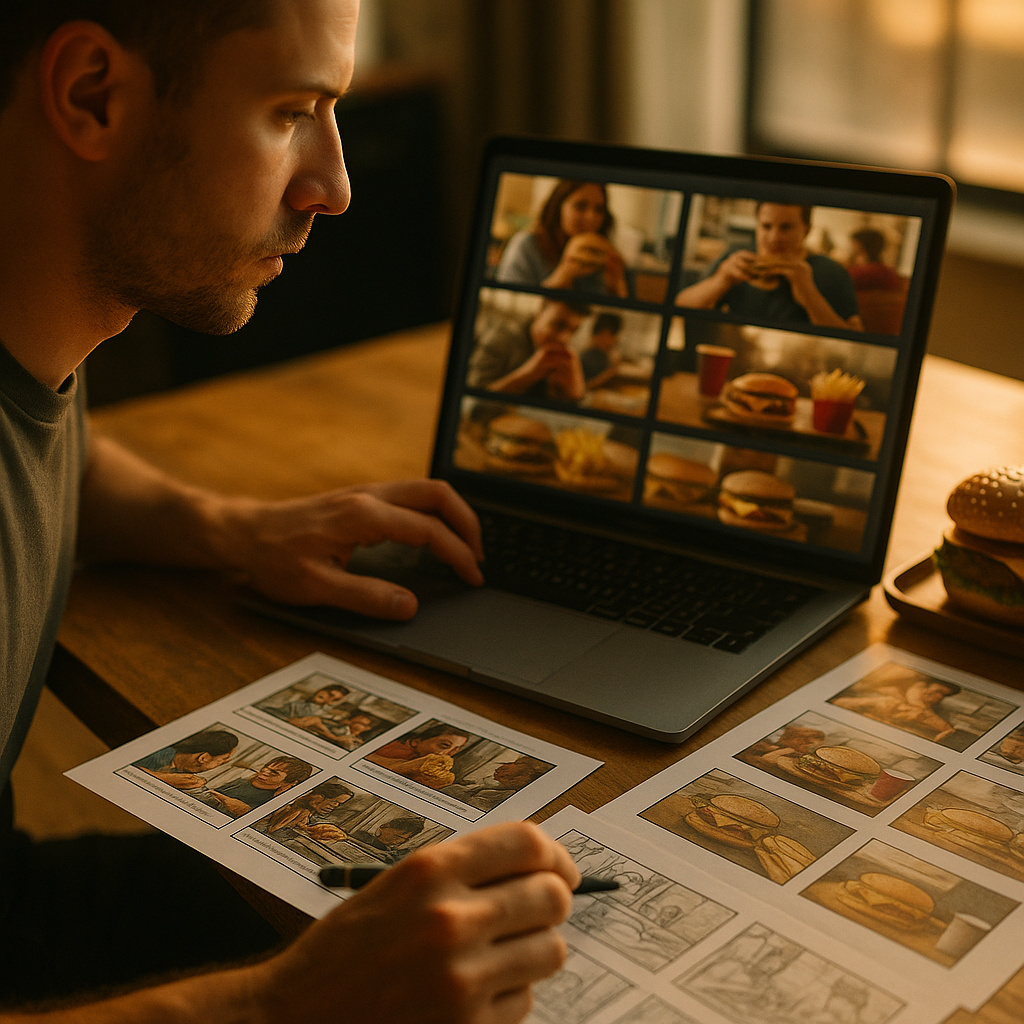
Three weeks. That’s how long it used to take a mid-sized regional QSR chain to move a campaign concept from brief to storyboard-ready assets for its creator roster. Today, that same process takes under 48 hours. The shift came down to one operational bet: AI-generated storyboards replacing the manual back-and-forth that used to eat entire sprint cycles.
This is the story of how that happened, what broke along the way, and what other multi-location brands can steal from the playbook.
The Bottleneck Nobody Wanted to Admit
The chain — 140-plus locations across three states, a marketing team of six, and a rotating bench of roughly 40 regional creators — had a familiar problem. Every new LTO (limited-time offer) or seasonal promo triggered the same slog: brief the creative lead, wait for a storyboard draft, route it through legal and franchise compliance, revise, revise again, then finally hand it to creators for filming.
By the time storyboards cleared approval, the promotional window had often shrunk by half. One director of marketing put it bluntly during an internal review: “We were spending more time storyboarding the burger than we spent selling it.” That’s not hyperbole for a QSR chain running six-week LTO cycles.
The math was brutal. A typical storyboard-to-approval cycle ran 15-21 business days. Creator shoot windows then needed another five to seven days. Add platform review and paid amplification setup, and a six-week promo often launched with two weeks of runway left, if that.
When your promotional window is six weeks and your creative approval cycle eats three of them, you’re not running a campaign — you’re running a countdown.
Why Storyboards Were the Real Chokepoint
Most brands assume the bottleneck in influencer programs is creator sourcing or contract negotiation. For this chain, it wasn’t. Their creator bench was solid, drawing on lessons similar to what worked in nano and micro-creator seeding strategies elsewhere in the industry. The real drag was pre-production: translating a marketing brief into a visual, shot-by-shot narrative that creators, franchisees, and legal could all sign off on without twelve rounds of email.
Storyboards matter more in QSR than most categories realize. Every regional franchisee wants input. Legal needs to confirm nutritional claims and pricing disclosures are accurate per location. Brand wants consistent tone across dozens of creators posting simultaneously. That’s a lot of stakeholders reviewing static sketches or vague shot lists — and a lot of room for miscommunication.
The team tried outsourcing storyboard creation to a freelance illustrator. It helped speed, but not enough, and cost scaled linearly with campaign volume. They needed something that scaled without adding headcount or per-project fees.
The AI Storyboard Pilot
In late 2025, the marketing team piloted an AI-assisted storyboard workflow using a generative visual tool paired with their existing brief templates. The process, in simplified form:
- Marketing inputs the campaign brief, key messaging points, and required legal disclaimers into a structured prompt template.
- The AI tool generates a full shot-by-shot storyboard — visual frames, suggested camera angles, on-screen text placement, and pacing notes — within minutes.
- Creative leads review and adjust in a shared workspace, tightening brand voice and swapping generic visuals for chain-specific menu items and store layouts.
- Legal and franchise stakeholders review the same visual draft simultaneously via a shared link, cutting serial back-and-forth to parallel review.
- Approved storyboards go straight to creators as a visual brief, with far less interpretation needed on set.
The output wasn’t perfect on the first pass. Early storyboards misrepresented product portion sizes and occasionally suggested shots that violated brand guidelines around drive-thru signage. But the iteration loop — regenerate, adjust, re-review — took hours instead of days.
By the third campaign cycle, the team had built a prompt library specific to their brand: menu items, store aesthetics, compliance language, and tone guardrails baked in. That reusable structure is what actually made the speed gains durable rather than a one-off fluke.
The Numbers That Made Leadership Pay Attention
Across four campaign cycles post-pilot, the chain tracked storyboard-to-approval time, creator brief clarity (measured via revision requests), and time-to-first-post.
- Storyboard-to-approval time dropped from an average of 18 business days to 2.5 days.
- Creator revision requests — asking for clarification on shot intent — fell by roughly 60%, since storyboards were now visual rather than text-based shot lists.
- Time-to-first-post after brief finalization shrank from three weeks to five days on average.
- Franchisee approval friction dropped noticeably, since regional operators could review actual visual mockups instead of imagining a shot list.
None of this is exotic. It mirrors a broader trend: eMarketer has repeatedly flagged creative production speed as one of the top constraints marketers cite when scaling influencer programs, especially for brands running frequent, time-boxed promotions like QSR LTOs.
Cutting turnaround from three weeks to five days didn’t just save time — it meant campaigns actually launched while the promotional window was still relevant, not two weeks after it mattered.
What Almost Went Wrong
This wasn’t a frictionless rollout. Three issues nearly derailed the pilot, and they’re worth naming because most brands will hit the same ones.
First, compliance risk from AI-generated claims. Early storyboard drafts occasionally generated suggested on-screen text that implied nutritional or pricing claims the legal team hadn’t approved. This is a live issue across the industry — the FTC has made clear that disclosure and claims accuracy obligations don’t disappear because a tool generated the draft. The brand’s fix was procedural: no AI-generated text ever ships without a human legal pass, full stop. That single rule matters more than any tool feature.
Second, creator pushback on losing creative latitude. Several creators felt the highly detailed AI storyboards left less room for their own style, a tension that echoes what’s happened elsewhere when brands over-brief creators — see how rigid creator briefs backfired for another brand chasing efficiency at the cost of authenticity. The team addressed it by explicitly labeling storyboards as “directional, not literal” and building in a creator-adaptation step before filming.
Third, brand consistency drift across a large creator pool. With 40-plus creators posting near-simultaneously, small storyboard interpretation differences compounded fast. The team solved this the way larger brands managing multi-creator consistency have: a shared visual style guide baked directly into the AI prompt template, so every generated storyboard started from the same brand-locked foundation.
Where This Fits the Bigger Shift in Creative Ops
This case isn’t really about one QSR chain. It’s a signal of where creative operations in influencer marketing are heading generally. Brands running AI-driven creator matching have already proven that AI tooling can compress sourcing timelines. Storyboarding is the next logical layer: compress pre-production the same way matching compressed discovery.
The operational logic scales beyond QSR. Any brand running frequent, time-sensitive promotions — retail drops, seasonal beauty launches, gaming content tied to patch releases — faces the same structural problem: creative approval cycles that outlast the relevance window of the campaign itself. HubSpot’s research on marketing operations consistently flags approval-cycle length as a top efficiency drag, right alongside budget allocation and attribution.
What’s notable here is that the ROI wasn’t just speed. Franchisee satisfaction improved because regional operators felt more in control of what launched under their storefronts. That’s a compliance and stakeholder-management win as much as a creative one — a dynamic not unlike what unfolded when Poppi rebuilt trust after regulatory scrutiny: process discipline paired with speed, not speed alone, is what earns internal buy-in.
What Other Brands Should Actually Copy
Don’t copy the tool. Copy the structure. The chain’s real unlock wasn’t a specific AI platform — it was three decisions any marketing team can replicate:
- Build a locked prompt template with brand guardrails baked in, so every output starts compliant instead of getting corrected after the fact.
- Mandate a human legal review step for any AI-generated text or claim, no exceptions, regardless of how minor.
- Treat AI storyboards as directional briefs, not final scripts — preserve creator latitude to keep content authentic, not templated.
Skip any of these three, and you either reintroduce the compliance risk the tool was supposed to reduce, or you end up with technically fast, creatively flat content that underperforms despite the speed gain.
The next step for most brands isn’t buying an AI storyboard tool tomorrow. It’s auditing where creative approval cycles actually lose time today — legal review, franchisee sign-off, creator revision loops — and testing an AI-assisted draft step at exactly that chokepoint before rolling it out chain-wide.
FAQs
What are AI-generated storyboards in influencer marketing?
They’re visual, shot-by-shot campaign drafts produced by generative AI tools based on a marketing brief. They typically include suggested camera angles, pacing, on-screen text, and scene composition, replacing manual sketch-based storyboarding as a faster starting point for creator briefs.
How much time can AI storyboarding actually save?
Results vary by team size and approval complexity, but this QSR chain cut storyboard-to-approval time from roughly 18 business days to about 2.5 days. Most of the savings came from parallel stakeholder review rather than the generation speed itself.
Does using AI storyboards create legal or compliance risk?
Yes, if unmanaged. Early drafts can generate inaccurate claims or non-compliant messaging. The fix is procedural: require a mandatory human legal review of any AI-generated text or claim before it reaches creators, regardless of how fast the tool is.
Will AI storyboards make creator content feel generic?
It can, if storyboards are treated as literal scripts. Brands that succeed treat AI output as a directional brief, giving creators room to adapt tone and delivery to their own audience while keeping core brand and compliance elements locked.
Is this approach only useful for large, multi-location brands?
No. Any brand running frequent, time-sensitive campaigns — retail drops, seasonal launches, LTOs — faces the same approval-cycle drag. Smaller teams may see even faster ROI since they typically have fewer stakeholders to route approvals through.
Visible FAQ Section (HTML)
FAQs
What are AI-generated storyboards in influencer marketing?
They’re visual, shot-by-shot campaign drafts produced by generative AI tools based on a marketing brief. They typically include suggested camera angles, pacing, on-screen text, and scene composition, replacing manual sketch-based storyboarding as a faster starting point for creator briefs.
How much time can AI storyboarding actually save?
Results vary by team size and approval complexity, but this QSR chain cut storyboard-to-approval time from roughly 18 business days to about 2.5 days. Most of the savings came from parallel stakeholder review rather than the generation speed itself.
Does using AI storyboards create legal or compliance risk?
Yes, if unmanaged. Early drafts can generate inaccurate claims or non-compliant messaging. The fix is procedural: require a mandatory human legal review of any AI-generated text or claim before it reaches creators, regardless of how fast the tool is.
Will AI storyboards make creator content feel generic?
It can, if storyboards are treated as literal scripts. Brands that succeed treat AI output as a directional brief, giving creators room to adapt tone and delivery to their own audience while keeping core brand and compliance elements locked.
Is this approach only useful for large, multi-location brands?
No. Any brand running frequent, time-sensitive campaigns — retail drops, seasonal launches, LTOs — faces the same approval-cycle drag. Smaller teams may see even faster ROI since they typically have fewer stakeholders to route approvals through.
Top Influencer Marketing Agencies
The leading agencies shaping influencer marketing in 2026
Agencies ranked by campaign performance, client diversity, platform expertise, proven ROI, industry recognition, and client satisfaction. Assessed through verified case studies, reviews, and industry consultations.
Moburst

-
2

The Shelf
Boutique Beauty & Lifestyle Influencer AgencyA data-driven boutique agency specializing exclusively in beauty, wellness, and lifestyle influencer campaigns on Instagram and TikTok. Best for brands already focused on the beauty/personal care space that need curated, aesthetic-driven content.Clients: Pepsi, The Honest Company, Hims, Elf Cosmetics, Pure LeafVisit The Shelf → -
3

Audiencly
Niche Gaming & Esports Influencer AgencyA specialized agency focused exclusively on gaming and esports creators on YouTube, Twitch, and TikTok. Ideal if your campaign is 100% gaming-focused — from game launches to hardware and esports events.Clients: Epic Games, NordVPN, Ubisoft, Wargaming, Tencent GamesVisit Audiencly → -
4

Viral Nation
Global Influencer Marketing & Talent AgencyA dual talent management and marketing agency with proprietary brand safety tools and a global creator network spanning nano-influencers to celebrities across all major platforms.Clients: Meta, Activision Blizzard, Energizer, Aston Martin, WalmartVisit Viral Nation → -
5

The Influencer Marketing Factory
TikTok, Instagram & YouTube CampaignsA full-service agency with strong TikTok expertise, offering end-to-end campaign management from influencer discovery through performance reporting with a focus on platform-native content.Clients: Google, Snapchat, Universal Music, Bumble, YelpVisit TIMF → -
6

NeoReach
Enterprise Analytics & Influencer CampaignsAn enterprise-focused agency combining managed campaigns with a powerful self-service data platform for influencer search, audience analytics, and attribution modeling.Clients: Amazon, Airbnb, Netflix, Honda, The New York TimesVisit NeoReach → -
7

Ubiquitous
Creator-First Marketing PlatformA tech-driven platform combining self-service tools with managed campaign options, emphasizing speed and scalability for brands managing multiple influencer relationships.Clients: Lyft, Disney, Target, American Eagle, NetflixVisit Ubiquitous → -
8

Obviously
Scalable Enterprise Influencer CampaignsA tech-enabled agency built for high-volume campaigns, coordinating hundreds of creators simultaneously with end-to-end logistics, content rights management, and product seeding.Clients: Google, Ulta Beauty, Converse, AmazonVisit Obviously →