


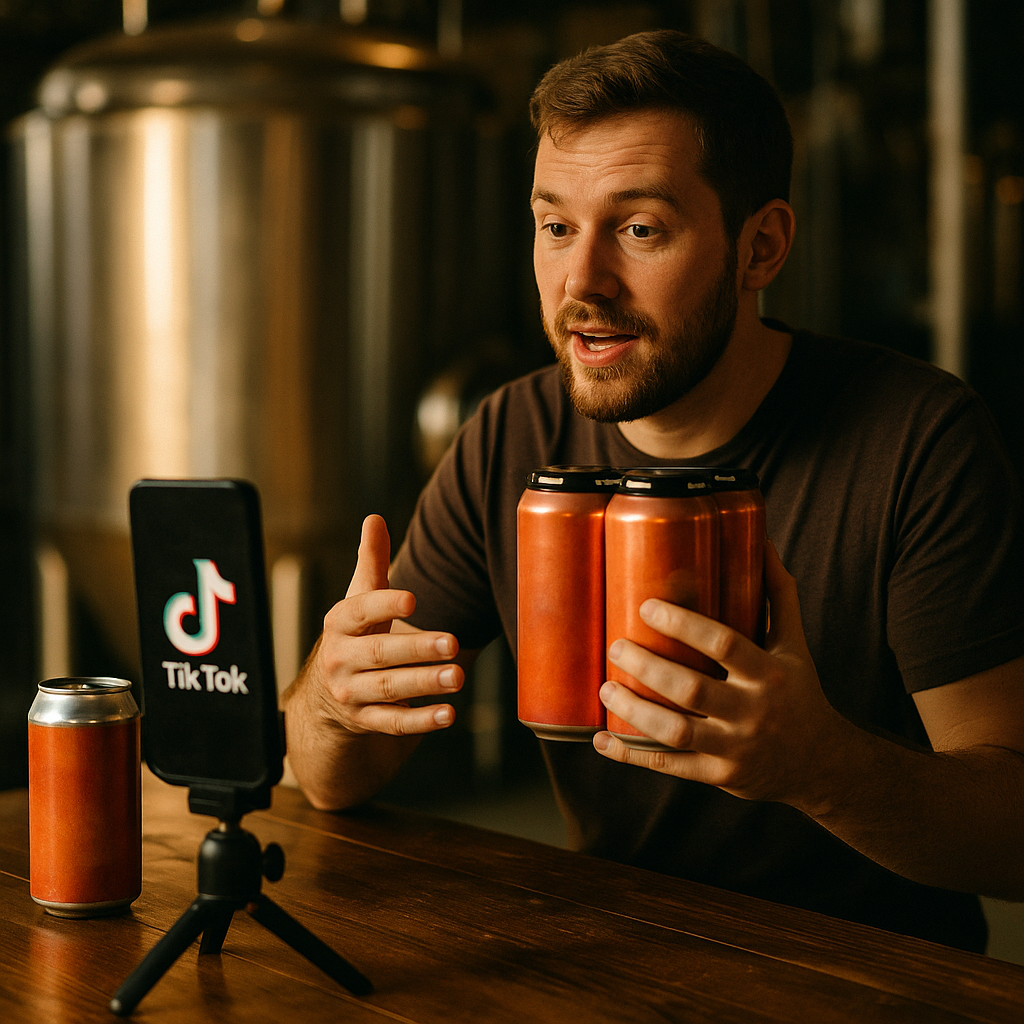
One seasonal batch. Ninety minutes. Sold out before the delivery truck even left the parking lot. No distributor, no big-box placement, no regional sales rep working the phones. Just a brewer, a phone camera, and TikTok Shop live selling doing the heavy lifting. If you think craft beer still needs a three-tier distribution deal to move volume, this case study will change your mind.
The Distributor Problem Nobody Talks About
Craft breweries have a math problem. Distributors typically take 25 to 30 percent margin off wholesale price, and that’s before slotting fees, delivery minimums, and the reality that your seasonal batch gets buried behind six other SKUs on a shelf nobody’s browsing slowly. For a small brewery producing limited seasonal runs (think 200 to 400 barrels), the distributor model often doesn’t pencil out. The volume is too low to matter to a distributor’s route economics, but too high to sell entirely at the taproom.
That’s the gap Hollow Creek Brewing, a mid-sized regional brewery, decided to close with TikTok Shop instead of another round of distributor pitch meetings.
What Actually Happened
Hollow Creek had a seasonal imperial stout, aged in bourbon barrels, that historically sold out at the taproom in about three weeks with zero marketing spend. The brewery’s operations lead figured there was untapped demand beyond the local radius, but a full distribution deal for a one-off seasonal felt like using a sledgehammer on a thumbtack.
Instead, they set up a TikTok Shop storefront, built a modest content calendar around the brewing process, and scheduled three live selling sessions timed to the release. The brewer himself hosted, no polished script, just answering questions in real time about barrel char, ABV, and why this batch tasted different from last year’s.
- First live session: 45 minutes, roughly 1,200 viewers, sold through 60 cases
- Second session (a week later, tied to a “last call” framing): sold through the remaining allocation in under 90 minutes
- Total direct-to-consumer revenue exceeded what the brewery would have netted from a comparable wholesale distribution run, even after shipping costs
The brewery kept roughly 20 to 25 percentage points more margin per case by selling direct through TikTok Shop live sessions instead of routing the batch through a traditional distributor.
No returns, no unsold cases sitting in a distributor warehouse, no negotiating shelf placement for a beer that only exists for six weeks a year. Just direct demand, captured live, converted immediately.
Why Live Selling Works Better Than Static Product Listings for Alcohol
Alcohol is a trust-and-story product. People aren’t just buying ABV and flavor notes, they’re buying the narrative of small-batch scarcity, the face behind the brand, and the sense that they got in before it sold out. A static product page can’t do that. A live session can.
TikTok’s live shopping format lets viewers ask questions in real time (“does this taste like last year’s batch?”), see social proof stacking up as other viewers purchase, and feel urgency as inventory counters tick down on screen. That combination of live Q&A, visible scarcity, and creator authenticity consistently outperforms passive e-commerce listings for impulse-adjacent categories, which is exactly the emotional territory limited-release craft beer lives in.
This mirrors what other CPG and beverage brands are discovering across live commerce more broadly. Livestream selling has posted conversion rates far above typical e-commerce benchmarks in markets where the format has matured, and TikTok Shop is importing much of that playbook to the US.
The Compliance Question Every Brewery Skips (And Shouldn’t)
Selling alcohol direct-to-consumer online isn’t a free-for-all. Regulations vary heavily by state, and some states restrict or outright prohibit DTC alcohol shipping. Before any brewery replicates this playbook, someone needs to map which states the brewery can legally ship to, verify age-gating is properly configured on the TikTok Shop storefront, and confirm labeling and licensing requirements are met for each destination state.
Hollow Creek limited its live selling promotion to states where it already held shipping permits, rather than opening the storefront nationally and hoping compliance would sort itself out later. That’s the boring part of this case study, but it’s also the part that keeps a brewery out of regulatory trouble. Brands operating in regulated categories should treat this the way they’d treat any FTC disclosure requirement: as a non-negotiable operational step, not an afterthought. The FTC’s guidance on endorsements and disclosures still applies even when the “creator” is the brewery’s own founder.
Building the Playbook: What Transfers to Other Brands
The brewery’s approach wasn’t accidental. A few deliberate choices made it repeatable.
- Scarcity was real, not manufactured. The batch size was genuinely limited by barrel capacity, so urgency messaging wasn’t hype, it was accurate. Audiences can smell fake scarcity from a mile away.
- The host knew the product cold. Live selling collapses if the host can’t answer detailed questions confidently. A brewer talking about mash bills and barrel provenance carries more credibility than a hired host reading a script.
- Pre-live content did the top-of-funnel work. Short-form videos in the two weeks before the live session built an audience that showed up ready to buy, rather than trying to convert cold viewers mid-stream.
- Shipping logistics were solved before launch, not during. Cases were pre-packed and staged with a fulfillment partner so orders could ship within 48 hours of the live session closing.
This is the same operational discipline showing up across other direct-to-consumer live commerce wins. Retail and DTC brands using tiered creator or host models for live selling are seeing similar cost-per-acquisition advantages, as detailed in coverage of Amazon Live’s tiered creator model and how it lowers CAC while scaling discovery. The mechanics differ by platform, but the underlying principle, real-time trust plus visible scarcity, is consistent.
Where This Fits Against Bigger Brand Playbooks
It’s tempting to think live selling is a tactic reserved for scrappy DTC upstarts. It isn’t. Larger brands are running structurally similar plays. Stanley’s Whatnot auction strategy turned overstock into sellouts using the same real-time urgency mechanics, just at a different scale and price point. The craft brewery version proves the model isn’t dependent on massive brand recognition. It’s dependent on genuine scarcity, an authentic host, and a platform that lets viewers buy without leaving the content.
There’s also a broader lesson about channel efficiency here. Brands chasing lower customer acquisition costs are increasingly finding that tighter creator matching drives stronger ROAS than broad-spectrum paid media, especially for products with a strong origin story to tell. A brewery’s barrel-aging process is exactly the kind of content that performs well in short-form video, because it’s visually interesting and hard to fake.
None of this replaces distribution for a brewery’s flagship year-round beers. Distributors still matter for shelf presence, volume consistency, and reaching customers who will never scroll TikTok Shop. But for limited seasonal runs, where volume is capped and the story is strong, live selling direct-to-consumer is proving to be a legitimate, margin-friendly channel rather than a gimmick.
What Other Regional Brands Should Watch Next
TikTok Shop’s live commerce infrastructure is still evolving fast, and category rules for alcohol, tobacco, and other regulated goods shift frequently. Brands considering this route should monitor TikTok’s advertising and commerce policies directly rather than relying on secondhand summaries, since platform rules for regulated categories can change with little notice. It’s also worth tracking broader retail media and social commerce data from sources like eMarketer to gauge whether live shopping adoption is accelerating or plateauing across categories comparable to craft beverage.
The bigger strategic question for regional brands isn’t whether live selling works. This case study, and others like it, answer that clearly. The question is whether a brand has the operational backbone (fulfillment speed, compliance mapping, a credible on-camera presence) to run it well repeatedly, not just once as a novelty.
Frequently Asked Questions
Do breweries need a distributor to sell beer online through TikTok Shop?
No, but breweries do need direct-to-consumer shipping permits for each state they intend to sell into, and those requirements vary significantly by state. Selling through TikTok Shop doesn’t remove the underlying alcohol compliance obligations, it just changes the sales channel.
How much does TikTok Shop live selling typically cost to set up?
Setup costs are largely operational rather than platform fees: staff time for hosting, pre-live content production, and fulfillment logistics. TikTok Shop itself takes a commission on sales, but there’s no major upfront licensing fee comparable to a distributor slotting fee.
Is TikTok Shop live selling only useful for limited or seasonal products?
It performs especially well for limited releases because scarcity and urgency drive live commerce conversion, but brands also use it successfully for year-round flagship products, particularly when there’s a strong founder or brand story to tell on camera.
What’s the biggest risk for alcohol brands doing live selling?
Compliance. Shipping alcohol to states where a brewery lacks proper permits, or failing to age-gate the storefront correctly, creates real regulatory exposure. This should be resolved before launch, not treated as a minor detail.
Can smaller or newer breweries realistically replicate this without a big marketing team?
Yes. The core requirements are a knowledgeable host, genuine product scarcity, pre-live short-form content to build an audience, and reliable fulfillment. None of those require a large team, though they do require deliberate planning rather than a spontaneous livestream.
The takeaway for regional brands: map your shipping compliance first, pick a genuinely limited product, and put someone who actually knows the product on camera. Live selling rewards authenticity and punishes anyone faking urgency.
Top Influencer Marketing Agencies
The leading agencies shaping influencer marketing in 2026
Agencies ranked by campaign performance, client diversity, platform expertise, proven ROI, industry recognition, and client satisfaction. Assessed through verified case studies, reviews, and industry consultations.
Moburst

-
2

The Shelf
Boutique Beauty & Lifestyle Influencer AgencyA data-driven boutique agency specializing exclusively in beauty, wellness, and lifestyle influencer campaigns on Instagram and TikTok. Best for brands already focused on the beauty/personal care space that need curated, aesthetic-driven content.Clients: Pepsi, The Honest Company, Hims, Elf Cosmetics, Pure LeafVisit The Shelf → -
3

Audiencly
Niche Gaming & Esports Influencer AgencyA specialized agency focused exclusively on gaming and esports creators on YouTube, Twitch, and TikTok. Ideal if your campaign is 100% gaming-focused — from game launches to hardware and esports events.Clients: Epic Games, NordVPN, Ubisoft, Wargaming, Tencent GamesVisit Audiencly → -
4

Viral Nation
Global Influencer Marketing & Talent AgencyA dual talent management and marketing agency with proprietary brand safety tools and a global creator network spanning nano-influencers to celebrities across all major platforms.Clients: Meta, Activision Blizzard, Energizer, Aston Martin, WalmartVisit Viral Nation → -
5

The Influencer Marketing Factory
TikTok, Instagram & YouTube CampaignsA full-service agency with strong TikTok expertise, offering end-to-end campaign management from influencer discovery through performance reporting with a focus on platform-native content.Clients: Google, Snapchat, Universal Music, Bumble, YelpVisit TIMF → -
6

NeoReach
Enterprise Analytics & Influencer CampaignsAn enterprise-focused agency combining managed campaigns with a powerful self-service data platform for influencer search, audience analytics, and attribution modeling.Clients: Amazon, Airbnb, Netflix, Honda, The New York TimesVisit NeoReach → -
7

Ubiquitous
Creator-First Marketing PlatformA tech-driven platform combining self-service tools with managed campaign options, emphasizing speed and scalability for brands managing multiple influencer relationships.Clients: Lyft, Disney, Target, American Eagle, NetflixVisit Ubiquitous → -
8

Obviously
Scalable Enterprise Influencer CampaignsA tech-enabled agency built for high-volume campaigns, coordinating hundreds of creators simultaneously with end-to-end logistics, content rights management, and product seeding.Clients: Google, Ulta Beauty, Converse, AmazonVisit Obviously →