


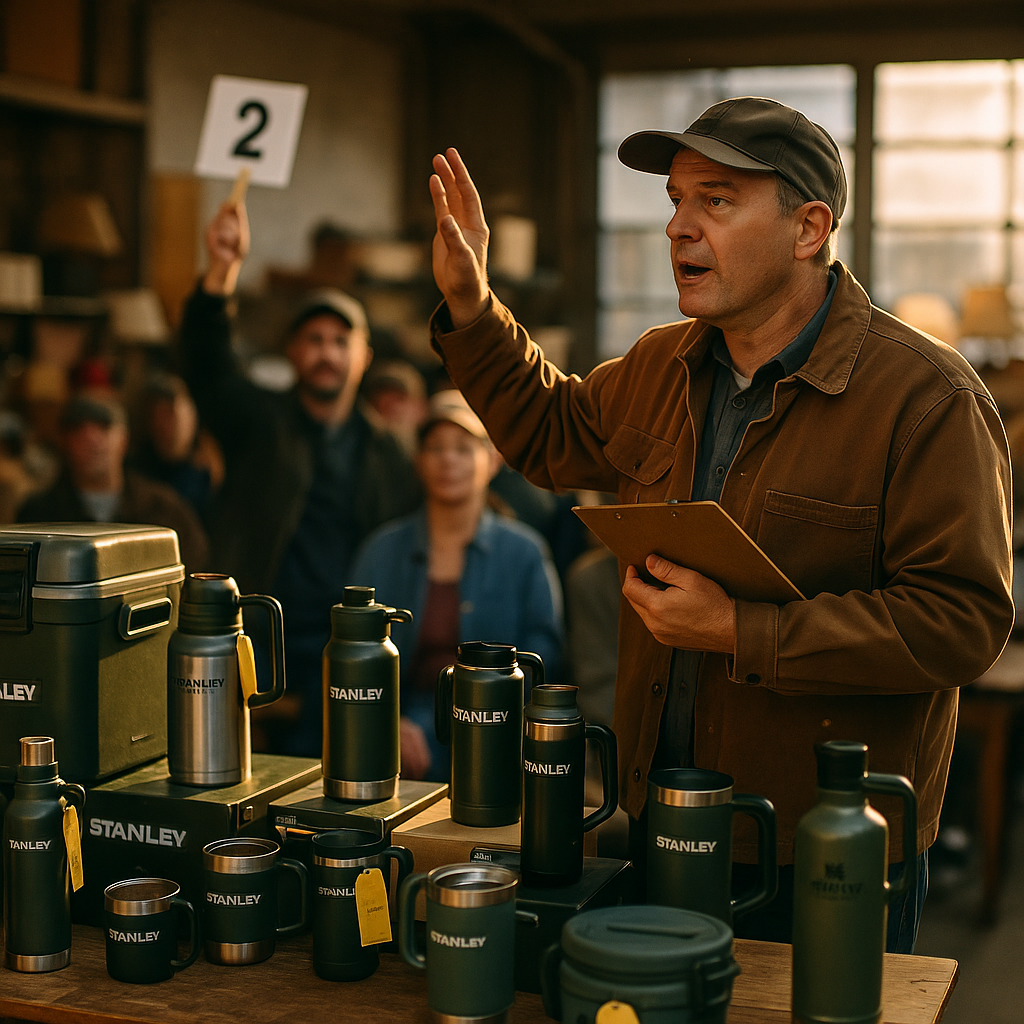
What do you do with a warehouse full of last season’s colorway? Stanley had an answer nobody expected: put it on camera, hand it to auctioneers, and watch strangers bid the price up in real time. The Stanley Whatnot relaunch didn’t just move overstock tumblers, it turned dead inventory into a scarcity event that sold out faster than most limited-edition drops.
This wasn’t a flash sale with a countdown timer. It was live, unscripted, and driven by a platform most CPG brands still treat as a curiosity. That’s exactly why it worked.
The Overstock Problem Every Brand Would Rather Not Talk About
Stanley’s Quencher boom turned the brand into a cultural fixture, but virality has a nasty side effect: forecasting chaos. When a product spikes 10x overnight, brands overcorrect. They order too much of the wrong colors, chase trends that fade in weeks, and end up sitting on pallets of tumblers nobody wants at full price.
Traditional clearance channels are brutal for a premium brand. Marking down on-site erodes the price anchor that makes a $45 tumbler feel aspirational. Offloading to liquidators protects brand image but recovers pennies on the dollar. Neither option builds anything. Neither creates a story.
Stanley needed a third path: one that moved inventory, protected brand equity, and generated content in the process. Livestream auction commerce, specifically on Whatnot’s livestream auction format, checked all three boxes.
Why Whatnot, and Why Now
Whatnot built its reputation on trading cards, sneakers, and collectibles, categories where scarcity and bidding psychology are native to the culture. Skeptics assumed a mainstream drinkware brand wouldn’t translate. Stanley proved otherwise.
The platform’s mechanics are deceptively simple: a host goes live, holds up an item, and lets viewers bid in a running comment thread until the clock runs out. No fixed price. No “buy now” button competing for attention. Just momentum, social proof, and the dopamine hit of winning.
Auction-format commerce doesn’t sell products, it sells the feeling of getting a deal in front of an audience watching you get it. That psychological hook is what separates livestream auctions from ordinary flash sales.
Sprout Social’s research on social commerce behavior has long shown that live, unscripted formats outperform polished pre-recorded content on trust metrics. Whatnot’s entire business model is built on that insight. Stanley simply borrowed the mechanic and applied it to a category, hydration gear, that had never seen this kind of theatrical retail before.
The Setup: Turning a Liability Into a Hook
Stanley didn’t hide the fact that these were overstock units. It leaned in. Hosts openly framed sessions as “warehouse clearance” events, showing shelves of boxed tumblers and explaining, colorway by colorway, why each one existed in surplus. Transparency became the marketing angle.
That framing matters more than it sounds. Consumers are increasingly skeptical of manufactured scarcity, the fake countdown timers and “only 3 left” banners that populate ecommerce sites. Real scarcity, tied to a real business reason (overproduction, discontinued colors, seasonal transition), reads as authentic. Whatnot’s auction format made that authenticity visible instead of asserted.
- Hosts showed actual pallet counts and inventory rooms on camera.
- Bidding started low (often below retail) to create early momentum and viewer commitment.
- Discontinued or limited colorways were positioned as “last chance” items, not manufactured hype.
- Sessions ran multiple times per week, training repeat viewers to check back for new drops.
What the Numbers Suggest About Livestream Auction Velocity
Whatnot has reported that top sellers on its platform can move thousands of units in a single live session, with the platform crossing multiple billions in annualized gross merchandise volume as livestream shopping scales in the U.S. market, according to company disclosures cited by eMarketer’s coverage of livestream commerce growth. Stanley’s sessions fit that pattern: sellout velocity on overstock SKUs outpaced what the brand’s own DTC clearance section had achieved in prior quarters.
The mechanism is straightforward. A static clearance page has no urgency beyond an expiring discount code. A live auction has a ticking clock, competing bidders, and a host narrating the action. That combination compresses the decision window from days to seconds.
Compare this to how Chobani built its livestream commerce playbook on TikTok Shop: both brands recognized that livestream isn’t just a distribution channel, it’s a behavioral accelerant. The format itself does work that discounting alone cannot.
Host Selection: Why Stanley Didn’t Use Its Biggest Influencers
Here’s the part that surprises most brand teams. Stanley didn’t hand the mic to its highest-follower ambassadors. It worked with Whatnot-native auction hosts, creators who already had bidding audiences and knew how to pace a sale, build tension, and close a bid.
This is a meaningful departure from typical influencer strategy. On Instagram or TikTok, reach and aesthetic fit often drive creator selection. On Whatnot, the skill that matters is auctioneering. A host who can read a chat room, escalate bids, and keep energy high for 90 minutes straight is a completely different skill set than a lifestyle creator posting a static unboxing.
Brands evaluating livestream auction platforms should treat host casting the way they’d treat a sales team hire, not a media buy. The nano-creator economy model Crocs used for Jibbitz offers a useful parallel: smaller, category-fluent creators often outperform big names when the format rewards genuine product knowledge over follower count.
Operational Lessons for Brands Sitting on Dead Stock
Overstock isn’t unique to Stanley. Every apparel, home goods, and CPG brand with seasonal SKUs faces the same math problem eventually. What makes this case study useful is the operational blueprint underneath the headline results.
- Segment inventory by story potential, not just SKU count. Colors and styles with a clear narrative (limited runs, past collabs, discontinued lines) auction better than generic overstock.
- Price the opening bid to move, not to protect margin. Low starting bids create the momentum that drives final prices up. Protecting margin on bid one kills the auction dynamic entirely.
- Schedule consistency beats one-off events. Weekly or biweekly sessions train an audience to return, turning liquidation into a recurring content series rather than a single clearance push.
- Track cost-per-unit-moved, not just GMV. Livestream auction commerce should be benchmarked against liquidation and markdown costs, not against full-price ecommerce conversion rates.
That last point matters for the finance conversation. A CFO comparing Whatnot auction revenue to full-price DTC revenue will see a discount. A CFO comparing it to the actual alternative, wholesale liquidation at 15-20 cents on the dollar, sees a dramatically better outcome.
The right benchmark for livestream auction clearance isn’t your best-selling channel. It’s your worst-case alternative: bulk liquidation. Against that baseline, even a 40% markdown looks like a win.
Compliance and Brand Safety Considerations
Auction-format selling introduces disclosure questions that flat-price ecommerce doesn’t. Hosts making real-time claims about product condition, availability, or “last chance” framing need clear guardrails to stay compliant with FTC endorsement and disclosure guidance. Brands running livestream auctions should have pre-approved scripts for scarcity claims and a documented process for verifying inventory counts hosts cite on air, since overstating “only X left” language can create legitimate deceptive-advertising exposure.
Legal and compliance teams unfamiliar with livestream formats should also review platform-specific rules. Whatnot, like TikTok Shop, has its own seller policies around returns, condition disclosure, and pricing claims that differ from standard ecommerce terms of service.
How This Compares to Other Livestream Commerce Plays
Stanley’s move sits alongside a broader shift in how brands treat livestream as more than a discovery channel. Amazon Live’s tiered creator model focuses on discovery and acquisition cost. Whatnot’s auction format focuses on urgency and inventory velocity. They’re solving different problems, and brands should pick the format that matches the business goal, not just the platform with the most buzz.
Poppi’s approach on TikTok Shop, detailed in how Poppi rebuilt trust through nano-creators, shows a similar principle applied to reputation repair rather than inventory clearance. The common thread across all these case studies: livestream commerce works best when the format’s native mechanic (auction tension, creator authenticity, discovery algorithms) maps directly onto the business problem at hand.
For Stanley, that mechanic was scarcity theater. Real inventory, real bidding, real time pressure. No fake countdown clocks required.
Bottom Line for Brand and Retail Teams
If you’re sitting on overstock and dreading another wholesale liquidation call, livestream auction platforms deserve a serious look before the pallets go out the door. Run a small pilot, cast hosts for their auctioneering skill rather than follower count, and benchmark results against your liquidation baseline, not your full-price channel, before deciding whether to scale it.
FAQs
What made Stanley’s Whatnot strategy different from a typical flash sale?
Stanley used live, uncapped bidding instead of fixed discounts, which created real-time urgency and social proof that static clearance pages can’t replicate.
Why did Stanley choose Whatnot instead of TikTok Shop or Amazon Live?
Whatnot’s auction-native format and collector-audience culture were built for scarcity-driven bidding, making it a better fit for clearing overstock than discovery-focused platforms.
How should brands measure ROI on livestream auction clearance?
Compare cost-per-unit-moved against the realistic alternative, typically wholesale liquidation, rather than against full-price ecommerce conversion benchmarks.
What compliance risks come with livestream auction selling?
Real-time scarcity claims and inventory statements made by hosts can trigger FTC disclosure requirements, so brands need pre-approved scripts and verified inventory data before going live.
Does this approach work for brands without Stanley’s brand recognition?
Yes, though smaller brands should expect longer ramp times to build an audience; starting with consistent, scheduled sessions matters more than initial follower count.
Frequently Asked Questions
What made Stanley’s Whatnot strategy different from a typical flash sale?
Stanley used live, uncapped bidding instead of fixed discounts, which created real-time urgency and social proof that static clearance pages can’t replicate.
Why did Stanley choose Whatnot instead of TikTok Shop or Amazon Live?
Whatnot’s auction-native format and collector-audience culture were built for scarcity-driven bidding, making it a better fit for clearing overstock than discovery-focused platforms.
How should brands measure ROI on livestream auction clearance?
Compare cost-per-unit-moved against the realistic alternative, typically wholesale liquidation, rather than against full-price ecommerce conversion benchmarks.
What compliance risks come with livestream auction selling?
Real-time scarcity claims and inventory statements made by hosts can trigger FTC disclosure requirements, so brands need pre-approved scripts and verified inventory data before going live.
Does this approach work for brands without Stanley’s brand recognition?
Yes, though smaller brands should expect longer ramp times to build an audience; starting with consistent, scheduled sessions matters more than initial follower count.
Top Influencer Marketing Agencies
The leading agencies shaping influencer marketing in 2026
Agencies ranked by campaign performance, client diversity, platform expertise, proven ROI, industry recognition, and client satisfaction. Assessed through verified case studies, reviews, and industry consultations.
Moburst

-
2

The Shelf
Boutique Beauty & Lifestyle Influencer AgencyA data-driven boutique agency specializing exclusively in beauty, wellness, and lifestyle influencer campaigns on Instagram and TikTok. Best for brands already focused on the beauty/personal care space that need curated, aesthetic-driven content.Clients: Pepsi, The Honest Company, Hims, Elf Cosmetics, Pure LeafVisit The Shelf → -
3

Audiencly
Niche Gaming & Esports Influencer AgencyA specialized agency focused exclusively on gaming and esports creators on YouTube, Twitch, and TikTok. Ideal if your campaign is 100% gaming-focused — from game launches to hardware and esports events.Clients: Epic Games, NordVPN, Ubisoft, Wargaming, Tencent GamesVisit Audiencly → -
4

Viral Nation
Global Influencer Marketing & Talent AgencyA dual talent management and marketing agency with proprietary brand safety tools and a global creator network spanning nano-influencers to celebrities across all major platforms.Clients: Meta, Activision Blizzard, Energizer, Aston Martin, WalmartVisit Viral Nation → -
5

The Influencer Marketing Factory
TikTok, Instagram & YouTube CampaignsA full-service agency with strong TikTok expertise, offering end-to-end campaign management from influencer discovery through performance reporting with a focus on platform-native content.Clients: Google, Snapchat, Universal Music, Bumble, YelpVisit TIMF → -
6

NeoReach
Enterprise Analytics & Influencer CampaignsAn enterprise-focused agency combining managed campaigns with a powerful self-service data platform for influencer search, audience analytics, and attribution modeling.Clients: Amazon, Airbnb, Netflix, Honda, The New York TimesVisit NeoReach → -
7

Ubiquitous
Creator-First Marketing PlatformA tech-driven platform combining self-service tools with managed campaign options, emphasizing speed and scalability for brands managing multiple influencer relationships.Clients: Lyft, Disney, Target, American Eagle, NetflixVisit Ubiquitous → -
8

Obviously
Scalable Enterprise Influencer CampaignsA tech-enabled agency built for high-volume campaigns, coordinating hundreds of creators simultaneously with end-to-end logistics, content rights management, and product seeding.Clients: Google, Ulta Beauty, Converse, AmazonVisit Obviously →