


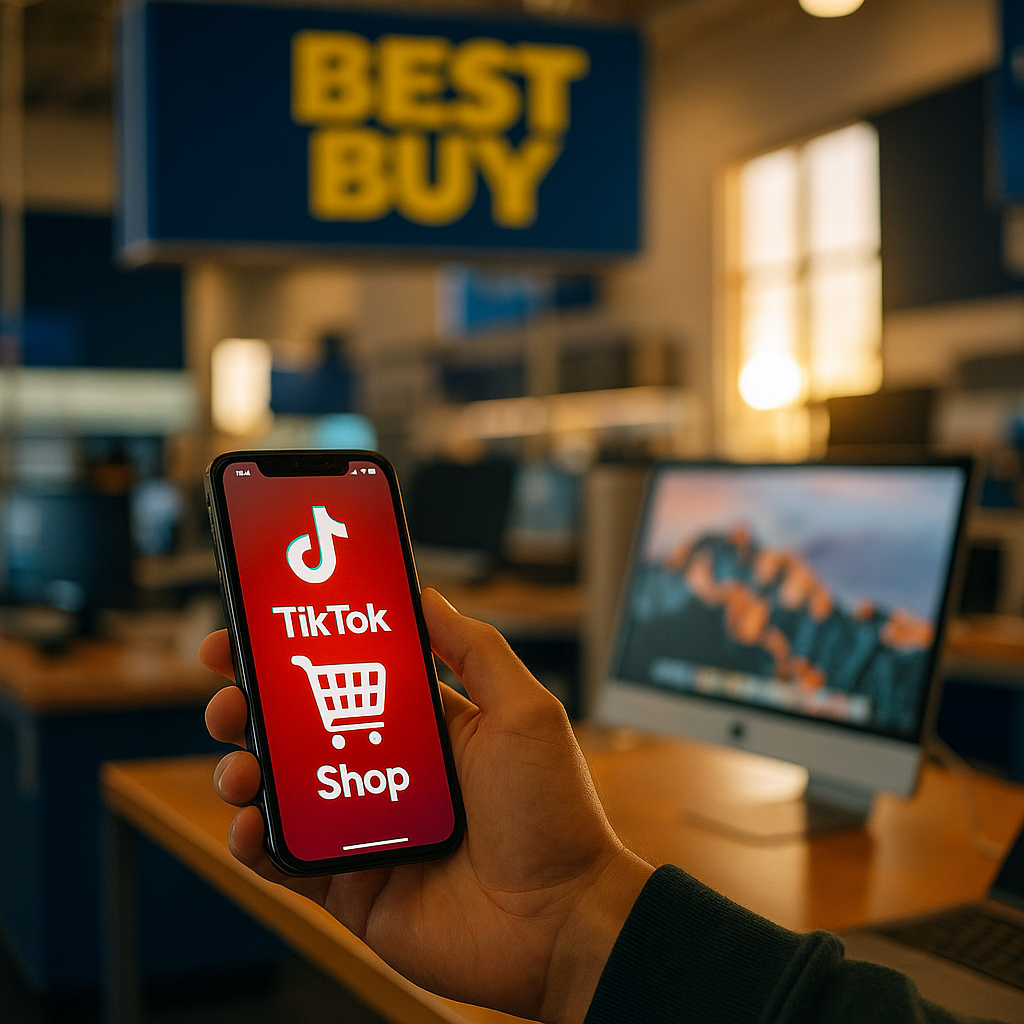
Electronics carry more purchase anxiety than almost any other retail category. So when Best Buy, a chain built on Geek Squad reassurance and blue-shirt expertise, puts its inventory inside TikTok Shop, it is a signal worth studying. A TikTok Shop launch from a retailer this risk-averse tells you the math finally works, even for high-consideration purchases that used to require a store visit and a sales associate’s blessing.
For electronics brands and retailers watching from the sidelines, Best Buy’s move is less a victory lap and more a field test. What worked, what broke, and what it means for anyone selling SKUs north of 200 dollars on a platform built for impulse buys.
Why Electronics Were the Last Category to Join Social Commerce
TikTok Shop built its early momentum on beauty, apparel, and novelty gadgets, things people buy on a whim after seeing a fifteen-second demo. Electronics retailers watched that wave and mostly stayed dry. The logic made sense: nobody impulse buys a 65 inch OLED television because a creator did a parkour transition in front of it.
Trust, warranty concerns, and return logistics kept most big-box electronics players out of the shop tab entirely. Customers wanted to touch a laptop before committing four figures to it. They wanted a human to explain the difference between two nearly identical soundbars. Social video felt better suited to lipstick swatches than spec sheets.
Best Buy’s entry suggests the barrier was never the category, it was the lack of a credible trust layer. Once that layer exists, even considered purchases move through short-form commerce.
What changed is the infrastructure around the purchase, not the purchase itself. Shoppable video now supports longer product demos, live replay, and bundled warranty add-ons at checkout. That shifts electronics from “too risky for impulse commerce” to “finally viable with the right guardrails.”
What Best Buy Actually Did Differently
Best Buy did not just slap a shop tab on existing social content. The retailer leaned into a few specific moves that smaller electronics sellers can copy without matching its budget.
- Tiered product rollout: Lower-ticket accessories (chargers, cases, smart plugs) went live first, building shop credibility before higher-consideration items like laptops and TVs joined the catalog.
- Geek Squad as content talent: Instead of outsourcing entirely to external creators, Best Buy used its own technical staff on camera, borrowing the built-in authority of a brand most shoppers already associate with expertise.
- Live shopping as a demo substitute: Live sessions replicated the in-store “ask a question, get an answer” dynamic that electronics buyers rely on, something static product pages can’t do.
- Return policy parity: Best Buy mirrored its in-store return window on TikTok Shop purchases, removing one of the biggest objections to buying electronics without handling them first.
None of this is exotic. It is disciplined execution of trust-building mechanics that other categories figured out years ago, applied to a category that assumed it was exempt.
Readers tracking how Best Buy builds its broader content operation will find useful context in how Best Buy’s AI content pipeline scales retail media, which shows the production backbone making a fast shop launch possible in the first place.
The Trust Gap Is the Real Product
Here is the uncomfortable truth for electronics retailers eyeing social commerce: your catalog isn’t the hard part. Your reputation is. TikTok Shop already has a counterfeit and quality-control problem in categories like electronics accessories, and shoppers know it. A retailer entering the space has to actively signal “this is the real thing, backed by a real company” in ways that pure creator-storefronts never had to.
That is partly why Best Buy’s launch leaned so heavily on in-house staff rather than a roster of unaffiliated creators. A Geek Squad technician explaining a product on camera carries institutional credibility that a random unboxing video does not. Electronics retailers without a recognizable brand name need to borrow that trust from somewhere else, whether that is manufacturer certification badges, verified warranty language, or creator partners with genuine technical credentials rather than general lifestyle reach.
This pattern isn’t unique to electronics. Other categories facing high trust bars have solved it with similar logic. Canon’s approach to EMEA content shows how a legacy hardware brand built trackable, trustworthy UGC into its sales funnel, detailed in how Canon EMEA turns creator UGC into trackable sales. TP-Link took a different route entirely, building its own creator channel rather than leaning on retail partners, as covered in how TP-Link built a creator channel to skip retail fees.
Compliance Is Not Optional Anymore
Electronics bring regulatory exposure that lifestyle categories mostly avoid: warranty claims, safety certifications, battery shipping restrictions, and accessibility disclosures all layer onto standard FTC endorsement rules. Any retailer scaling a TikTok Shop presence in this category needs a compliance process that goes further than a generic #ad disclosure.
Review the FTC’s endorsement guidance closely if your creator program touches technical claims about battery life, performance benchmarks, or compatibility. A creator overstating a laptop’s battery life in a sponsored video isn’t a minor slip, it’s a claim your legal team will have to defend if customers complain. Build creator briefs that specify exactly which claims are approved, and route anything touching specs or safety through a compliance check before it posts.
This is also where agencies and in-house teams increasingly diverge. GameSquare’s work with Chartis on making influencer ROI auditable, covered in how GameSquare and Chartis make influencer ROI auditable, points to where the industry is headed: documentation and auditability as a baseline requirement, not a nice-to-have.
What the Data Suggests About Category Readiness
Social commerce platforms don’t publish category-level conversion data the way retailers would like, but directional signals exist. eMarketer’s social commerce forecasts have repeatedly shown higher-ticket categories lagging behind apparel and beauty in shop-tab adoption, even as overall platform GMV climbs. That gap is exactly what Best Buy is betting it can close.
Crocs offers a useful parallel from a different angle: a brand that turned TikTok Shop into a genuinely large revenue channel by building creator density rather than relying on a single hero campaign, detailed in how Crocs turned TikTok Shop into a 52M creator channel. Comfrt did something similar at even larger creator scale, discussed in how Comfrt built a 600,000 creator TikTok Shop army. The lesson transfers: volume and repetition build the trust that a single flagship launch can’t.
Electronics retailers shouldn’t expect a single viral moment to carry a shop launch. The category needs repeated, credible exposure before conversion rates catch up to apparel and beauty benchmarks.
A Practical Entry Checklist for Electronics Retailers
If you’re weighing a TikTok Shop launch and you sell anything more complex than a phone case, a few operational steps matter more than creative polish.
- Start with accessories, not flagships. Build shop-tab trust on lower-risk SKUs before pushing high-ticket items into the feed.
- Mirror your existing return policy exactly. Any gap between in-store and social commerce returns becomes a trust leak.
- Use technical staff or certified creators, not generalists. Spec claims need a credible source on camera.
- Build a claims-approval workflow before scaling creator volume. Retrofitting compliance after a campaign launches is expensive and slow.
- Invest in live shopping for anything requiring explanation. Static video rarely answers the “but will this work for my setup” question that drives electronics hesitation.
None of this requires Best Buy’s budget. It requires Best Buy’s discipline, which is a far more replicable asset.
Where This Leaves Smaller Electronics Retailers
Mid-size electronics retailers don’t need to match Best Buy’s catalog breadth to benefit from its playbook. The core insight, that trust mechanics determine category viability more than product fit, applies at any scale. A regional electronics chain or a DTC hardware brand can borrow the tiered rollout and in-house credibility approach without needing Geek Squad’s name recognition. What they need instead is a clear, repeatable process for building that trust signal through creator selection and compliance rigor, which costs discipline more than dollars.
For teams building out their own creator operations from scratch, there’s value in studying how other hardware and tech brands structured their internal teams rather than outsourcing entirely, a pattern visible in why TP-Link hired a specialist instead of an agency. The common thread across every successful entry: someone internal owns the category expertise, and creators amplify it rather than replace it.
Best Buy’s launch won’t be the last major electronics retailer to test TikTok Shop, and it shouldn’t be treated as a finished case study. Treat it as an early signal, run a tiered pilot on your lowest-risk SKUs, document every compliance decision, and scale only once your return rate data proves the trust gap has actually closed.
FAQs
Is TikTok Shop a good fit for high-ticket electronics?
It can work, but only with strong trust signals in place: matched return policies, credible on-camera expertise, and transparent warranty terms. High-ticket items convert more slowly than accessories and need a longer trust-building runway before launch.
What compliance risks are unique to electronics creator content?
Electronics creators often make technical claims about battery life, performance, or compatibility that require more scrutiny than typical lifestyle endorsements. Retailers should route spec-related claims through a legal or compliance review before publishing, in line with FTC endorsement guidance.
Should electronics retailers use external creators or in-house staff for TikTok Shop content?
Best Buy’s approach favored in-house technical staff for credibility, but a hybrid model works well too: in-house talent for complex products, vetted external creators with genuine technical knowledge for broader reach.
How long does it typically take to see ROI from a TikTok Shop launch in electronics?
Most retailers should expect a multi-month ramp rather than immediate returns, since electronics shoppers typically research longer before converting. Starting with accessories helps generate faster, lower-risk revenue signals while flagship products build momentum.
What’s the biggest mistake electronics retailers make when entering social commerce?
Launching flagship, high-ticket SKUs first without first establishing trust through smaller purchases, consistent return policies, and credible on-camera expertise. Trust has to be built incrementally in this category, not assumed from day one.
FAQs
Is TikTok Shop a good fit for high-ticket electronics?
It can work, but only with strong trust signals in place: matched return policies, credible on-camera expertise, and transparent warranty terms. High-ticket items convert more slowly than accessories and need a longer trust-building runway before launch.
What compliance risks are unique to electronics creator content?
Electronics creators often make technical claims about battery life, performance, or compatibility that require more scrutiny than typical lifestyle endorsements. Retailers should route spec-related claims through a legal or compliance review before publishing, in line with FTC endorsement guidance.
Should electronics retailers use external creators or in-house staff for TikTok Shop content?
Best Buy’s approach favored in-house technical staff for credibility, but a hybrid model works well too: in-house talent for complex products, vetted external creators with genuine technical knowledge for broader reach.
How long does it typically take to see ROI from a TikTok Shop launch in electronics?
Most retailers should expect a multi-month ramp rather than immediate returns, since electronics shoppers typically research longer before converting. Starting with accessories helps generate faster, lower-risk revenue signals while flagship products build momentum.
What’s the biggest mistake electronics retailers make when entering social commerce?
Launching flagship, high-ticket SKUs first without first establishing trust through smaller purchases, consistent return policies, and credible on-camera expertise. Trust has to be built incrementally in this category, not assumed from day one.
Top Influencer Marketing Agencies
The leading agencies shaping influencer marketing in 2026
Agencies ranked by campaign performance, client diversity, platform expertise, proven ROI, industry recognition, and client satisfaction. Assessed through verified case studies, reviews, and industry consultations.
Moburst

-
2

The Shelf
Boutique Beauty & Lifestyle Influencer AgencyA data-driven boutique agency specializing exclusively in beauty, wellness, and lifestyle influencer campaigns on Instagram and TikTok. Best for brands already focused on the beauty/personal care space that need curated, aesthetic-driven content.Clients: Pepsi, The Honest Company, Hims, Elf Cosmetics, Pure LeafVisit The Shelf → -
3

Audiencly
Niche Gaming & Esports Influencer AgencyA specialized agency focused exclusively on gaming and esports creators on YouTube, Twitch, and TikTok. Ideal if your campaign is 100% gaming-focused — from game launches to hardware and esports events.Clients: Epic Games, NordVPN, Ubisoft, Wargaming, Tencent GamesVisit Audiencly → -
4

Viral Nation
Global Influencer Marketing & Talent AgencyA dual talent management and marketing agency with proprietary brand safety tools and a global creator network spanning nano-influencers to celebrities across all major platforms.Clients: Meta, Activision Blizzard, Energizer, Aston Martin, WalmartVisit Viral Nation → -
5

The Influencer Marketing Factory
TikTok, Instagram & YouTube CampaignsA full-service agency with strong TikTok expertise, offering end-to-end campaign management from influencer discovery through performance reporting with a focus on platform-native content.Clients: Google, Snapchat, Universal Music, Bumble, YelpVisit TIMF → -
6

NeoReach
Enterprise Analytics & Influencer CampaignsAn enterprise-focused agency combining managed campaigns with a powerful self-service data platform for influencer search, audience analytics, and attribution modeling.Clients: Amazon, Airbnb, Netflix, Honda, The New York TimesVisit NeoReach → -
7

Ubiquitous
Creator-First Marketing PlatformA tech-driven platform combining self-service tools with managed campaign options, emphasizing speed and scalability for brands managing multiple influencer relationships.Clients: Lyft, Disney, Target, American Eagle, NetflixVisit Ubiquitous → -
8

Obviously
Scalable Enterprise Influencer CampaignsA tech-enabled agency built for high-volume campaigns, coordinating hundreds of creators simultaneously with end-to-end logistics, content rights management, and product seeding.Clients: Google, Ulta Beauty, Converse, AmazonVisit Obviously →