


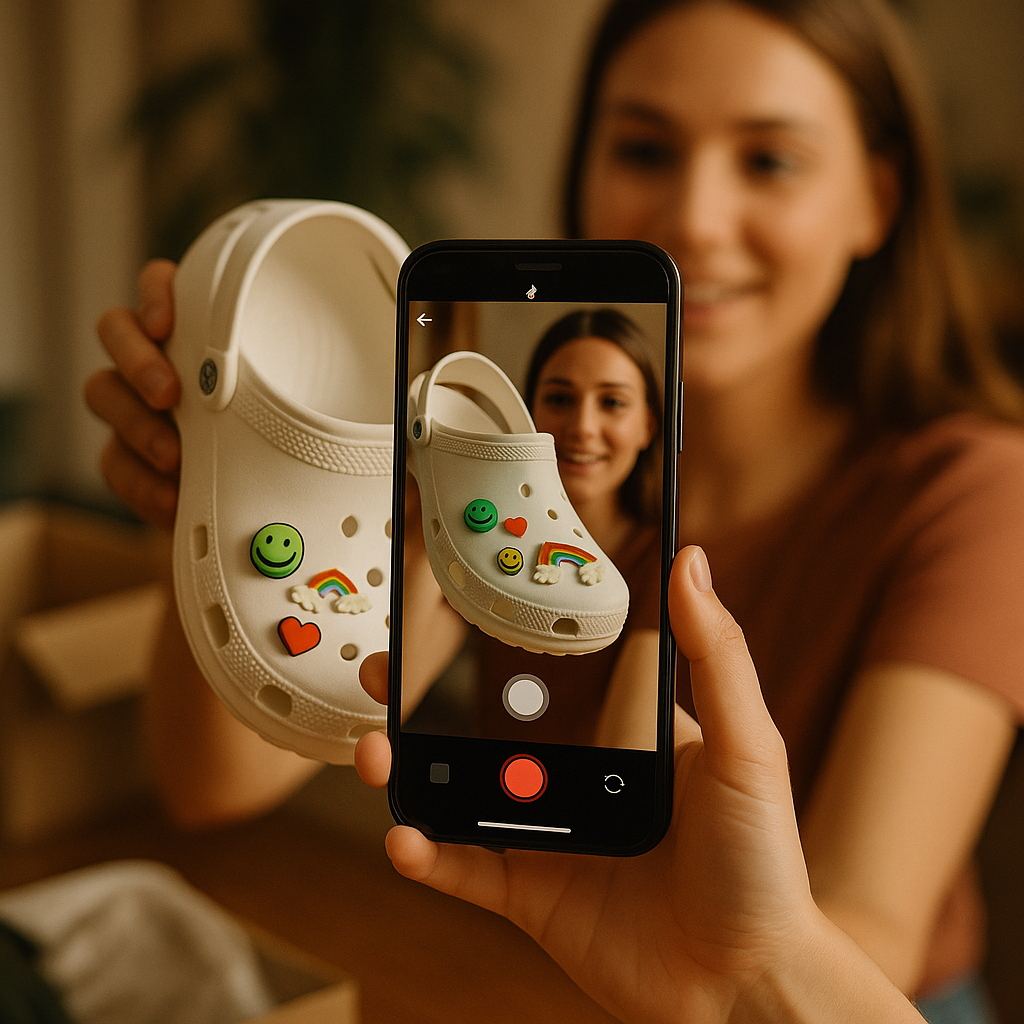
One brand did $52 million in TikTok Shop sales without a single celebrity campaign. Crocs, the foam clog everyone loved to mock a decade ago, is now one of the platform’s top sellers, built almost entirely on creator commerce mechanics most brands still treat as an afterthought. How did a legacy footwear company outmaneuver DTC darlings at their own game?
The $52 Million Question: What Actually Happened
Crocs didn’t stumble into TikTok Shop success. The brand restructured its entire influencer operation around commission-based affiliate selling, treating creators less like campaign talent and more like a distributed sales force. That distinction matters more than it sounds.
Most legacy brands still run influencer marketing like a media buy: pay a flat fee, get a post, hope for reach. Crocs flipped the model. Creators earn commission on every sale they drive, which means the brand only pays for performance, not promises. It’s the same logic behind affiliate marketing that’s existed for decades, except TikTok Shop compresses the discovery, purchase, and fulfillment loop into a single app session.
Crocs’ TikTok Shop strategy generated tens of millions in tracked revenue by paying creators on commission rather than flat fees, shifting the entire risk model from brand to performance.
Why TikTok Shop Rewards Volume Over Prestige
Here’s the part that trips up traditional marketing teams: TikTok Shop’s algorithm doesn’t care how big your creator is. It cares about conversion velocity. A nano creator with 8,000 followers who sells 40 pairs of clogs in a week can outperform a macro influencer with a million followers and a single flat-fee post.
Crocs leaned into this by recruiting hundreds, not dozens, of creators across wildly different follower tiers. The strategy resembles what e.l.f. Beauty did in building its own nine-figure TikTok Shop playbook, where breadth of creator participation mattered more than any single viral moment. Volume creates a flywheel: more videos mean more chances to rank in the shop feed, which means more sales, which means the algorithm keeps surfacing your product.
Compare this to Liquid Death’s approach, which turns micro creator UGC into trackable revenue through decentralized content production. Different category, same underlying principle: scale beats scarcity on commerce-native platforms.
Inside the Commission Structure
Crocs reportedly set tiered commission rates, higher percentages for creators who drive consistent volume, with bonus incentives during key retail windows like back-to-school and holiday. This isn’t groundbreaking in affiliate marketing broadly, but it’s still rare in influencer marketing, where flat fees and gifting still dominate budget allocation at most brands.
The math is simple enough that any brand can model it. Instead of paying $5,000 for a single sponsored post with uncertain ROI, Crocs pays a percentage of actual revenue generated. If a creator sells nothing, the brand spends nothing. If a creator sells thousands of dollars in product, both sides win proportionally.
- Base commission rates scaled by product category and margin
- Performance bonuses tied to sales velocity during promotional windows
- Product seeding used as a low-cost entry point for new creator relationships
- Exclusive drops and colorways reserved for top-performing affiliate creators
This model shifts risk almost entirely onto the brand’s terms, which is exactly why finance teams love it once marketing can prove the mechanics work.
The Content That Actually Converts
Scroll through Crocs-branded TikTok Shop content and you won’t find polished brand films. You’ll find unboxings, try-on hauls, styling tutorials, and comedic bits about how ugly the shoes are (a joke Crocs has embraced for years, honestly). This unpolished, native-feeling content performs better on TikTok Shop than anything resembling a traditional ad.
The pattern echoes what CeraVe discovered when a viral joke turned into an actual sales lift, proof that authenticity and humor often outperform polished brand messaging on platforms where users expect entertainment first, product second.
Crocs also benefits from a built-in advantage: the product is inherently visual, colorful, customizable with Jibbitz charms, and easy to demonstrate in a fifteen-second clip. Not every brand has that luxury, but the lesson transfers regardless of category. Give creators something worth filming, and the commission structure does the rest.
What Brands Get Wrong About TikTok Shop
Plenty of brands have tried and failed to replicate Crocs-level results on TikTok Shop. The most common mistake? Treating it as a distribution channel for existing content instead of a distinct commerce environment with its own creator incentives, discovery mechanics, and buyer psychology.
Another frequent error is underinvesting in the affiliate recruitment pipeline. Brands assume creators will find them organically once a shop is live. They won’t, not at scale. Crocs invested in active creator outreach and onboarding, similar to how TP-Link chose to hire a specialist rather than rely on a generalist agency to build category-specific creator relationships instead of broad, shallow ones.
Fulfillment and logistics also trip up brands that haven’t operationalized TikTok Shop as a real sales channel. Late shipments, inventory mismatches, and slow customer service response times tank shop ratings fast, and TikTok’s algorithm punishes underperforming shops by reducing product visibility. Crocs’ existing DTC infrastructure gave it an advantage most challenger brands don’t have on day one.
Is This Model Repeatable Outside Footwear?
Yes, but with caveats. The commission-first, volume-heavy approach works best for products with broad appeal, visual differentiation, and healthy margins that can absorb affiliate payouts without crushing profitability. Categories like beauty, apparel, and home goods have seen similar dynamics play out, according to trend data from eMarketer’s coverage of social commerce growth.
Brands operating on thinner margins need to be more selective about commission rates and creator tiers. It’s not a strategy you copy wholesale, it’s a framework you adapt to your own unit economics. Henkel’s approach to fusing creator commerce into FMCG retail media offers a useful comparison point for brands operating with tighter margins than a fashion or footwear label.
Compliance also deserves attention here. Affiliate and commission-based creator relationships still fall under the same disclosure requirements as any sponsored content. Brands should review the FTC’s endorsement guidelines to ensure creators are properly disclosing paid partnerships, especially as commission structures scale into the hundreds of creators.
Measuring What Matters
Attribution on TikTok Shop is genuinely easier than most influencer marketing channels because the purchase happens inside the app. No last-click confusion, no cross-platform guesswork. That said, brands still need to track cost per sale, creator-level ROI, and repeat purchase rates to know whether the model is actually profitable long-term, not just top-line impressive.
This mirrors the attribution discipline Coty applied when it rebuilt influencer spend around sales data rather than vanity metrics, a shift documented in how Coty rebuilt its entire influencer spend model around sales attribution. Vanity metrics like views and likes matter less when commission dollars are directly tied to conversion.
For brands benchmarking their own social commerce performance, resources like Sprout Social’s social commerce reporting tools and HubSpot’s marketing analytics guidance offer useful frameworks for structuring dashboards around creator-driven revenue rather than engagement alone.
Key Takeaway
Crocs didn’t win TikTok Shop with a bigger budget or a celebrity face. It won by restructuring risk, paying for performance instead of promises, and treating hundreds of small creators as a distributed sales channel. Any brand willing to rebuild its commission structure and creator recruitment pipeline around that logic can compete, regardless of category or company size.
Frequently Asked Questions
How much did Crocs actually earn from TikTok Shop?
Reports indicate Crocs generated approximately $52 million in tracked TikTok Shop sales, driven primarily by a commission-based affiliate creator model rather than traditional flat-fee sponsorships.
What makes TikTok Shop different from regular influencer marketing?
TikTok Shop integrates discovery, purchase, and fulfillment inside a single app experience, which allows for direct sales attribution. Traditional influencer marketing typically relies on external links or codes, creating attribution gaps that TikTok Shop largely eliminates.
Do brands need celebrity creators to succeed on TikTok Shop?
No. Crocs’ strategy relied heavily on volume across nano and micro creators rather than celebrity endorsements. TikTok Shop’s algorithm rewards conversion velocity and content volume over follower count alone.
How do commission-based creator programs work?
Creators earn a percentage of sales generated through their content instead of a flat upfront fee. This shifts financial risk from the brand to a performance-based model, meaning brands only pay when actual sales occur.
Is the Crocs model repeatable for other product categories?
The framework is adaptable but works best for products with strong visual appeal, broad audience relevance, and margins healthy enough to support commission payouts. Brands in beauty, apparel, and home goods have applied similar principles successfully.
FAQs
How much did Crocs actually earn from TikTok Shop?
Reports indicate Crocs generated approximately $52 million in tracked TikTok Shop sales, driven primarily by a commission-based affiliate creator model rather than traditional flat-fee sponsorships.
Top Influencer Marketing Agencies
The leading agencies shaping influencer marketing in 2026
Agencies ranked by campaign performance, client diversity, platform expertise, proven ROI, industry recognition, and client satisfaction. Assessed through verified case studies, reviews, and industry consultations.
Moburst

-
2

The Shelf
Boutique Beauty & Lifestyle Influencer AgencyA data-driven boutique agency specializing exclusively in beauty, wellness, and lifestyle influencer campaigns on Instagram and TikTok. Best for brands already focused on the beauty/personal care space that need curated, aesthetic-driven content.Clients: Pepsi, The Honest Company, Hims, Elf Cosmetics, Pure LeafVisit The Shelf → -
3

Audiencly
Niche Gaming & Esports Influencer AgencyA specialized agency focused exclusively on gaming and esports creators on YouTube, Twitch, and TikTok. Ideal if your campaign is 100% gaming-focused — from game launches to hardware and esports events.Clients: Epic Games, NordVPN, Ubisoft, Wargaming, Tencent GamesVisit Audiencly → -
4

Viral Nation
Global Influencer Marketing & Talent AgencyA dual talent management and marketing agency with proprietary brand safety tools and a global creator network spanning nano-influencers to celebrities across all major platforms.Clients: Meta, Activision Blizzard, Energizer, Aston Martin, WalmartVisit Viral Nation → -
5

The Influencer Marketing Factory
TikTok, Instagram & YouTube CampaignsA full-service agency with strong TikTok expertise, offering end-to-end campaign management from influencer discovery through performance reporting with a focus on platform-native content.Clients: Google, Snapchat, Universal Music, Bumble, YelpVisit TIMF → -
6

NeoReach
Enterprise Analytics & Influencer CampaignsAn enterprise-focused agency combining managed campaigns with a powerful self-service data platform for influencer search, audience analytics, and attribution modeling.Clients: Amazon, Airbnb, Netflix, Honda, The New York TimesVisit NeoReach → -
7

Ubiquitous
Creator-First Marketing PlatformA tech-driven platform combining self-service tools with managed campaign options, emphasizing speed and scalability for brands managing multiple influencer relationships.Clients: Lyft, Disney, Target, American Eagle, NetflixVisit Ubiquitous → -
8

Obviously
Scalable Enterprise Influencer CampaignsA tech-enabled agency built for high-volume campaigns, coordinating hundreds of creators simultaneously with end-to-end logistics, content rights management, and product seeding.Clients: Google, Ulta Beauty, Converse, AmazonVisit Obviously →