


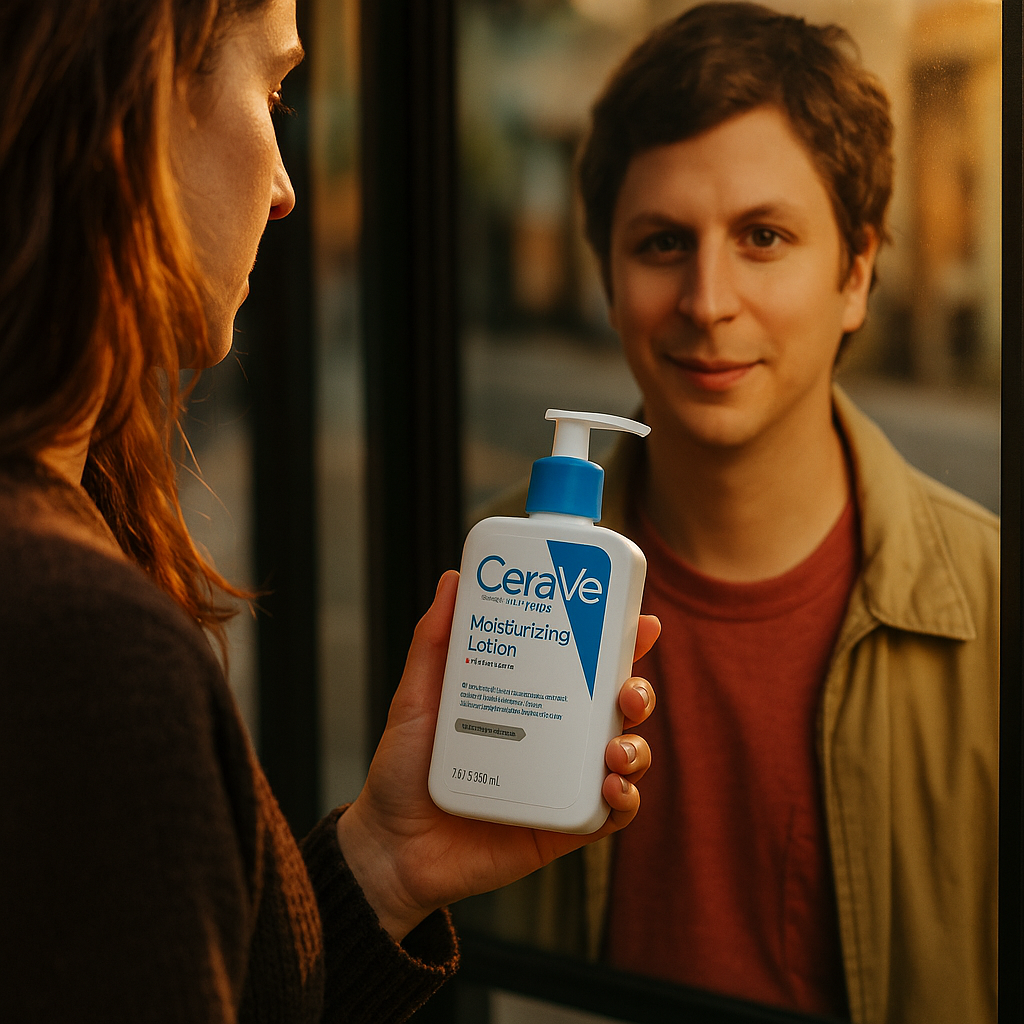
One Super Bowl ad. One decade-old internet joke about a Canadian actor sharing syllables with a skincare brand. And a reported double-digit search spike within 48 hours. The CeraVe Michael Cera campaign is the rare case where a brand weaponized confusion instead of correcting it, then backed the punchline with clinical credibility to convert attention into cart adds.
The Joke That Predates the Campaign
For years, people mispronounced CeraVe as “Sera-vee” or joked that actor Michael Cera secretly owned the brand. It was a harmless meme, the kind that surfaces every few months on social media and fades. Most brands would ignore it. CeraVe’s marketing team, working with agency partners, decided the confusion was too good to waste.
The result: a Super Bowl LVIII spot in which Michael Cera plays a deadpan “founder” of CeraVe, touring a fictional headquarters and taking credit for the brand’s dermatologist-developed formulas. It was absurd, self-aware, and impossible to ignore. That’s the point. Attention in a 30-second national ad slot costs millions, and CeraVe made sure every dollar bought something people would actually talk about the next morning.
The campaign worked because it did not ask consumers to believe a celebrity endorsement. It asked them to enjoy a joke, then quietly reminded them the product is developed with dermatologists, not celebrities.
Why Dermatologist Credibility Was the Real Hero
Here’s the part most recaps skip. CeraVe’s entire brand equity rests on a clinical positioning: developed with dermatologists, recommended in-office, formulated around ceramides. Michael Cera’s comedic performance never claimed medical authority. He played it straight as the “inventor,” and the humor came from the audience knowing that’s false, that the real story is a lab full of dermatologists, not a Hollywood actor.
That gap between the joke and the truth is what made the campaign safe from a compliance standpoint. CeraVe never implied Michael Cera formulated the product or endorsed it clinically. He was cast as a satirical foil, which sidesteps the stricter disclosure requirements that apply when a celebrity makes an actual efficacy claim. Marketers dealing with regulated categories (skincare, supplements, health) should study this distinction closely, since the FTC’s endorsement guidelines treat implied claims and literal claims very differently.
What the Campaign Did Not Do
- It did not position Michael Cera as a dermatology expert or medical spokesperson.
- It did not remove or downplay the brand’s existing dermatologist partnerships and clinical messaging.
- It did not run without a compliance review of every joke that touched product claims.
The Numbers Behind the Meme
Search interest for “CeraVe” spiked sharply in the days following the Super Bowl airing, with brand search volume reportedly climbing well above typical post-Super Bowl bumps for skincare advertisers. Retail data cited by industry trackers showed a short-term sales lift at mass retailers in the following weeks, consistent with the pattern eMarketer has documented for high-visibility cultural moments in beauty and personal care. Social listening volume around the CeraVe name also surged, much of it organic remixing of the ad rather than paid amplification.
What’s notable for brand strategists is the shelf-level effect. CeraVe wasn’t just trending online, it was moving off physical shelves at Target, Walmart, and CVS at a measurably faster clip than the prior quarter’s baseline. That’s the difference between a viral moment and a commercial one. Plenty of ads generate laughs and zero incremental revenue. This one closed the loop.
A viral moment without a credibility anchor is just noise. CeraVe paired the joke with dermatologist-backed proof points, which is why the spike showed up in sales data, not just social mentions.
How This Fits the Broader Creator and Celebrity Playbook
CeraVe’s move isn’t isolated. Brands increasingly blend celebrity stunt marketing with creator-style authenticity signals to hedge against ad fatigue. Compare this to how Dr. Squatch used YouTube comedy to win retail shelf space, or how Duolingo systemized virality around its mascot’s unhinged persona. Both brands leaned into absurdity while protecting a credible product core underneath the jokes.
The pattern extends to creator economy strategy too. e.l.f. Beauty’s TikTok Shop playbook shows how humor and cultural relevance can be systematized into repeatable commerce, not just one-off stunts. And Feastables’ nano-creator taste tests prove that credibility signals, whether dermatologist backing or genuine product testing, still outperform pure celebrity wattage when it comes to converting attention into sales.
What Brand Marketers Should Actually Steal From This
Skip the temptation to copy the celebrity stunt itself. The transferable lesson is structural, not creative.
- Find your existing cultural confusion or meme, don’t manufacture one. CeraVe didn’t invent the Michael Cera joke, it mined a real pattern already living in consumer conversation. Check social listening data for recurring jokes, mispronunciations, or misattributions tied to your brand name.
- Pair the stunt with a credibility layer that survives scrutiny. For CeraVe, that was dermatologist development. For a fintech brand, it might be regulatory compliance. For a food brand, it might be sourcing transparency.
- Run the joke through legal and compliance before media buys, not after. Regulated categories can’t afford a viral moment that also triggers a disclosure violation.
- Measure beyond impressions. Track search lift, retail sell-through, and social sentiment together. A meme that doesn’t move product isn’t a marketing win, it’s a content win, and those pay different bills.
Where the Model Has Limits
Not every brand has a decade-old meme sitting dormant, ready to be activated. Manufacturing a fake confusion moment from scratch usually reads as forced, and audiences are unusually good at smelling manufactured virality now. There’s also risk in leaning on a celebrity whose off-brand behavior could later contaminate the association, a lesson plenty of marketing teams have learned the hard way after a celebrity partner became a liability months into a campaign.
Budget matters too. A Super Bowl slot plus celebrity talent fee plus production is a multimillion-dollar bet most mid-market brands can’t place. The scaled-down version of this strategy looks more like what Liquid Death does with micro-creator UGC, using irreverent humor at a fraction of the cost while still tying content back to trackable revenue.
Operational Takeaways for Brand and Agency Teams
If you’re building next year’s campaign calendar, the CeraVe case offers a usable framework rather than a one-time story. Audit your brand’s existing meme equity first. Then decide whether a credibility layer, clinical, regulatory, or reputational, exists to support a stunt before you greenlight the creative. Finally, budget for measurement infrastructure that connects social buzz to actual retail or e-commerce data, because that connection is what separates a case study from a cautionary tale.
Marketing teams evaluating similar plays should also review HubSpot’s campaign benchmarking resources and cross-reference category-specific ad performance data on Statista before committing seven figures to a single cultural bet.
Frequently Asked Questions
Why did CeraVe cast Michael Cera in its campaign?
CeraVe leaned into an existing internet joke about people confusing the brand name with actor Michael Cera. Casting him as a fictional “founder” turned a long-running meme into a Super Bowl moment with built-in shareability.
Did the campaign actually increase sales?
Reported search volume and retail sell-through data showed a measurable short-term lift following the ad’s airing, with brand searches and shelf movement both climbing above typical post-Super Bowl baselines for the category.
Was the Michael Cera campaign a genuine celebrity endorsement?
No. Michael Cera played a satirical role rather than making clinical or efficacy claims, which kept the campaign outside the stricter disclosure requirements that apply to genuine product endorsements.
Can smaller brands replicate this strategy?
Yes, at a smaller scale. The core mechanic, pairing a real cultural confusion or joke with a credible proof point, works without a Super Bowl budget if executed through creator content or social-first campaigns instead of national TV.
What role did dermatologist backing play in the campaign’s success?
It gave the joke a safety net. Audiences could laugh at the absurd premise while still trusting the product’s clinical credibility, which is what likely converted attention into actual purchases rather than just social engagement.
Frequently Asked Questions
Why did CeraVe cast Michael Cera in its campaign?
CeraVe leaned into an existing internet joke about people confusing the brand name with actor Michael Cera. Casting him as a fictional “founder” turned a long-running meme into a Super Bowl moment with built-in shareability.
Did the campaign actually increase sales?
Reported search volume and retail sell-through data showed a measurable short-term lift following the ad’s airing, with brand searches and shelf movement both climbing above typical post-Super Bowl baselines for the category.
Was the Michael Cera campaign a genuine celebrity endorsement?
No. Michael Cera played a satirical role rather than making clinical or efficacy claims, which kept the campaign outside the stricter disclosure requirements that apply to genuine product endorsements.
Can smaller brands replicate this strategy?
Yes, at a smaller scale. The core mechanic, pairing a real cultural confusion or joke with a credible proof point, works without a Super Bowl budget if executed through creator content or social-first campaigns instead of national TV.
What role did dermatologist backing play in the campaign’s success?
It gave the joke a safety net. Audiences could laugh at the absurd premise while still trusting the product’s clinical credibility, which is what likely converted attention into actual purchases rather than just social engagement.
The next brand that finds an untapped meme sitting in its own name or category should treat it as an asset audit, not a punchline, then pressure-test the credibility layer before greenlighting the media buy.
Top Influencer Marketing Agencies
The leading agencies shaping influencer marketing in 2026
Agencies ranked by campaign performance, client diversity, platform expertise, proven ROI, industry recognition, and client satisfaction. Assessed through verified case studies, reviews, and industry consultations.
Moburst

-
2

The Shelf
Boutique Beauty & Lifestyle Influencer AgencyA data-driven boutique agency specializing exclusively in beauty, wellness, and lifestyle influencer campaigns on Instagram and TikTok. Best for brands already focused on the beauty/personal care space that need curated, aesthetic-driven content.Clients: Pepsi, The Honest Company, Hims, Elf Cosmetics, Pure LeafVisit The Shelf → -
3

Audiencly
Niche Gaming & Esports Influencer AgencyA specialized agency focused exclusively on gaming and esports creators on YouTube, Twitch, and TikTok. Ideal if your campaign is 100% gaming-focused — from game launches to hardware and esports events.Clients: Epic Games, NordVPN, Ubisoft, Wargaming, Tencent GamesVisit Audiencly → -
4

Viral Nation
Global Influencer Marketing & Talent AgencyA dual talent management and marketing agency with proprietary brand safety tools and a global creator network spanning nano-influencers to celebrities across all major platforms.Clients: Meta, Activision Blizzard, Energizer, Aston Martin, WalmartVisit Viral Nation → -
5

The Influencer Marketing Factory
TikTok, Instagram & YouTube CampaignsA full-service agency with strong TikTok expertise, offering end-to-end campaign management from influencer discovery through performance reporting with a focus on platform-native content.Clients: Google, Snapchat, Universal Music, Bumble, YelpVisit TIMF → -
6

NeoReach
Enterprise Analytics & Influencer CampaignsAn enterprise-focused agency combining managed campaigns with a powerful self-service data platform for influencer search, audience analytics, and attribution modeling.Clients: Amazon, Airbnb, Netflix, Honda, The New York TimesVisit NeoReach → -
7

Ubiquitous
Creator-First Marketing PlatformA tech-driven platform combining self-service tools with managed campaign options, emphasizing speed and scalability for brands managing multiple influencer relationships.Clients: Lyft, Disney, Target, American Eagle, NetflixVisit Ubiquitous → -
8

Obviously
Scalable Enterprise Influencer CampaignsA tech-enabled agency built for high-volume campaigns, coordinating hundreds of creators simultaneously with end-to-end logistics, content rights management, and product seeding.Clients: Google, Ulta Beauty, Converse, AmazonVisit Obviously →