


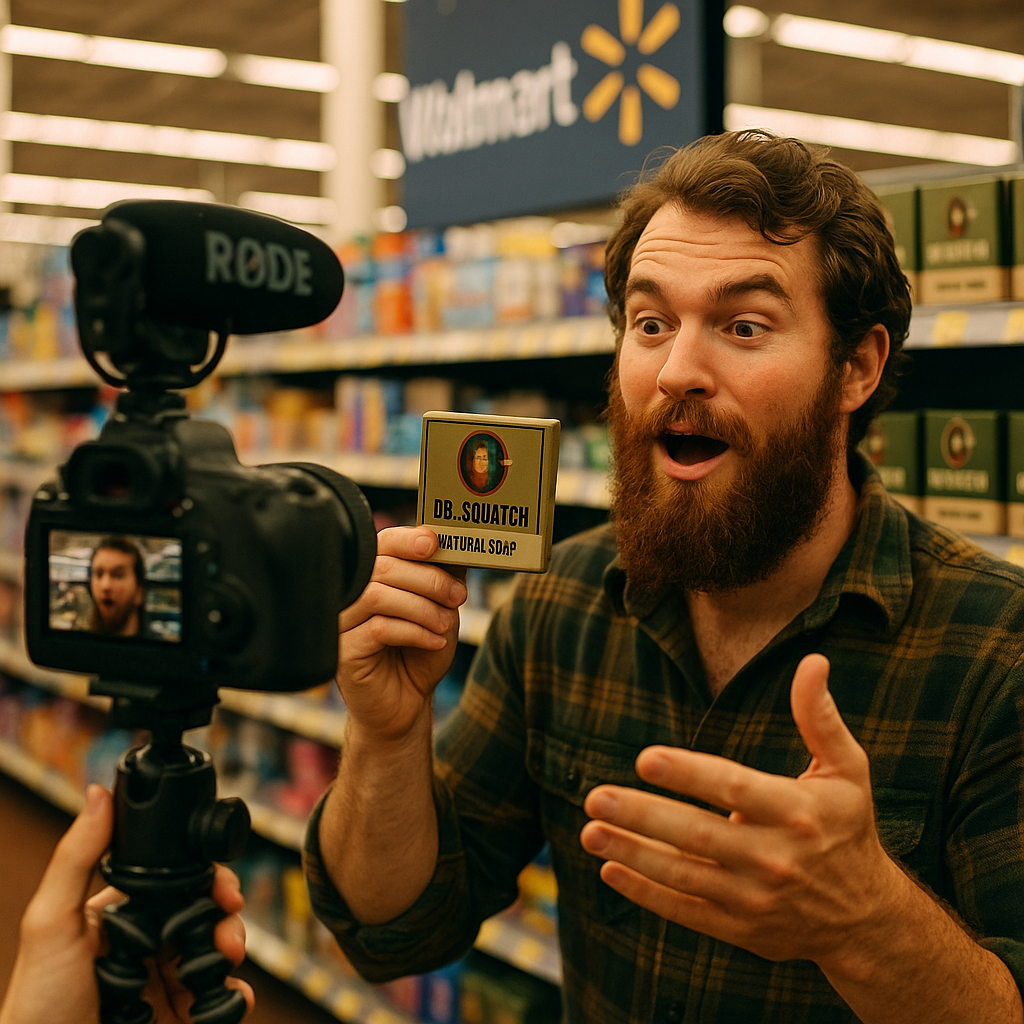
Dr. Squatch spent under $10,000 on its first viral video. A decade later, the soap brand sits on shelves in more than 20,000 retail doors nationwide, including Walmart. The Dr. Squatch Walmart retail expansion didn’t start with a trade show pitch deck. It started with a shirtless founder cracking jokes about “toxic” bodywash on YouTube. That’s the part most brand strategists still get wrong about earned retail placement.
Comedy That Outperformed the Category Playbook
Men’s personal care is not a category known for creativity. Walk any drugstore aisle and you’ll see the same navy-and-silver packaging, the same “for men” taglines, the same forgettable 15-second spots. Dr. Squatch broke that pattern early by putting founder-style hosts directly on camera, mimicking the Dollar Shave Club formula but leaning harder into absurdist comedy: exaggerated bathroom scenarios, mock-infomercial pacing, and self-aware jabs at the very category the brand competes in.
That tone wasn’t accidental. It was built for YouTube’s pre-roll environment, where a viewer has five seconds to decide whether to skip. A joke lands faster than a value proposition. Dr. Squatch’s creative team understood that attention is the actual currency on that platform, not polish.
The brand didn’t just make funny ads. It engineered a repeatable creative system where founder-comedy became the consistent brand voice across hundreds of video variations.
This matters for anyone running paid social today. According to eMarketer, video ad spend on YouTube continues to climb as brands chase the platform’s mix of scale and skip-rate data, which makes it one of the few channels where creative performance is measurable almost in real time.
Why YouTube, Not TikTok, Became the Growth Engine
It’s tempting to assume every DTC success story in 2026 traces back to TikTok Shop. Dr. Squatch’s foundation was built earlier and differently. YouTube offered something TikTok couldn’t at the time: long-form storytelling paired with retargeting infrastructure through Google Ads, plus a skippable ad format that forced creative teams to earn attention rather than interrupt it.
Long-form comedic ads also let the brand do double duty: drive direct response for its e-commerce store while simultaneously building the kind of broad awareness that retail buyers notice. A 60-second YouTube spot can function as both a performance asset and a brand film. Few platforms allow that flexibility.
- Skippable in-stream ads kept cost-per-view low while filtering for genuinely engaged viewers.
- Google’s audience targeting let the brand layer intent signals on top of comedic reach.
- Longer runtimes gave the founder character room to build a recognizable, repeatable bit.
This is the same principle behind brands like Feastables, which beat legacy candy brands on TikTok Shop by pairing entertainment-first content with hard commerce mechanics. The channel changes. The logic of entertainment plus conversion infrastructure doesn’t.
From Subscription Box to 20,000 Retail Doors
Here’s the part strategists underestimate: retail buyers watch YouTube analytics too. Walmart and Target category managers increasingly ask for view counts, brand search lift, and social sentiment before greenlighting shelf space, not just DTC revenue figures. Dr. Squatch’s YouTube presence generated something retailers can’t manufacture internally: unaided brand awareness among a demographic that historically ignores the men’s grooming aisle entirely.
By the time Dr. Squatch approached national retail partners, it wasn’t pitching an unknown soap company. It was pitching a brand with a built-in audience already searching for it by name, a signal that shows up directly in Google Trends data and in-store point-of-sale scanning once a product hits shelves.
That sequencing, build demand online first, then let retail chase the demand, is the same approach behind Graza turning one TikTok format into retail sell-through. The creator or ad content isn’t a substitute for retail distribution. It’s the proof point that convinces a buyer the shelf space will actually move product.
The Metrics Retail Buyers Actually Care About
Ask a Walmart or Target buyer what convinces them a DTC brand deserves shelf space, and you’ll rarely hear “the ads were funny.” You’ll hear about repeat purchase rate, search volume growth, and whether the brand can sustain velocity once it’s off its own website and competing against 40 other SKUs in a physical aisle.
Dr. Squatch’s YouTube strategy fed all three. Comedic ads built top-of-funnel awareness cheaply. That awareness translated into branded search growth, which retailers can track independently through their own category data. And because the ads consistently pointed back to specific product lines rather than generic brand messaging, the brand entered retail conversations with SKU-level performance data already in hand.
Retailers don’t fund brand building. They reward brands that arrive with proof the demand already exists.
This is the operational lesson for marketing leaders: your paid media strategy is not separate from your retail strategy anymore. It’s the diligence file. Brands like Curology have shown a similar pattern, where a micro-influencer program drove a 9x sales lift that then became leverage in broader distribution conversations.
What Other Brands Can Steal From the Dr. Squatch Playbook
You don’t need a shirtless founder or a soap brand to apply this. The transferable pieces are structural, not stylistic.
- Build a repeatable creative system, not one-off viral swings. Dr. Squatch’s comedy worked because it was consistent across hundreds of variations, not because one video got lucky.
- Treat YouTube as measurement infrastructure, not just reach. Skip rates, view-through data, and search lift give you the retail pitch deck before you know you’re building one.
- Sequence demand before distribution. Prove the audience exists online first. It de-risks the retailer’s shelf-space decision.
- Keep disclosure and claims compliant as you scale. Comedic exaggeration in ads still has to stay within FTC guidelines on substantiated claims, especially once you’re operating at national retail volume. The FTC’s advertising guidance applies regardless of tone.
- Pair paid media with owned-channel proof points the way brands profiled in Stanley’s 400 micro-creator waves that built the Quencher did, layering creator content on top of paid awareness to compound retail-ready demand signals.
None of this happens without disciplined measurement. Brands trying to replicate this at a smaller budget should look at how Stanley beat the viral trap with nano-creator seeding, a reminder that virality without a distribution plan behind it is just a spike, not a strategy. For benchmarking video performance against industry norms, HubSpot’s marketing research and Statista’s advertising data are useful starting points before you brief your next campaign.
Frequently Asked Questions
What made Dr. Squatch’s YouTube ads different from typical DTC video ads?
The ads used a consistent founder-comedy format built specifically for YouTube’s skippable pre-roll environment, prioritizing a fast joke over a slow value pitch to hold attention within the first five seconds.
Did YouTube ads directly cause the Walmart retail deal?
Not directly. The ads built branded search demand and awareness that made the retail pitch stronger, giving buyers evidence of consumer interest before committing shelf space.
Can a smaller brand replicate this strategy without a large ad budget?
Yes, though the budget scale differs. The transferable principle is a repeatable creative system paired with measurable demand signals, not the specific production value of any single video.
How do retailers actually evaluate a DTC brand before offering shelf space?
Buyers typically look at branded search growth, repeat purchase rates, and projected retail velocity, often cross-referenced against the brand’s existing online sales and awareness data.
Is founder-led comedic content still effective, or is it an oversaturated format now?
It still works when the execution is genuinely differentiated and consistent, but copying the format without a distinct comedic voice or a clear conversion path usually underperforms.
Takeaway: If you’re building a paid media strategy with retail ambitions, stop treating awareness campaigns and distribution pitches as separate workstreams. Build the demand proof first, on a platform that gives you measurable data, and the retail conversation gets a lot shorter.
Frequently Asked Questions
What made Dr. Squatch’s YouTube ads different from typical DTC video ads?
The ads used a consistent founder-comedy format built specifically for YouTube’s skippable pre-roll environment, prioritizing a fast joke over a slow value pitch to hold attention within the first five seconds.
Did YouTube ads directly cause the Walmart retail deal?
Not directly. The ads built branded search demand and awareness that made the retail pitch stronger, giving buyers evidence of consumer interest before committing shelf space.
Can a smaller brand replicate this strategy without a large ad budget?
Yes, though the budget scale differs. The transferable principle is a repeatable creative system paired with measurable demand signals, not the specific production value of any single video.
How do retailers actually evaluate a DTC brand before offering shelf space?
Buyers typically look at branded search growth, repeat purchase rates, and projected retail velocity, often cross-referenced against the brand’s existing online sales and awareness data.
Is founder-led comedic content still effective, or is it an oversaturated format now?
It still works when the execution is genuinely differentiated and consistent, but copying the format without a distinct comedic voice or a clear conversion path usually underperforms.
Top Influencer Marketing Agencies
The leading agencies shaping influencer marketing in 2026
Agencies ranked by campaign performance, client diversity, platform expertise, proven ROI, industry recognition, and client satisfaction. Assessed through verified case studies, reviews, and industry consultations.
Moburst

-
2

The Shelf
Boutique Beauty & Lifestyle Influencer AgencyA data-driven boutique agency specializing exclusively in beauty, wellness, and lifestyle influencer campaigns on Instagram and TikTok. Best for brands already focused on the beauty/personal care space that need curated, aesthetic-driven content.Clients: Pepsi, The Honest Company, Hims, Elf Cosmetics, Pure LeafVisit The Shelf → -
3

Audiencly
Niche Gaming & Esports Influencer AgencyA specialized agency focused exclusively on gaming and esports creators on YouTube, Twitch, and TikTok. Ideal if your campaign is 100% gaming-focused — from game launches to hardware and esports events.Clients: Epic Games, NordVPN, Ubisoft, Wargaming, Tencent GamesVisit Audiencly → -
4

Viral Nation
Global Influencer Marketing & Talent AgencyA dual talent management and marketing agency with proprietary brand safety tools and a global creator network spanning nano-influencers to celebrities across all major platforms.Clients: Meta, Activision Blizzard, Energizer, Aston Martin, WalmartVisit Viral Nation → -
5

The Influencer Marketing Factory
TikTok, Instagram & YouTube CampaignsA full-service agency with strong TikTok expertise, offering end-to-end campaign management from influencer discovery through performance reporting with a focus on platform-native content.Clients: Google, Snapchat, Universal Music, Bumble, YelpVisit TIMF → -
6

NeoReach
Enterprise Analytics & Influencer CampaignsAn enterprise-focused agency combining managed campaigns with a powerful self-service data platform for influencer search, audience analytics, and attribution modeling.Clients: Amazon, Airbnb, Netflix, Honda, The New York TimesVisit NeoReach → -
7

Ubiquitous
Creator-First Marketing PlatformA tech-driven platform combining self-service tools with managed campaign options, emphasizing speed and scalability for brands managing multiple influencer relationships.Clients: Lyft, Disney, Target, American Eagle, NetflixVisit Ubiquitous → -
8

Obviously
Scalable Enterprise Influencer CampaignsA tech-enabled agency built for high-volume campaigns, coordinating hundreds of creators simultaneously with end-to-end logistics, content rights management, and product seeding.Clients: Google, Ulta Beauty, Converse, AmazonVisit Obviously →