


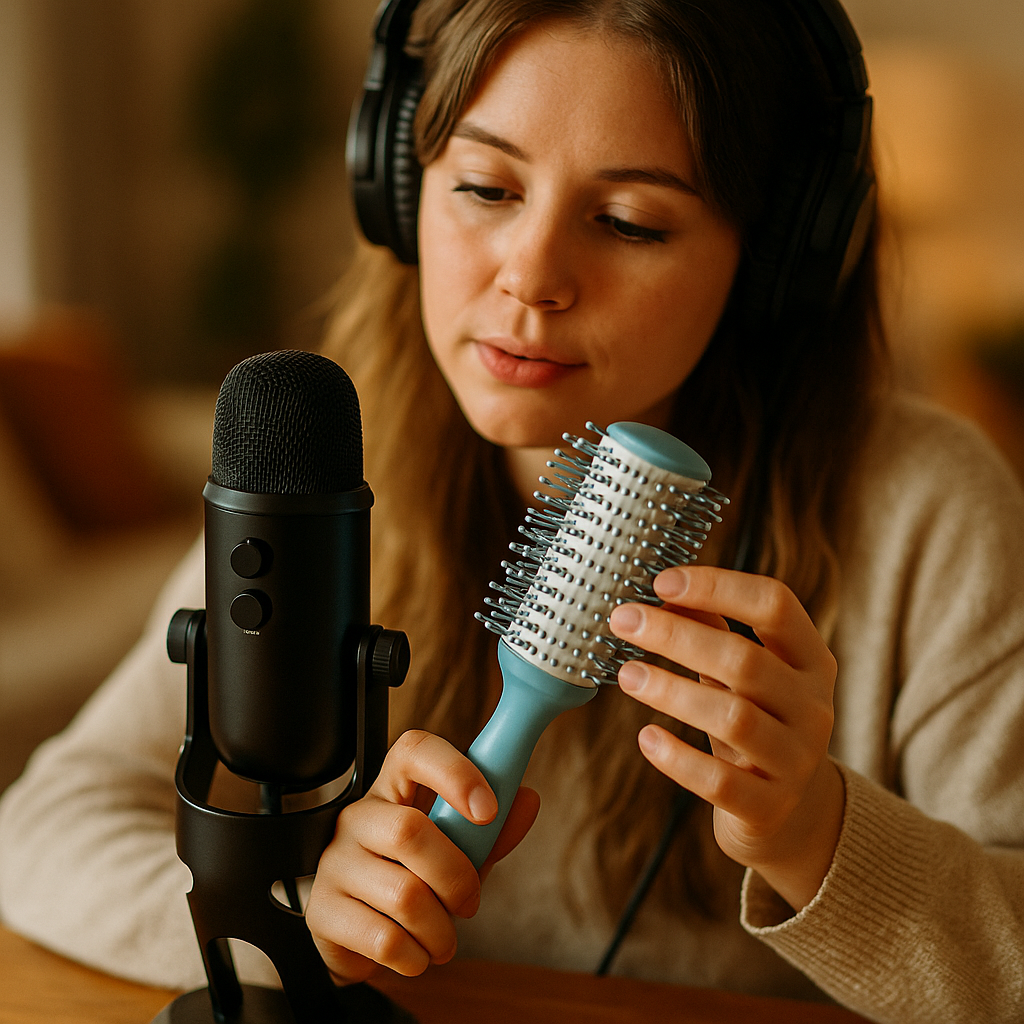
Viewers skip 73% of ad content within the first five seconds, yet ASMR product videos routinely hold attention for 30 seconds or longer without a single word of copy. Why? Because a crisp unboxing click or a satisfying lid-pop bypasses skepticism entirely. ASMR product demo scripts work because they never ask for trust, they demonstrate it through sound. For brands tired of fighting banner blindness and skip buttons, that’s not a gimmick. It’s a measurable edge.
The Psychology Behind Sound-First Selling
Traditional demo ads rely on claims. “Clinically proven.” “Dermatologist tested.” “Lasts 24 hours.” Viewers have heard it all, and ad fatigue has made them numb to adjectives. ASMR flips the script, literally, by removing the pitch and replacing it with sensory evidence.
When a creator taps a glass jar and the viewer hears a dense, satisfying thud instead of a hollow clink, the brain registers quality before the conscious mind has formed an opinion. That’s not pseudoscience. Audio branding research has long shown that sound cues trigger faster, more durable associations than visual claims alone, which is part of why sonic branding has become its own discipline inside marketing departments.
A product that sounds premium gets judged as premium, often before the viewer reads a single word of copy or sees a price tag.
This matters more in a feed where consumers scroll past hundreds of claims a day. ASMR content doesn’t compete on volume of information. It competes on sensory credibility, and that’s a much harder thing for a skeptical audience to dismiss.
What an ASMR Product Demo Script Actually Looks Like
Here’s the part most brand teams get wrong: they think ASMR means “no script.” It doesn’t. It means the script shifts from dialogue to choreography. Every beat still needs to be planned, just not spoken.
- Opening sound hook (0 to 2 seconds): A distinct, recognizable noise, a cap twist, a seal break, a fabric rustle, that signals “pay attention” without a voice doing it.
- Texture reveal (2 to 8 seconds): Close-mic capture of the product surface, liquid, or mechanism. This is where quality perception gets built.
- Function demonstration (8 to 20 seconds): The actual use case, shown through sound-forward action: a pump dispensing, a zipper closing, a blade slicing cleanly.
- Resolution beat (20 to 30 seconds): A satisfying close, like a snap-shut case or a final pour, that gives the viewer a sense of completion.
- Silent CTA card (final 2 to 3 seconds): Minimal on-screen text, logo, and offer. No voiceover needed if the sound did its job.
Scripting this requires a sound map, not a dialogue sheet. Writers and producers mark timestamps for specific foley actions, mic distance, and pacing instead of lines of speech. It’s closer to scoring a short film than writing an ad.
Brands already running the broader satisfying-content playbook will recognize some overlap here. The foundational structure is covered in our breakdown of ASMR content scripting, but product demo work adds a layer of commercial intent that pure satisfaction content doesn’t need to carry.
Sound Design Decisions That Build (or Kill) Trust
Not every crunch or click builds credibility. Bad ASMR product demos feel staged, overly processed, or artificially boosted, and audiences notice fast. A few operational rules separate the ones that convert from the ones that get scrolled past:
- Use real mic proximity, not post-production boosts. Binaural or shotgun mics placed close to the action capture authentic texture. Viewers can tell when a sound has been layered in after the fact, and it reads as fake.
- Match sound to material. A cosmetic jar should sound like glass or plastic, not like a foley library’s generic “pop.” Mismatched sound erodes trust faster than no sound at all.
- Keep ambient noise low but present. Total silence outside the product sound feels sterile and over-produced. A faint room tone keeps it grounded in reality.
- Avoid sound effects that exaggerate function. If a zipper doesn’t actually glide that smoothly, don’t add a sound that implies it does. That’s where ASMR demo work brushes up against regulatory risk.
This last point deserves its own section, because it’s the one brand and legal teams tend to overlook.
The Compliance Angle Nobody Talks About
Here’s an uncomfortable truth: a sound can make an implied claim just as easily as a spoken line can. If a skincare pump sounds unusually luxurious because of audio enhancement, and the product doesn’t actually feel or perform that way, you’ve created a deceptive impression even though no one said a word.
The FTC’s endorsement guidelines apply to implied claims, not just explicit ones. A demo that exaggerates product performance through sound manipulation can trigger the same scrutiny as a misleading verbal claim. Brand and legal teams running influencer programs should treat sound design sign-off the same way they treat script approval.
Silence doesn’t exempt a video from compliance review. If the sound implies a benefit the product can’t back up, it’s still a claim.
For teams already building review workflows around spoken claims, it’s worth extending that same rigor to sound. Our guide on pairing credible voices with compliant claims covers the broader framework, and the same documentation discipline applies here: log what was altered in post, keep raw audio on file, and brief creators on what sound effects are off-limits.
Where ASMR Demos Perform Best
Not every product category benefits equally. ASMR demo scripts tend to outperform on TikTok and Instagram Reels for categories with inherently satisfying mechanics: beauty and skincare, kitchen gadgets, stationery, packaging-forward snacks, and tech accessories with tactile feedback like clicks or snaps.
Categories that struggle: anything intangible, service-based, or digital-first. You can’t ASMR a software subscription, though some teams have tried with keyboard-click overlays and mixed results.
Retail media placements are an emerging opportunity too. Amazon and Walmart Connect both support video ad units where sound-forward product demos can run with autoplay sound on mobile, a format mismatch that traditional voiceover ads often get wrong. If your team is building creative for these placements, our piece on retail media video review walks through the approval nuances specific to that inventory.
According to eMarketer, short-form video continues to pull disproportionate ad budget relative to its share of total impressions, and sound-rich formats like ASMR are part of why engagement rates on these placements outperform static or text-overlay creative.
Scripting for Sound When You Can’t Rely on Dialogue
Writers trained on voiceover-heavy briefs sometimes struggle with ASMR because there’s no copy to lean on. The discipline shifts entirely to timing, sequencing, and anticipation. A useful exercise: write the script as a list of sounds in sequence, then ask whether a viewer could understand the product’s value from audio alone, eyes closed.
If the answer is no, the sound design isn’t doing enough work. If the answer is yes, you’ve likely built something that will outperform a scripted voiceover on completion rate.
This connects to a broader shift happening across short-form creative. Brands that have moved away from heavy dialogue are seeing similar gains in formats like faceless UGC scripts and sound-off video structures, where the absence of a talking head or spoken pitch forces more intentional visual and sonic storytelling. ASMR demos sit at the opposite end of that spectrum: instead of removing sound, they remove everything except sound.
Ingredient-driven categories can extend this further by pairing ASMR texture shots with brief on-screen label callouts, a hybrid approach covered in our ingredient breakdown scripting guide, which helps when a product’s sound alone can’t carry the full claim.
Measuring Whether It’s Actually Working
Skip the usual vanity metrics. Watch time and audio-on rate matter more than likes for this format. If viewers are muting the video within the first three seconds, the sound design isn’t landing, full stop.
Track these specifically:
- Average watch time versus your account baseline
- Audio-on percentage (available in TikTok Ads Manager and Meta Ads Manager reporting)
- Completion rate on the final sound beat, not just the opening hook
- Click-through from the silent CTA card, isolated from any spoken-CTA control group
Run an A/B test: identical product, one version scripted with voiceover, one scripted purely for sound. Platforms like TikTok Ads make this kind of split test straightforward, and the data usually settles the internal debate faster than any creative brief discussion could.
Next Step
Pick one SKU with a genuinely satisfying mechanical or textural moment, strip the voiceover entirely, and script it purely around sound sequencing. Run it against your current top-performing demo for two weeks and let the watch-time data make the case for a broader rollout.
Frequently Asked Questions
What makes a product good for an ASMR demo script?
Products with inherent tactile or mechanical sound, like a snap closure, a pump dispenser, a crunch, or a pour, work best. Intangible or digital products generally don’t translate well to this format.
Do ASMR product demos still need a script?
Yes. The script shifts from dialogue to a sound map that times foley actions, mic proximity, and pacing instead of spoken lines. Skipping this planning step usually produces unfocused, meandering footage.
Can enhanced sound effects create legal risk?
Yes. If sound design implies a product benefit or quality level the item doesn’t actually deliver, it can be treated as a deceptive implied claim under FTC endorsement guidelines, even without spoken words.
Which platforms perform best for ASMR product demos?
TikTok and Instagram Reels lead due to autoplay-with-sound behavior and younger audiences who actively seek sensory content. Retail media video placements on platforms like Amazon are an emerging secondary channel.
How do you measure ROI on sound-first creative?
Prioritize audio-on rate, watch time relative to account baseline, and completion rate at the final sound beat, then compare conversion against a voiceover-led control to isolate the format’s actual lift.
Top Influencer Marketing Agencies
The leading agencies shaping influencer marketing in 2026
Agencies ranked by campaign performance, client diversity, platform expertise, proven ROI, industry recognition, and client satisfaction. Assessed through verified case studies, reviews, and industry consultations.
Moburst

-
2

The Shelf
Boutique Beauty & Lifestyle Influencer AgencyA data-driven boutique agency specializing exclusively in beauty, wellness, and lifestyle influencer campaigns on Instagram and TikTok. Best for brands already focused on the beauty/personal care space that need curated, aesthetic-driven content.Clients: Pepsi, The Honest Company, Hims, Elf Cosmetics, Pure LeafVisit The Shelf → -
3

Audiencly
Niche Gaming & Esports Influencer AgencyA specialized agency focused exclusively on gaming and esports creators on YouTube, Twitch, and TikTok. Ideal if your campaign is 100% gaming-focused — from game launches to hardware and esports events.Clients: Epic Games, NordVPN, Ubisoft, Wargaming, Tencent GamesVisit Audiencly → -
4

Viral Nation
Global Influencer Marketing & Talent AgencyA dual talent management and marketing agency with proprietary brand safety tools and a global creator network spanning nano-influencers to celebrities across all major platforms.Clients: Meta, Activision Blizzard, Energizer, Aston Martin, WalmartVisit Viral Nation → -
5

The Influencer Marketing Factory
TikTok, Instagram & YouTube CampaignsA full-service agency with strong TikTok expertise, offering end-to-end campaign management from influencer discovery through performance reporting with a focus on platform-native content.Clients: Google, Snapchat, Universal Music, Bumble, YelpVisit TIMF → -
6

NeoReach
Enterprise Analytics & Influencer CampaignsAn enterprise-focused agency combining managed campaigns with a powerful self-service data platform for influencer search, audience analytics, and attribution modeling.Clients: Amazon, Airbnb, Netflix, Honda, The New York TimesVisit NeoReach → -
7

Ubiquitous
Creator-First Marketing PlatformA tech-driven platform combining self-service tools with managed campaign options, emphasizing speed and scalability for brands managing multiple influencer relationships.Clients: Lyft, Disney, Target, American Eagle, NetflixVisit Ubiquitous → -
8

Obviously
Scalable Enterprise Influencer CampaignsA tech-enabled agency built for high-volume campaigns, coordinating hundreds of creators simultaneously with end-to-end logistics, content rights management, and product seeding.Clients: Google, Ulta Beauty, Converse, AmazonVisit Obviously →