


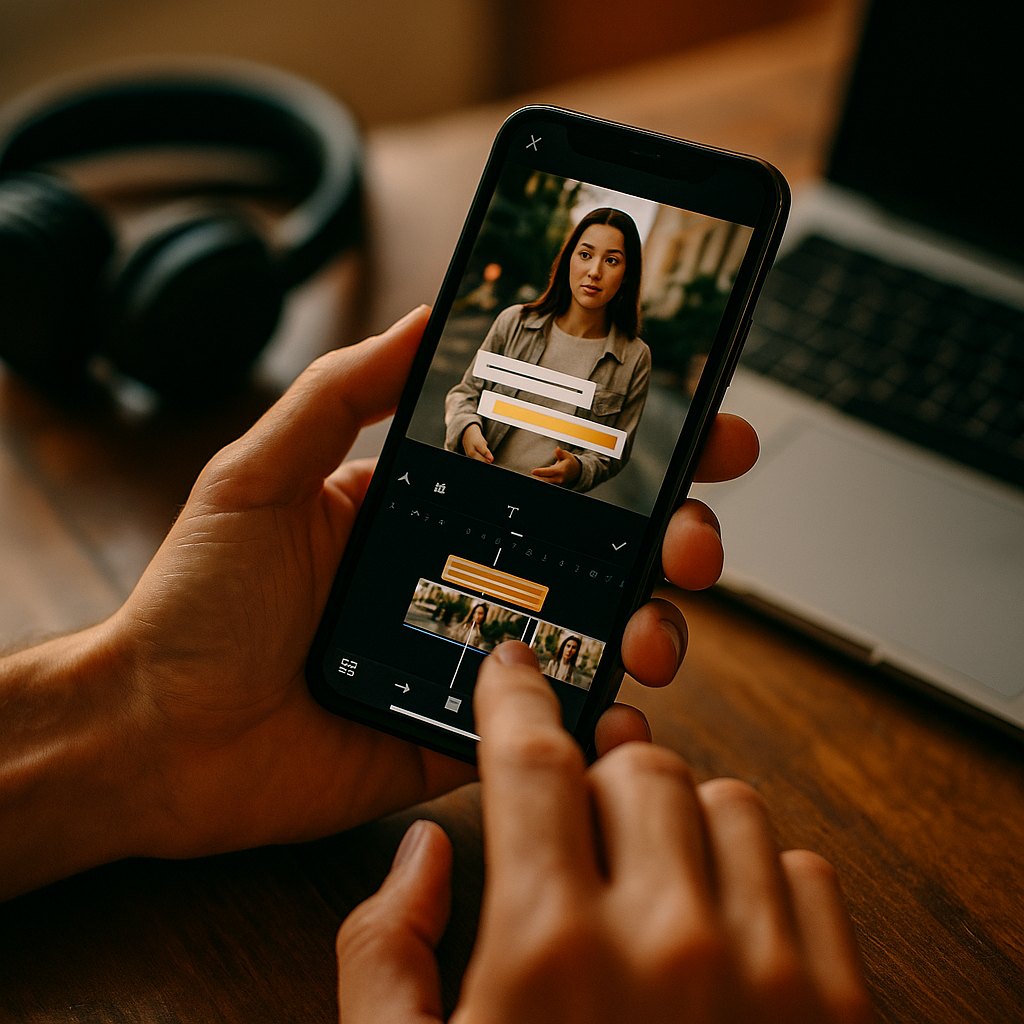
Up to 85% of video views on social feeds happen with the sound off, according to data platforms like Meta have cited for years, yet most brands still script like every viewer is wearing headphones. The silent scroll format isn’t a creative nice-to-have anymore. It’s the default viewing condition, and if your text-overlay videos aren’t built for it, you’re losing the hook before anyone hears a word.
Why Sound-Off Is the Rule, Not the Exception
Think about where people actually watch. Office breaks, commutes, bed at midnight next to a sleeping partner, waiting rooms. None of these are sound-friendly environments. Platforms know this, which is why Instagram, TikTok, and Facebook all autoplay muted by default. Captions and text overlays aren’t an accessibility add-on anymore, they’re the primary delivery mechanism for your message.
This changes the entire scripting process. You’re not writing dialogue that happens to get captioned later. You’re writing a visual script first, with audio as the secondary layer. That’s a mindset shift most content teams haven’t fully made, even in 2026.
If your video only works with sound on, you’ve built a radio ad and called it a video. The silent scroll format demands you design for the eyes first.
What Actually Makes Sound-Off Scripts Work
Scripting for silence isn’t about slapping subtitles on a talking-head video. It’s a structural discipline. Here’s what separates text-overlay videos that convert from ones that get scrolled past in under a second.
- Front-load the payoff in text, not voice. Your first on-screen line needs to carry the hook. If a viewer reads only one sentence before swiping, that sentence has to do the job your opening line of dialogue used to do.
- Keep text chunks short. Three to six words per screen is the sweet spot. Long sentences crammed into one frame get skipped before they’re read.
- Sync text timing to visual beats, not speech cadence. If you’re writing captions after the fact, you’re already behind. Text and visuals need to be choreographed together from the first draft.
- Use motion and emphasis sparingly but purposefully. Bold, color shifts, and pop-ins should mark the information that actually matters, not decorate every line equally.
- Build redundancy into visuals. If the product name only appears in spoken audio, half your audience never catches it. Put it on screen, more than once if the video runs past 20 seconds.
This is the same discipline we broke down in silent-first video editing, where caption timing and visual pacing get treated as one unified track rather than two separate production steps.
The Three-Second Text Hook
You have roughly three seconds before someone decides to keep scrolling. That’s not a metaphor, it’s close to what platform engagement data consistently shows across short-form feeds. In sound-off scripting, those three seconds belong entirely to text and visual contrast.
Don’t open with a slow build. Don’t open with your logo. Open with a claim, a question, or a tension that the viewer has to resolve by watching further. “I wasted $200 before I found this” works. “Welcome back to my channel” does not.
A good exercise: mute your last ten videos and watch only the first three seconds with the sound off. If you can’t tell what the video is about, your audience couldn’t either, and the algorithm noticed the drop-off before you did.
Structuring the Script Document Itself
Most scriptwriting templates still have two columns: visual and audio. For sound-off content, you need a third: on-screen text, timed independently. Treat it like subtitling a foreign film where the subtitles are the whole point, not a translation afterthought.
A practical format looks like this:
- Timestamp
- Visual action (what’s happening on screen)
- Text overlay copy (exact wording, exact timing)
- Optional spoken line (for sound-on viewers, kept secondary)
Writing the text column first forces discipline. If the script only makes sense with audio, you’ll catch it at the draft stage instead of after the video underperforms. This approach pairs well with the structural thinking behind recipe-style tutorial scripts, where sequential steps need to land visually even when a viewer skips ahead.
Where Brands Get This Wrong
The most common mistake is treating captions as an afterthought dumped in during the editing phase. Auto-generated captions are fine for compliance, but they’re rarely paced for comprehension or emphasis. They also tend to miss brand terminology, product names, or ingredient claims, which creates a problem when accuracy matters for compliance reasons, something covered in detail in ingredient breakdown videos.
Second mistake: overloading the screen. Teams panic about sound-off viewers missing information, then cram five lines of text onto one frame to compensate. That backfires. Viewers skim, they don’t read paragraphs on a six-inch screen while walking to a meeting. Trim ruthlessly. If a line doesn’t move the narrative or the offer forward, cut it.
Third: ignoring contrast and legibility. Light gray text over a busy background photographs fine on a monitor and disappears entirely on a phone in direct sunlight. Test your overlays on an actual device, outdoors, at low brightness. It’s unglamorous QA, but it catches more failures than any creative review meeting will.
Auto-captions get you compliant. Scripted overlays get you converted. The gap between the two is where most sound-off campaigns quietly lose performance.
Pacing for Platforms That Autoplay Differently
Not every feed behaves the same way. TikTok’s For You feed rewards an immediate, almost aggressive text hook because competition for attention is brutal within the first frame. LinkedIn’s native video, by contrast, often gets watched in professional settings where sound-off isn’t just likely, it’s expected, and tone needs to stay more measured even in the opening text.
Instagram Reels sits somewhere in between: fast hook, but slightly more room to build before the payoff line lands. If you’re repurposing one script across platforms, adjust the text pacing per platform rather than assuming one timing works everywhere. This is the same logic behind platform-specific thinking in scripting short-form video that ranks, where feed behavior dictates structural choices, not just creative taste.
For reference on how platforms themselves recommend structuring video for feed behavior, Meta’s advertiser resources at business.meta.com and TikTok’s creative guidance at ads.tiktok.com are worth checking periodically, since autoplay defaults and caption tools shift as platforms update their algorithms.
Measuring What Actually Matters
Standard watch-time metrics can mislead you here. A video can hold attention because the visuals are interesting while the actual message, delivered only through text, never registers. Track completion rate alongside click-through or save rate specifically for sound-off segments if your analytics platform allows audience filtering by device or sound state.
Sprout Social and similar analytics tools can help surface engagement patterns by content type, which is useful when you’re trying to isolate whether a drop-off is a hook problem or a pacing problem further into the video. Check Sprout Social’s analytics resources if you’re building out a sound-off testing framework internally.
Run A/B tests where the only variable is text pacing, not the underlying video. You’ll often find that the same footage with tighter text timing outperforms the original by a meaningful margin, sometimes double-digit percentage gains in completion rate. That’s a cheap, repeatable optimization most teams skip because it feels too small to matter. It isn’t.
FTC and Disclosure Considerations for Text-Only Claims
If your overlay text makes a claim, that claim is subject to the same disclosure rules as spoken claims. A sound-off viewer who never hears a disclaimer spoken aloud still needs to see it clearly on screen, legible, and timed long enough to actually read. The FTC’s endorsement guidance doesn’t carve out an exception for muted content, and regulators have increasingly scrutinized whether disclosures are genuinely perceivable, not just technically present for a fraction of a second.
This matters even more for creator partnerships where the script is handed off externally. Build disclosure text into the required overlay structure from the brief stage, not as a note added in post. Teams working through comparison or claims-heavy formats should look at how this is handled in dupe comparison videos, where the same legibility and timing standards apply.
Building This Into Your Creator Briefs
If you’re working with influencers rather than producing in-house, your brief needs to specify text-overlay requirements explicitly, not leave it to creator discretion. Most creators default to sound-on habits because that’s how they consume content themselves. Give them the three-column script structure, specify minimum font size relative to screen, and require a muted self-test before submission.
This is especially critical for nano and micro creator programs running at volume, where review bandwidth per video is limited and you can’t catch every pacing issue manually. A clear brief upfront, similar to the frameworks used in nano creator briefs, saves far more revision time than catching problems after delivery.
FAQs
What percentage of social video is actually watched without sound?
Estimates vary by platform and context, but figures commonly cited by marketers and platform data range from 70% to 85% of feed video views happening muted, particularly on mobile during commutes or workday browsing.
Do I still need spoken audio if I script for sound-off viewing?
Yes, for accessibility and for the audience that does watch with sound, but the spoken track should support the visual script rather than carry it. Treat audio as a secondary layer, not the primary message delivery system.
How long should text overlays stay on screen?
A general rule is roughly one second per three to four words of reading time, adjusted slightly longer for compliance disclosures so they’re genuinely legible rather than just technically present.
Can auto-generated captions replace a scripted text overlay approach?
No. Auto-captions handle transcription for accessibility compliance but aren’t paced, emphasized, or structured for comprehension and conversion the way a deliberately scripted overlay sequence is.
Which platforms prioritize sound-off viewing the most?
TikTok, Instagram Reels, and Facebook feed video all default to muted autoplay, making sound-off scripting essential across all three. LinkedIn video also sees heavy muted viewing in professional settings.
Start by muting your five best-performing videos and your five worst. The pattern you’ll find in the first three seconds of text usually explains the performance gap better than any other variable you could test next.
FAQs
What percentage of social video is actually watched without sound?
Estimates vary by platform and context, but figures commonly cited by marketers and platform data range from 70% to 85% of feed video views happening muted, particularly on mobile during commutes or workday browsing.
Do I still need spoken audio if I script for sound-off viewing?
Yes, for accessibility and for the audience that does watch with sound, but the spoken track should support the visual script rather than carry it. Treat audio as a secondary layer, not the primary message delivery system.
How long should text overlays stay on screen?
A general rule is roughly one second per three to four words of reading time, adjusted slightly longer for compliance disclosures so they’re genuinely legible rather than just technically present.
Can auto-generated captions replace a scripted text overlay approach?
No. Auto-captions handle transcription for accessibility compliance but aren’t paced, emphasized, or structured for comprehension and conversion the way a deliberately scripted overlay sequence is.
Which platforms prioritize sound-off viewing the most?
TikTok, Instagram Reels, and Facebook feed video all default to muted autoplay, making sound-off scripting essential across all three. LinkedIn video also sees heavy muted viewing in professional settings.
Top Influencer Marketing Agencies
The leading agencies shaping influencer marketing in 2026
Agencies ranked by campaign performance, client diversity, platform expertise, proven ROI, industry recognition, and client satisfaction. Assessed through verified case studies, reviews, and industry consultations.
Moburst

-
2

The Shelf
Boutique Beauty & Lifestyle Influencer AgencyA data-driven boutique agency specializing exclusively in beauty, wellness, and lifestyle influencer campaigns on Instagram and TikTok. Best for brands already focused on the beauty/personal care space that need curated, aesthetic-driven content.Clients: Pepsi, The Honest Company, Hims, Elf Cosmetics, Pure LeafVisit The Shelf → -
3

Audiencly
Niche Gaming & Esports Influencer AgencyA specialized agency focused exclusively on gaming and esports creators on YouTube, Twitch, and TikTok. Ideal if your campaign is 100% gaming-focused — from game launches to hardware and esports events.Clients: Epic Games, NordVPN, Ubisoft, Wargaming, Tencent GamesVisit Audiencly → -
4

Viral Nation
Global Influencer Marketing & Talent AgencyA dual talent management and marketing agency with proprietary brand safety tools and a global creator network spanning nano-influencers to celebrities across all major platforms.Clients: Meta, Activision Blizzard, Energizer, Aston Martin, WalmartVisit Viral Nation → -
5

The Influencer Marketing Factory
TikTok, Instagram & YouTube CampaignsA full-service agency with strong TikTok expertise, offering end-to-end campaign management from influencer discovery through performance reporting with a focus on platform-native content.Clients: Google, Snapchat, Universal Music, Bumble, YelpVisit TIMF → -
6

NeoReach
Enterprise Analytics & Influencer CampaignsAn enterprise-focused agency combining managed campaigns with a powerful self-service data platform for influencer search, audience analytics, and attribution modeling.Clients: Amazon, Airbnb, Netflix, Honda, The New York TimesVisit NeoReach → -
7

Ubiquitous
Creator-First Marketing PlatformA tech-driven platform combining self-service tools with managed campaign options, emphasizing speed and scalability for brands managing multiple influencer relationships.Clients: Lyft, Disney, Target, American Eagle, NetflixVisit Ubiquitous → -
8

Obviously
Scalable Enterprise Influencer CampaignsA tech-enabled agency built for high-volume campaigns, coordinating hundreds of creators simultaneously with end-to-end logistics, content rights management, and product seeding.Clients: Google, Ulta Beauty, Converse, AmazonVisit Obviously →