


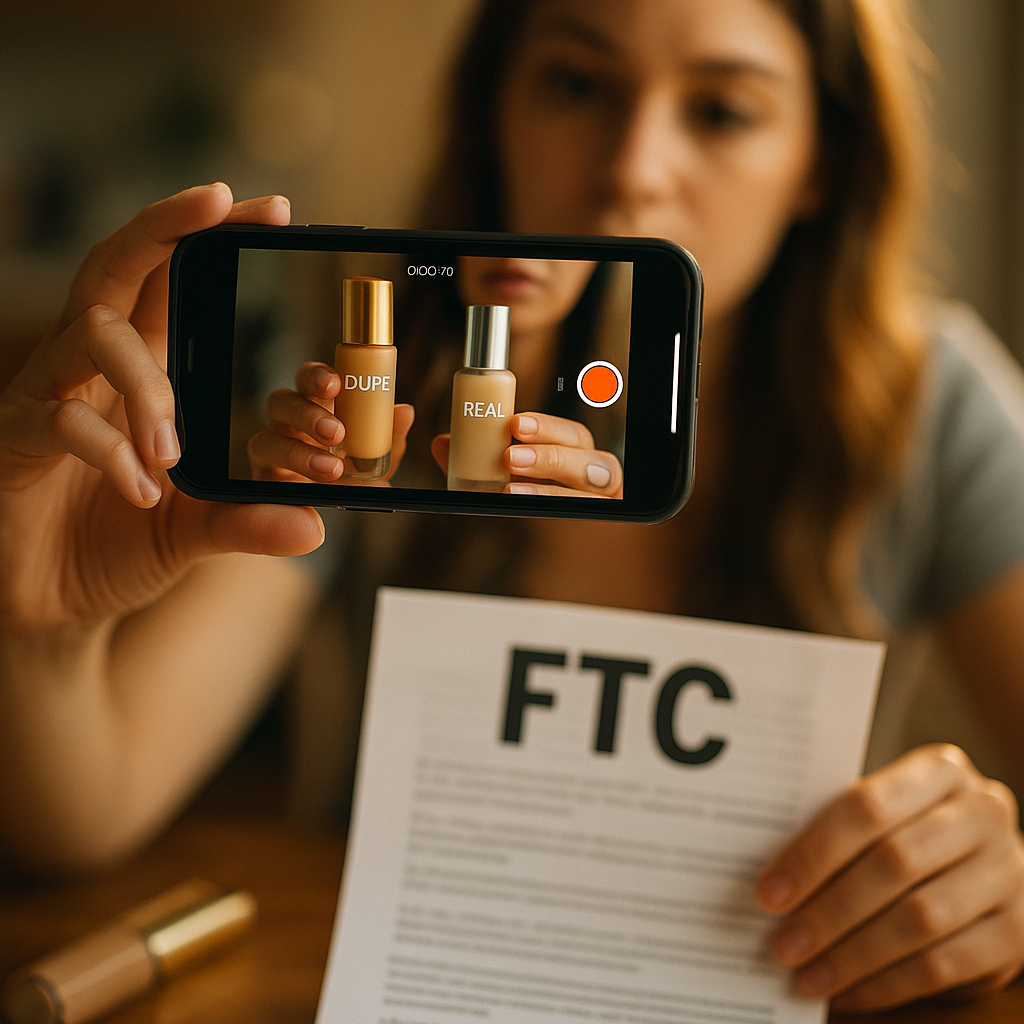
Dupe comparison videos now outperform traditional product reviews by wide margins on engagement, yet a single unsubstantiated claim can trigger a platform takedown, a legal letter, or an FTC inquiry. Brands chasing the “save $40 and get the same results” narrative are learning the hard way that virality and liability live on the same timeline. If your influencer program touches dupe content, the script is your first and last line of defense.
The dupe comparison format works because it taps into something retail has known forever: shoppers trust a side-by-side more than a monologue. But “this $12 serum is basically the same as the $68 one” is a factual assertion, not a vibe. Say it carelessly, and you’ve made a performance claim you now have to defend.
Why Dupe Content Draws Regulatory Heat
The FTC has been explicit that comparative claims, especially ones implying equivalence in ingredients, performance, or results, need substantiation. A creator saying “it works just as well” without any testing behind it is functionally no different than a brand making the same claim in a paid ad. The FTC’s endorsement guidance treats influencer content as advertising when there’s a material connection, and dupe videos almost always involve either a paid partnership or a free product seed.
There’s also a second risk layer most marketing teams underweight: the original brand being “duped” can pursue trademark dilution or false advertising claims if your comparison implies their product is overpriced junk by contrast. That’s less about regulators and more about expensive cease-and-desist letters landing in your inbox.
A dupe video isn’t just a product review wearing a trendy format. It’s a comparative advertising claim, and comparative claims carry the heaviest evidentiary burden in influencer marketing.
The Claim Hierarchy: What You Can Say Without Proof, and What You Can’t
Not every statement in a dupe script carries the same risk. Build your brief around a three-tier claim structure so creators know exactly where the guardrails sit.
- Sensory and subjective claims (texture, scent, packaging feel) are low risk because they’re opinion based. “This feels just as silky” is defensible as personal experience.
- Price and value claims (cost per use, ingredient list similarity) are medium risk. These need to be factually verifiable, meaning your creator should be comparing actual published ingredient decks or pricing, not guessing.
- Performance and results claims (“clears acne just as fast,” “lasts just as long”) are high risk. These require actual testing data, and without it, they shouldn’t appear in the script at all.
Most compliance failures happen because creators improvise in the high-risk tier during filming because it sounds more persuasive on camera. That’s where your script has to do the heavy lifting, not your trust in the creator’s judgment.
Scripting the Comparison Without Making It an Accusation
The strongest dupe scripts avoid naming the premium brand as inferior and instead frame the content around the viewer’s decision process. Structure matters more than most teams realize:
- Open with the shopping moment, not the verdict. “I was standing in the aisle trying to decide if the $65 version was worth it” is a relatable hook that doesn’t front-load a claim.
- Separate observation from opinion verbally. Scripts should include explicit language like “in my experience” or “for my skin” before any results statement.
- Show the comparison, don’t just state it. If ingredient decks are being compared, put them on screen. If price per ounce is the claim, display the math. Visual proof reduces reliance on verbal assertion, which is where legal exposure concentrates.
- Close with a caveat, not a crown. “This worked for me, everyone’s skin is different” is both honest and protective. It also tends to read as more credible to skeptical audiences, which is a nice bonus.
This approach borrows heavily from fair comparison formats used in other content types. If you’ve scripted versus format videos before, the discipline is identical: give both products their due, let the viewer draw the conclusion, and keep your creator’s language in the observational lane.
Disclosure Isn’t Optional, and It’s Not Just One Line
Every dupe comparison involving a paid relationship, free product, or affiliate link needs disclosure that’s clear and conspicuous, not buried in a caption or flashed for half a second. TikTok, Instagram, and YouTube all have native disclosure tools, and Meta’s branded content policies require them to be used, not supplemented with vague hashtags.
But disclosure in dupe content needs an extra layer most briefs skip: clarifying which brand, if either, is sponsoring the content. If a skincare brand gifts a creator their $14 product to compare against a $60 competitor, viewers deserve to know the comparison wasn’t neutral. Script a line for this. Don’t leave it to a text overlay nobody reads.
What Your Creator Brief Actually Needs
A dupe-specific brief should go further than a standard content brief. At minimum, include:
- A pre-approved claims list separating what can be said outright versus what needs a qualifier.
- Source documentation for any ingredient, price, or spec comparison the creator plans to cite on camera.
- A disclosure script line, not just a checkbox instruction to “disclose per FTC guidelines.”
- A review step before publishing, especially for creators with large followings where a retraction is costly and visible.
Teams that have scaled nano creator briefs know the tension here: too much legal language kills authenticity, too little invites risk. The fix is writing the guardrails into the narrative structure itself rather than appending a compliance paragraph nobody reads past the first line.
The safest dupe videos don’t sound like they were written by a legal team. They sound like a friend being careful about what they’re willing to promise you.
Handling the “Side by Side” Visual Without Overstating It
Visual comparisons carry their own risk because a split screen implies equivalence even if the narration hedges. If a creator places two products side by side with matching swatches or textures, that visual is making a claim regardless of what’s said aloud. Direct your editors to avoid framing that visually suggests identical results, like matched before-and-after shots using different products.
This is the same principle that governs before and after reels: the image often carries more persuasive weight than the voiceover, so the editing choices need the same scrutiny as the script.
Platform Rules Are Tightening Faster Than Brand Playbooks
TikTok and Instagram have both increased enforcement around unsubstantiated comparative claims in commerce content, partly driven by pressure from brands whose products get named unfavorably in dupe videos. Sprout Social’s platform trend reporting has tracked rising takedown rates on comparison content that names competitor brands directly without evidentiary support.
The practical implication: brands should treat dupe scripts the way they treat stitch and duet response ads, meaning every piece of borrowed or comparative context gets a legal and platform-policy pass before it goes live, not after it starts trending.
A Quick Gut Check Before You Greenlight
Before approving any dupe comparison script, run it through three questions: Can every factual claim be sourced? Is the disclosure clear without requiring the viewer to pause the video? Does the script leave room for “your results may vary” without sounding defensive? If the answer to any of these is no, send it back. A reshoot costs less than a retraction, and infinitely less than a regulatory inquiry.
Brands that get this right treat dupe content as a genre with its own rulebook, not a loose variation of a standard testimonial. That distinction is what separates a viral win from a liability nobody budgeted for.
The Takeaway
Script dupe comparisons the way you’d script testimony under oath: separate fact from feeling, source every number, and disclose plainly. Do that consistently, and the format keeps converting without keeping your legal team on speed dial.
Frequently Asked Questions
What makes a dupe comparison claim legally risky?
Risk increases whenever the claim is specific, measurable, and unverified, such as asserting identical performance or ingredient equivalence without supporting documentation. Subjective sensory claims carry far less exposure than results-based claims.
Do creators need to disclose which brand gifted or sponsored the product in a dupe video?
Yes. Viewers need to know if the comparison was influenced by a paid partnership or free product from either brand involved, not just a generic sponsorship disclosure.
Can a brand get in trouble if a creator makes a false comparison about a competitor?
Yes, especially if the brand directed, approved, or compensated the content. Material connection extends liability to the brand even when the creator wrote the specific language.
Should dupe scripts avoid naming the premium brand directly?
Not necessarily, but any direct naming should pair with verifiable claims only. Vague disparagement without evidence increases both regulatory and trademark risk.
How is dupe content different from a standard product review?
A standard review evaluates one product. A dupe comparison makes an implicit or explicit equivalence claim between two products, which raises the evidentiary bar significantly higher than a solo opinion piece.
FAQs (Structured Data)
Top Influencer Marketing Agencies
The leading agencies shaping influencer marketing in 2026
Agencies ranked by campaign performance, client diversity, platform expertise, proven ROI, industry recognition, and client satisfaction. Assessed through verified case studies, reviews, and industry consultations.
Moburst

-
2

The Shelf
Boutique Beauty & Lifestyle Influencer AgencyA data-driven boutique agency specializing exclusively in beauty, wellness, and lifestyle influencer campaigns on Instagram and TikTok. Best for brands already focused on the beauty/personal care space that need curated, aesthetic-driven content.Clients: Pepsi, The Honest Company, Hims, Elf Cosmetics, Pure LeafVisit The Shelf → -
3

Audiencly
Niche Gaming & Esports Influencer AgencyA specialized agency focused exclusively on gaming and esports creators on YouTube, Twitch, and TikTok. Ideal if your campaign is 100% gaming-focused — from game launches to hardware and esports events.Clients: Epic Games, NordVPN, Ubisoft, Wargaming, Tencent GamesVisit Audiencly → -
4

Viral Nation
Global Influencer Marketing & Talent AgencyA dual talent management and marketing agency with proprietary brand safety tools and a global creator network spanning nano-influencers to celebrities across all major platforms.Clients: Meta, Activision Blizzard, Energizer, Aston Martin, WalmartVisit Viral Nation → -
5

The Influencer Marketing Factory
TikTok, Instagram & YouTube CampaignsA full-service agency with strong TikTok expertise, offering end-to-end campaign management from influencer discovery through performance reporting with a focus on platform-native content.Clients: Google, Snapchat, Universal Music, Bumble, YelpVisit TIMF → -
6

NeoReach
Enterprise Analytics & Influencer CampaignsAn enterprise-focused agency combining managed campaigns with a powerful self-service data platform for influencer search, audience analytics, and attribution modeling.Clients: Amazon, Airbnb, Netflix, Honda, The New York TimesVisit NeoReach → -
7

Ubiquitous
Creator-First Marketing PlatformA tech-driven platform combining self-service tools with managed campaign options, emphasizing speed and scalability for brands managing multiple influencer relationships.Clients: Lyft, Disney, Target, American Eagle, NetflixVisit Ubiquitous → -
8

Obviously
Scalable Enterprise Influencer CampaignsA tech-enabled agency built for high-volume campaigns, coordinating hundreds of creators simultaneously with end-to-end logistics, content rights management, and product seeding.Clients: Google, Ulta Beauty, Converse, AmazonVisit Obviously →