


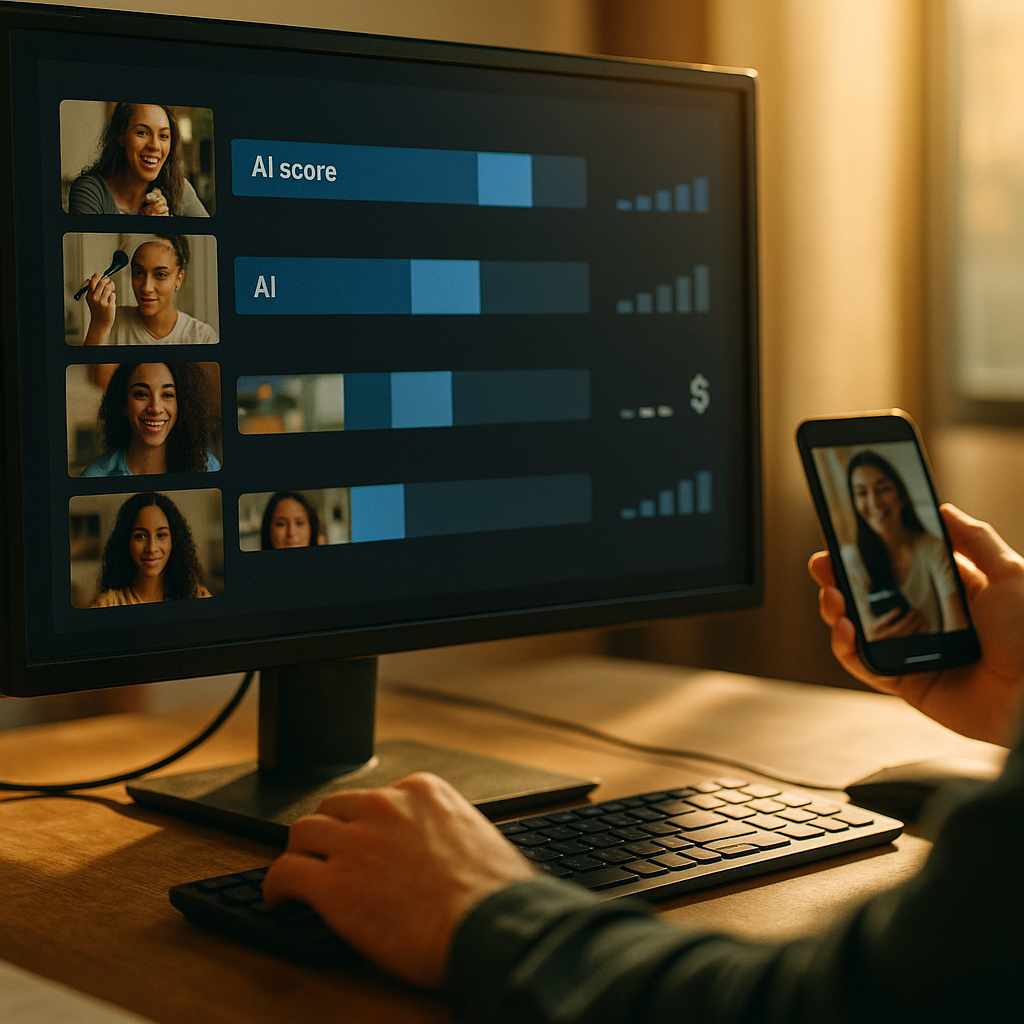
Only about one in five organic creator clips has the structural DNA to survive paid distribution. That’s not a guess. It’s what happens when brands run historical ad data against creative scoring models and watch most “viral” UGC collapse under a media budget. So why do most marketing teams still pick whitelisting candidates by gut feel and follower count? AI-driven UGC scoring is quietly becoming the gatekeeper between creative that merely performs organically and creative that actually scales as paid media.
Why Organic Performance Lies to You
A clip with 2 million organic views feels like a sure bet. It isn’t. Organic reach is driven by algorithmic distribution, novelty, and audience familiarity with the creator. Paid reach is driven by cold-audience resonance, hook strength in the first two seconds, and whether the creative survives repetition without fatiguing. These are different jobs, and a clip can be great at one while failing the other completely.
Media buyers have known this for years, usually the hard way. A creator post goes viral, gets whitelisted, gets $40,000 in spend behind it, and the CPA is double the account average. The team scratches its heads. The real answer is simpler than anyone wants to admit: nobody checked whether the clip had the structural markers that correlate with paid performance before the money went out the door.
Teams that score UGC before spend report cutting wasted whitelisting budget by roughly 30 to 40 percent, according to agency benchmarking shared across several performance marketing forums in the past year.
What AI Scoring Models Actually Look At
Modern creative scoring tools (the kind now built into platforms like TikTok’s ad infrastructure and various third-party creative intelligence vendors) don’t watch a video the way a human brand manager does. They parse it frame by frame and extract quantifiable signals:
- Hook velocity: how quickly the first three seconds establish a problem, pattern interrupt, or emotional trigger.
- Face-to-product ratio: the balance of human presence to product visibility, which correlates heavily with trust signals in cold traffic.
- Caption and on-screen text density: clips with sound-off comprehension consistently outperform in feed environments.
- Pacing and cut frequency: models trained on thousands of past ad sets can flag whether a clip’s editing rhythm matches patterns associated with completed views versus scroll-past.
- Audio and music licensing status: a flagged or unlicensed track that’s fine organically can tank a paid unit or trigger a platform strike.
None of this requires a human to “feel” whether something is good. It requires pattern matching against a labeled dataset of clips that scaled versus clips that didn’t. That’s exactly the kind of task machine learning is suited for, and it’s why this category has moved from novelty to near-necessity for teams running six-figure monthly whitelisting budgets.
The Prediction Problem Isn’t Solved, It’s Managed
Let’s be honest about the limits here. No model predicts virality with certainty. What these systems do is reduce variance. They move a brand from “we have no idea which of these 50 clips will work” to “these 8 clips share the structural traits of our top 10 percent historical performers, test those first.” That’s a meaningful operational shift even if it isn’t magic.
There’s also a cold-start problem. A brand new to a vertical, or a creator program still building its first dataset, doesn’t have enough historical ad performance to train a reliable model. In those cases, scoring tools lean on cross-brand or cross-vertical benchmarks, which are useful but noisier. This is similar to the adoption gap documented in creator discovery AI tools, where teams trust pattern-matching for sourcing long before they trust it for attribution. Scoring UGC sits somewhere in between: more mature than attribution modeling, less mature than basic discovery filtering.
How This Changes the Whitelisting Workflow
The old workflow looked like this: creator posts, brand social team notices engagement, someone forwards it to paid media, paid media whitelists it, budget flows, results come back in two weeks. That cycle is slow and expensive when it’s wrong.
The scored workflow compresses decision-making to the front end. Clips get ingested (sometimes before they’re even posted organically, via direct creator upload) and scored against the brand’s own historical ad library within hours. Only clips clearing a threshold score move to a small-budget test tranche. Winners from that tranche get scaled. This isn’t theoretical, it mirrors the shift already happening in dynamic creative optimization for whitelisted ad testing, where the testing layer itself has become automated and continuous rather than a quarterly event.
One operational detail that trips up a lot of teams: scoring models need a review bottleneck removed, not added. If your creative team still manually watches every clip before it enters the scoring pipeline, you’ve just added a step. The point of scoring is to replace that manual triage, not sit on top of it, an issue explored in depth around video quality scoring and review bottlenecks.
Budget Risk: The Part Finance Actually Cares About
CFOs don’t care about hook velocity. They care about wasted spend. And wasted spend on underperforming whitelisted creative is a real, trackable line item that scoring directly addresses. Consider the math: if a brand runs $500,000 a year through creator whitelisting and historically only 20 percent of pushed clips hit target CPA, that’s $400,000 spent testing creative that was never going to work. Even a modest improvement in pre-spend filtering, say moving that hit rate from 20 to 35 percent, recovers six figures without touching the media budget itself.
This is the argument that gets scoring tools budget approval even in years when marketing spend is under scrutiny. It’s not a creative nicety. It’s risk mitigation dressed up as a creative tool, similar to how bot follower audit tools get approved as fraud prevention rather than discretionary tech spend.
A brand that scores UGC before spend isn’t buying better creative, it’s buying fewer expensive mistakes.
Compliance and Rights Don’t Disappear Just Because a Model Says “Scale It”
A high prediction score means nothing if the brand doesn’t have the usage rights to put paid dollars behind the clip. This gets overlooked constantly. Teams get excited about a 92 score, rush to whitelist, and discover the creator’s contract only covered organic posting. Now there’s a scramble, a renegotiation, or worse, a clip running without proper rights and a potential dispute down the line.
Scoring workflows need to be paired with rights and disclosure verification baked into the same pipeline, not bolted on after. This connects directly to the audit trail concerns raised in creator match scoring and compliance audit trails, and to the contract review gaps flagged in coverage of AI contract redlines needing human checkpoints. The lesson repeats across every category of marketing AI: a model’s confidence score and a legal department’s sign-off are two different things, and conflating them is how brands end up explaining themselves to the FTC.
Disclosure compliance adds another wrinkle. A clip that scores well creatively but lacks clear #ad or #sponsored labeling can’t simply be fixed in post. Platforms and regulators both expect disclosure to be native to the content, not patched on before a whitelisting push, a tension covered in the context of creator disclosure rules in personalization tools.
Where This Is Headed
Expect scoring to move earlier in the pipeline, into the briefing stage itself. Instead of scoring finished clips, some platforms are starting to score concepts and shot lists before a creator even films, flagging structural weaknesses before production dollars are spent at all. That’s a logical next step and one that mirrors how Sprout Social and similar platforms have pushed predictive analytics further upstream in content planning over the past few product cycles.
There’s also a consolidation trend worth watching. Point solutions for creative scoring are getting absorbed into broader creator marketing suites, the same pattern seen with bundled creator marketing systems that combine discovery, scoring, payment, and compliance into one interface. Brands evaluating vendors in this space should ask less about the scoring algorithm’s accuracy claims and more about how cleanly it integrates with existing rights management and media buying tools. According to eMarketer, creator-driven ad spend continues to outpace overall digital ad growth, which means the cost of inefficient whitelisting only compounds as budgets scale.
The Takeaway
Don’t whitelist on vibes anymore. Run every creator clip through a scoring pass before it touches a media budget, pair that score with a rights and disclosure check in the same workflow, and treat the output as a filter that narrows your test set, not a guarantee of performance. The brands winning on creator ad efficiency right now aren’t the ones with the best creators. They’re the ones that stopped guessing which clips deserved a budget.
FAQs
What is UGC scoring in the context of paid advertising?
UGC scoring is the use of AI models to analyze creator-generated video clips against historical ad performance data, predicting which clips are likely to perform well as paid media before any budget is spent on distribution.
How accurate are AI predictions for which creator clips will scale?
No model guarantees virality, but scoring tools reliably reduce the pool of candidate clips to those sharing structural traits with past top performers, improving hit rates significantly compared to manual selection based on organic engagement alone.
Does a high UGC score mean a brand can whitelist the clip immediately?
No. A strong score addresses creative likelihood of performance only. Brands still need to verify usage rights, disclosure compliance, and contract terms before putting paid spend behind any creator clip.
What signals do these scoring models actually measure?
Common signals include hook strength in the opening seconds, face-to-product ratio, on-screen text density for sound-off viewing, pacing and cut frequency, and audio licensing status.
Is UGC scoring only useful for large brands with big whitelisting budgets?
It delivers the clearest ROI for brands running substantial whitelisting spend, but smaller brands can use scoring to avoid wasting limited test budgets on clips unlikely to convert in cold-traffic environments.
Top Influencer Marketing Agencies
The leading agencies shaping influencer marketing in 2026
Agencies ranked by campaign performance, client diversity, platform expertise, proven ROI, industry recognition, and client satisfaction. Assessed through verified case studies, reviews, and industry consultations.
Moburst

-
2

The Shelf
Boutique Beauty & Lifestyle Influencer AgencyA data-driven boutique agency specializing exclusively in beauty, wellness, and lifestyle influencer campaigns on Instagram and TikTok. Best for brands already focused on the beauty/personal care space that need curated, aesthetic-driven content.Clients: Pepsi, The Honest Company, Hims, Elf Cosmetics, Pure LeafVisit The Shelf → -
3

Audiencly
Niche Gaming & Esports Influencer AgencyA specialized agency focused exclusively on gaming and esports creators on YouTube, Twitch, and TikTok. Ideal if your campaign is 100% gaming-focused — from game launches to hardware and esports events.Clients: Epic Games, NordVPN, Ubisoft, Wargaming, Tencent GamesVisit Audiencly → -
4

Viral Nation
Global Influencer Marketing & Talent AgencyA dual talent management and marketing agency with proprietary brand safety tools and a global creator network spanning nano-influencers to celebrities across all major platforms.Clients: Meta, Activision Blizzard, Energizer, Aston Martin, WalmartVisit Viral Nation → -
5

The Influencer Marketing Factory
TikTok, Instagram & YouTube CampaignsA full-service agency with strong TikTok expertise, offering end-to-end campaign management from influencer discovery through performance reporting with a focus on platform-native content.Clients: Google, Snapchat, Universal Music, Bumble, YelpVisit TIMF → -
6

NeoReach
Enterprise Analytics & Influencer CampaignsAn enterprise-focused agency combining managed campaigns with a powerful self-service data platform for influencer search, audience analytics, and attribution modeling.Clients: Amazon, Airbnb, Netflix, Honda, The New York TimesVisit NeoReach → -
7

Ubiquitous
Creator-First Marketing PlatformA tech-driven platform combining self-service tools with managed campaign options, emphasizing speed and scalability for brands managing multiple influencer relationships.Clients: Lyft, Disney, Target, American Eagle, NetflixVisit Ubiquitous → -
8

Obviously
Scalable Enterprise Influencer CampaignsA tech-enabled agency built for high-volume campaigns, coordinating hundreds of creators simultaneously with end-to-end logistics, content rights management, and product seeding.Clients: Google, Ulta Beauty, Converse, AmazonVisit Obviously →