


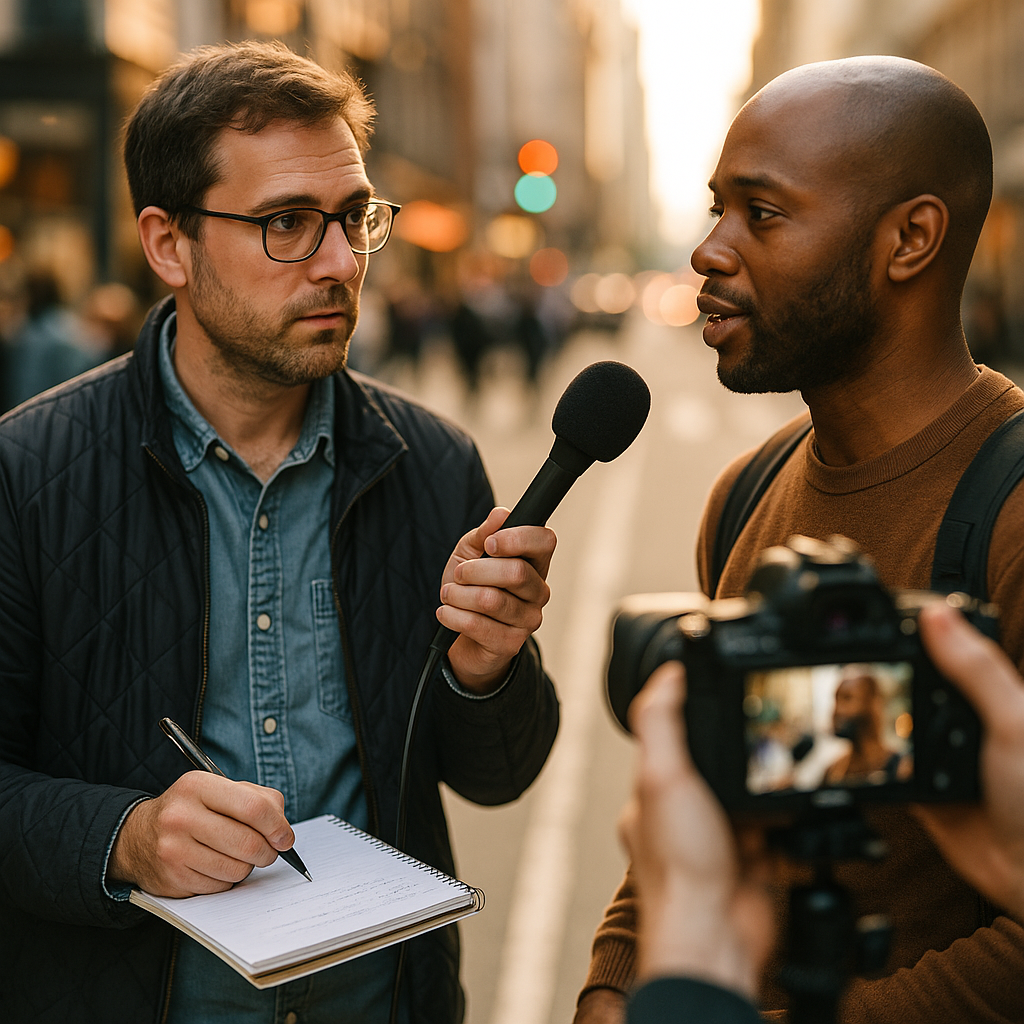
Eighty percent of viewers say they trust a stranger’s on-camera opinion more than a brand’s own ad copy. That single fact explains why vox pops, those “stop people on the street and ask them a question” clips, have quietly become one of the highest-converting formats in paid social. The catch? The best ones aren’t spontaneous at all. A well-run street interview vox pop is scripted down to the beat, even though it reads as raw, unfiltered truth.
If your team is still treating vox pops as “just go film some reactions,” you’re leaving conversion data on the table and exposing the brand to compliance risk. Here’s how to script authenticity without faking it.
Why Vox Pops Outperform Polished Creator Content
Vox pops work because they borrow the credibility of a focus group while delivering the pacing of a TikTok. Viewers assume the interviewer didn’t pick favorites, that the responses are genuine, and that the product held up under real scrutiny. That assumption is the entire value proposition. Break it, and the format collapses.
Brands running street interview campaigns consistently report stronger click-through and lower cost-per-acquisition than standard UGC, particularly for categories where trust is the conversion bottleneck: skincare, supplements, fintech apps, and B2B SaaS tools sold on word-of-mouth credibility. The format also travels well across platforms, since a tight 8-second answer clips cleanly into Reels, Shorts, and TikTok without losing context.
A vox pop that looks unscripted but performs consistently isn’t lucky. It’s engineered. Every “authentic” clip you’ve seen from a brand went through a question architecture before anyone hit record.
Compare this to customer interview testimonial reels, which rely on a single curated subject. Vox pops instead rely on volume and variance: ten strangers, overlapping sentiment, and the illusion of consensus. That illusion is powerful, but it only works if your question design actually produces usable answers.
The Architecture of an “Unscripted” Question
Here’s the part most brands get wrong: they send a field producer out with an open-ended question like “What do you think of this product?” and get back forty seconds of rambling, half of which is unusable. A scripted vox pop doesn’t script the answer. It scripts the shape of the answer by engineering the question.
- Constrain the frame. “What’s the one thing you’d tell a friend about this?” produces a tighter, more quotable answer than “What did you think?”
- Bake in the comparison. “How does this compare to what you usually use?” naturally surfaces a competitive angle without you ever naming a competitor on camera.
- Front-load the emotion. Ask for a reaction before you ask for reasoning. “React to the price” gets a gut response; “explain the price” gets a hedge.
- Keep it to one beat. One question, one answer, one clip. Multi-part questions produce multi-part answers that are harder to cut down to 6 seconds.
This is the same discipline used in vox pop street interview campaigns built for scale: a repeatable question bank, not a single clever prompt you hope lands.
Casting Is the Real Script
You can’t script a stranger’s face, but you can absolutely script who you approach. Casting on the street is where most of the “editing” actually happens, long before post-production. Field teams are briefed on a target demographic mix, an energy level (animated beats monotone, every time), and a rough speaking style that will cut well against your brand’s tone.
Smart teams also run a quick pre-interview off-camera to gauge whether the person has a usable opinion before wasting tape. That’s not manipulation, it’s basic production efficiency. The FTC’s guidance on endorsement and testimonial disclosure doesn’t prohibit pre-screening participants; it prohibits misrepresenting that the opinions are paid, planted, or unrepresentative of genuine use.
Where brands get into trouble is when they pay interview subjects without disclosure, or stage repeat appearances across multiple “random” street interviews. Both erode the format’s core promise and invite regulatory scrutiny. If a subject is compensated, that needs to be visible or verbally disclosed on camera, full stop.
A Quick Casting Checklist
- Mix of ages and visible demographics that match your actual customer base, not just your aspirational one
- At least one skeptical or neutral respondent per batch, it builds credibility by showing the brand wasn’t cherry-picking only superfans
- Location that matches brand context (a fitness app vox pop outside a gym reads differently than one outside a mall)
- Verbal consent and disclosure captured on tape, not just a paper release form
Structuring the Edit for Conversion, Not Just Entertainment
A funny vox pop gets views. A converting vox pop gets views and a landing page click. The difference is almost always in the edit sequencing, not the raw footage. Here’s the structure that consistently performs across paid campaigns:
- Cold open on the strongest soundbite (0 to 2 seconds): skip the “so what do you think” setup entirely. Start mid-reaction.
- Pattern of three (2 to 10 seconds): stack three different respondents giving variations on the same core claim. Repetition from different faces reads as consensus, not coincidence.
- The contrarian beat (10 to 14 seconds): one person who was skeptical, then converted on camera. This single beat does more trust-building than ten enthusiastic responses stacked together.
- Price or proof reveal (14 to 18 seconds): let a respondent react to the price or a specific stat unprompted. Genuine sticker-shock reactions convert better than scripted-sounding praise.
- CTA via text overlay, not voiceover (final 2 seconds): keep the interview audio as the last thing viewers hear. A voiceover CTA breaks the documentary feel you spent 18 seconds building.
This pacing mirrors what’s working in storytime text overlay formats, where the hook has to land before a viewer’s thumb moves. The difference with vox pops is that your hook is a real human’s unscripted-sounding reaction, which is exponentially harder to fake convincingly if the question design was sloppy.
Where Brands Get Burned
The fastest way to kill a vox pop campaign’s credibility is to make it look too clean. If every respondent is attractive, articulate, and enthusiastically on-message, audiences smell a script from a mile away and the trust premium evaporates. Sprout Social’s research on social trust consistently shows that audiences reward visible imperfection over polish in UGC-style formats.
Other common failure points:
- Over-rehearsed field producers. If the interviewer’s delivery sounds like a radio ad, the whole format reads as fake, even if the public’s answers were genuine.
- No negative or neutral responses in the final cut. A 100 percent positive hit rate is statistically implausible and audiences know it.
- Missing disclosure. Any paid participant, discount, or incentive needs on-screen or verbal disclosure per FTC endorsement guidelines. This isn’t optional and ignorance isn’t a defense in a regulatory review.
- Reusing the same faces across campaigns. Viewers have long memories for faces on TikTok. One repeat appearance and your “random street interview” claim is dead.
The single biggest ROI lever in vox pop production isn’t the edit, it’s disclosure discipline. Campaigns that build compliance into the script from day one avoid the costly reshoots and takedowns that eat into margin later.
Measuring What Actually Converts
Treat vox pops like any other paid creative: test question variants the way you’d test ad copy. Run two question architectures against the same product, same location, same day, and compare hook rate and click-through independently. Most teams find that comparison-based questions (“how does this compare to X”) consistently outperform satisfaction questions (“how do you like it”) on click-through, because comparison answers do implicit competitive positioning without the brand ever naming a rival.
Track watch-through on the contrarian beat specifically. If viewers drop off right as the skeptical respondent starts talking, your pattern-of-three section before it probably ran too long. HubSpot’s content benchmarking resources are a useful starting point if your team hasn’t built a formal testing cadence for UGC-style formats yet.
For teams scaling vox pops across multiple markets or languages, build a question bank once and localize the prompts rather than reinventing the format per market. The structural beats (cold open, pattern of three, contrarian pivot, reveal, silent CTA) are language-agnostic and travel well, similar to how nano creator briefs standardize structure while leaving room for individual voice.
What About Platform-Native Formats Like Duets?
Some brands now chain vox pop responses into reaction formats, having a creator duet or stitch the street interview with their own take. This extends reach without new field production. If you’re exploring that route, the sequencing principles in stitch and duet response ads apply directly, since you’re essentially adding a second authenticity layer on top of the first.
FAQs
Frequently Asked Questions
Are scripted vox pops legal and compliant?
Yes, as long as compensation and any material connection between the brand and the respondent are disclosed on camera or in the caption. The FTC’s endorsement guidelines govern disclosure, not the use of a question script. Scripting the prompt is standard production practice; hiding payment or staging is where the legal risk begins.
How many street interviews do I need to film for one finished clip?
Most production teams budget 15 to 25 interviews to yield one usable 15 to 20 second edit. Hit rate depends heavily on question design and casting discipline; tighter, more constrained questions produce a higher usable percentage per interview.
Should the interviewer appear on camera?
Generally no. Keeping the interviewer off-screen (just the voice asking the question) keeps focus on the respondent and preserves the documentary feel. If the interviewer is a recognizable creator, a brief on-camera moment can work, but it shifts the format closer to a hosted testimonial than a pure vox pop.
How is a vox pop different from a standard testimonial video?
A testimonial features one curated subject speaking at length about their experience. A vox pop stacks multiple strangers’ brief reactions to create the impression of broad, unprompted consensus. Vox pops trade depth for volume and perceived randomness.
Can AI generate realistic vox pop style content?
AI tools can simulate the visual style, but synthetic “street interview” content carries significant disclosure risk if presented as real public opinion. Platforms and regulators are increasingly scrutinizing AI-generated testimonial-style content, so brands should disclose synthetic media clearly rather than risk it passing as genuine.
What’s the ideal length for a vox pop ad?
Fifteen to twenty-two seconds performs best across TikTok and Reels placements. Longer cuts can work for YouTube Shorts or top-of-funnel awareness campaigns, but conversion-focused placements benefit from the tighter structure.
Next step: pull your last three UGC briefs, swap one open-ended question for a constrained comparison prompt, and run it against the original in a small paid test before you scale the format.
Top Influencer Marketing Agencies
The leading agencies shaping influencer marketing in 2026
Agencies ranked by campaign performance, client diversity, platform expertise, proven ROI, industry recognition, and client satisfaction. Assessed through verified case studies, reviews, and industry consultations.
Moburst

-
2

The Shelf
Boutique Beauty & Lifestyle Influencer AgencyA data-driven boutique agency specializing exclusively in beauty, wellness, and lifestyle influencer campaigns on Instagram and TikTok. Best for brands already focused on the beauty/personal care space that need curated, aesthetic-driven content.Clients: Pepsi, The Honest Company, Hims, Elf Cosmetics, Pure LeafVisit The Shelf → -
3

Audiencly
Niche Gaming & Esports Influencer AgencyA specialized agency focused exclusively on gaming and esports creators on YouTube, Twitch, and TikTok. Ideal if your campaign is 100% gaming-focused — from game launches to hardware and esports events.Clients: Epic Games, NordVPN, Ubisoft, Wargaming, Tencent GamesVisit Audiencly → -
4

Viral Nation
Global Influencer Marketing & Talent AgencyA dual talent management and marketing agency with proprietary brand safety tools and a global creator network spanning nano-influencers to celebrities across all major platforms.Clients: Meta, Activision Blizzard, Energizer, Aston Martin, WalmartVisit Viral Nation → -
5

The Influencer Marketing Factory
TikTok, Instagram & YouTube CampaignsA full-service agency with strong TikTok expertise, offering end-to-end campaign management from influencer discovery through performance reporting with a focus on platform-native content.Clients: Google, Snapchat, Universal Music, Bumble, YelpVisit TIMF → -
6

NeoReach
Enterprise Analytics & Influencer CampaignsAn enterprise-focused agency combining managed campaigns with a powerful self-service data platform for influencer search, audience analytics, and attribution modeling.Clients: Amazon, Airbnb, Netflix, Honda, The New York TimesVisit NeoReach → -
7

Ubiquitous
Creator-First Marketing PlatformA tech-driven platform combining self-service tools with managed campaign options, emphasizing speed and scalability for brands managing multiple influencer relationships.Clients: Lyft, Disney, Target, American Eagle, NetflixVisit Ubiquitous → -
8

Obviously
Scalable Enterprise Influencer CampaignsA tech-enabled agency built for high-volume campaigns, coordinating hundreds of creators simultaneously with end-to-end logistics, content rights management, and product seeding.Clients: Google, Ulta Beauty, Converse, AmazonVisit Obviously →