


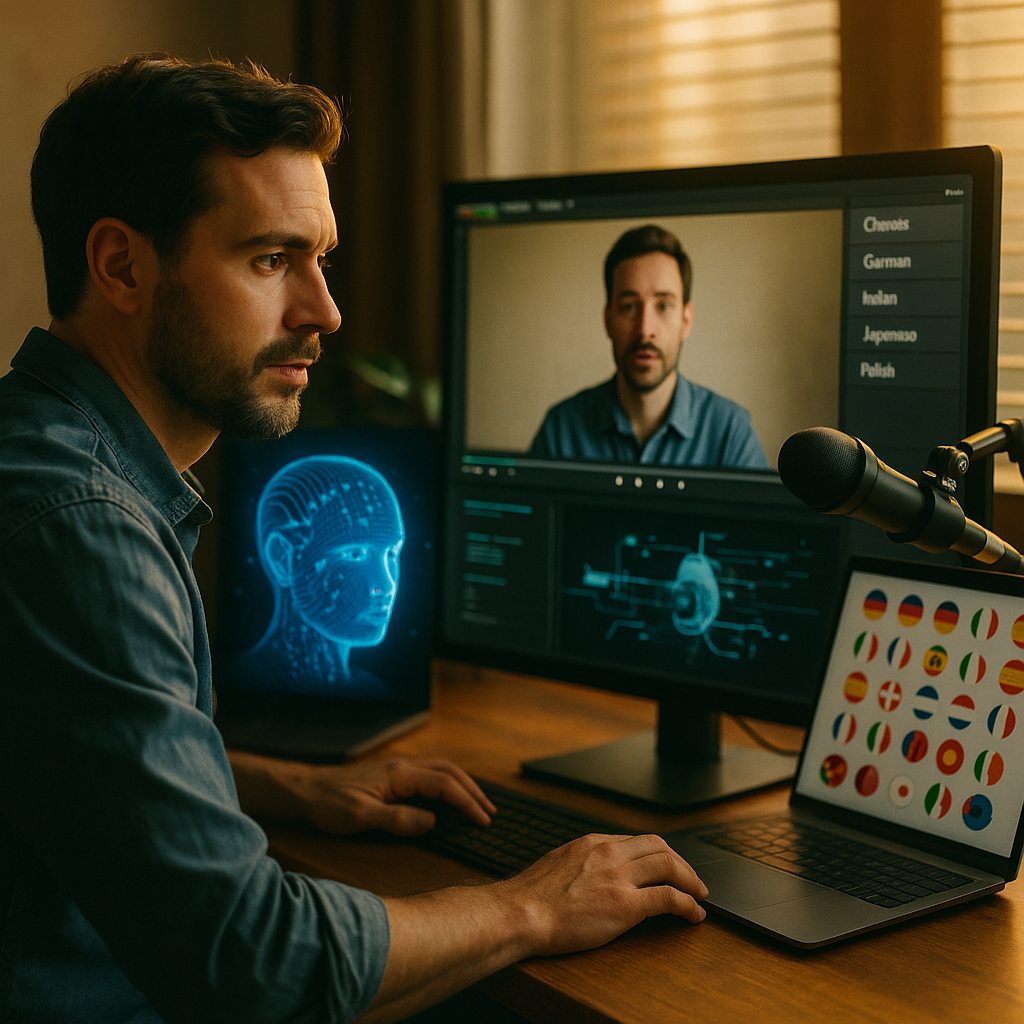
One actor. One script. Thirty languages, ready to ship before lunch. That is not a pitch deck fantasy anymore, it is what AI actor localization tools like Arcads and its competitors are doing to global creative production right now. Dubbing studios used to charge five figures and three weeks per market. Brands running lean are skipping that entirely.
If your team still treats “going international” as a reshoot event, you are burning budget you don’t need to burn. Here is how AI actor localization actually works, where it breaks, and how to brief it so legal doesn’t flag it later.
What AI Actor Localization Actually Means
Strip away the marketing language and the mechanics are simple. You shoot or generate one UGC-style actor delivering a script on camera. The platform then uses voice cloning and lip-sync modeling to regenerate that same performance in dozens of languages, matching mouth movements to the new audio track. The actor’s face, gestures, and energy stay constant. Only the words and accent change.
Arcads popularized this for performance marketing by pairing AI avatars with synthetic voices trained on short samples. Competitors including HeyGen, Synthesia, and Captions have built similar localization pipelines, some leaning more on enterprise training content, others squarely on paid social ad creative. For brand teams, the use case is the same: produce a hero video once, then localize it for every market you run media in, without rebooking talent, without a new shoot, without waiting on a translation agency’s turnaround time.
Teams running multi-market paid social are cutting localization costs by 70 to 90 percent compared to traditional dubbing and reshoot workflows, according to vendor case studies from the AI video space.
Why This Matters for Budget Owners, Not Just Creative Teams
Localization used to be a line item that scaled linearly with market count. Ten markets meant ten dubbing sessions, ten sets of subtitles, sometimes ten separate shoots if you wanted native-looking talent. That math made international expansion expensive enough that mid-sized brands often skipped it and ran English creative everywhere, hoping captions would carry the message.
AI actor localization breaks that linear cost curve. One source asset, multiplied across languages at a fraction of the marginal cost. That changes the calculus for media planners too. If localized creative lifts click-through rate and conversion (and eMarketer research consistently shows native-language ads outperform subtitled or English-only creative in non-English markets), then the ROI case for localization at scale gets a lot easier to defend in a budget meeting.
This is also an operational efficiency story, not just a creative one. Fewer vendors to manage. Fewer approval loops across markets. Faster time to launch when a product update or promo needs to go live in 15 countries simultaneously.
The Workflow: Scripting Once, Shipping Everywhere
Here’s roughly how a competent AI actor localization workflow runs in practice:
- Write a master script in the source language, built for clarity and pacing rather than idiom-heavy copy that translates poorly.
- Generate or shoot the base actor read, either with a real UGC creator or a fully synthetic avatar.
- Feed localized scripts into the platform, either via professional translation or reviewed machine translation.
- Let the tool regenerate voice and lip-sync for each target language, producing a near-native-looking output.
- Run native-speaker QA before anything goes to media buying, because automated translation still mangles idioms and tone.
That fifth step is not optional. Skipping native review is how brands end up with technically correct but culturally tone-deaf ads. A phrase that lands as casual confidence in English can read as arrogant or just weird in German or Japanese. The AI handles mouth movement and voice quality beautifully. It does not understand cultural register. That’s still a human job.
Scripting for Translation, Not Just for Delivery
The biggest mistake brand teams make is writing the master script the same way they’d write any single-market ad, full of wordplay, slang, and cultural references that don’t survive translation. If your hook relies on an English pun, it dies in French. If your CTA uses a region-specific idiom, it confuses a voice clone trying to match syllable timing in Portuguese.
Write shorter sentences. Favor concrete claims over clever wordplay. This isn’t just a localization best practice, it overlaps heavily with what already works in voiceover-driven UGC scripts generally: clarity beats cleverness when a machine or a non-native viewer has to parse your message fast. The same discipline that makes a script work for AI voice synthesis makes it translate cleanly too.
Where It Breaks: Accuracy, Nuance, and Legal Exposure
Let’s be honest about the failure modes, because vendors won’t lead with these.
Lip-sync quality varies by language pair. English-to-Spanish localization tends to look clean because syllable counts and mouth shapes are fairly close. English-to-Mandarin or English-to-Arabic can look noticeably off, with mouth movements that don’t quite match the audio. If your creative runs on platforms where viewers watch with sound on and full attention (think YouTube pre-roll versus TikTok scroll), that mismatch is more noticeable and more damaging to brand perception.
Then there’s claims accuracy. A product claim that’s compliant in the US might violate advertising standards elsewhere. The UK’s Information Commissioner’s Office and equivalent bodies across the EU have different rules on data claims, health claims, and testimonial disclosure than the US FTC. Running one script through 30 languages means running one legal review through 30 jurisdictions, and that review needs to happen before media spend, not after a compliance complaint lands.
Localizing the voice is the easy part. Localizing the legal claim, the disclosure language, and the cultural register is where most AI-scaled campaigns actually fail.
This is the same discipline brands already need for AI-generated creative generally, something we’ve covered in detail around scripting claims that survive platform review. Multiply that risk by every market you’re launching in, and the review process needs its own checklist, not a one-time sign-off.
Picking the Right Tool for Your Volume
Not every brand needs the same tool. If you’re running a handful of markets with moderate ad spend, a platform like HeyGen or Captions with straightforward language packs might be plenty. If you’re running performance creative at scale across 20+ markets with constant iteration, Arcads-style tools built specifically for paid social ad formats (hooks, pattern interrupts, vertical framing) will save more time because the output is already shaped for the platforms you’re buying on.
Questions worth asking before you commit budget to a vendor:
- Does the platform support the specific language pairs you need, and what’s lip-sync quality like for each?
- Can you bulk-upload scripts and generate variants at the volume your media plan requires?
- What’s the actual turnaround time from script to exportable video, per language?
- Does pricing scale per language, per minute of output, or per seat, and how does that compare at your actual volume?
- Is there a native-speaker review step built into the workflow, or is that entirely on your team?
Get these answers before signing a contract, not after you’ve already briefed 30 markets’ worth of creative.
Building This Into Your Creative Operating Model
The brands getting real value from AI actor localization aren’t treating it as a one-off production hack. They’re building it into how they structure creative from the start, the same way smart teams approach persona-driven scripting to cut creative fatigue. One master brief generates a base script. That script feeds localization. Localized outputs feed a short-form video library that media buyers can pull from per market without waiting on a new production cycle.
This also changes how you brief creators and script writers. Instead of writing one ad for one market, you’re writing a master asset meant to travel. That’s a different skill than most UGC scriptwriting, closer to writing for global dubbing than writing for a single TikTok audience. Worth training your scripting team on that distinction now, because the tools are only going to get better and the volume expectations are only going to grow. Platforms like HubSpot have already started publishing localization playbooks for exactly this reason.
Next Step
Pick one high-performing hero video, localize it into three test markets using an AI actor tool, and run native-speaker QA before it ever touches paid media. If the lift justifies the cost at three markets, scale the same workflow to thirty. Don’t skip the review step to save a week, that’s where the compliance and brand-safety risk actually lives.
Frequently Asked Questions
What is AI actor localization?
AI actor localization is the process of using AI video platforms to regenerate a single actor’s on-camera performance in multiple languages, matching voice and lip movement to translated scripts without reshooting with new talent.
How much does AI actor localization cost compared to traditional dubbing?
Costs vary by platform and volume, but brands generally report savings of 70 to 90 percent compared to traditional studio dubbing and market-specific reshoots, primarily because no new talent, studio time, or travel is required per language.
Does AI actor localization work for every language?
Quality varies significantly by language pair. Languages with similar syllable structures and mouth shapes to the source language, such as English to Spanish, tend to produce cleaner lip-sync than more distant pairs like English to Mandarin or English to Arabic.
Is machine-translated script enough for localized ads?
No. Machine translation handles literal meaning but misses cultural tone, idiom, and register. Native-speaker review before launch is essential to avoid messaging that reads as awkward, confusing, or unintentionally offensive in the target market.
Do localized AI ads need separate legal review per market?
Yes. Advertising claims, disclosure requirements, and testimonial rules differ by jurisdiction. A claim compliant under FTC guidelines in the US may not meet standards set by regulators in the UK, EU, or other markets, so legal review should happen per market before media spend.
Which brands benefit most from AI actor localization?
Brands running paid social or performance marketing across multiple international markets see the fastest ROI, since the tool eliminates the linear cost scaling of traditional dubbing and reshoot workflows as market count grows.
Top Influencer Marketing Agencies
The leading agencies shaping influencer marketing in 2026
Agencies ranked by campaign performance, client diversity, platform expertise, proven ROI, industry recognition, and client satisfaction. Assessed through verified case studies, reviews, and industry consultations.
Moburst

-
2

The Shelf
Boutique Beauty & Lifestyle Influencer AgencyA data-driven boutique agency specializing exclusively in beauty, wellness, and lifestyle influencer campaigns on Instagram and TikTok. Best for brands already focused on the beauty/personal care space that need curated, aesthetic-driven content.Clients: Pepsi, The Honest Company, Hims, Elf Cosmetics, Pure LeafVisit The Shelf → -
3

Audiencly
Niche Gaming & Esports Influencer AgencyA specialized agency focused exclusively on gaming and esports creators on YouTube, Twitch, and TikTok. Ideal if your campaign is 100% gaming-focused — from game launches to hardware and esports events.Clients: Epic Games, NordVPN, Ubisoft, Wargaming, Tencent GamesVisit Audiencly → -
4

Viral Nation
Global Influencer Marketing & Talent AgencyA dual talent management and marketing agency with proprietary brand safety tools and a global creator network spanning nano-influencers to celebrities across all major platforms.Clients: Meta, Activision Blizzard, Energizer, Aston Martin, WalmartVisit Viral Nation → -
5

The Influencer Marketing Factory
TikTok, Instagram & YouTube CampaignsA full-service agency with strong TikTok expertise, offering end-to-end campaign management from influencer discovery through performance reporting with a focus on platform-native content.Clients: Google, Snapchat, Universal Music, Bumble, YelpVisit TIMF → -
6

NeoReach
Enterprise Analytics & Influencer CampaignsAn enterprise-focused agency combining managed campaigns with a powerful self-service data platform for influencer search, audience analytics, and attribution modeling.Clients: Amazon, Airbnb, Netflix, Honda, The New York TimesVisit NeoReach → -
7

Ubiquitous
Creator-First Marketing PlatformA tech-driven platform combining self-service tools with managed campaign options, emphasizing speed and scalability for brands managing multiple influencer relationships.Clients: Lyft, Disney, Target, American Eagle, NetflixVisit Ubiquitous → -
8

Obviously
Scalable Enterprise Influencer CampaignsA tech-enabled agency built for high-volume campaigns, coordinating hundreds of creators simultaneously with end-to-end logistics, content rights management, and product seeding.Clients: Google, Ulta Beauty, Converse, AmazonVisit Obviously →