


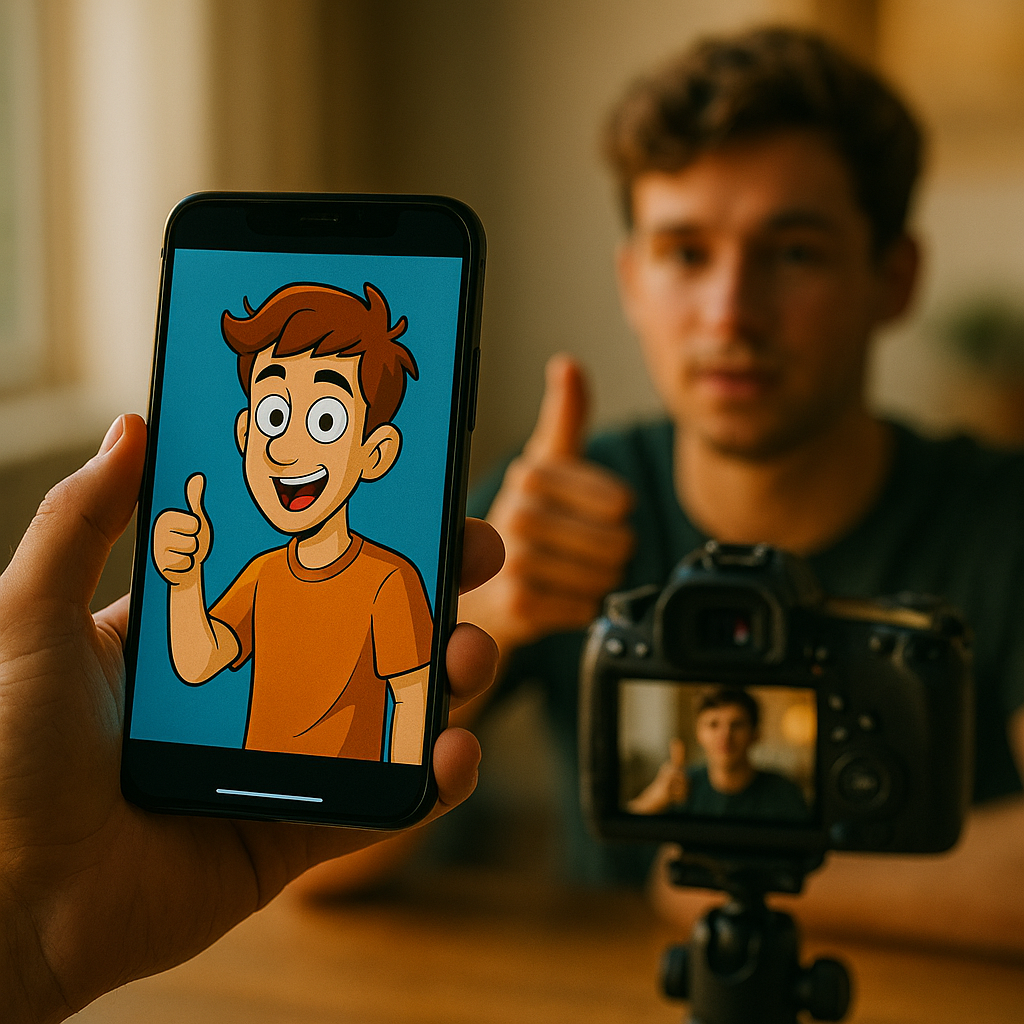
One mid-funnel skincare brand swapped a polished live-action testimonial for a two-dimensional animated character pitching the same claim, same script, same offer. The animated version pulled a 34% lower cost per acquisition. That’s not a fluke anymore. AI cartoon and animated UGC is quietly outperforming real footage across categories where trust, novelty, or regulatory caution matter more than realism.
If you’re still treating animation as the budget fallback for when talent falls through, you’re leaving performance on the table.
Why Stylized Creative Is Winning the Scroll
Feed fatigue is real. The average user has seen thousands of iterations of the same UGC formula: ring light, bathroom mirror, “I was today years old.” Animated content breaks that pattern instantly. It doesn’t look like an ad pretending to be organic, and it doesn’t look like organic content pretending to sell. It’s its own category, which means it earns a longer look before the thumb decides to scroll.
There’s also a cognitive efficiency angle. Stylized characters strip away distracting variables, bad lighting, awkward pauses, inconsistent energy, so the message lands cleaner. Viewers process cartoon faces faster than photorealistic ones because the brain isn’t busy evaluating authenticity cues. That’s a win for comprehension, especially in categories like finance, health, and supplements where the claim itself needs to be understood in the first three seconds.
Animated creative removes the “is this person real” skepticism tax entirely, because nobody expects a cartoon to be a real customer. That reframes the entire trust equation.
The Performance Data Brands Are Actually Seeing
Marketing teams running side-by-side tests are reporting consistent patterns, not universal wins, but directional ones worth planning around:
- Higher hook rates in the first two seconds, likely novelty-driven.
- Stronger completion rates on 15 to 30 second formats, where a tight animated gag or payoff keeps attention.
- Lower moderation flags on regulated categories like supplements, finance, and skincare claims.
- Mixed results on direct response conversion, animated wins on cold audiences, live-action still edges out on retargeting where social proof matters more.
That last point matters. Animation isn’t a universal replacement. It’s a tool for specific jobs: top-of-funnel attention capture, claim-heavy categories, and brands that want distinctive, ownable creative without a production calendar. For bottom-funnel trust-building, a real customer with a real face still tends to close harder. The smart play is a blended library, not a wholesale switch. Our breakdown of animated clips versus live-action UGC for whitelisting gets into exactly how to split that budget by funnel stage.
Where Animation Actually Beats Real Footage
Regulated and Claim-Heavy Categories
If your product makes a health, wealth, or efficacy claim, a human testimonial carries implicit risk. Viewers assume a real person is vouching with their own experience, and if that claim doesn’t hold up, the backlash lands on both the brand and the talent. An animated spokescharacter delivering the same line reads as clearly brand-owned messaging. Nobody mistakes a cartoon for a personal endorsement, which lowers the perceived deception risk and, in practice, lowers platform rejection rates too. We’ve covered this exact mechanic in scripting claims that survive platform review, and it’s become one of the more useful workarounds for teams tired of getting bounced by ad review.
Fast Iteration Without Reshoots
Need five variants of the same hook to test against different audience segments? With live-action, that’s five booking calendars, five locations, five rounds of usage rights negotiation. With animation, it’s a prompt change and a render. Teams running persona-driven ad variants at scale are increasingly leaning on animated formats specifically because the iteration loop shrinks from weeks to hours.
Brand Safety and Talent Risk
Live-action creators can go off-script, get canceled, or simply age out of a campaign’s visual identity. An animated character doesn’t do interviews, doesn’t post controversial opinions, and doesn’t need a new contract renegotiated every quarter. For brands burned by a creator controversy mid-campaign, that stability alone justifies the production shift.
Where Real Footage Still Wins
Don’t get carried away. There are jobs animation simply can’t do as well.
- Social proof conversion moments. When the ad’s entire job is “look, this worked for someone like you,” a real face with real texture still outperforms. Viewers want to see pores, not polygons.
- Unboxing and tactile demonstration. Texture, weight, sound, the physical sensory cues of a product in hand are hard to replicate convincingly in stylized form, and they matter for categories like beauty tools or food.
- Founder or expert credibility plays. If the message depends on a real person’s authority (a dermatologist, a founder, an industry expert) animating them undercuts the very credibility you’re borrowing. See how expert reaction videos and expert reaction pairings are scripted for exactly this reason.
The honest answer is that animation and live-action aren’t competitors, they’re different tools solving different funnel problems. Brands that treat this as an either/or decision usually pick wrong for at least half their use cases.
Building an Animated UGC Workflow That Doesn’t Feel Generic
The early wave of AI cartoon ads all looked the same: same character rig, same voice cadence, same three gestures. That sameness is starting to hurt performance as audiences pattern-match the format itself. To avoid blending into a sea of identical cartoon spokespeople, a few operational habits matter.
First, invest in a recurring character rather than a one-off. Audiences build familiarity with a consistent animated persona the same way they do with a recurring human creator. Brands doing this well are essentially running persona-driven UGC with recurring characters, just rendered instead of filmed. Second, don’t let the animation carry the entire creative burden. The script still has to do the heavy lifting: a weak hook with great animation still underperforms a strong hook with mediocre visuals. Review how faceless UGC scripts structure voiceover pacing, because the same principles of rhythm and payoff apply directly to animated formats.
Third, treat compliance review as part of production, not an afterthought. Animated content still makes claims, still runs through the same platform review queues, and still falls under FTC disclosure rules if there’s any brand relationship implied. Teams that skip this step find out the hard way that a cartoon doesn’t exempt you from FTC endorsement guidelines. Build your review checklist the way you would for any other sponsored format, and check platform-specific ad policies before launch, since Google’s ad policies and Meta’s review systems treat stylized claims with the same scrutiny as live-action ones.
Format Pairings Worth Testing
Animated UGC doesn’t have to stand alone. Some of the strongest performers pair a stylized open with a live-action payoff, or vice versa, giving viewers the novelty hook and the trust close in one asset. A few combinations worth testing in your next creative sprint:
- Animated myth-busting intro into a real customer reveal, borrowing structure from myth vs fact scripting.
- Animated ingredient breakdown paired with a real demo, adapting the claim structure from ingredient breakdown videos.
- Stylized cold-open hook feeding into a text-overlay sound-off format for feed placements, per the structure in sound-off video scripts.
According to industry trend data tracked by eMarketer, short-form video spend continues shifting toward diversified creative formats rather than single-style libraries, which tracks with what performance teams are seeing on the ground. Platforms like Sprout Social have also flagged animated and AI-generated formats as a fast-growing content category worth benchmarking against existing live-action baselines.
Building the Library, Not Just the Ad
The brands getting the most out of this trend aren’t producing one animated spot and calling it done. They’re building a short-form video library that mixes animated, live-action, and hybrid formats, then letting performance data decide which style wins for which audience segment and funnel stage. That’s a fundamentally different operating model than the old “shoot once, run everywhere” approach, and it requires marketing teams to think more like content studios than ad buyers.
This also changes how you brief creative. Instead of writing one script and handing it to a production team, you’re now writing scripts that explicitly specify format: animated for cold top-of-funnel, live-action for retargeting, hybrid for consideration-stage retention. That’s more upfront planning, but it pays off in media efficiency because you stop forcing one creative style to do every job in the funnel.
Takeaway
Stylized animated UGC isn’t a novelty trend, it’s a legitimate funnel tool that outperforms live-action specifically at the top of funnel and in claim-sensitive categories. Build a test plan that pits animated hooks against your current live-action control for one quarter, measure hook rate and CPA separately by funnel stage, then let the data decide your creative mix instead of a gut call.
FAQs
Is AI cartoon UGC cheaper than live-action UGC?
Usually, yes, especially at scale. Once a character rig and voice model are built, generating new script variants costs a fraction of booking talent, locations, and editors for each new concept.
Does animated UGC still need FTC disclosure?
Yes. If the content implies a brand relationship or makes a claim on the brand’s behalf, standard endorsement and disclosure rules still apply regardless of whether the creative is animated or filmed.
Which funnel stage works best for animated creative?
Top-of-funnel and cold-audience prospecting tend to perform best, since novelty drives attention. Bottom-funnel retargeting still generally favors live-action social proof.
Can animated UGC replace influencer partnerships entirely?
No. Animation solves for attention and claim safety, but it can’t replicate the trust transfer of a real creator’s endorsement. Most effective programs use both.
How do you keep animated content from feeling generic?
Build a recurring, distinctive character instead of generic stock avatars, invest in strong scripts first, and treat the animation style as a brand asset worth protecting rather than a cheap filler format.
Top Influencer Marketing Agencies
The leading agencies shaping influencer marketing in 2026
Agencies ranked by campaign performance, client diversity, platform expertise, proven ROI, industry recognition, and client satisfaction. Assessed through verified case studies, reviews, and industry consultations.
Moburst

-
2

The Shelf
Boutique Beauty & Lifestyle Influencer AgencyA data-driven boutique agency specializing exclusively in beauty, wellness, and lifestyle influencer campaigns on Instagram and TikTok. Best for brands already focused on the beauty/personal care space that need curated, aesthetic-driven content.Clients: Pepsi, The Honest Company, Hims, Elf Cosmetics, Pure LeafVisit The Shelf → -
3

Audiencly
Niche Gaming & Esports Influencer AgencyA specialized agency focused exclusively on gaming and esports creators on YouTube, Twitch, and TikTok. Ideal if your campaign is 100% gaming-focused — from game launches to hardware and esports events.Clients: Epic Games, NordVPN, Ubisoft, Wargaming, Tencent GamesVisit Audiencly → -
4

Viral Nation
Global Influencer Marketing & Talent AgencyA dual talent management and marketing agency with proprietary brand safety tools and a global creator network spanning nano-influencers to celebrities across all major platforms.Clients: Meta, Activision Blizzard, Energizer, Aston Martin, WalmartVisit Viral Nation → -
5

The Influencer Marketing Factory
TikTok, Instagram & YouTube CampaignsA full-service agency with strong TikTok expertise, offering end-to-end campaign management from influencer discovery through performance reporting with a focus on platform-native content.Clients: Google, Snapchat, Universal Music, Bumble, YelpVisit TIMF → -
6

NeoReach
Enterprise Analytics & Influencer CampaignsAn enterprise-focused agency combining managed campaigns with a powerful self-service data platform for influencer search, audience analytics, and attribution modeling.Clients: Amazon, Airbnb, Netflix, Honda, The New York TimesVisit NeoReach → -
7

Ubiquitous
Creator-First Marketing PlatformA tech-driven platform combining self-service tools with managed campaign options, emphasizing speed and scalability for brands managing multiple influencer relationships.Clients: Lyft, Disney, Target, American Eagle, NetflixVisit Ubiquitous → -
8

Obviously
Scalable Enterprise Influencer CampaignsA tech-enabled agency built for high-volume campaigns, coordinating hundreds of creators simultaneously with end-to-end logistics, content rights management, and product seeding.Clients: Google, Ulta Beauty, Converse, AmazonVisit Obviously →