


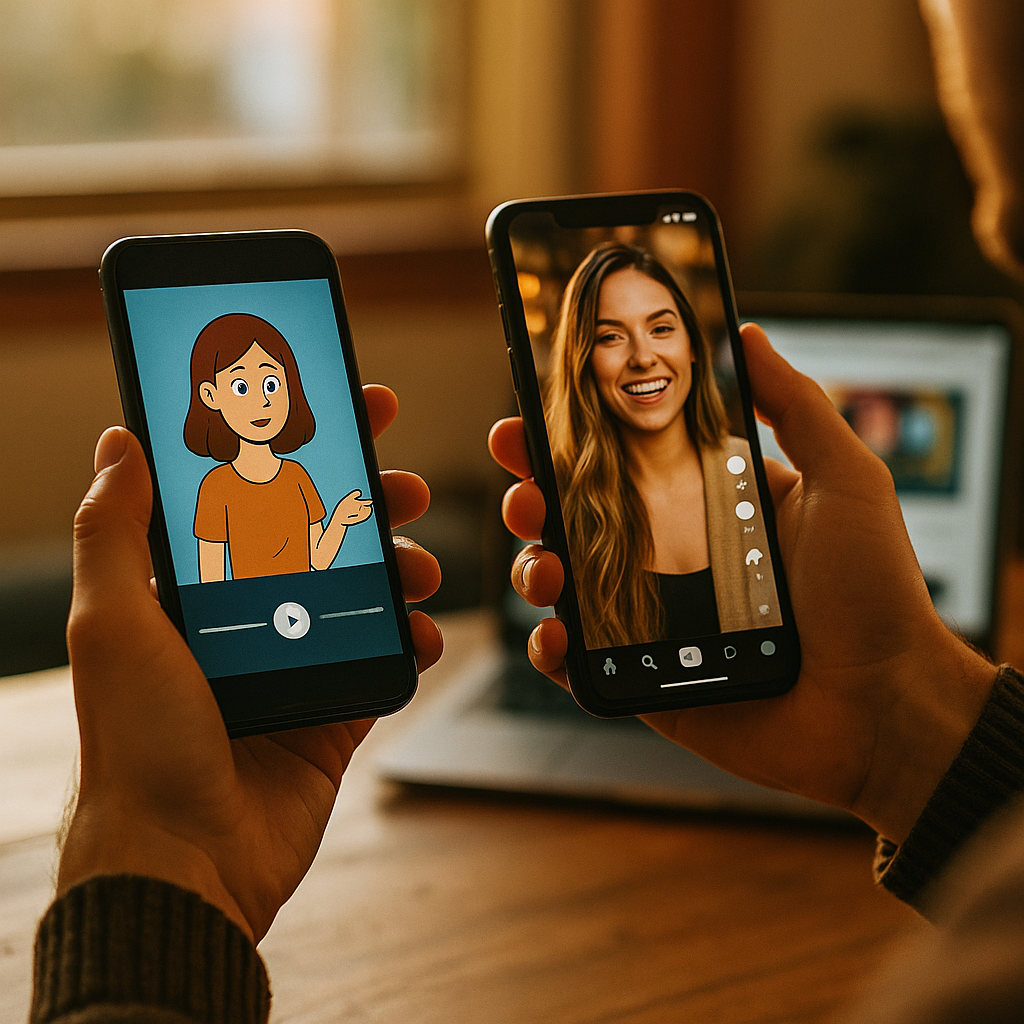
Brands running paid whitelisting campaigns now face a question that didn’t exist three years ago: should the ad feature a real human or a synthetic one? Nearly 40% of performance marketers tested AI-generated video assets in paid social last year, according to data cited across industry surveys, yet live-action UGC still commands higher click-through rates in most verticals. Choosing wrong on animated AI clips vs live-action UGC for whitelisting doesn’t just waste budget. It can tank conversion rates for months before anyone notices the pattern.
What Whitelisting Actually Buys You
Paid whitelisting (running ads through a creator’s handle via Meta Partnership Ads or TikTok Spark Ads) only works if the audience believes the face on screen. That’s the entire value proposition. You’re borrowing trust, not just reach. So the format decision isn’t aesthetic. It’s a trust mechanics question.
Brands that treat whitelisting like generic ad inventory miss this. A creator’s audience follows them because of a parasocial bond, however small. Swap that creator’s face for an AI avatar mid campaign and you risk breaking the exact thing you paid for. On the other hand, animated AI clips solve real production bottlenecks that live-action simply can’t touch at scale.
The Case for Animated AI Clips
Animated AI generation has gotten genuinely useful for paid social, not just novelty content. Tools built on diffusion models can now produce a 15 second product demo in hours instead of the two to three week turnaround typical of a live-action shoot with a creator, agency coordination, and usage rights negotiation.
- Speed to market: No shoot scheduling, no creator availability bottlenecks. You can iterate five hook variations in a single afternoon.
- Cost per variant: Testing ten creative angles with live-action talent means ten separate shoot days or ten separate usage fees. Animated assets scale variant testing at a fraction of the cost.
- Consistency at volume: Multi-market brands running the same campaign across twelve geos can localize tone and language without rebooking talent in each region.
This matters most for categories where the product, not the person, is the hero. Software demos, financial tools, and B2B SaaS explainer ads often perform just as well animated because the audience isn’t buying into a creator’s lifestyle. They’re buying into a feature walkthrough. For these use cases, pairing AI-driven video with structured content strategy works well, similar to the approach outlined in scripting short form video for algorithmic discovery.
Animated AI clips win on speed and cost. Live-action UGC wins on trust. Whitelisting budgets should split by funnel stage, not by which format is trendier this quarter.
Why Live-Action UGC Still Wins Trust
Here’s the uncomfortable truth for teams excited about AI production pipelines: humans still spot synthetic content, even when they can’t articulate why. Facial micro-expressions, inconsistent lighting on skin, and slightly-off hand movements trigger subconscious skepticism. In categories where credibility drives the purchase decision, skincare claims, supplement efficacy, financial advice, that skepticism kills conversion.
Live-action UGC also carries something animated content structurally cannot replicate: visible proof of use. A creator holding a product, applying it on camera, reacting in real time, that’s evidence. An animated avatar doing the same thing reads as illustration, not testimony.
This is why ingredient-led and claims-heavy campaigns almost always outperform with real creators. Brands running ingredient breakdown videos rely on the creator’s physical presence as implicit proof the claims hold up. You lose that entirely with synthetic video, no matter how polished the render looks.
Cost, Speed, and Scale: The Real Comparison
Let’s talk numbers, because that’s what finance will ask about regardless of which format performs better creatively.
A typical mid-tier creator whitelisting deal runs $1,500 to $8,000 depending on reach and usage term, plus the ad spend layered on top. Animated AI production can bring the per-asset cost down to a few hundred dollars once a brand has built reusable character models and brand voice templates. That’s a legitimate argument for scaling animated content in lower-funnel retargeting, where creative fatigue sets in fast and you need fresh variants weekly, not monthly.
But cost per asset isn’t the full picture. Factor in performance decay. Live-action UGC whitelisted through a real creator’s account tends to hold engagement longer because the algorithm and the audience both read it as native content, not an ad unit. eMarketer research on paid social performance consistently shows creator-led formats outperforming studio-produced assets on cost-per-click, even when production budgets for the latter are higher.
The smartest approach we’re seeing from mid-size DTC brands: use animated AI clips for top-of-funnel awareness and retargeting sequences where volume matters more than individual asset trust, then reserve live-action whitelisting budget for consideration and conversion stages where a human face closes the deal.
Compliance and Disclosure Risks
This is where a lot of marketing teams get sloppy, and it’s the section legal will actually read.
The FTC has made clear that synthetic endorsers must be disclosed as such. If an AI-generated avatar is making a claim about a product’s efficacy, viewers need to know it’s not a real person’s experience. Running an animated clip through whitelisting without that disclosure isn’t a gray area anymore, it’s a direct violation risk that regulators have specifically called out in recent guidance updates.
Live-action UGC has its own compliance layer, of course. Whitelisted content still needs proper usage rights, FTC-compliant disclosure tags, and platform-specific partnership labels through tools like Meta Business Suite. Brands that skip this step on either format are gambling with ad account suspensions, not just fines. For a deeper breakdown of how to structure whitelisting specs that actually clear platform review, see our guide on Meta partnership ad specs.
One more wrinkle: synthetic voice cloning. If an AI clip uses a cloned version of a real creator’s voice or likeness without explicit contractual permission, that’s a separate legal exposure entirely, distinct from FTC disclosure rules. Several high-profile disputes over unauthorized AI likeness use have already landed in court. Don’t assume your production vendor has cleared this on your behalf.
Which Format Fits Which Funnel Stage?
Rather than picking one format brand-wide, map the decision to funnel stage and claim intensity.
- Cold awareness: Animated AI clips work well here. Audiences aren’t evaluating trust yet, they’re absorbing a hook. Volume and speed matter more than authenticity signals.
- Consideration: Blend both. Use live-action for primary creative, animated variants for quick A/B testing of hooks and CTAs.
- Conversion and retargeting with claims: Live-action UGC, full stop. This is where disclosure, trust, and visible proof matter most, especially for health, beauty, and finance categories.
- High-frequency retargeting: Animated clips reduce creative fatigue cost-effectively, since you can rotate backgrounds, text overlays, and pacing without rebooking a creator.
Formats like dupe comparison videos and stitched review compilations lean almost entirely on live-action because the entire value is comparative, real-world proof. You can’t animate your way into that kind of credibility. Meanwhile, founder-driven trust formats like founder rebuttal videos work precisely because the person is identifiable and accountable, something synthetic avatars structurally can’t deliver.
Platform guidance is evolving fast here too. TikTok’s advertising policies now require explicit labeling for AI-generated content used in paid placements, and Google’s ad policies have added similar synthetic media disclosure requirements. Build this into your creative review checklist now, before a campaign gets flagged mid-flight.
A Quick Gut Check Before You Greenlight Either Format
Ask three questions before locking a whitelisting creative brief: Does this claim require visible proof of use? Does the audience need to trust a specific person, or just understand a feature? Can legal confirm disclosure requirements are met for the format chosen? If you can’t answer all three cleanly, you’re not ready to spend media dollars yet.
The brands getting this right aren’t choosing a side in the animated-versus-live-action debate. They’re running both, deliberately, mapped to funnel stage and claim risk, and tracking performance by format in their reporting dashboards rather than lumping all whitelisting spend into one bucket.
Frequently Asked Questions
Is animated AI video cheaper than live-action UGC for whitelisting?
Generally yes, per asset. Once a brand builds reusable AI templates, variant production costs drop significantly compared to booking new live-action shoots for every test. However, total campaign cost should factor in performance decay and compliance review time, not just production cost alone.
Do I need FTC disclosure for AI-generated avatars in ads?
Yes. If a synthetic avatar is making a product claim or appearing to endorse a product, the FTC requires clear disclosure that it’s AI-generated content, separate from standard influencer partnership disclosure rules.
Can animated AI clips use whitelisting permissions the same way live-action creator content does?
Only if the animated content is built around an actual creator’s likeness or voice with explicit contractual rights. A fully synthetic avatar unrelated to any real creator doesn’t require whitelisting permissions in the traditional sense, but it does require its own disclosure and usage rights clearance.
Which format performs better for conversion-stage ads?
Live-action UGC typically outperforms animated content at conversion stages, particularly for categories involving health claims, beauty results, or financial products, where visible human proof drives trust more than polished visuals.
Should every whitelisting campaign test both formats?
If budget allows, yes. Running both formats across different funnel stages and comparing cost-per-result by format gives marketing teams the data needed to allocate future budget intelligently rather than guessing.
Next step: audit your current whitelisting budget by funnel stage this week. Move claims-heavy, conversion-focused spend toward live-action creators, and shift top-of-funnel testing dollars toward animated AI variants. The split, not the choice, is where the ROI actually lives.
Top Influencer Marketing Agencies
The leading agencies shaping influencer marketing in 2026
Agencies ranked by campaign performance, client diversity, platform expertise, proven ROI, industry recognition, and client satisfaction. Assessed through verified case studies, reviews, and industry consultations.
Moburst

-
2

The Shelf
Boutique Beauty & Lifestyle Influencer AgencyA data-driven boutique agency specializing exclusively in beauty, wellness, and lifestyle influencer campaigns on Instagram and TikTok. Best for brands already focused on the beauty/personal care space that need curated, aesthetic-driven content.Clients: Pepsi, The Honest Company, Hims, Elf Cosmetics, Pure LeafVisit The Shelf → -
3

Audiencly
Niche Gaming & Esports Influencer AgencyA specialized agency focused exclusively on gaming and esports creators on YouTube, Twitch, and TikTok. Ideal if your campaign is 100% gaming-focused — from game launches to hardware and esports events.Clients: Epic Games, NordVPN, Ubisoft, Wargaming, Tencent GamesVisit Audiencly → -
4

Viral Nation
Global Influencer Marketing & Talent AgencyA dual talent management and marketing agency with proprietary brand safety tools and a global creator network spanning nano-influencers to celebrities across all major platforms.Clients: Meta, Activision Blizzard, Energizer, Aston Martin, WalmartVisit Viral Nation → -
5

The Influencer Marketing Factory
TikTok, Instagram & YouTube CampaignsA full-service agency with strong TikTok expertise, offering end-to-end campaign management from influencer discovery through performance reporting with a focus on platform-native content.Clients: Google, Snapchat, Universal Music, Bumble, YelpVisit TIMF → -
6

NeoReach
Enterprise Analytics & Influencer CampaignsAn enterprise-focused agency combining managed campaigns with a powerful self-service data platform for influencer search, audience analytics, and attribution modeling.Clients: Amazon, Airbnb, Netflix, Honda, The New York TimesVisit NeoReach → -
7

Ubiquitous
Creator-First Marketing PlatformA tech-driven platform combining self-service tools with managed campaign options, emphasizing speed and scalability for brands managing multiple influencer relationships.Clients: Lyft, Disney, Target, American Eagle, NetflixVisit Ubiquitous → -
8

Obviously
Scalable Enterprise Influencer CampaignsA tech-enabled agency built for high-volume campaigns, coordinating hundreds of creators simultaneously with end-to-end logistics, content rights management, and product seeding.Clients: Google, Ulta Beauty, Converse, AmazonVisit Obviously →