


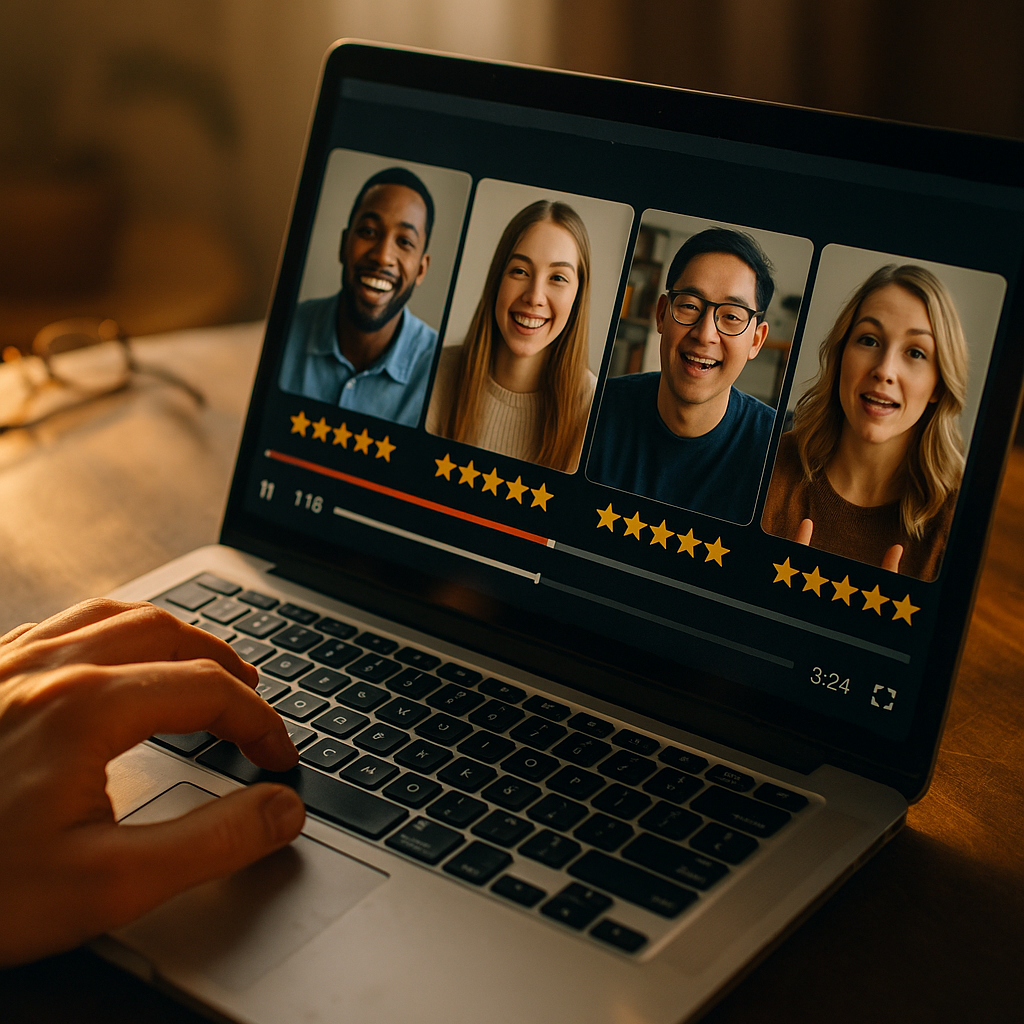
Eighty-nine percent of consumers check reviews before buying, yet most brands still run testimonials one at a time, like they’re rationing trust. Stitched review compilations flip that math. By scripting social proof montages at scale, you turn a scattered pile of customer clips, UGC snippets, and creator reactions into a single, high-velocity trust engine that outperforms polished ad copy nine times out of ten. The catch? Most teams still build these the lazy way, and it shows.
What Is a Stitched Review Compilation, Exactly?
A stitched review compilation is a short-form video that sequences multiple real customer or creator reactions into one continuous piece, usually 20 to 60 seconds, built around a single product claim or use case. Think of it as a highlight reel for trust. Instead of one person saying “this product changed my skin,” you get five people saying slightly different versions of the same thing, back to back, with pacing that mimics a montage rather than a testimonial dump.
This isn’t new. QVC was doing audience-reaction stitching before social video existed. What’s changed is the mechanism: TikTok’s Stitch feature, Instagram Remix, and a wave of AI-assisted editing tools now let brands assemble these at a pace that manual video editors never could. The format has quietly become one of the highest-converting ad units in the UGC toolkit, and it pairs naturally with approaches covered in stitch and duet response ads.
Why Montages Beat Single Testimonials Right Now
Single testimonials ask viewers to trust one stranger. Montages ask viewers to trust a pattern. That’s a meaningful psychological difference, and it’s backed by data: social proof research consistently shows that consensus signals (multiple independent voices agreeing) move purchase intent faster than any individual endorsement, no matter how polished.
A compilation of five imperfect, unscripted reactions will almost always outperform one perfectly lit testimonial, because viewers read repetition as authenticity, not coincidence.
There’s also a practical scale argument. Brands running influencer programs often sit on hundreds of unused clips: nano creator sends, customer service screen recordings, review platform video submissions. A stitched compilation lets you monetize that backlog instead of commissioning new content every quarter. If you’re already running nano creator briefs or collecting customer interview clips, you likely have more raw material than you realize.
Why does this matter for ROI specifically? Because paid media teams are fighting creative fatigue constantly, and compilations are modular. Swap one clip, refresh the whole ad, without reshooting anything.
The Script Skeleton: Building a Compilation That Doesn’t Feel Like a Supercut
Here’s where most brands get it wrong. They treat compilation editing as a purely post-production job: grab clips, cut them to beat, done. That approach produces montages that feel random, and random doesn’t convert. You need a script skeleton before you ever open an editing timeline.
- Open with the sharpest claim. Lead with the clip that states the core benefit most directly, even if it’s not the most polished footage. Hook mechanics matter more than production value here.
- Sequence by objection, not by chronology. Order clips to answer the viewer’s likely doubts in sequence: does it work, is it worth the price, will it last. This mirrors the logic used in before and after reels, where proof beats are structured, not accidental.
- Vary the voice, not the message. Repetition of the same claim in different voices and settings is the entire mechanism. Repetition of the same clip style gets boring fast.
- Close on specificity. End with the most detailed, concrete claim, a number, a timeframe, a comparison, because specificity is what sticks after the video ends.
Write this sequence out as a literal shot list before editing. Treat it the same way you’d treat a vox pop street interview script: a document that defines order, pacing, and the emotional arc, even though the footage itself is unscripted.
Sourcing at Scale Without Burning Your Legal Team
Volume is the whole appeal of this format, and volume is also where things break. Every clip in a compilation needs documented usage rights, separately from whatever rights you secured for the original post. A customer’s organic TikTok review being great doesn’t mean you can legally stitch it into a paid ad without consent.
Build a simple intake system: a rights release tied to every clip the moment you request or receive it, whether that’s through a review platform, a DM request, or a formal UGC contract. If you’re running this at genuine scale, a lightweight CRM or asset tagging system (even a well-structured spreadsheet) beats chasing permissions after the edit is done. The FTC has been increasingly vocal about disclosure and endorsement authenticity, so treat compliance review as a non-negotiable step, not a final checkbox. For broader context on claims that survive scrutiny, the approach used in dupe comparison video scripting applies almost directly here: document the source, keep claims attributable, and never let an edited clip imply something the original creator didn’t actually say.
Review the FTC’s own endorsement guidance before scaling this workflow across markets; the FTC’s guidance on endorsements is the baseline most legal teams will ask you to reference anyway.
Platform Mechanics That Make or Break the Format
Different platforms reward different stitching mechanics, and treating them identically is a fast way to waste production time.
TikTok rewards native Stitch usage because the algorithm recognizes the format and distributes it accordingly. Brands that manually recreate the stitch effect in post-production (rather than using the native tool) often see lower reach, even with identical content. If you’re coordinating multiple creators into a single compiled thread, the mechanics covered in multi creator stitch chains are worth studying closely before you brief anyone.
Instagram Reels handles compilations differently, favoring smooth cuts over visible stitch transitions. A montage built for TikTok often needs a re-edit, not just a resize, before it performs on Reels.
Meta ad placements add another layer: whitelisting requirements and partnership ad specs mean a compilation that works organically might need reformatting to run as paid media. If you’re planning to push these compilations into paid spend, review the specs outlined in Meta partnership ads whitelisting before you lock the final cut. Meta’s own documentation on partnership ads and branded content is worth bookmarking for your ops team too.
Measuring What Actually Converts
Here’s the uncomfortable truth: most brands ship stitched compilations and then measure them like they measure every other ad, by watch time and CTR. That misses the point entirely. The real signal is whether the compilation shortens the consideration phase, meaning you should be watching time-to-purchase after first exposure, not just engagement.
Set up a holdout test if you can. Run the compilation to one audience segment and a standard single-testimonial ad to a matched segment, then compare conversion rate and average order value, not just impressions. Platforms like Sprout Social and native ad managers can help track this at the campaign level, but the real work is in setting the comparison up correctly before launch, not analyzing it after.
Fatigue is real too. A compilation that crushes it for six weeks will plateau, usually faster than single-creator content, because the pattern becomes familiar to repeat viewers. Build refresh cycles into your calendar rather than waiting for performance to drop. The cadence logic in a creative refresh calendar applies directly: swap two or three clips every few weeks rather than rebuilding the whole asset from scratch.
One more thing worth tracking: which individual clips within the compilation get rewatched or screenshotted most, if your analytics allow that granularity. That data tells you which customer voice to feature more heavily next time, and it’s far more useful than aggregate watch-through rate. According to eMarketer, UGC-driven formats continue to outperform brand-produced video on cost-per-acquisition across most verticals tracked, which is reason enough to invest in getting the sourcing and sequencing right rather than treating compilations as a quick win.
FAQs
Frequently Asked Questions
What makes a stitched review compilation different from a standard testimonial ad?
A standard testimonial ad features one customer voice making one claim. A stitched review compilation sequences multiple independent voices making related claims, which triggers a consensus effect that single testimonials can’t replicate.
How many clips should go into one compilation?
Most high-performing compilations run between four and seven clips in 20 to 60 seconds. Fewer than four feels thin, more than seven starts to dilute individual claims and slow pacing.
Do I need separate usage rights for each clip in a compilation?
Yes. Rights secured for an original organic post don’t automatically extend to paid or repurposed use in a compilation. Every clip needs its own documented release before it goes into a paid campaign.
Which platform should I build the compilation for first?
Start with whichever platform generated the source clips, since native stitch or remix tools get algorithmic preference there. Re-edit for other platforms rather than reusing the same cut everywhere.
How often should compilations be refreshed?
Plan to swap several clips every few weeks rather than waiting for performance to visibly decline. Compilations fatigue faster than single-creator ads because the pattern becomes recognizable to repeat viewers.
Can AI tools help source or assemble these compilations at scale?
AI-assisted editing tools can speed up clip selection and rough cuts, but rights verification and claim accuracy still require human review before anything ships to paid media.
Start small: pull ten of your best unused customer clips this week, sequence them by objection rather than chronology, and run one holdout test before scaling the format across your whole paid budget.
Top Influencer Marketing Agencies
The leading agencies shaping influencer marketing in 2026
Agencies ranked by campaign performance, client diversity, platform expertise, proven ROI, industry recognition, and client satisfaction. Assessed through verified case studies, reviews, and industry consultations.
Moburst

-
2

The Shelf
Boutique Beauty & Lifestyle Influencer AgencyA data-driven boutique agency specializing exclusively in beauty, wellness, and lifestyle influencer campaigns on Instagram and TikTok. Best for brands already focused on the beauty/personal care space that need curated, aesthetic-driven content.Clients: Pepsi, The Honest Company, Hims, Elf Cosmetics, Pure LeafVisit The Shelf → -
3

Audiencly
Niche Gaming & Esports Influencer AgencyA specialized agency focused exclusively on gaming and esports creators on YouTube, Twitch, and TikTok. Ideal if your campaign is 100% gaming-focused — from game launches to hardware and esports events.Clients: Epic Games, NordVPN, Ubisoft, Wargaming, Tencent GamesVisit Audiencly → -
4

Viral Nation
Global Influencer Marketing & Talent AgencyA dual talent management and marketing agency with proprietary brand safety tools and a global creator network spanning nano-influencers to celebrities across all major platforms.Clients: Meta, Activision Blizzard, Energizer, Aston Martin, WalmartVisit Viral Nation → -
5

The Influencer Marketing Factory
TikTok, Instagram & YouTube CampaignsA full-service agency with strong TikTok expertise, offering end-to-end campaign management from influencer discovery through performance reporting with a focus on platform-native content.Clients: Google, Snapchat, Universal Music, Bumble, YelpVisit TIMF → -
6

NeoReach
Enterprise Analytics & Influencer CampaignsAn enterprise-focused agency combining managed campaigns with a powerful self-service data platform for influencer search, audience analytics, and attribution modeling.Clients: Amazon, Airbnb, Netflix, Honda, The New York TimesVisit NeoReach → -
7

Ubiquitous
Creator-First Marketing PlatformA tech-driven platform combining self-service tools with managed campaign options, emphasizing speed and scalability for brands managing multiple influencer relationships.Clients: Lyft, Disney, Target, American Eagle, NetflixVisit Ubiquitous → -
8

Obviously
Scalable Enterprise Influencer CampaignsA tech-enabled agency built for high-volume campaigns, coordinating hundreds of creators simultaneously with end-to-end logistics, content rights management, and product seeding.Clients: Google, Ulta Beauty, Converse, AmazonVisit Obviously →