


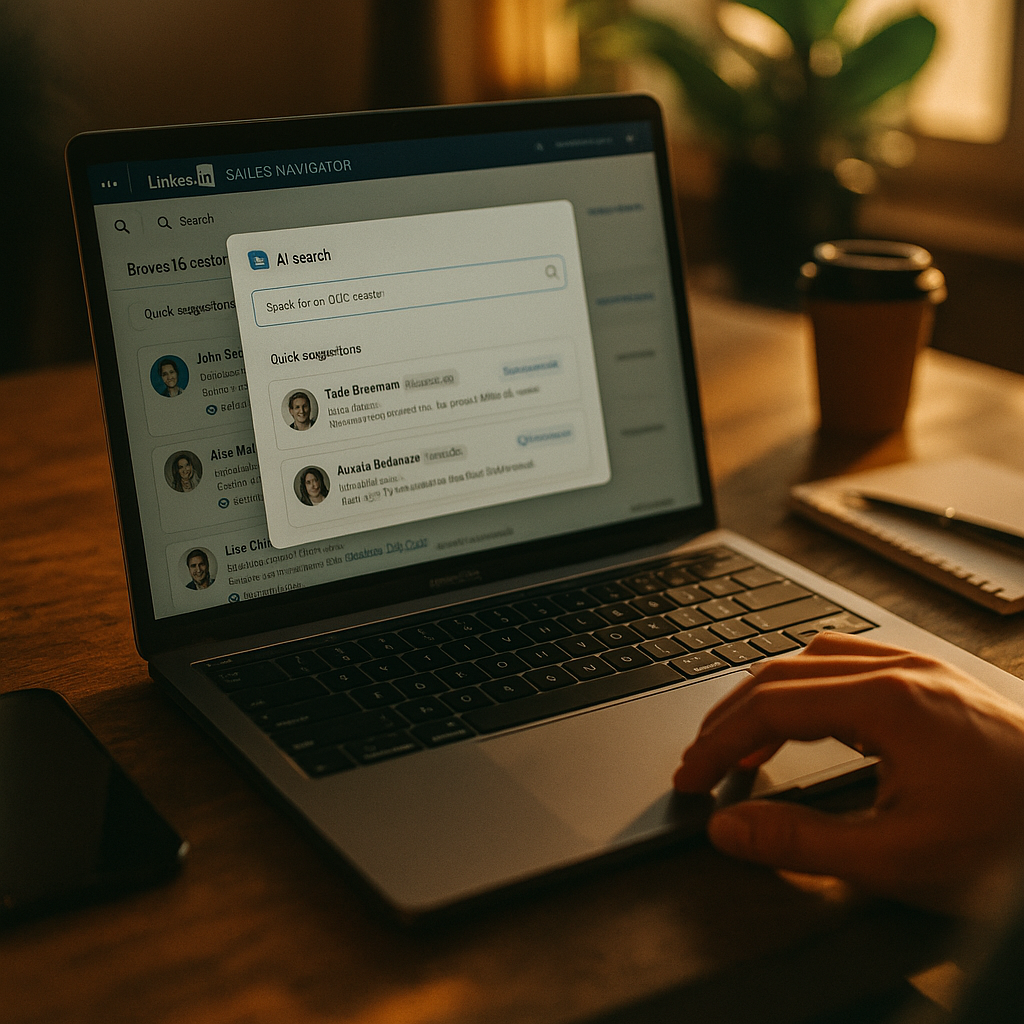
LinkedIn now has more AI-powered prospecting muscle than most martech stacks brands pay five figures a year for. The platform’s new AI-enhanced Sales Navigator and Hiring Assistant tools weren’t built with influencer marketing in mind, but B2B teams scrambling to find credible, niche creators are already repurposing them for exactly that. If you’re still sourcing B2B creators through manual searches and cold DMs, you’re working harder than you need to.
What LinkedIn Actually Shipped
LinkedIn’s AI Sales Navigator upgrade layers generative search and relationship mapping on top of the existing prospecting tool. Instead of Boolean strings and filter stacking, users can now type a plain-language request, something like “find mid-market fintech operators who post regularly about payments compliance,” and get a ranked list with engagement signals attached. Hiring Assistant, originally pitched as a recruiter’s copilot, does something similar for talent discovery: it scans profiles, activity history, and network proximity to surface people who match a role or topic profile, then drafts outreach.
Neither tool was marketed as a creator discovery engine. But strip away the framing and you’re looking at AI-assisted sourcing software that happens to sit on top of the largest professional identity graph on the internet. For B2B marketers, that’s the real story.
The same AI that helps a sales rep find a VP of Procurement to pitch can help a brand find the operations leader with 40,000 engaged followers who’d make a credible paid creator.
Why This Matters for B2B Creator Sourcing
B2B influencer marketing has a sourcing problem that consumer brands rarely deal with. There’s no TikTok Creator Marketplace equivalent for supply chain analysts or cybersecurity architects. Agencies have historically relied on referrals, conference networks, and painstaking manual LinkedIn searches to find subject-matter experts with real audiences. It’s slow, it’s inconsistent, and it scales terribly once you’re running programs across multiple verticals or regions.
AI Sales Navigator and Hiring Assistant change the math because they apply machine learning to a dataset brands can’t replicate anywhere else: verified job titles, tenure, skills endorsements, and content engagement, all in one place. That’s a meaningfully different signal set than follower count or vanity engagement rate, which is still the default currency on consumer platforms.
- Faster identification of credible voices within narrow B2B niches
- Built-in verification of job title, seniority, and company affiliation
- Engagement data tied to professional content, not just reach
- Lower reliance on third-party influencer databases with shaky B2B coverage
The ROI Case Your Finance Team Will Actually Buy
Every influencer program lives or dies on whether finance believes the sourcing cost justifies the output. Manual B2B creator vetting easily eats 8 to 12 hours per campaign when you factor in profile research, background checks on content history, and outreach drafting. AI-assisted sourcing compresses that into a fraction of the time because the ranking and matching work happens before a human ever opens a profile.
That efficiency gain is the pitch. It’s not that AI finds creators a sharp strategist couldn’t find eventually. It’s that it finds them faster, with less billable hours burned on discovery instead of strategy and creative. If you’re building a finance approval model for a creator program, time-to-shortlist is a line item worth quantifying.
According to eMarketer, B2B marketers continue to shift budget toward creator-led and thought-leadership content as trust in traditional brand messaging erodes. Faster sourcing tools matter more when the budget pressure to move quickly is already there.
Risk and Compliance: The Part Nobody’s Talking About Yet
Here’s the catch. LinkedIn wasn’t designed as a sponsorship disclosure platform, and neither tool currently flags whether a prospect has existing brand relationships, competitor affiliations, or a history of paid promotion that could create conflicts. That’s on your team to check manually, every time.
There’s also a platform policy angle worth watching closely. LinkedIn’s terms govern automated outreach and data scraping tightly, and using Sales Navigator or Hiring Assistant outputs for influencer recruitment sits in a gray zone the platform hasn’t explicitly addressed. Brands running high-volume outreach through these tools should loop in legal before treating this as a scaled sourcing channel rather than a research aid.
Disclosure compliance doesn’t disappear just because the sourcing method got smarter, either. The FTC’s endorsement guidelines still apply the moment money or product changes hands, regardless of whether you found the creator through a manual search or an AI-ranked shortlist. Teams that have already built disclosure workflows for consumer platforms, similar to the approach outlined in our payout and compliance checklist, should extend the same rigor to LinkedIn sourcing rather than treating B2B as lower-risk by default.
How This Fits Into an Existing Creator Workflow
Most brands running B2B influencer programs already have a vetting pipeline built for other platforms. The smart move isn’t replacing that pipeline, it’s inserting AI Sales Navigator and Hiring Assistant at the top of the funnel as a faster discovery layer, then routing shortlisted names through the same background checks, rate negotiation, and contract process you’d use anywhere else.
Practically, that looks like this:
- Use natural-language search in Sales Navigator to build a longlist against your target persona (title, industry, seniority, geography).
- Cross-reference engagement signals and recent posting activity to filter for creators who actually publish, not just lurk.
- Run manual conflict-of-interest and brand-safety checks before outreach, the same way you would for a LinkedIn thought leadership program.
- Draft outreach using Hiring Assistant’s templating as a starting point, then personalize heavily. Generic AI-drafted pitches get ignored by people who get fifty of them a day.
Agencies managing multiple B2B clients should think about this the way they’d think about vetting tiers for agency partners, applying consistent scoring criteria so sourcing quality doesn’t vary wildly depending on who’s running the search that week.
Where It Falls Short
AI sourcing tools are pattern matchers, not judgment engines. They’re excellent at surfacing people who fit a profile on paper. They’re far worse at telling you whether someone’s content tone fits your brand voice, whether their audience is genuinely engaged or algorithmically inflated, or whether they’ll be a pain to work with on deliverables and timelines. None of that shows up in a LinkedIn activity feed.
There’s also a coverage gap worth naming: these tools only see what’s on LinkedIn. A brilliant creator who publishes primarily on Substack or YouTube and treats LinkedIn as an afterthought won’t surface no matter how good the AI ranking gets. Treat this as one sourcing channel among several, not a replacement for cross-platform discovery, the same caution brands apply when weighing long-form review pipelines against shorter-format content.
Benchmarking tools like Sprout Social or HubSpot still have a role here, especially for validating engagement authenticity once LinkedIn’s AI hands you a shortlist.
FAQs
Frequently Asked Questions
Can LinkedIn’s AI Sales Navigator actually find influencers, or is it just for sales prospecting?
It was built for sales prospecting, but the same natural-language search and ranking features work well for identifying credible B2B voices with engaged professional audiences. Brands are repurposing it as a discovery layer, not a replacement for full creator vetting.
Does using Hiring Assistant for creator sourcing violate LinkedIn’s terms of service?
LinkedIn hasn’t issued explicit guidance on using Hiring Assistant for influencer recruitment rather than talent acquisition. Terms around automated outreach and data use are strict, so brands should consult legal before scaling this beyond manual research.
How is AI-assisted B2B creator sourcing different from consumer influencer platforms?
Consumer platforms typically rank by follower count and engagement rate. LinkedIn’s tools incorporate verified job title, seniority, company affiliation, and professional content engagement, which is a more reliable credibility signal for B2B audiences.
Do FTC disclosure rules still apply to creators sourced through LinkedIn AI tools?
Yes. Disclosure obligations are tied to the existence of a paid or material relationship, not the sourcing method. Any compensated LinkedIn creator partnership still needs clear, compliant disclosure under FTC guidelines.
Should agencies replace manual B2B creator vetting with these AI tools?
No. These tools speed up the discovery and longlisting stage, but manual checks on brand safety, tone fit, and conflicts of interest still need a human reviewer before any outreach or contract happens.
Pilot AI Sales Navigator on your next niche B2B search, cap the time saved against your current manual process, and bring that number to your next budget review before someone else claims the efficiency win. For deeper background on building out LinkedIn as a full creator channel, see our LinkedIn Business resources alongside your own program data.
Top Influencer Marketing Agencies
The leading agencies shaping influencer marketing in 2026
Agencies ranked by campaign performance, client diversity, platform expertise, proven ROI, industry recognition, and client satisfaction. Assessed through verified case studies, reviews, and industry consultations.
Moburst

-
2

The Shelf
Boutique Beauty & Lifestyle Influencer AgencyA data-driven boutique agency specializing exclusively in beauty, wellness, and lifestyle influencer campaigns on Instagram and TikTok. Best for brands already focused on the beauty/personal care space that need curated, aesthetic-driven content.Clients: Pepsi, The Honest Company, Hims, Elf Cosmetics, Pure LeafVisit The Shelf → -
3

Audiencly
Niche Gaming & Esports Influencer AgencyA specialized agency focused exclusively on gaming and esports creators on YouTube, Twitch, and TikTok. Ideal if your campaign is 100% gaming-focused — from game launches to hardware and esports events.Clients: Epic Games, NordVPN, Ubisoft, Wargaming, Tencent GamesVisit Audiencly → -
4

Viral Nation
Global Influencer Marketing & Talent AgencyA dual talent management and marketing agency with proprietary brand safety tools and a global creator network spanning nano-influencers to celebrities across all major platforms.Clients: Meta, Activision Blizzard, Energizer, Aston Martin, WalmartVisit Viral Nation → -
5

The Influencer Marketing Factory
TikTok, Instagram & YouTube CampaignsA full-service agency with strong TikTok expertise, offering end-to-end campaign management from influencer discovery through performance reporting with a focus on platform-native content.Clients: Google, Snapchat, Universal Music, Bumble, YelpVisit TIMF → -
6

NeoReach
Enterprise Analytics & Influencer CampaignsAn enterprise-focused agency combining managed campaigns with a powerful self-service data platform for influencer search, audience analytics, and attribution modeling.Clients: Amazon, Airbnb, Netflix, Honda, The New York TimesVisit NeoReach → -
7

Ubiquitous
Creator-First Marketing PlatformA tech-driven platform combining self-service tools with managed campaign options, emphasizing speed and scalability for brands managing multiple influencer relationships.Clients: Lyft, Disney, Target, American Eagle, NetflixVisit Ubiquitous → -
8

Obviously
Scalable Enterprise Influencer CampaignsA tech-enabled agency built for high-volume campaigns, coordinating hundreds of creators simultaneously with end-to-end logistics, content rights management, and product seeding.Clients: Google, Ulta Beauty, Converse, AmazonVisit Obviously →