


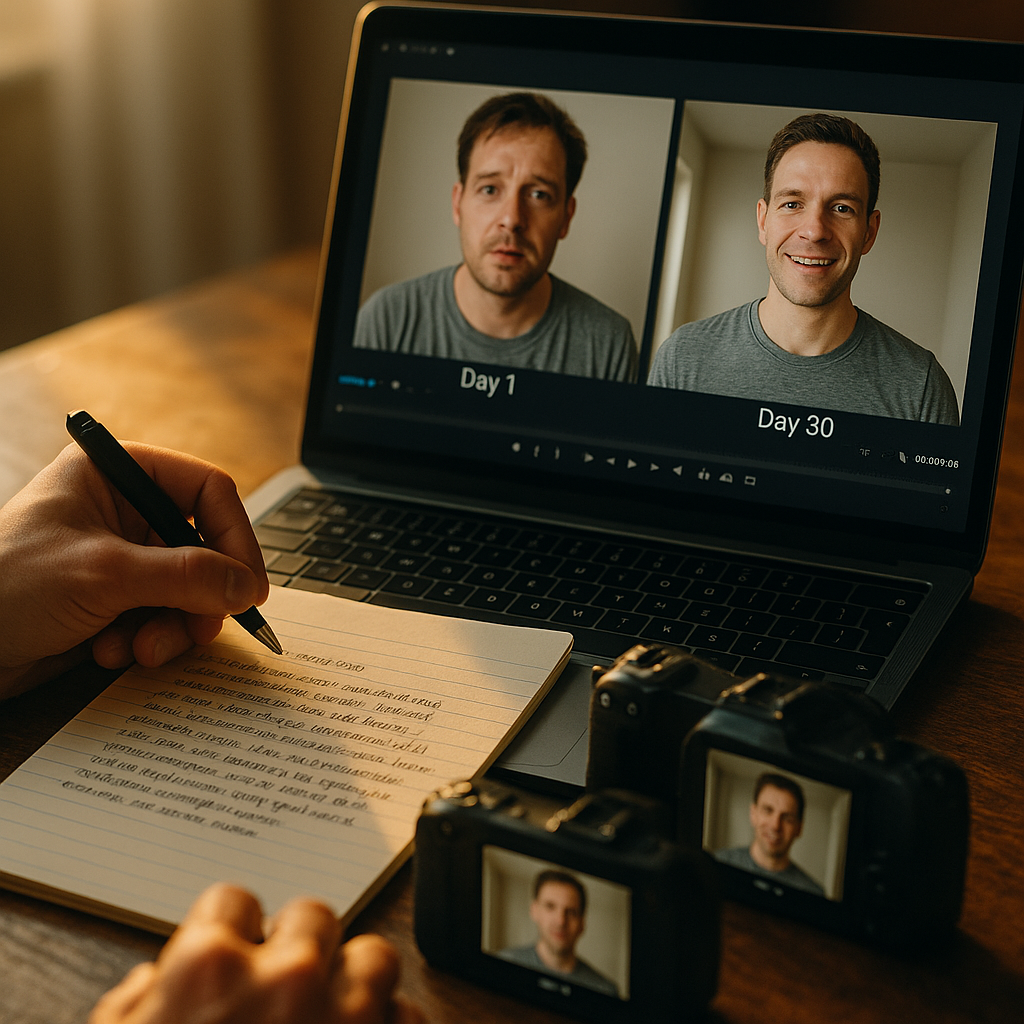
73% of consumers say they distrust before-and-after content, yet transformation videos remain some of the highest-converting formats in beauty, fitness, and wellness marketing. The gap between those two facts is exactly where a well-scripted Day 1 vs Day 30 progress series earns its keep. Done right, it turns skepticism into proof. Done wrong, it’s a compliance letter waiting to happen.
This format lives or dies on structure, not luck. Brands that treat it as “just film two clips and cut them together” end up with content that looks staged, gets flagged by platform reviewers, or worse, draws regulatory attention. The ones that win treat it like a documented experiment with a script, a timeline, and a paper trail.
Why Progress Series Content Outperforms Standard Testimonials
A standard testimonial asks viewers to trust a stranger’s word. A progress series asks them to trust their own eyes across time. That’s a fundamentally different cognitive load, and it’s why transformation formats consistently show stronger watch-through rates on TikTok and Instagram Reels compared to static review content, according to benchmarking data from Sprout Social.
The format also solves a real marketing problem: claim substantiation. Regulators and platform reviewers increasingly want evidence behind “results” language, and a documented Day 1 to Day 30 arc gives you something a single glowing review never could. Time-stamped, sequential proof.
A transformation video without a documented timeline isn’t proof. It’s just two clips a viewer is asked to trust on faith, and faith doesn’t survive an FTC inquiry.
The Four-Beat Structure That Actually Converts
Every high-performing progress series follows a predictable rhythm, even when the creative feels spontaneous. Strip away the production polish and you’ll find these four beats almost every time.
- The baseline (Day 1): Unfiltered, slightly awkward, specific. The creator names the problem in plain language, not marketing copy.
- The friction (Day 7 to Day 14): A brief check-in acknowledging doubt or slow progress. This beat is the one most brands cut, and it’s the one that builds the most trust.
- The shift (Day 21): The first visible or felt change, described conservatively rather than dramatically.
- The result (Day 30): Side-by-side comparison with context, not just a reveal.
Skip the friction beat and the whole series reads as fake, because real transformations are never linear. Audiences have been burned by too many “overnight results” ads to buy a clean arc anymore.
Scripting the Day 1 Scene: Specificity Beats Polish
The opening scene is where most brands overproduce and underdeliver. A script that leans into specificity (exact product usage, exact starting complaint, exact expectations) builds more credibility than one that leans into aesthetics.
Good Day 1 script elements:
- A stated, measurable baseline (“my skin has been flaking for about three weeks”)
- A visible or audible marker that proves timing (a calendar, a dated receipt, a visible product batch code)
- An honest expectation, including skepticism (“I’ve tried four things that didn’t work, so I’m not expecting much”)
That last line matters more than it seems. It preempts the “sponsored, obviously fake” comment before it’s typed. For more on structuring honest, lower-polish openers, the approach used in faceless UGC scripts applies directly here: the voice carries the credibility, not the face or the set.
Documenting the Middle: Where Trust Is Actually Built
Day 30 is the payoff, but the middle section is the load-bearing wall. Without it, you’re just making a before-and-after ad with extra steps. With it, you’re making a case study.
Smart scripting for the middle stretch includes:
- A journaling-style voiceover or on-screen text update at a consistent interval (every 5 to 7 days works well)
- At least one moment of mild setback or plateau, scripted honestly rather than scrubbed out
- Reference to actual product usage frequency, since vague claims (“I used it sometimes”) undercut the whole series
This is also where ingredient or mechanism explanation earns its place. A viewer who understands why a result is happening trusts it more than one who’s just shown that it happened. The ingredient breakdown format pairs naturally with progress series content, often as a cutaway or companion video that explains the “why” behind the Day 21 shift.
Brands that script the middle beats, not just the bookends, see meaningfully higher comment engagement because viewers interact with the process, not just the outcome.
Avoiding the FTC Trap: What Proof Actually Means
Here’s the uncomfortable truth: a beautifully produced Day 1 vs Day 30 video can still get you in trouble if the results shown aren’t typical, or if there’s no disclosure that results vary. The FTC has been explicit that testimonials implying atypical results require clear disclosure, and transformation content is a frequent target precisely because it’s so visually persuasive.
Operationally, this means your script needs built-in substantiation, not an afterthought disclaimer bolted on in post. Build these into the brief before filming:
- A documented timeline (dated photos, dated usage logs) that the brand can produce if challenged
- On-screen “results not typical” language where applicable, timed to appear during the reveal, not buried in a description
- Creator scripts that avoid absolute language (“cured,” “guaranteed,” “instantly”) in favor of personal, bounded claims (“this is what worked for me”)
This is the same discipline covered in expert reaction videos, where credibility and compliance have to be scripted together, not treated as separate workstreams. If your legal or compliance team isn’t reviewing the Day 1 and Day 30 scripts side by side before filming, you’re exposed.
Format Variations Worth Testing
The classic split-screen reveal isn’t the only way to structure this content. A few variations are gaining traction heading into this year’s creator briefs:
- Myth-correction framing: Day 1 opens with a misconception the creator held, Day 30 corrects it with evidence. This pairs well with the approach in myth vs fact videos.
- Multi-creator composite series: Three or four creators running the same 30-day arc in parallel, cut together to show consistency across different starting points. This is harder to fake and performs well as a retargeting asset.
- Persona-based continuity: A recurring creator character runs the progress arc as part of a longer content relationship, which borrows structure from persona-driven scripting to avoid creative fatigue across repeated 30-day cycles.
Whichever variation you choose, resist the urge to compress the timeline for production convenience. Audiences can usually tell when “Day 30” was filmed an hour after “Day 1,” and the format’s entire value proposition collapses the moment that’s suspected.
Measuring Whether the Format Is Actually Working
Don’t just track views and conversions in isolation. The metrics that tell you whether a progress series is doing its job are different from standard UGC benchmarks.
- Comment sentiment specificity: Are viewers asking detailed follow-up questions (“how often did you use it”) rather than generic skepticism comments? That’s a sign the middle beats landed.
- Save and share rate relative to likes: Transformation content that’s trusted gets saved for reference, not just liked in passing.
- Retention curve shape: A steep drop before the Day 30 reveal usually means the middle section dragged or felt staged.
Industry benchmarking from eMarketer and Statista continues to show transformation and testimonial formats outperforming standard product demos on conversion-adjacent metrics, but only when the content clears the trust bar. Below that bar, the format actively underperforms because viewers feel manipulated rather than informed.
For teams building out a broader content library around this format, it’s worth reading how short-form video libraries can repurpose progress series clips across both organic and paid channels without rebriefing creators from scratch each cycle.
Building the Brief: What to Hand Creators
A progress series brief should never be “film yourself before and after using the product.” It needs:
- A required documentation method (dated photos, app-based timestamps, or visible calendar markers)
- Specific language guardrails (banned absolute claims, required disclosure phrasing)
- A mandatory mid-point check-in beat, scripted loosely but required structurally
- Guidance on tone for the Day 1 scene, favoring honesty over hype
Resources like HubSpot offer general content brief templates worth adapting, but the compliance-specific guardrails above are what separate a usable progress series brief from a generic UGC request.
Treat the creator brief as a legal document as much as a creative one. It’s the thing you’ll point to if a claim ever gets questioned, and it’s the thing that keeps the content honest enough to actually work.
Run one properly documented Day 1 vs Day 30 series before scaling the format across your creator roster, then use its comment section and completion rate as the template for every brief that follows.
Frequently Asked Questions
How long should a Day 1 vs Day 30 progress series actually run?
Thirty days is a benchmark, not a rule. Match the timeline to realistic product results: skincare often needs a full cycle, while habit-based products might show meaningful change in two weeks. The key is matching the stated timeline to what the product can genuinely deliver.
Do I need model release or documentation beyond the video itself?
Yes. Dated photos, usage logs, or timestamped app data should exist independently of the final edit so the brand can substantiate the claim if a platform or regulator asks. Treat this documentation as part of production, not an optional extra.
What’s the biggest mistake brands make with this format?
Compressing the timeline for production convenience, or cutting the “friction” beat where the creator shows doubt or slow progress. Both choices make the content feel staged and reduce trust, which defeats the entire purpose of the format.
Should results-vary disclosures appear on screen or only in captions?
On screen, timed to the reveal moment. Caption-only disclosures are easy to miss and weaker from a compliance standpoint, especially given current FTC guidance on testimonial transparency.
Can this format work for B2B or service-based brands, not just beauty and fitness?
Yes, with adjusted markers. A software onboarding progress series or a service-based before-and-after (agency results, coaching outcomes) follows the same four-beat structure, just with different proof points like dashboards or metrics instead of visual change.
Top Influencer Marketing Agencies
The leading agencies shaping influencer marketing in 2026
Agencies ranked by campaign performance, client diversity, platform expertise, proven ROI, industry recognition, and client satisfaction. Assessed through verified case studies, reviews, and industry consultations.
Moburst

-
2

The Shelf
Boutique Beauty & Lifestyle Influencer AgencyA data-driven boutique agency specializing exclusively in beauty, wellness, and lifestyle influencer campaigns on Instagram and TikTok. Best for brands already focused on the beauty/personal care space that need curated, aesthetic-driven content.Clients: Pepsi, The Honest Company, Hims, Elf Cosmetics, Pure LeafVisit The Shelf → -
3

Audiencly
Niche Gaming & Esports Influencer AgencyA specialized agency focused exclusively on gaming and esports creators on YouTube, Twitch, and TikTok. Ideal if your campaign is 100% gaming-focused — from game launches to hardware and esports events.Clients: Epic Games, NordVPN, Ubisoft, Wargaming, Tencent GamesVisit Audiencly → -
4

Viral Nation
Global Influencer Marketing & Talent AgencyA dual talent management and marketing agency with proprietary brand safety tools and a global creator network spanning nano-influencers to celebrities across all major platforms.Clients: Meta, Activision Blizzard, Energizer, Aston Martin, WalmartVisit Viral Nation → -
5

The Influencer Marketing Factory
TikTok, Instagram & YouTube CampaignsA full-service agency with strong TikTok expertise, offering end-to-end campaign management from influencer discovery through performance reporting with a focus on platform-native content.Clients: Google, Snapchat, Universal Music, Bumble, YelpVisit TIMF → -
6

NeoReach
Enterprise Analytics & Influencer CampaignsAn enterprise-focused agency combining managed campaigns with a powerful self-service data platform for influencer search, audience analytics, and attribution modeling.Clients: Amazon, Airbnb, Netflix, Honda, The New York TimesVisit NeoReach → -
7

Ubiquitous
Creator-First Marketing PlatformA tech-driven platform combining self-service tools with managed campaign options, emphasizing speed and scalability for brands managing multiple influencer relationships.Clients: Lyft, Disney, Target, American Eagle, NetflixVisit Ubiquitous → -
8

Obviously
Scalable Enterprise Influencer CampaignsA tech-enabled agency built for high-volume campaigns, coordinating hundreds of creators simultaneously with end-to-end logistics, content rights management, and product seeding.Clients: Google, Ulta Beauty, Converse, AmazonVisit Obviously →