


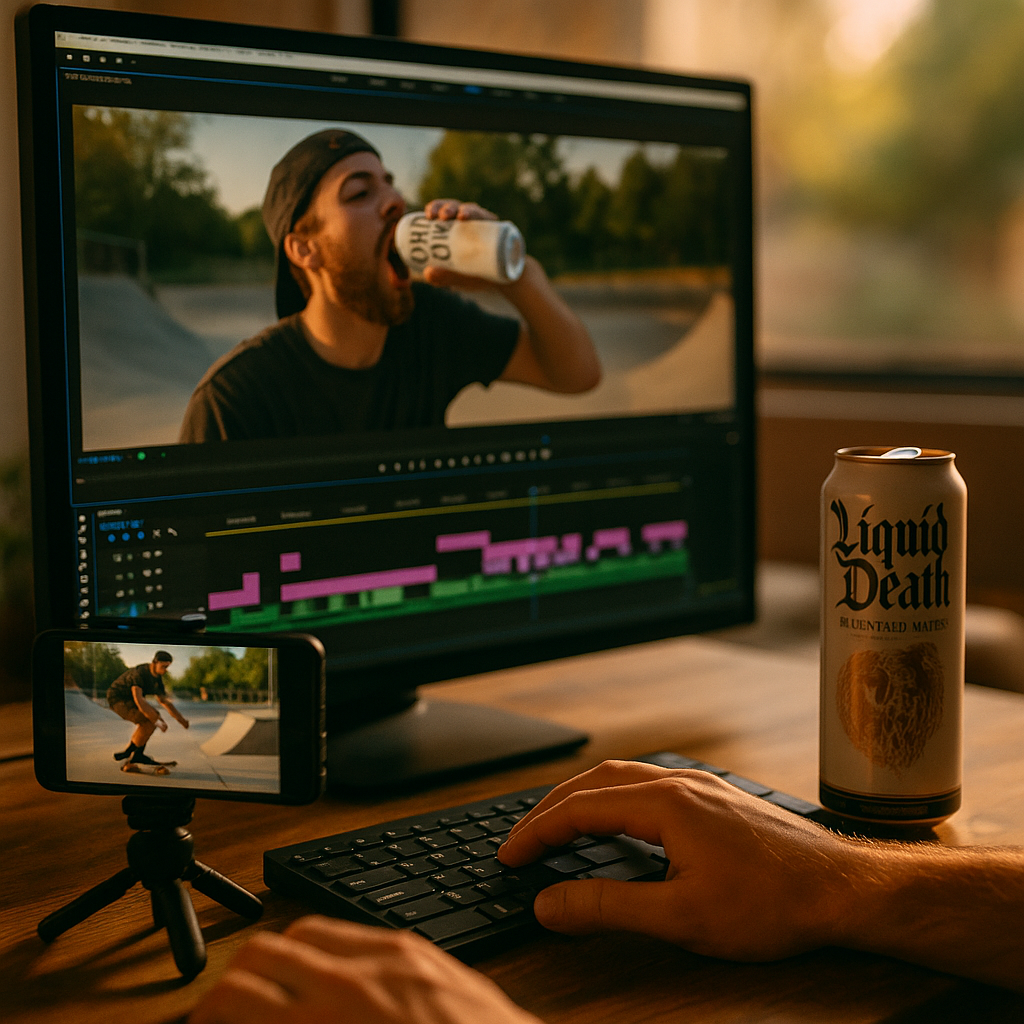
Ninety one percent of marketers say creator content outperforms branded ads on paid media, yet most brands still strip out the personality that made it work in the first place. Liquid Death didn’t. The canned water brand took its most unhinged, profane, gloriously off-brand creator clips and ran them straight into paid acquisition, no sanding down the edges, no corporate rewrite. The result: a paid media engine that converts like direct response and still feels like Liquid Death.
The Problem Most Brands Never Solve
Here’s the tension every performance marketer knows. Organic creator content wins because it feels unscripted. The moment you pump it into a paid feed with a CTA bolted on, it often dies. Compliance teams sanitize the copy. Legal flags the humor. Media buyers crop out the parts that made it shareable because they “don’t fit the funnel.” What’s left is a watered down ad that performs worse than the UGC it was copied from.
Liquid Death built its entire identity on refusing that compromise. The brand’s whole premise, selling water like it’s heavy metal, only works if the chaos survives the transition from TikTok comment section to Meta Ads Manager. So the team reorganized its process around a simple rule: the creator’s voice is the asset, not the backdrop.
Liquid Death treats creator profanity, absurdism, and shock humor as performance signal, not brand risk. That reframe is the entire playbook.
What “Paid Acquisition” Actually Means Here
Liquid Death isn’t just boosting popular posts. It runs a structured pipeline: source organic creator content, identify which clips are already generating engagement velocity, then push the top performers into paid spend as spark-style ads and acquisition creative on Meta and TikTok. This mirrors a pattern seen elsewhere in performance marketing, like how Ryanair turns organic clips into spark ads within days of a video trending, compressing the usual weeks-long production cycle into something closer to real time arbitrage.
The brand’s broader creator strategy, detailed in Liquid Death’s absurdist UGC playbook, treats every unboxing, reaction, and prank video as raw material. Not every clip gets promoted. But the ones that do get selected on a specific criteria set: completion rate, comment sentiment, and shareability, not polish or brand safety scoring in the traditional sense.
Why Shock Value Converts Better Than Polish
Conventional wisdom says risky humor scares off performance. Liquid Death’s numbers argue the opposite. Ads built from genuinely weird, creator-led moments tend to hold attention longer in the first three seconds, the window that determines whether a paid social ad survives the algorithm’s early signal check. A flat, branded 15 second spot rarely earns that attention. A creator screaming about “murdering their thirst” does.
This isn’t unique to Liquid Death as a category insight. Shock value creators driving shelf velocity is now a documented pattern across the brand’s retail performance, where social buzz translates into actual grocery store movement, not just impressions. The acquisition ads are simply the paid amplifier for a demand signal that already existed organically.
The Operational Backbone: Speed Over Perfection
None of this works without a fast internal loop between social listening, creative ops, and media buying. Liquid Death’s team monitors which organic posts are gaining traction within the first 24 to 48 hours, then moves qualifying content into paid rotation almost immediately. Waiting a week for legal sign off or a brand safety audit kills the window. By the time a clip has been “approved” through a traditional six person committee, the cultural moment it rode in on has usually passed.
That speed requirement forces a different kind of governance. Instead of pre-approving every piece of creator content line by line, Liquid Death sets guardrails upfront (what’s off limits, what triggers automatic review) and lets the team move fast within those lines. It’s closer to how lean social teams outperform agencies on speed, trading heavy process for tight, pre-negotiated boundaries.
- Source fast: Monitor organic creator content daily, not weekly, for early engagement spikes.
- Vet lightly: Use pre-set guardrails instead of case by case legal review for every clip.
- Convert immediately: Push qualifying UGC into paid acquisition within 48 to 72 hours of it trending.
- Keep the edit minimal: Add a CTA overlay or caption, not a full creative rework.
Keeping Brand Voice Intact Under Compliance Pressure
Every legal and compliance team has the same instinct: smooth out anything that could be misread. Liquid Death’s approach inverts that by building compliance review around disclosure and platform policy, not tone. Creators still need to follow FTC disclosure guidance for paid or sponsored content, and ads still need to clear TikTok’s ad policy requirements and Meta’s advertising standards. But within those lines, the brand doesn’t water down the humor to satisfy an internal comfort level. That distinction, compliant versus corporate safe, is where most CPG marketers lose the thread.
It’s worth comparing this to brands that lean heavily on AI generated or templated UGC to scale faster. That approach can hit production targets, but it often struggles with authenticity signals. The gap shows up directly in performance data, similar to what’s documented in why AI generated UGC tests still lag on trust. Liquid Death’s refusal to over-process creator content is, in a sense, a hedge against that exact problem.
What the Performance Data Suggests
Public ad performance benchmarks support the thesis even without Liquid Death’s internal dashboards. Industry data from eMarketer and social engagement research from Sprout Social consistently show that creator-sourced video outperforms traditional branded creative on cost per acquisition and click-through rate across Meta and TikTok, particularly in categories where the product itself is low consideration, like beverages.
That category fit matters. Liquid Death sells canned water, a commodity product with almost no functional differentiation. The brand’s entire value proposition is cultural, not nutritional. That makes creator-driven, personality forward content a near perfect match for acquisition media, because the ad’s job isn’t to explain a feature. It’s to make someone feel something in under five seconds and tap the CTA.
When the product has no functional story to tell, the creator’s personality becomes the entire pitch. That’s the acquisition mechanic.
Where This Strategy Breaks Down
This isn’t a universal template. A heavily regulated category, financial services, pharma, children’s products, can’t run unscreened creator chaos into paid acquisition without serious legal exposure. Liquid Death’s freedom comes partly from operating in a low-stakes category where the worst case outcome of an off-color joke is a complaint, not a regulatory fine.
Brands trying to copy this model need to honestly assess their risk tolerance before mimicking the speed. A B2B software company or a healthcare brand adopting this exact workflow would likely trigger far more friction with compliance, and rightly so. The lesson to take isn’t “stop reviewing creator content.” It’s “review for the right things and stop confusing brand safety with brand personality.”
Building the Playbook for Your Own Brand
Marketers looking to adapt this approach should start smaller than Liquid Death’s full-send version. Pick a narrow set of creators already producing content that resonates organically. Set clear, written guardrails for what’s off limits rather than requiring individual sign off on every asset. Shorten the time between organic trend detection and paid rotation, even if that means accepting more imperfect creative. And track performance against your branded control ads directly, not against vanity engagement metrics, so the business case for keeping the voice intact is measurable rather than anecdotal.
Platforms are increasingly building tools to support exactly this workflow. Both Meta and TikTok have expanded creator-to-ad conversion features (letting brands turn organic posts into paid spark ads with minimal friction) which signals the ad platforms themselves expect more brands to move in this direction.
Next Step
Audit your last ten paid acquisition ads against the organic creator content they were sourced from. If the paid version lost its edge in the edit, you’re not protecting the brand, you’re diluting the exact thing that made the content work in the first place.
Frequently Asked Questions
What does it mean to turn creator content into paid acquisition ads?
It means taking organic, unscripted creator videos that are already performing well and pushing them into paid media placements, like Meta or TikTok ads, with minimal creative rework, so the ad retains the authenticity that drove organic engagement.
How does Liquid Death keep its brand voice in paid ads?
The brand avoids heavy editing or legal rewrites of creator content. Instead, it sets upfront guardrails for compliance and platform policy, then lets the creator’s original tone, humor, and delivery carry through into the paid version with minimal alteration.
Does this approach work for every industry?
No. It works best in low consideration, low regulatory risk categories. Brands in finance, healthcare, or other heavily regulated industries need significantly more review before running unscreened creator content as paid acquisition media.
What metrics indicate this strategy is working?
Lower cost per acquisition compared to branded creative, higher three second video completion rates, and stronger click-through rate on paid placements sourced from organic creator content versus studio produced ads.
How fast should brands move creator content into paid rotation?
Liquid Death aims for 48 to 72 hours after a piece of content shows early engagement velocity. Waiting longer than a week typically means missing the cultural moment that made the content perform in the first place.
Top Influencer Marketing Agencies
The leading agencies shaping influencer marketing in 2026
Agencies ranked by campaign performance, client diversity, platform expertise, proven ROI, industry recognition, and client satisfaction. Assessed through verified case studies, reviews, and industry consultations.
Moburst

-
2

The Shelf
Boutique Beauty & Lifestyle Influencer AgencyA data-driven boutique agency specializing exclusively in beauty, wellness, and lifestyle influencer campaigns on Instagram and TikTok. Best for brands already focused on the beauty/personal care space that need curated, aesthetic-driven content.Clients: Pepsi, The Honest Company, Hims, Elf Cosmetics, Pure LeafVisit The Shelf → -
3

Audiencly
Niche Gaming & Esports Influencer AgencyA specialized agency focused exclusively on gaming and esports creators on YouTube, Twitch, and TikTok. Ideal if your campaign is 100% gaming-focused — from game launches to hardware and esports events.Clients: Epic Games, NordVPN, Ubisoft, Wargaming, Tencent GamesVisit Audiencly → -
4

Viral Nation
Global Influencer Marketing & Talent AgencyA dual talent management and marketing agency with proprietary brand safety tools and a global creator network spanning nano-influencers to celebrities across all major platforms.Clients: Meta, Activision Blizzard, Energizer, Aston Martin, WalmartVisit Viral Nation → -
5

The Influencer Marketing Factory
TikTok, Instagram & YouTube CampaignsA full-service agency with strong TikTok expertise, offering end-to-end campaign management from influencer discovery through performance reporting with a focus on platform-native content.Clients: Google, Snapchat, Universal Music, Bumble, YelpVisit TIMF → -
6

NeoReach
Enterprise Analytics & Influencer CampaignsAn enterprise-focused agency combining managed campaigns with a powerful self-service data platform for influencer search, audience analytics, and attribution modeling.Clients: Amazon, Airbnb, Netflix, Honda, The New York TimesVisit NeoReach → -
7

Ubiquitous
Creator-First Marketing PlatformA tech-driven platform combining self-service tools with managed campaign options, emphasizing speed and scalability for brands managing multiple influencer relationships.Clients: Lyft, Disney, Target, American Eagle, NetflixVisit Ubiquitous → -
8

Obviously
Scalable Enterprise Influencer CampaignsA tech-enabled agency built for high-volume campaigns, coordinating hundreds of creators simultaneously with end-to-end logistics, content rights management, and product seeding.Clients: Google, Ulta Beauty, Converse, AmazonVisit Obviously →