


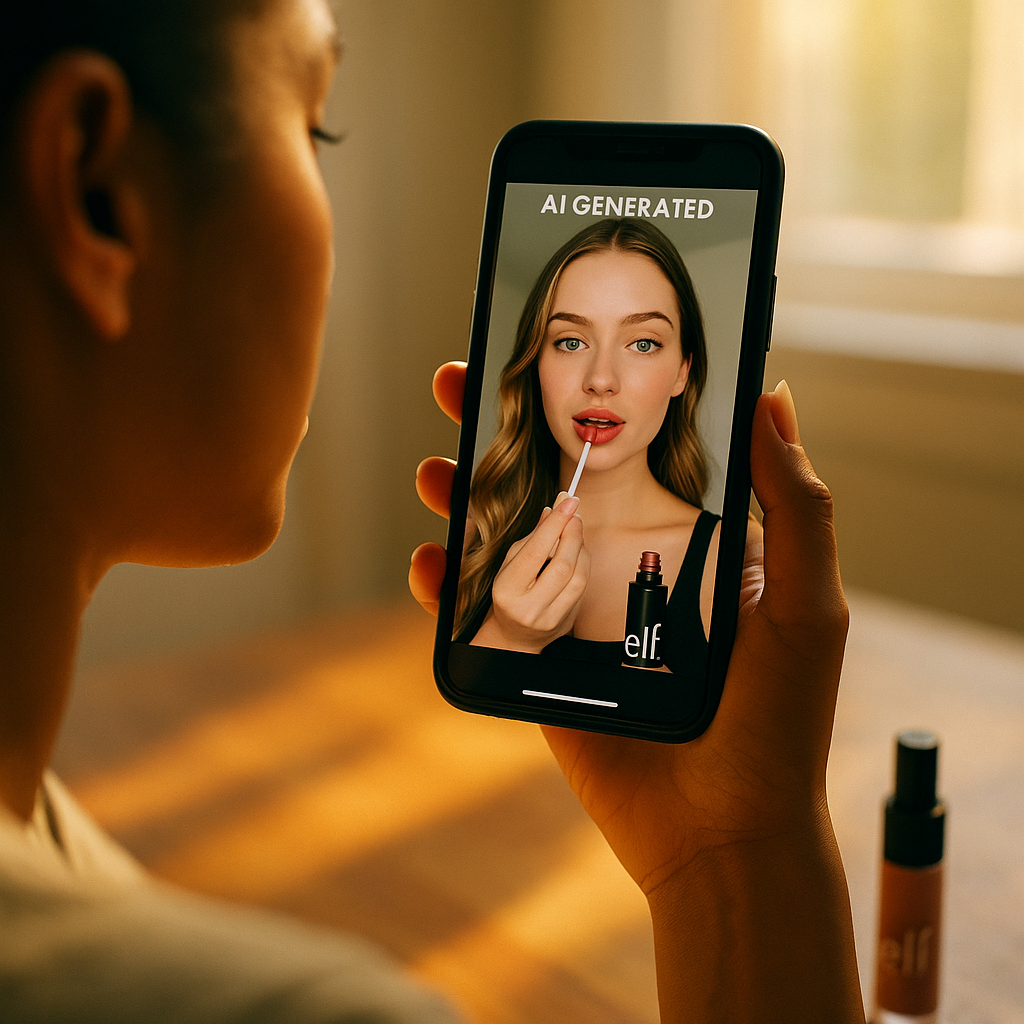
Can a brand synthesize the one thing influencer marketing was built to sell: authenticity? e.l.f. Cosmetics, a brand that has built its entire paid social engine on real creators, is now running structured tests with AI generated UGC inside its paid media mix. The early verdict is messier than either the AI hype crowd or the skeptics expected.
What e.l.f. Is Actually Testing
This isn’t a brand swapping creators for chatbots. e.l.f. Beauty has spent years building one of the most sophisticated creator operations in CPG beauty, vetting thousands of nano creators through nano creator vetting workflows and scaling to tens of thousands of partnerships annually. AI generated UGC is being layered into that system as a supplementary format, not a replacement.
In practice, the testing program looks like this: marketing teams generate synthetic talking-head style ads using AI avatar and voice tools, format them to mimic organic creator content (vertical video, handheld framing, casual lighting), and run them as paid spark ads alongside human-created UGC in controlled A/B splits. The goal is isolating performance variables: does an AI-generated face reviewing a mascara convert at a comparable rate to a real creator saying the same lines? Does hook retention hold up when the “creator” doesn’t exist?
e.l.f. has a track record of pushing creative boundaries here. The brand was among the first major advertisers to run a fully AI-generated national ad spot, and it has consistently treated its social team as a testing lab rather than a cost center, a pattern visible in how it turns viral sounds into reusable spark ads.
Why a Creator-First Brand Would Risk This
It seems counterintuitive. e.l.f. built brand equity on the “Eyes Lips Face” ethos, a campaign framework that turned everyday creators into the face of the brand at massive scale, as detailed in how it turned Eyes Lips Face into a repeatable creator engine. So why introduce synthetic content into a system built on real people?
The answer is operational, not philosophical. Sourcing, briefing, and approving UGC from thousands of creators is expensive and slow, even with mature infrastructure. AI generated UGC compresses that timeline from weeks to hours. For a brand that needs constant creative refresh to feed algorithm-hungry paid social platforms, speed has real dollar value. If AI variants can match even 70 percent of human UGC performance at a fraction of the production time, the math gets interesting fast for performance marketing teams under pressure to hit CPA targets.
The real test isn’t whether AI generated UGC can look authentic. It’s whether it can convert at a cost structure that justifies the trust risk brands take on by using it.
The Results So Far: Engagement Holds, Trust Wobbles
Internal performance signals reportedly show a split outcome, consistent with broader category data. AI-generated hooks can match or occasionally beat human UGC on scroll-stopping metrics like three-second view rate, largely because novelty and uncanny-valley curiosity drive initial clicks. But downstream metrics tell a different story. Comment sentiment on clearly synthetic content skews more skeptical, and conversion rates on product pages linked from AI-generated spark ads tend to lag behind their human-creator counterparts once the initial curiosity click wears off.
This tracks with what research from eMarketer has flagged repeatedly: consumers reward content that signals lived experience, not just polished delivery. A synthetic face can deliver a scripted line flawlessly, but it can’t replicate the small imperfections (a product smudge, a genuine laugh, an off-script aside) that make UGC read as credible in the first place.
Compare this to how Liquid Death’s absurdist UGC playbook works precisely because it leans into chaotic, unpolished human energy. That’s a hard signal to fake, and it’s exactly the gap AI tools haven’t closed yet.
Where AI UGC Actually Fits in the Funnel
Top of funnel, not bottom. That’s the emerging consensus among teams running these tests, e.l.f. included. AI generated UGC performs reasonably well as a prospecting asset, something that interrupts the scroll and introduces a product benefit quickly. It performs poorly as a trust-closing asset further down the purchase journey, where viewers are actively evaluating whether to believe a claim before buying.
This maps onto a broader pattern across the influencer marketing industry. Brands increasingly use AI tools not to replace creator content but to extend its life, similarly to how Coca-Cola’s AI content platform localizes creators at scale, taking real creator footage and adapting it for new markets rather than generating talent from scratch. e.l.f.’s testing program sits closer to that model than to full synthetic replacement, at least for now.
- Prospecting and cold audiences: AI UGC can hold its own on CPM efficiency and initial engagement.
- Retargeting and warm audiences: human UGC still outperforms on conversion and basket size.
- Community and comments sections: synthetic content invites more scrutiny and skepticism, which can bleed into brand sentiment if not labeled clearly.
The Disclosure Problem Nobody’s Fully Solved
Here’s where it gets legally and reputationally sticky. The FTC has made clear that deceptive endorsement rules apply regardless of whether the endorser is human or synthetic. If a piece of content looks and sounds like an organic customer review but was generated entirely by AI, failing to disclose that fact isn’t a gray area. It’s a compliance exposure.
e.l.f.’s approach reportedly includes clear internal labeling standards for AI-assisted content, even when those disclosures aren’t always visible to the end viewer in paid placements. That’s a risk calculation every brand running similar tests needs to make explicitly, not informally. Platforms are moving in the same direction: Meta’s business tools and TikTok’s advertising policies increasingly require labeling for AI-generated or AI-modified content, and enforcement is tightening as synthetic media becomes harder to detect at a glance.
Treating AI generated UGC like regular paid creative, without disclosure review, is the fastest way to turn a performance test into a PR headache.
What This Means for Your Testing Roadmap
If you’re a brand marketer watching e.l.f.’s moves and wondering whether to greenlight your own AI UGC pilot, a few operational lessons from this case translate directly:
- Run AI UGC as a distinct line item in your testing matrix, not blended with human UGC performance data. Averaging the two hides where each format actually wins.
- Build disclosure review into your creative approval workflow before launch, not after legal flags it.
- Reserve AI generated content for prospecting and awareness budgets. Protect retargeting and conversion budgets for verified human creators until the trust gap closes.
- Track comment sentiment, not just view-through rate. Engagement volume can mask a credibility problem that only shows up in qualitative signals.
This is consistent with how more mature influencer programs are structuring risk generally. Brands like Huda Beauty have shown that tying creator tiers to real sales data produces more defensible budget decisions than relying on engagement vanity metrics alone, a principle that applies just as cleanly to AI content testing as it does to human creator tiering.
For a deeper read on how auditability is becoming table stakes across influencer spend, GameSquare’s work with Chartis on making influencer ROI auditable is worth studying alongside this case. The same audit logic that applies to human creator spend should apply to AI-generated variants, arguably with more scrutiny given the compliance exposure.
Visible FAQs
What is AI generated UGC?
AI generated UGC refers to marketing content made to look and sound like organic, user-generated content but produced using AI tools rather than real customers or creators. This includes synthetic avatars, AI voice generation, and automated video editing designed to mimic the casual, handheld style of authentic social content.
Why is e.l.f. Cosmetics testing AI generated UGC?
e.l.f. is testing AI generated UGC primarily to address speed and cost pressures in its paid social creative pipeline. Producing enough fresh creative to feed algorithm-driven ad platforms is resource-intensive, and AI tools can compress production timelines significantly compared to sourcing and approving content from human creators.
Does AI generated UGC convert as well as human creator content?
Early testing suggests AI generated UGC can match human content on top-of-funnel engagement metrics like view rate, but it tends to underperform on conversion and trust-related metrics further down the funnel. Comment sentiment also skews more skeptical on content that reads as synthetic.
Is AI generated UGC legal to use in advertising without disclosure?
Regulators including the FTC treat deceptive endorsement rules as applying regardless of whether content is human or AI-generated. Brands using AI generated UGC in a way that implies real customer experience without disclosure risk running afoul of advertising transparency requirements and platform policies.
Should every brand start testing AI generated UGC?
Not without a clear measurement plan. Brands should isolate AI generated content performance from human UGC in reporting, limit its use to prospecting and awareness campaigns initially, and build disclosure review into creative approval before scaling spend behind it.
The practical move for marketing teams watching this space: pilot AI generated UGC in a single, isolated budget line against your top prospecting audience, measure conversion separately from engagement, and don’t touch your retargeting budget until the trust gap closes.
Top Influencer Marketing Agencies
The leading agencies shaping influencer marketing in 2026
Agencies ranked by campaign performance, client diversity, platform expertise, proven ROI, industry recognition, and client satisfaction. Assessed through verified case studies, reviews, and industry consultations.
Moburst

-
2

The Shelf
Boutique Beauty & Lifestyle Influencer AgencyA data-driven boutique agency specializing exclusively in beauty, wellness, and lifestyle influencer campaigns on Instagram and TikTok. Best for brands already focused on the beauty/personal care space that need curated, aesthetic-driven content.Clients: Pepsi, The Honest Company, Hims, Elf Cosmetics, Pure LeafVisit The Shelf → -
3

Audiencly
Niche Gaming & Esports Influencer AgencyA specialized agency focused exclusively on gaming and esports creators on YouTube, Twitch, and TikTok. Ideal if your campaign is 100% gaming-focused — from game launches to hardware and esports events.Clients: Epic Games, NordVPN, Ubisoft, Wargaming, Tencent GamesVisit Audiencly → -
4

Viral Nation
Global Influencer Marketing & Talent AgencyA dual talent management and marketing agency with proprietary brand safety tools and a global creator network spanning nano-influencers to celebrities across all major platforms.Clients: Meta, Activision Blizzard, Energizer, Aston Martin, WalmartVisit Viral Nation → -
5

The Influencer Marketing Factory
TikTok, Instagram & YouTube CampaignsA full-service agency with strong TikTok expertise, offering end-to-end campaign management from influencer discovery through performance reporting with a focus on platform-native content.Clients: Google, Snapchat, Universal Music, Bumble, YelpVisit TIMF → -
6

NeoReach
Enterprise Analytics & Influencer CampaignsAn enterprise-focused agency combining managed campaigns with a powerful self-service data platform for influencer search, audience analytics, and attribution modeling.Clients: Amazon, Airbnb, Netflix, Honda, The New York TimesVisit NeoReach → -
7

Ubiquitous
Creator-First Marketing PlatformA tech-driven platform combining self-service tools with managed campaign options, emphasizing speed and scalability for brands managing multiple influencer relationships.Clients: Lyft, Disney, Target, American Eagle, NetflixVisit Ubiquitous → -
8

Obviously
Scalable Enterprise Influencer CampaignsA tech-enabled agency built for high-volume campaigns, coordinating hundreds of creators simultaneously with end-to-end logistics, content rights management, and product seeding.Clients: Google, Ulta Beauty, Converse, AmazonVisit Obviously →