


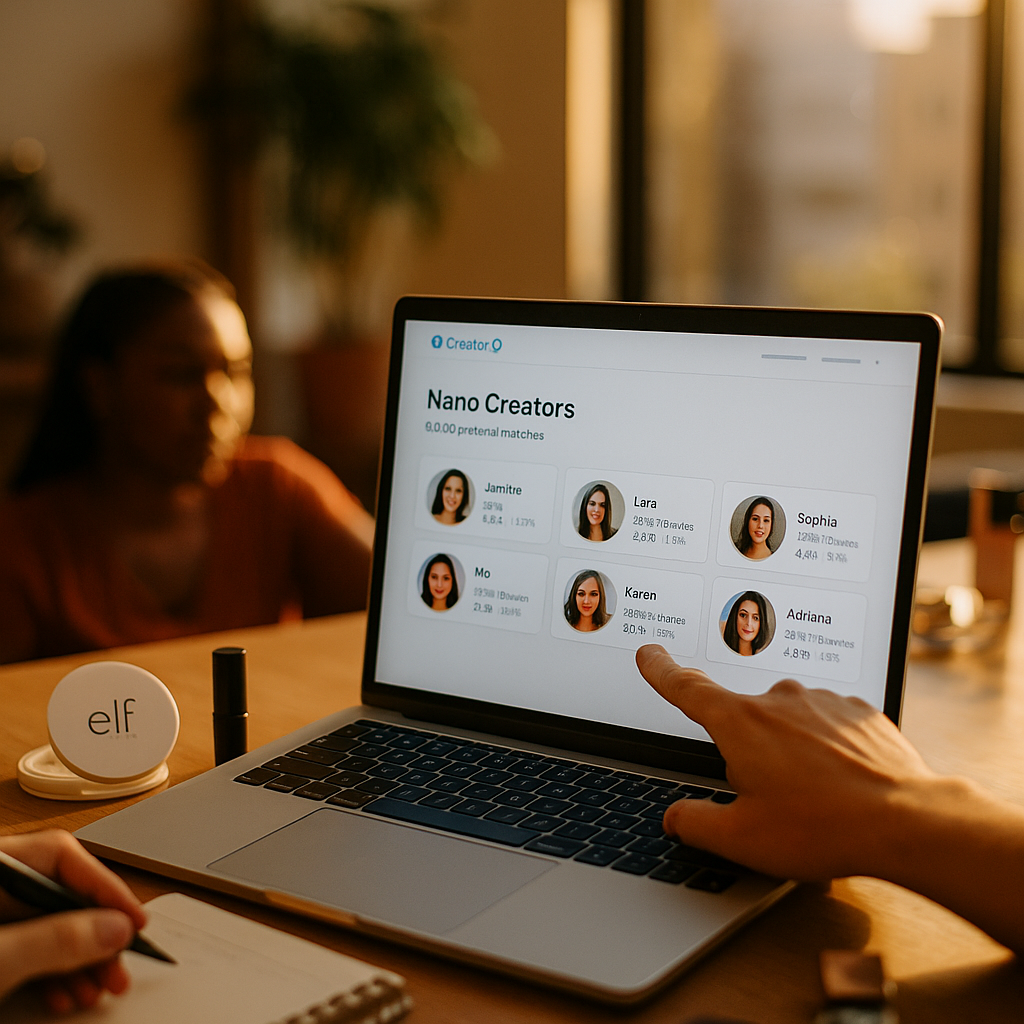
Nine thousand creators. One skincare drop. Zero manual vetting spreadsheets. If that sounds impossible, you haven’t looked at how e.l.f. Beauty runs nano-influencer vetting at scale. The brand has turned a notoriously messy part of influencer marketing, finding and qualifying thousands of small creators, into a repeatable, data-driven system built on CreatorIQ. Here’s how they did it, and what it means for anyone still vetting creators by hand.
The Nano Problem Nobody Wants to Admit
Nano-influencers (typically 1,000 to 10,000 followers) convert better than almost anyone else on the creator spectrum. Audiences trust them because they feel like a friend recommending a product, not a celebrity cashing a check. Multiple industry studies, including data referenced by eMarketer, show engagement rates for nano accounts consistently outperforming mid-tier and macro influencers on a percentage basis.
The catch? Volume. Running a nano-first strategy means managing hundreds or thousands of relationships instead of a handful of celebrity contracts. Most brands simply can’t do it manually. Vetting one creator for brand safety, audience quality, and fraud signals takes time. Vetting ten thousand takes a system.
e.l.f. Beauty figured that out early. The brand already has a reputation for scaling creator programs aggressively, a pattern explored in our earlier look at how e.l.f. scaled past 15,900 creator partnerships in a single year. Nano-influencer vetting at that volume isn’t a nice-to-have. It’s the whole operating model.
What Data-Driven Discovery Actually Means
CreatorIQ’s discovery engine doesn’t just search hashtags and follower counts. It pulls audience demographics, historical content performance, brand affinity signals, and fraud indicators into a single scoring layer. For a team vetting nano-influencers, that means filtering out bot-inflated accounts and engagement pods before a human ever opens a profile.
e.l.f.’s marketing team uses this layer to set qualification thresholds: minimum audience authenticity scores, category relevance tags, and historical brand-safety flags. Creators who clear the bar get surfaced into campaign shortlists automatically. Creators who don’t never make it into a brief.
At nano scale, manual vetting isn’t just slow, it’s a liability. Automated discovery turns brand safety from a bottleneck into a default setting.
This matters because the FTC has sharpened its scrutiny of influencer disclosures and brand responsibility over the past few cycles. Brands running thousands of nano partnerships can’t afford to discover a compliance problem after a campaign has already gone live. Platforms that bake disclosure history and past violation flags into discovery scoring give marketing teams a real risk mitigation layer, not just a search tool. Reviewing FTC endorsement guidance before scaling any nano program is still non-negotiable, but automated vetting narrows the gap between policy and practice.
Why Nano Scale Breaks Traditional Vetting Workflows
Think about the math. A traditional influencer manager might comfortably vet and onboard 20 to 30 creators a week by hand, checking engagement authenticity, reviewing past content, negotiating rates. At that pace, building a 5,000-creator nano program would take years.
e.l.f. compresses that timeline by letting CreatorIQ’s algorithms do the first pass. Human reviewers only step in for edge cases, ambiguous brand fit, or borderline audience quality scores. That’s the operational unlock: software handles the repetitive 80%, people handle the judgment-call 20%.
- Audience authenticity scoring flags suspicious follower growth patterns automatically.
- Category and interest tagging matches creators to specific product lines, from skincare to cosmetics tools.
- Historical performance data predicts likely engagement before a single dollar is spent.
- Compliance history surfaces prior disclosure issues before contracts go out.
This isn’t unique to beauty. Brands like Huda Beauty have built similar tiered systems tying creator tiers to real sales data, proving that structured discovery scales across categories, not just e.l.f.’s specific playbook.
From Discovery to Activation: Closing the Loop
Finding qualified nano-creators is only half the battle. The real ROI comes from how quickly a brand can move from discovery to activation, then measure what happened. e.l.f.’s CreatorIQ setup links discovery data directly into campaign management, so once a creator clears vetting, they can be added to a brief, sent product, and tracked for performance without re-entering data in a separate system.
That integration matters more than it sounds. Disconnected tools create friction, and friction kills nano-scale programs because the margins on any single creator relationship are small. A $200 gifting deal with a nano-creator doesn’t justify twenty minutes of manual data entry. It has to be near-instant or the economics don’t work.
Compare this to brands still running influencer vetting through spreadsheets and email threads. Princess Polly’s affiliate-driven approach, detailed in our piece on how the brand’s 11,000 creators crack the CPA code, shows a similar principle: scale only works when the back-end systems can absorb volume without adding headcount proportionally.
Measuring ROI When You Have Thousands of Micro-Bets
Here’s the uncomfortable truth about nano-influencer programs: individually, most creators move almost no revenue. The value is aggregate. That changes how marketing leaders need to think about attribution and reporting.
e.l.f.’s approach leans on CreatorIQ’s reporting layer to roll up performance across cohorts rather than obsessing over single-creator ROI. Are nano-creators in the 2,000 to 5,000 follower range outperforming those in the 5,000 to 10,000 range for a specific product category? That’s the kind of question a data-driven discovery system can actually answer, because it’s already tracking which creators cleared vetting, what content they produced, and how it performed.
Nano-influencer ROI isn’t about any single creator’s performance. It’s about cohort-level patterns that only emerge when vetting data and performance data live in the same system.
This cohort-based thinking mirrors what GameSquare and Chartis have pushed for in making influencer ROI auditable at scale. Auditability isn’t just a compliance checkbox, it’s what lets CFOs sign off on continued nano-program investment year over year.
For brands benchmarking their own creator economics, tools like HubSpot’s marketing analytics resources and Sprout Social’s engagement benchmarks offer useful external reference points, even if the real competitive edge comes from proprietary vetting data like e.l.f.’s.
What This Means for Brands Without CreatorIQ Budget
Not every brand can license an enterprise discovery platform on day one. That’s fine. The principle still applies at smaller scale: build qualification criteria before you start outreach, not during it. Define minimum audience authenticity thresholds. Decide upfront what disqualifies a creator, whether that’s past FTC violations, suspicious engagement patterns, or content misaligned with brand values.
Smaller teams can replicate pieces of e.l.f.’s model using lower-cost tools, manual spot-checks against Statista’s creator economy data, or platform-native insights from Meta Business Suite and TikTok’s advertiser tools. The gap between a $50,000 program and a $5 million one isn’t the existence of a vetting process, it’s the speed and scale at which that process runs.
Brands scaling UGC without massive platform budgets have found workarounds too. Scrub Daddy’s affiliate model, covered in our piece on how an open affiliate model built a TikTok Shop empire, shows that structured discovery criteria can scale even without enterprise software, as long as the qualification logic is clear and consistently applied.
The Takeaway
e.l.f. Beauty’s nano-influencer vetting isn’t a hack, it’s infrastructure. The brand treats discovery as a data problem first and a relationship problem second, which is exactly why it can operate at a scale most competitors can’t match. If your team is still vetting creators one profile at a time, the question isn’t whether to automate, it’s how fast you can build the qualification criteria that make automation safe.
Frequently Asked Questions
What is nano-influencer vetting?
Nano-influencer vetting is the process of evaluating creators with roughly 1,000 to 10,000 followers for audience authenticity, brand safety, and content quality before onboarding them into a marketing campaign. At scale, it typically requires automated tools rather than manual review.
How does CreatorIQ help brands vet nano-influencers?
CreatorIQ’s discovery engine scores creators on audience authenticity, category relevance, and historical performance, then surfaces qualified candidates automatically. This lets brands like e.l.f. Beauty screen thousands of creators without manually reviewing each profile.
Why do nano-influencers matter for ROI?
Nano-influencers often deliver higher engagement rates relative to follower count because their audiences perceive them as more authentic. The tradeoff is volume: brands need to manage many more relationships to see meaningful aggregate impact.
Can smaller brands replicate e.l.f.’s nano-influencer strategy without enterprise software?
Yes. Smaller brands can define clear qualification criteria (minimum engagement authenticity, category fit, compliance history) and apply them manually or with lower-cost tools. The core principle, vetting before outreach rather than during it, scales regardless of budget.
What compliance risks come with scaling nano-influencer programs?
The main risks are inconsistent FTC disclosure compliance and brand safety issues across a large creator pool. Automated vetting that flags prior violations or misaligned content before contracts are signed significantly reduces this exposure.
Top Influencer Marketing Agencies
The leading agencies shaping influencer marketing in 2026
Agencies ranked by campaign performance, client diversity, platform expertise, proven ROI, industry recognition, and client satisfaction. Assessed through verified case studies, reviews, and industry consultations.
Moburst

-
2

The Shelf
Boutique Beauty & Lifestyle Influencer AgencyA data-driven boutique agency specializing exclusively in beauty, wellness, and lifestyle influencer campaigns on Instagram and TikTok. Best for brands already focused on the beauty/personal care space that need curated, aesthetic-driven content.Clients: Pepsi, The Honest Company, Hims, Elf Cosmetics, Pure LeafVisit The Shelf → -
3

Audiencly
Niche Gaming & Esports Influencer AgencyA specialized agency focused exclusively on gaming and esports creators on YouTube, Twitch, and TikTok. Ideal if your campaign is 100% gaming-focused — from game launches to hardware and esports events.Clients: Epic Games, NordVPN, Ubisoft, Wargaming, Tencent GamesVisit Audiencly → -
4

Viral Nation
Global Influencer Marketing & Talent AgencyA dual talent management and marketing agency with proprietary brand safety tools and a global creator network spanning nano-influencers to celebrities across all major platforms.Clients: Meta, Activision Blizzard, Energizer, Aston Martin, WalmartVisit Viral Nation → -
5

The Influencer Marketing Factory
TikTok, Instagram & YouTube CampaignsA full-service agency with strong TikTok expertise, offering end-to-end campaign management from influencer discovery through performance reporting with a focus on platform-native content.Clients: Google, Snapchat, Universal Music, Bumble, YelpVisit TIMF → -
6

NeoReach
Enterprise Analytics & Influencer CampaignsAn enterprise-focused agency combining managed campaigns with a powerful self-service data platform for influencer search, audience analytics, and attribution modeling.Clients: Amazon, Airbnb, Netflix, Honda, The New York TimesVisit NeoReach → -
7

Ubiquitous
Creator-First Marketing PlatformA tech-driven platform combining self-service tools with managed campaign options, emphasizing speed and scalability for brands managing multiple influencer relationships.Clients: Lyft, Disney, Target, American Eagle, NetflixVisit Ubiquitous → -
8

Obviously
Scalable Enterprise Influencer CampaignsA tech-enabled agency built for high-volume campaigns, coordinating hundreds of creators simultaneously with end-to-end logistics, content rights management, and product seeding.Clients: Google, Ulta Beauty, Converse, AmazonVisit Obviously →