


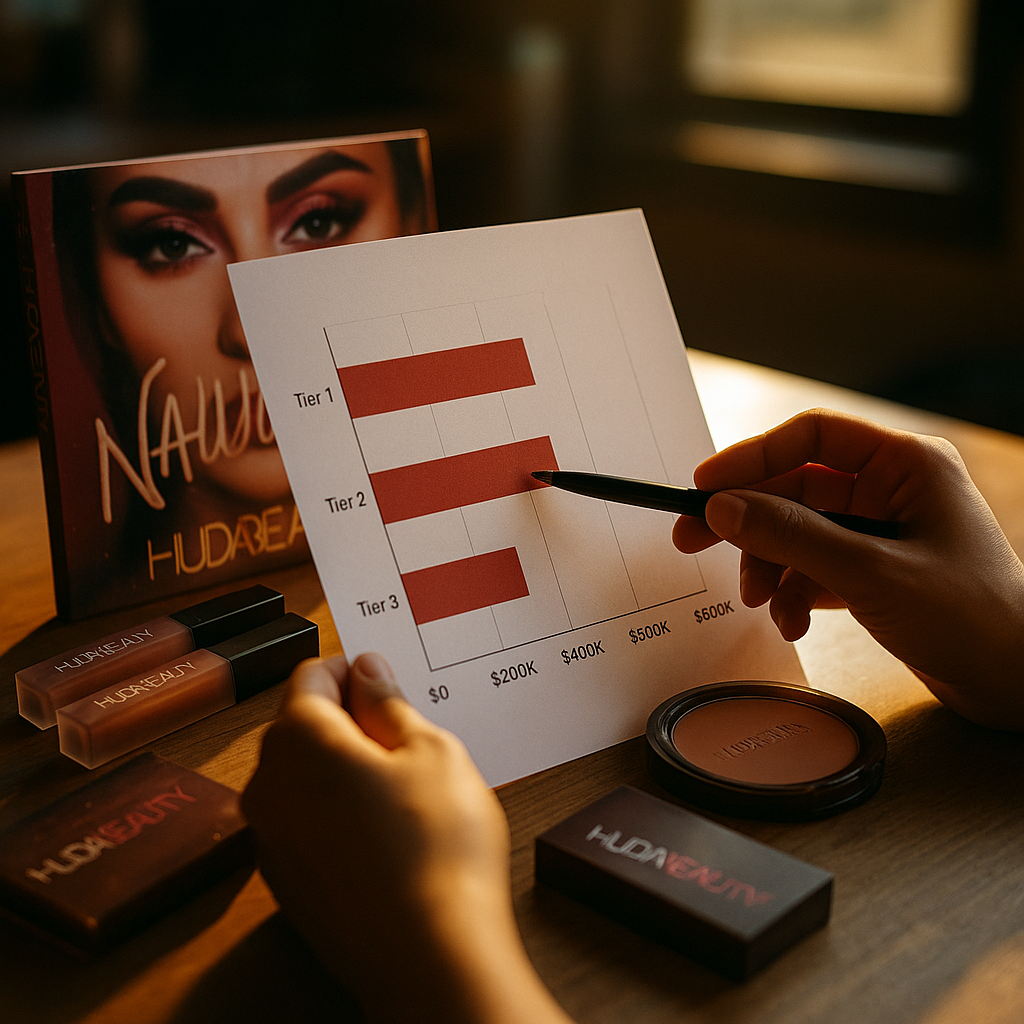
Only 34% of marketers say they can directly tie influencer content to revenue. Huda Beauty just made that gap look optional. Through a creator tier engagement tracking system that scores every post, story, and TikTok Shop link against downstream sales, the brand has quietly turned its influencer roster into a live performance dashboard. For an industry still arguing about whether reach or conversion matters more, this is the answer nobody wanted to hear: track both, tier accordingly, pay for outcomes.
What Huda Beauty Actually Built
Strip away the marketing language and the system is simple in concept, hard in execution. Huda Beauty segments its creator base into tiers, not by follower count alone but by a blended score that weighs engagement rate, content velocity, and, critically, attributable sales through affiliate links, TikTok Shop, and unique promo codes. A creator posting three times a month with modest reach but a 4% conversion rate can outrank a six-figure follower account that drives clicks nobody converts.
This is not a novel idea in theory. Plenty of brands claim to do “performance-based” influencer marketing. What sets Huda Beauty apart is the operational discipline: tiers are reviewed on a recurring cadence, not once a year during budget planning. Creators move up or down based on trailing data, and the payout structure shifts with them. It is less a loyalty program and more a live leaderboard tied to commission math.
Huda Beauty’s model treats every piece of creator content as a data point first and a brand asset second, which flips the traditional influencer brief on its head.
Why Tiering Creators Changes the Math
Most brands still allocate influencer budget the way agencies did a decade ago: pay for reach, hope for sales. That approach worked when attribution was fuzzy and nobody expected precision. It does not survive contact with a CFO asking for cost-per-acquisition numbers.
Huda Beauty’s tiering model forces a different conversation. Instead of asking “how many followers does this creator have,” the brand asks “what did this creator’s last five posts actually sell.” That shift matters because it exposes a truth many brand teams avoid saying out loud: follower count and sales performance correlate weakly at best. According to eMarketer research on influencer marketing spend, brands increasingly prioritize micro and mid-tier creators precisely because engagement quality outperforms raw audience size on conversion metrics.
The beauty category is particularly suited to this kind of tracking because purchase intent signals are strong and immediate. A swatch video, a tutorial, a “get ready with me” segment, these formats drive clicks in a way that awareness content in other verticals simply does not. Huda Beauty is capitalizing on a category advantage most CPG and fashion brands would envy.
The Data Stack Behind the Tiers
None of this works without infrastructure. Huda Beauty’s engagement tracking pulls from a mix of first-party affiliate platforms, TikTok Shop’s native analytics, and third-party attribution tools that stitch together cross-platform activity. The brand reportedly cross-references engagement rate against actual purchase data at the SKU level, which lets the team see not just that a creator drove sales, but which product line responded best to which creator archetype.
This mirrors a broader industry trend. Coty’s influencer spend rebuild, covered in our piece on rebuilding spend around attribution, follows a similar logic: stop paying for impressions, start paying for measurable lift. e.l.f. Beauty has taken a parallel path with its nine-figure TikTok Shop playbook, where creator commissions scale directly with unit sales rather than flat fees.
What makes Huda Beauty’s system notable is the granularity. Tiers are not static categories like “macro” or “micro.” They are dynamic scores recalculated on a rolling basis, which means a creator’s standing (and paycheck) can shift within a single campaign cycle if their content underperforms or overperforms expectations.
Is This Just Whitelisting With Extra Steps?
Not quite, though the two strategies rhyme. Whitelisting, the practice of running creator content as paid ads through the creator’s own handle, has become standard for brands like e.l.f. Cosmetics. Whitelisting optimizes distribution of existing content. Huda Beauty’s tier system optimizes the selection and compensation of creators before content is even produced, using historical sales data as the filter.
Think of it as upstream versus downstream optimization. Whitelisting fixes underperforming reach after the fact by boosting the right posts. Tiering fixes underperforming creators before the budget is spent, by routing dollars toward proven converters. Used together, the two approaches create a feedback loop: tier data informs which creators get budget, and whitelisting data informs which of their posts deserve paid amplification.
The Uncomfortable Part: What Happens to Creators Who Don’t Convert
Here is where the model gets less flattering for creators and more favorable for brand margins. A tiering system that pays for performance inherently deprioritizes creators with strong aesthetic value but weak sales conversion. That is a real tension in the influencer economy right now. A creator might drive brand sentiment and awareness without ever showing up in a last-click attribution model.
Huda Beauty’s answer, from what’s publicly known, is a blended tier score rather than pure sales-only ranking. Engagement rate and content quality still factor in. But make no mistake, sales data carries disproportionate weight, and creators who consistently underperform on conversion will see their tier, and their pay, decline over time.
This raises a fair question for the wider industry: are we building a system that rewards only bottom-funnel creators while starving the top-of-funnel storytellers who built category awareness in the first place? Sprout Social’s research on influencer marketing trends suggests brands still value both functions, but budget allocation increasingly tilts toward measurable outcomes. Huda Beauty’s model is simply an aggressive, transparent version of a shift already underway.
Compliance and Disclosure Still Matter Here
None of this performance tracking changes the disclosure requirements creators operate under. The FTC’s endorsement guidelines still require clear disclosure of paid partnerships regardless of whether a creator is in a top tier or bottom tier. Brands running tiered commission structures need to be especially careful that affiliate links and promo codes are disclosed consistently, since the sales-tracking mechanism itself (unique codes, trackable links) is often the same infrastructure regulators scrutinize for disclosure compliance.
Brand and legal teams building similar systems should treat disclosure audits as a standing line item, not an afterthought. A tiering model that quietly incentivizes creators to under-disclose in order to appear more “organic” and drive higher conversion is a compliance risk waiting to surface.
What Brands Without Huda’s Budget Can Actually Copy
Not every brand has Huda Beauty’s internal data science resources. But the underlying principle scales down easily enough. Start with three things: unique trackable links or codes for every creator, a recurring review cadence (monthly, not annual), and a tier structure with real financial consequences attached, not just vanity labels like “VIP creator.”
- Assign every creator a trackable, brand-specific link or discount code from day one.
- Review performance data on a fixed schedule and rebalance budget allocation accordingly.
- Weight conversion data alongside engagement rate rather than relying on either metric alone.
- Build disclosure compliance checks into the same reporting cycle as performance reviews.
Brands like Liquid Death and Alo Yoga have shown that this doesn’t require enterprise-level infrastructure. It requires discipline and a willingness to reallocate budget based on what the data actually says, even when that means cutting a creator with a great personal brand but weak sales numbers.
Where This Trend Is Headed
Expect more beauty and fashion brands to formalize tiering systems over the next few product cycles. The category’s high purchase intent and short consideration window make it an easy proving ground for sales-linked creator programs. HubSpot’s ongoing marketing benchmark data consistently shows attribution clarity as one of the top priorities for CMOs evaluating influencer spend, and Huda Beauty’s model gives skeptical finance teams exactly the kind of dashboard they’ve been asking for.
The brands that adapt fastest will be the ones willing to treat creator relationships as living performance contracts rather than one-off campaign line items. That is an operational shift, not just a technology one.
Frequently Asked Questions
What is creator tier engagement tracking?
Creator tier engagement tracking is a system that ranks influencers into performance tiers based on a combination of engagement metrics and attributable sales data, then adjusts compensation and content priority according to that ranking.
How does Huda Beauty measure creator sales performance?
Huda Beauty tracks creator performance through affiliate links, promo codes, and TikTok Shop analytics, cross-referencing engagement rate with actual purchase data to score creators on a recurring basis rather than a fixed annual review.
Is tiering the same as influencer whitelisting?
No. Whitelisting is a paid media tactic that amplifies existing creator content through ads. Tiering happens earlier in the process, determining which creators receive budget and how much they’re paid based on historical performance data.
Does sales-based tiering hurt creators who focus on brand awareness?
It can. A pure sales-weighted tier system tends to deprioritize creators who drive sentiment and reach without strong bottom-funnel conversion, which is why most brands blend engagement metrics with sales data rather than ranking on conversion alone.
What compliance risks come with tiered, sales-linked creator programs?
The main risk is disclosure consistency. Since these programs rely on trackable codes and affiliate links, brands must ensure creators disclose paid partnerships clearly and consistently, regardless of tier, to stay compliant with FTC endorsement guidelines.
Can smaller brands build a similar tracking system without enterprise tools?
Yes. Smaller brands can replicate the core principle with unique trackable links per creator, a fixed review cadence, and a tier structure with real budget consequences, without needing the same data infrastructure as a large beauty brand.
The takeaway for brand teams: stop treating influencer tiers as vanity labels and start treating them as budget-allocation mechanisms tied to trackable sales data. Build the tracking infrastructure first, then let the tier system, not gut instinct, decide who gets paid more next quarter.
Top Influencer Marketing Agencies
The leading agencies shaping influencer marketing in 2026
Agencies ranked by campaign performance, client diversity, platform expertise, proven ROI, industry recognition, and client satisfaction. Assessed through verified case studies, reviews, and industry consultations.
Moburst

-
2

The Shelf
Boutique Beauty & Lifestyle Influencer AgencyA data-driven boutique agency specializing exclusively in beauty, wellness, and lifestyle influencer campaigns on Instagram and TikTok. Best for brands already focused on the beauty/personal care space that need curated, aesthetic-driven content.Clients: Pepsi, The Honest Company, Hims, Elf Cosmetics, Pure LeafVisit The Shelf → -
3

Audiencly
Niche Gaming & Esports Influencer AgencyA specialized agency focused exclusively on gaming and esports creators on YouTube, Twitch, and TikTok. Ideal if your campaign is 100% gaming-focused — from game launches to hardware and esports events.Clients: Epic Games, NordVPN, Ubisoft, Wargaming, Tencent GamesVisit Audiencly → -
4

Viral Nation
Global Influencer Marketing & Talent AgencyA dual talent management and marketing agency with proprietary brand safety tools and a global creator network spanning nano-influencers to celebrities across all major platforms.Clients: Meta, Activision Blizzard, Energizer, Aston Martin, WalmartVisit Viral Nation → -
5

The Influencer Marketing Factory
TikTok, Instagram & YouTube CampaignsA full-service agency with strong TikTok expertise, offering end-to-end campaign management from influencer discovery through performance reporting with a focus on platform-native content.Clients: Google, Snapchat, Universal Music, Bumble, YelpVisit TIMF → -
6

NeoReach
Enterprise Analytics & Influencer CampaignsAn enterprise-focused agency combining managed campaigns with a powerful self-service data platform for influencer search, audience analytics, and attribution modeling.Clients: Amazon, Airbnb, Netflix, Honda, The New York TimesVisit NeoReach → -
7

Ubiquitous
Creator-First Marketing PlatformA tech-driven platform combining self-service tools with managed campaign options, emphasizing speed and scalability for brands managing multiple influencer relationships.Clients: Lyft, Disney, Target, American Eagle, NetflixVisit Ubiquitous → -
8

Obviously
Scalable Enterprise Influencer CampaignsA tech-enabled agency built for high-volume campaigns, coordinating hundreds of creators simultaneously with end-to-end logistics, content rights management, and product seeding.Clients: Google, Ulta Beauty, Converse, AmazonVisit Obviously →