


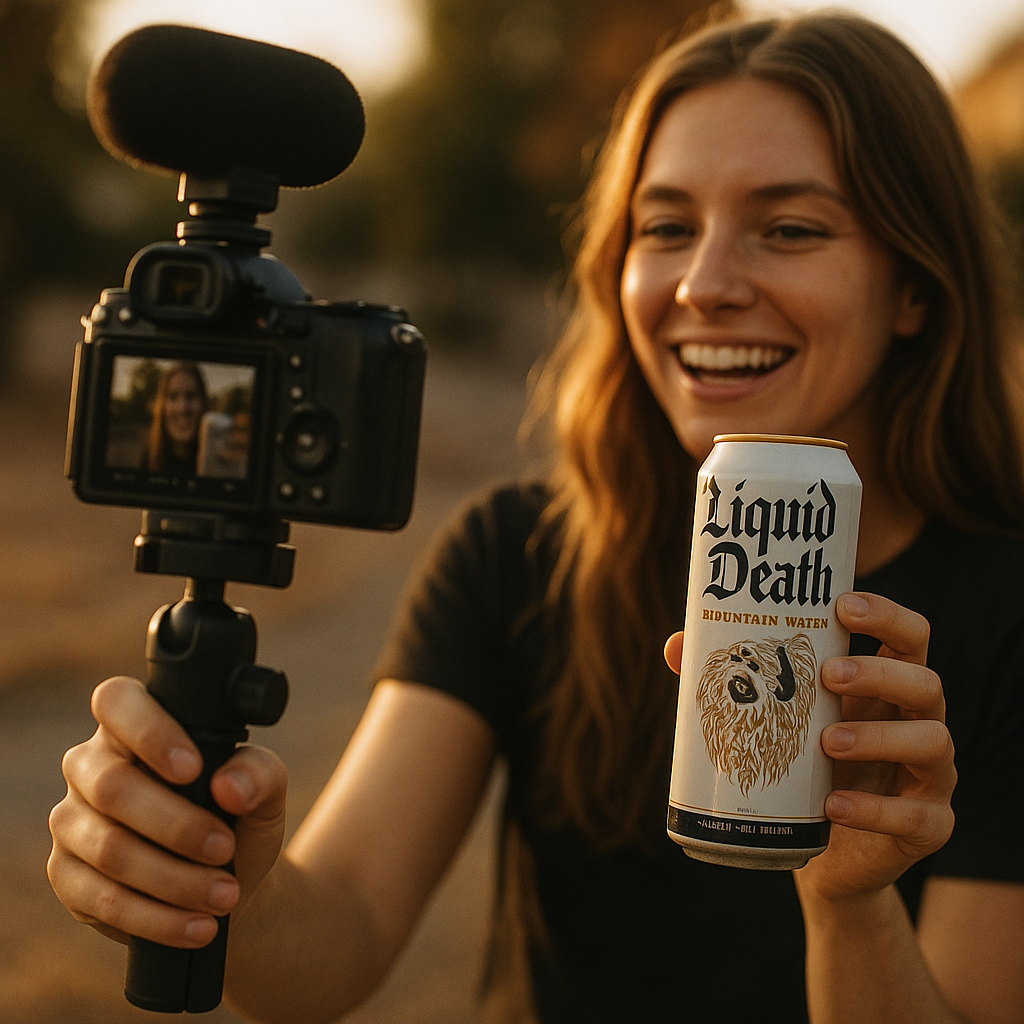
Liquid Death spends less on traditional media than most Series B beverage startups, yet it moves more cans through creator content than brands with ten times its marketing budget. How? The canned water brand treats every piece of micro creator UGC as a line item, not a vanity metric. This is the case study behind micro creator UGC as a revenue system, not a brand awareness afterthought.
The Problem Most Brands Never Solve
Ask any CMO how much revenue their influencer program generated last quarter, and you’ll usually get a pause, a caveat, then a vague answer involving reach and engagement rate. That’s the industry’s dirty secret. Most brands can tell you what content got made. Almost none can tell you what it sold.
Liquid Death built its entire creator operation to answer that exact question. The brand doesn’t chase follower counts. It chases attributable transactions, and it structures contracts, content rights, and payouts around proving them.
Why Micro Creators, Not Celebrities?
Liquid Death’s founder Mike Cessario has been public about the brand’s skepticism of celebrity-first influencer deals. Big names generate impressions. They rarely generate a traceable path to checkout. Micro creators, typically those with 10,000 to 100,000 followers, produce content that reads as a recommendation rather than an ad. That distinction matters more than reach ever will.
Data from eMarketer has repeatedly shown that smaller creator tiers post higher engagement rates than mega influencers, and engagement on a beverage brand’s TikTok isn’t the point. Conversion is. Liquid Death’s team has said internally that a nano or micro creator’s video, when tagged with a trackable code, routinely outperforms celebrity placements on cost per acquisition.
Liquid Death doesn’t ask “how many people saw this?” It asks “how many people bought something because of this?” That single question reshapes the entire creator program.
The Mechanics: How UGC Becomes a Tracked Sale
Here’s where most brands stop short. They send product, get a video, post it to the brand account, and call it a win. Liquid Death goes several steps further, building a closed loop between content and commerce.
- Unique promo codes per creator. Every micro creator in the program receives a distinct discount code tied to their handle. No shared codes, no ambiguity about attribution.
- Affiliate links routed through commerce platforms. Codes and links feed directly into the brand’s e-commerce backend, so a sale is logged against a specific creator, not a campaign bucket.
- Whitelisting for paid amplification. High-performing organic UGC gets pushed into paid social with the creator’s handle as the running ad account, extending reach without losing the authentic voice that made the content work in the first place.
- Tiered payout structures. Base fees are modest. The real money is in revenue share and performance bonuses tied to codes redeemed, which keeps incentives aligned instead of paying flat fees for content that never converts.
This mirrors a broader shift happening across DTC. Brands like e.l.f. Cosmetics have taken a similar approach, turning organic UGC into paid assets through whitelisting strategies that stretch content spend further than any new production budget could.
What the Numbers Actually Look Like
Liquid Death doesn’t publish granular ROI figures publicly, which is typical for privately funded beverage brands, but the operational pattern is consistent across public interviews and marketing conference talks from the brand’s growth team. The brand has emphasized cost per acquisition as its north star metric, and creator-driven CPA has consistently beaten paid social CPA in categories where the brand competes for shelf space against Poland Spring, LaCroix, and Celsius.
The mechanism is simple math. A micro creator might cost $150 to $500 for a piece of content. If that creator’s unique code drives even 40 to 60 redemptions at a $2 average order value margin, the content pays for itself within days, and every redemption after that is incremental profit. Compare that to a six-figure celebrity placement with no attribution path, and the math isn’t close.
A $300 micro creator payout that generates a trackable, repeatable revenue stream beats a $50,000 celebrity post with no attribution every single time. That’s not brand philosophy, that’s just accounting.
Compliance Isn’t Optional, It’s Infrastructure
Trackable revenue means trackable disclosure risk too. Liquid Death’s affiliate and promo code structure creates a paper trail that regulators can actually audit, which cuts both ways. It’s good for proving ROI, and it’s good for proving compliance with FTC endorsement guidelines around material connections between brands and creators.
Every creator in the program discloses the paid or affiliate relationship, typically through platform-native tools on TikTok and Instagram. This isn’t just legal box-checking. Brands that get caught mishandling disclosure exposure end up with far more expensive problems than a missed conversion, including regulatory scrutiny and reputational fallout that erases months of hard-won trust.
Agencies structuring similar programs for other CPG brands have leaned on platforms like Sprout Social and native TikTok tools to manage disclosure workflows at scale, since manual tracking breaks down fast once a program grows past a few dozen creators.
Retail Media and the Feedback Loop
Liquid Death sells through Whole Foods, Walmart, and thousands of independent retailers, not just DTC. That retail footprint changes how creator content gets measured. The brand has increasingly connected influencer-driven UGC to retail media data, matching spikes in creator activity against point-of-sale lift in specific markets.
This kind of cross-channel attribution is becoming table stakes for CPG brands broadly. Henkel has built similar infrastructure connecting creator commerce into retail media, proving that the fusion of influencer content and shelf-level sales data isn’t a nice-to-have anymore. It’s becoming the baseline expectation from finance teams asking marketing to justify budget.
Liquid Death’s team has also invested in creator content tagging that flows into broader marketing mix modeling, so a single TikTok video isn’t judged in isolation. It’s judged against its contribution to a multi-touch path that might include a retargeting ad, a retail endcap, and a friend’s recommendation. That’s a more honest picture of how purchases actually happen, and it’s a lot harder to fake.
What Other Brands Get Wrong When Copying This Model
The mistake most brands make when they try to replicate Liquid Death’s approach is copying the aesthetic (the irreverent captions, the horror movie parody ads) while skipping the infrastructure. Tone doesn’t drive revenue. Tracking does.
A few specific failure points show up repeatedly:
- No unique attribution per creator. Brands hand out one shared code for a whole campaign, then wonder why they can’t tell which creators actually moved product.
- Flat fees with no performance upside. Paying every creator the same rate regardless of results removes any incentive to optimize content for conversion.
- Treating whitelisting as an afterthought. Organic content that performs well organically deserves paid amplification, but most brands never build the workflow to identify and act on it quickly.
- Ignoring retail lift entirely. DTC-only attribution misses the majority of sales for brands with any meaningful retail distribution.
Brands in adjacent categories have solved pieces of this puzzle in their own ways. Feastables, for instance, built its nano creator taste test strategy around a similarly tight feedback loop between content and shelf performance, proving the model isn’t unique to beverages.
Building the Program: What It Takes Operationally
None of this happens without dedicated tooling and headcount. Liquid Death runs its creator relationships through a mix of in-house coordination and platform partnerships, using affiliate infrastructure that plugs into Shopify and retail data feeds. The brand’s marketing team treats creator management less like a PR function and more like a performance marketing channel, complete with weekly reporting on CPA, redemption rates, and content velocity.
For brands without that internal capacity, vetted creator networks offer a faster path. Stack Influence, for example, has built a model around vetted creator networks that cut launch costs for DTC brands trying to replicate this kind of trackable performance without building the entire stack from scratch.
According to HubSpot’s research on influencer marketing benchmarks, brands that tie creator compensation to measurable outcomes report significantly stronger program retention over time, largely because both sides are working from the same scoreboard. That alignment is the real unlock, not the discount code technology itself.
Next Steps for Brands Watching From the Sidelines
Stop paying flat fees for content you can’t trace to revenue. Build unique attribution into every creator contract before the first piece of content ships, then reinvest in whatever tier and format actually moves product, not whatever looks best in a deck.
FAQs
What makes micro creator UGC different from standard influencer content?
Micro creator UGC typically comes from creators with 10,000 to 100,000 followers, producing content that reads as personal recommendation rather than paid advertising. It tends to generate higher engagement rates and, when properly tracked, more attributable conversions than celebrity-tier placements.
How does Liquid Death track revenue from creator content?
The brand assigns unique promo codes and affiliate links to individual creators, routing redemptions through its e-commerce backend so each sale is attributed to a specific creator rather than a general campaign.
What is whitelisting in influencer marketing?
Whitelisting allows a brand to run paid ads through a creator’s own social account, using the creator’s handle and authentic content format while gaining full targeting and budget control typically reserved for brand-owned ad accounts.
Do brands still need to worry about FTC disclosure rules with affiliate codes?
Yes. Affiliate and promo code relationships still count as material connections under FTC guidelines, and creators must disclose the paid or commission-based relationship regardless of whether compensation is a flat fee or performance-based.
Can smaller brands replicate this model without a large marketing team?
Yes. Vetted creator networks and affiliate platforms have made it possible for smaller DTC brands to implement unique attribution and tiered payouts without building an entirely in-house creator operations team from scratch.
Top Influencer Marketing Agencies
The leading agencies shaping influencer marketing in 2026
Agencies ranked by campaign performance, client diversity, platform expertise, proven ROI, industry recognition, and client satisfaction. Assessed through verified case studies, reviews, and industry consultations.
Moburst

-
2

The Shelf
Boutique Beauty & Lifestyle Influencer AgencyA data-driven boutique agency specializing exclusively in beauty, wellness, and lifestyle influencer campaigns on Instagram and TikTok. Best for brands already focused on the beauty/personal care space that need curated, aesthetic-driven content.Clients: Pepsi, The Honest Company, Hims, Elf Cosmetics, Pure LeafVisit The Shelf → -
3

Audiencly
Niche Gaming & Esports Influencer AgencyA specialized agency focused exclusively on gaming and esports creators on YouTube, Twitch, and TikTok. Ideal if your campaign is 100% gaming-focused — from game launches to hardware and esports events.Clients: Epic Games, NordVPN, Ubisoft, Wargaming, Tencent GamesVisit Audiencly → -
4

Viral Nation
Global Influencer Marketing & Talent AgencyA dual talent management and marketing agency with proprietary brand safety tools and a global creator network spanning nano-influencers to celebrities across all major platforms.Clients: Meta, Activision Blizzard, Energizer, Aston Martin, WalmartVisit Viral Nation → -
5

The Influencer Marketing Factory
TikTok, Instagram & YouTube CampaignsA full-service agency with strong TikTok expertise, offering end-to-end campaign management from influencer discovery through performance reporting with a focus on platform-native content.Clients: Google, Snapchat, Universal Music, Bumble, YelpVisit TIMF → -
6

NeoReach
Enterprise Analytics & Influencer CampaignsAn enterprise-focused agency combining managed campaigns with a powerful self-service data platform for influencer search, audience analytics, and attribution modeling.Clients: Amazon, Airbnb, Netflix, Honda, The New York TimesVisit NeoReach → -
7

Ubiquitous
Creator-First Marketing PlatformA tech-driven platform combining self-service tools with managed campaign options, emphasizing speed and scalability for brands managing multiple influencer relationships.Clients: Lyft, Disney, Target, American Eagle, NetflixVisit Ubiquitous → -
8

Obviously
Scalable Enterprise Influencer CampaignsA tech-enabled agency built for high-volume campaigns, coordinating hundreds of creators simultaneously with end-to-end logistics, content rights management, and product seeding.Clients: Google, Ulta Beauty, Converse, AmazonVisit Obviously →