


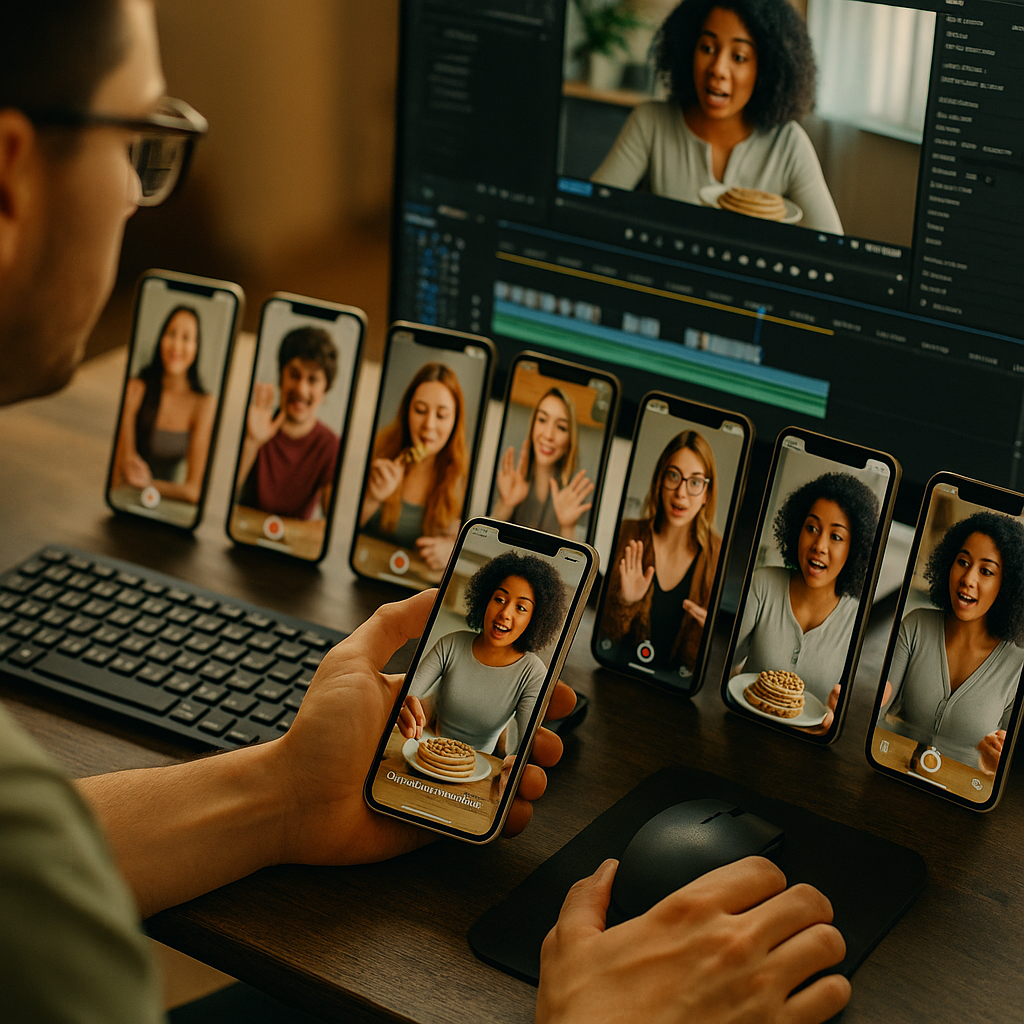
Six thousand videos a month. That’s roughly 200 pieces of UGC published every single day, seven days a week, with no holidays. Most marketing teams would need a content department the size of a small newsroom to hit that number. One app studio did it with a four-person team, a library of creator scripts, and an AI scheduling layer that never sleeps. If you’re wondering what a real UGC video production pipeline looks like at industrial scale, this is the blueprint.
Why App Studios Hit a Content Ceiling Before Anyone Else
Mobile app studios live and die on paid user acquisition, and UGC-style ad creative has become the dominant format on Meta, TikTok, and YouTube Shorts. The problem is volume. App install campaigns burn through creative fast because ad fatigue sets in within days, not weeks, especially on performance-focused placements. A studio running dozens of apps across multiple markets needs fresh hooks constantly, or its cost-per-install creeps upward within a week of launch.
Traditional UGC production, briefing a creator, waiting for a draft, running revisions, clearing usage rights, simply can’t keep pace with that burn rate. The studio in question (a subscription-app portfolio operator that asked not to be named publicly due to competitive sensitivity) was spending nearly three weeks per creative batch before the shift. That timeline doesn’t survive contact with a performance marketing calendar.
Creator Scripts: Turning Briefs Into a Repeatable Asset
The first fix wasn’t technology. It was structure. The studio built a library of modular creator scripts, each one a skeleton built around a proven hook, a problem statement, a product reveal, and a call to action. Instead of writing a new brief for every creator on every app, the team assembled scripts from pre-tested components.
Think of it like a content management system for dialogue rather than for web pages. A script might open with “I didn’t think an app could fix this, but…” and close with a CTA variant pulled from a tested bank of six. Creators still improvise delivery and personality, which is what keeps the content from feeling robotic, but the narrative architecture is locked in advance. This is the same logic brands like e.l.f. Beauty use when they turn a simple format into a repeatable creator engine, just applied to app marketing instead of beauty.
Scripting isn’t about controlling creators. It’s about removing the thirty minutes of “what do I even say” friction that kills turnaround time on every single brief.
Each script also carries built-in compliance language, disclosure wording, claims restrictions, and platform-specific do’s and don’ts baked directly into the document. That single decision later saved the studio from several near-miss FTC disclosure issues, since creators were never left guessing what they could or couldn’t say about app functionality or pricing.
What a Script Library Actually Contains
- Hook variants tagged by emotional trigger (frustration, curiosity, humor, social proof)
- Pre-approved claims language reviewed by legal once per quarter, not per video
- Platform-specific aspect ratio and caption notes
- CTA banks matched to funnel stage (install, trial, subscription conversion)
- Disclosure requirements aligned with FTC endorsement guidance
AI Scheduling Does the Heavy Lifting Humans Can’t
Scripts solved the creative bottleneck on the input side. The output side, actually getting thousands of finished clips onto the right platforms at the right times with the right metadata, needed something else entirely. That’s where AI scheduling tools came in.
The studio connected its content intake pipeline to an AI scheduling layer that handles ingestion, tagging, and distribution timing automatically. When a creator uploads raw footage, the system auto-tags it by app, hook type, language, and funnel stage, then slots it into a publishing queue based on historical performance data for that time slot and platform. No human touches the calendar manually anymore. A content ops lead reviews flagged exceptions, but routine publishing runs itself.
This mirrors a pattern showing up across the industry. Coca-Cola’s content platform, for instance, uses AI to localize creator content at scale rather than rebuilding assets market by market. The app studio applied the same principle to scheduling instead of localization: let the software make thousands of small, repetitive decisions so humans can focus on strategy and quality control.
According to eMarketer, UGC-style ad formats now account for a growing share of social ad spend precisely because they outperform polished studio creative on cost efficiency. Scale only works, though, if the publishing infrastructure can match the pace of creative production. Most teams build one half of that equation and wonder why throughput still stalls.
The Math Behind 6,000 Videos a Month
Here’s how the numbers actually broke down. The studio works with roughly 180 active creators across its app portfolio at any given time, averaging between one and two deliverables per creator per day. Scripts cut brief-to-delivery time from several days to under 24 hours in most cases. AI scheduling then absorbed the publishing workload that previously consumed two full-time employees’ calendars.
At 6,000 videos a month, a single broken script or a mistimed publish doesn’t just waste one asset, it can quietly undermine an entire week’s worth of ad account performance data.
The studio reports a 40 percent reduction in cost-per-install on top-performing apps since the system went live, attributing most of the gain to simply never running out of fresh creative. Ad fatigue, the silent killer of performance campaigns, stopped being a constraint because new hooks were always queued and ready. That kind of consistent throughput is hard to overstate. HubSpot’s research on content marketing has long shown that publishing frequency correlates with audience growth, and the same logic holds for paid creative refresh rates.
Where the Risk Actually Lives
Scaling to this volume isn’t free of hazard. Four risks surfaced quickly, and any studio attempting something similar should plan for them before launch, not after a problem surfaces.
- Disclosure drift. At high volume, it’s easy for a creator to forget disclosure language buried in script version twelve. Quarterly audits against FTC endorsement rules became non-negotiable.
- Creative sameness. Scripts can calcify into formula if nobody refreshes the hook library. The studio rotates 20 percent of its scripts monthly to avoid audience fatigue setting in across the whole catalog at once.
- Trust erosion. Audiences are increasingly sharp about spotting AI-assisted or overly templated content, a concern explored in depth around why AI-generated UGC still lags on trust. The studio deliberately keeps human creators in the loop for delivery and personality, using AI only for logistics, not for generating the content itself.
- Creator burnout. Producing one to two videos daily is a real workload. The studio pays per-delivery rather than per-hour and caps daily output per creator to avoid churn.
Vetting creators at this scale also matters more, not less. Studios running smaller programs often skip formal vetting, but at hundreds of active creators, informal trust breaks down fast. The approach used by e.l.f. Beauty to vet thousands of nano creators through structured platforms is instructive here: volume without a vetting layer invites brand safety problems eventually.
Is This Approach Right for Every Brand?
Probably not. A studio running one flagship app with a single audience segment doesn’t need 6,000 monthly videos, that would be waste, not efficiency. This model fits portfolios: multiple apps, multiple geographies, multiple funnel stages running simultaneously, where the marginal cost of one more video is low but the marginal value of fresh creative stays high throughout. Sprout Social’s industry benchmarking suggests publishing cadence needs vary enormously by vertical, and app marketing sits at the high-frequency end of that spectrum because install campaigns are so creative-hungry.
Lean teams outperforming larger ones isn’t a new story in this industry. Ryanair’s social team has shown for years that a small, fast-moving team can outpace agency-sized operations purely on speed and iteration. The app studio case follows the same playbook, just swapping travel content for app install creative and swapping manual speed for AI-assisted speed.
Measuring whether any of this actually pays off matters just as much as building it. Without auditable attribution, a studio producing 6,000 videos a month has no way of knowing which scripts, hooks, or creators are actually driving installs versus just adding noise. Frameworks like the one GameSquare and Chartis built to make influencer ROI auditable offer a useful reference point for any team scaling creator output this aggressively.
The Takeaway
If you’re drowning in creative requests but your output hasn’t moved, the fix usually isn’t more creators, it’s better infrastructure. Build a script library that locks in compliance and structure while leaving room for personality, then let AI scheduling handle the repetitive distribution work your team shouldn’t be doing by hand anyway.
FAQs
What are creator scripts in UGC video production?
Creator scripts are modular content templates that provide creators with a pre-built narrative structure, including hooks, claims language, and calls to action, while still allowing room for personal delivery and improvisation. They speed up brief-to-delivery time and build compliance directly into the creative process.
How does AI scheduling help with high-volume UGC publishing?
AI scheduling tools automatically tag, sort, and publish video content based on historical performance data, platform requirements, and funnel stage, removing the need for manual calendar management. This lets a small team manage thousands of monthly publishes without adding headcount.
Does scaling UGC production this way hurt content quality?
Not if scripts are rotated regularly and creators retain creative control over delivery. The main risk is formulaic sameness, which teams typically manage by refreshing a portion of the script library every month and monitoring engagement for fatigue signals.
What compliance risks come with producing thousands of UGC videos monthly?
The biggest risks are disclosure drift, where creators forget required endorsement language, and inconsistent claims across markets. Building disclosure requirements directly into creator scripts and auditing them quarterly against FTC endorsement guidance significantly reduces this exposure.
Is this UGC scaling model suitable for small brands?
Generally no. High-volume UGC pipelines make the most sense for portfolios with multiple products, apps, or markets that need constant creative refresh to fight ad fatigue. A single-product brand with one core audience rarely needs thousands of monthly videos and would likely see diminishing returns from the added complexity.
Top Influencer Marketing Agencies
The leading agencies shaping influencer marketing in 2026
Agencies ranked by campaign performance, client diversity, platform expertise, proven ROI, industry recognition, and client satisfaction. Assessed through verified case studies, reviews, and industry consultations.
Moburst

-
2

The Shelf
Boutique Beauty & Lifestyle Influencer AgencyA data-driven boutique agency specializing exclusively in beauty, wellness, and lifestyle influencer campaigns on Instagram and TikTok. Best for brands already focused on the beauty/personal care space that need curated, aesthetic-driven content.Clients: Pepsi, The Honest Company, Hims, Elf Cosmetics, Pure LeafVisit The Shelf → -
3

Audiencly
Niche Gaming & Esports Influencer AgencyA specialized agency focused exclusively on gaming and esports creators on YouTube, Twitch, and TikTok. Ideal if your campaign is 100% gaming-focused — from game launches to hardware and esports events.Clients: Epic Games, NordVPN, Ubisoft, Wargaming, Tencent GamesVisit Audiencly → -
4

Viral Nation
Global Influencer Marketing & Talent AgencyA dual talent management and marketing agency with proprietary brand safety tools and a global creator network spanning nano-influencers to celebrities across all major platforms.Clients: Meta, Activision Blizzard, Energizer, Aston Martin, WalmartVisit Viral Nation → -
5

The Influencer Marketing Factory
TikTok, Instagram & YouTube CampaignsA full-service agency with strong TikTok expertise, offering end-to-end campaign management from influencer discovery through performance reporting with a focus on platform-native content.Clients: Google, Snapchat, Universal Music, Bumble, YelpVisit TIMF → -
6

NeoReach
Enterprise Analytics & Influencer CampaignsAn enterprise-focused agency combining managed campaigns with a powerful self-service data platform for influencer search, audience analytics, and attribution modeling.Clients: Amazon, Airbnb, Netflix, Honda, The New York TimesVisit NeoReach → -
7

Ubiquitous
Creator-First Marketing PlatformA tech-driven platform combining self-service tools with managed campaign options, emphasizing speed and scalability for brands managing multiple influencer relationships.Clients: Lyft, Disney, Target, American Eagle, NetflixVisit Ubiquitous → -
8

Obviously
Scalable Enterprise Influencer CampaignsA tech-enabled agency built for high-volume campaigns, coordinating hundreds of creators simultaneously with end-to-end logistics, content rights management, and product seeding.Clients: Google, Ulta Beauty, Converse, AmazonVisit Obviously →