


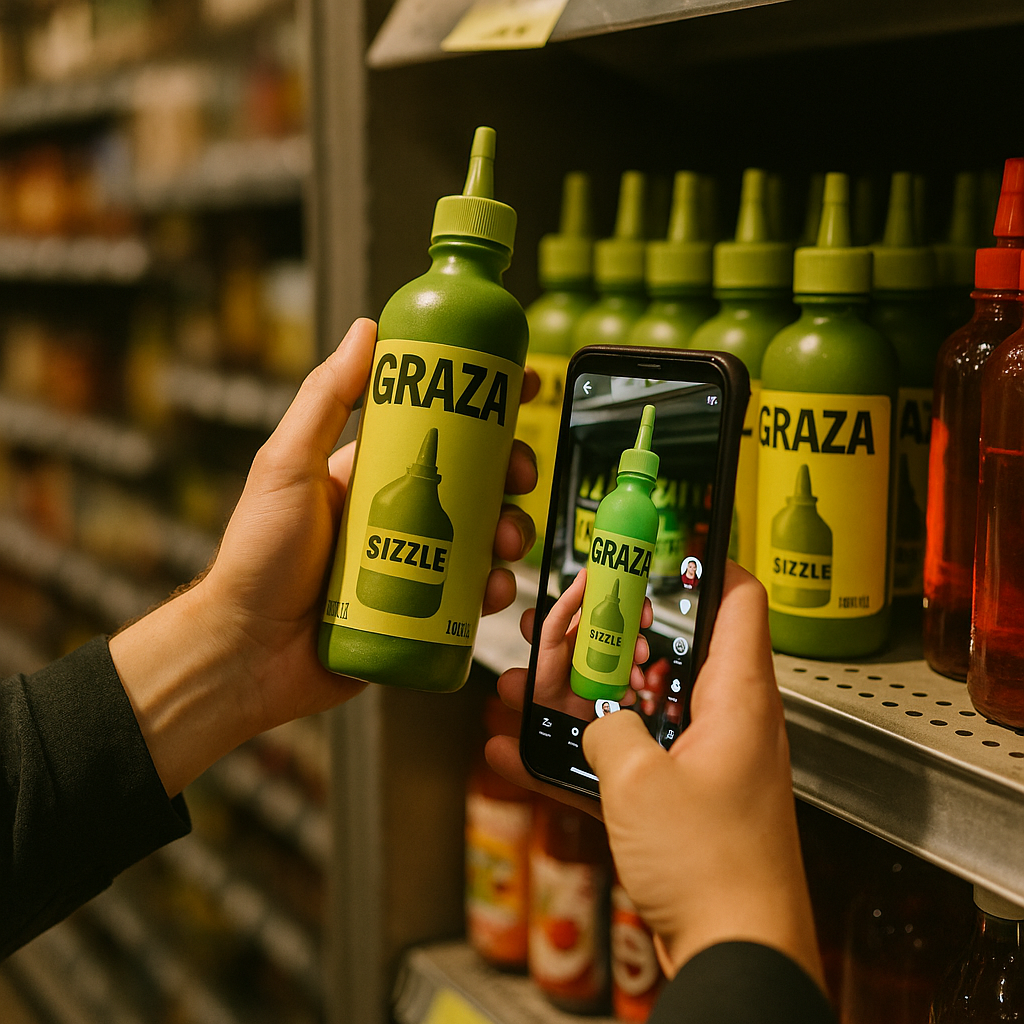
One TikTok format. Three years of consistent posting. A condiment brand now sitting on grocery shelves next to olive oil giants that have advertised on television since before the internet existed. Graza’s squeeze-bottle olive oil case study is the closest thing the creator economy has to a controlled experiment: what happens when a brand picks one comedic bit and refuses to get bored of it?
Most DTC brands chase trend cycles. Graza built a moat by ignoring them.
The Format That Wouldn’t Quit
Graza launched in 2021 with a simple premise: olive oil in a squeeze bottle, marketed like a condiment instead of a pantry staple. The product itself was a wedge issue. Olive oil purists scoffed. But the packaging created a physical affordance — squeeze, drizzle, done — that happened to be perfect for short-form video.
The brand’s breakout format wasn’t a dance or a trend audio. It was a recurring bit: quick-cut, deadpan videos showing the bottle being used in absurd, over-the-top ways, often paired with a punchy voiceover or on-screen text delivering a joke at the one-second mark. Think fast zooms, sound-effect timing, and a squeeze-bottle hero shot that repeats almost identically across dozens of videos.
Graza didn’t go viral once. It built a repeatable comedic template and ran it hundreds of times, treating the format itself as the brand asset — not any single video.
That’s the part most brand marketers miss when they study viral case studies. They look for the one video that “broke,” not the underlying production system that made breakage statistically likely on a long enough timeline.
Why Format Repetition Beats One-Hit Virality
Ask any social lead how many videos it takes to find a hit, and you’ll get a shrug. Nobody knows in advance. What Graza understood early is that consistency of format lowers the variance of outcomes over time, even if it doesn’t guarantee any single win.
Here’s the operating logic, distilled:
- One format, many executions. Same visual grammar, same pacing, same joke structure — different scenarios each time.
- Low production cost per video. Because the format is templated, each new video is cheap to produce, which means more shots on goal without burning budget.
- Audience pattern recognition. Viewers start to recognize the bit before the punchline lands, which drives watch-through and comments (“here we go again”).
- Retail buyers notice repetition, not spikes. A single viral moment is a nice press mention. Sustained engagement across dozens of posts is a demand signal a buyer can underwrite.
This mirrors what worked for Ridge Wallet’s founder-led demo videos — a format repeated relentlessly until it became the brand’s signature rather than a one-off campaign. The lesson generalizes: distinctiveness compounds when you commit to a format long enough for the algorithm and the audience to both learn it.
From TikTok Views to Retail Sell-Through
Views don’t stock shelves. Sell-through does. This is where the Graza case study becomes genuinely instructive for brand and category teams, not just social media managers.
Retail buyers at chains like Target, Whole Foods, and regional grocers evaluate new CPG brands on velocity — units sold per store, per week — not follower counts. A brand can have three million TikTok followers and still get pulled from shelves if velocity underperforms category benchmarks. Graza’s format-driven content did two things that mattered to buyers:
- It created off-shelf demand generation that drove first-time trial without a national ad budget.
- It built a recognizable visual identity (the bottle, the color-coded caps, the squeeze motion) that shoppers could spot instantly in-store, shortening the path from “I saw that on my phone” to “that’s the one” at the shelf.
That second point is underrated. Packaging that photographs and videos well isn’t a nice-to-have anymore — it’s a distribution channel. Graza’s bottle design was reportedly informed by how it would look mid-squeeze on camera, which is a genuinely modern constraint for CPG product design. Compare that to legacy olive oil brands still packaged in glass bottles with label copy nobody can read on a 6-inch screen.
Sell-through data backs this up directionally: category reports from eMarketer and retail analytics providers have repeatedly shown that DTC-native CPG brands with strong short-form video engagement post materially higher velocity in their first 12 months on shelf compared to traditionally launched competitors. Graza’s expansion from direct-to-consumer into Target, Whole Foods, and specialty grocers followed this exact pattern: build digital demand first, let retail distribution follow proof, not the other way around.
What the Content Calendar Actually Looked Like
Nobody outside Graza’s internal team has the exact production numbers, but the visible cadence on TikTok and Instagram Reels tells its own story. The brand posted with a frequency that most CPG marketing teams would call reckless — multiple times per week, often daily during launch windows for new SKUs like Sizzle (their high-heat cooking oil) and Drizzle (their finishing oil).
A few operational patterns are worth stealing:
- Founder visibility, not founder dependency. Co-founder Andrew Benin appeared in content, but the format didn’t collapse without him. The bit could be executed by any team member holding the bottle.
- UGC amplification, not just brand-owned content. Once the format caught on, everyday users started making their own versions, and Graza’s team clearly monitored and reposted or stitched the best ones — extending reach without extending production cost.
- Format discipline over trend-chasing. Graza didn’t abandon the bit every time a new TikTok trend audio appeared. They let the format be the constant and treated trend audio as an optional layer on top, not a replacement.
This is the inverse of how most brand social calendars are built. Most teams chase whatever’s trending this week, which means starting from zero on brand recognition every single time. Graza built equity in a repeatable bit the way a sitcom builds equity in a running joke.
The Compliance and Risk Angle Brands Skip
Because Graza’s format leaned heavily on comedic exaggeration — bottles squeezed in physically improbable ways, ingredients used outside typical cooking contexts — it’s worth flagging what other brands need to watch before copying this playbook.
The FTC’s endorsement guidelines still apply even to owned-channel comedic content, particularly once creators and UGC start amplifying it. If a brand reposts a creator’s video making product claims (health benefits, usage instructions, comparative claims against competitors), disclosure and substantiation rules kick in the same as they would for a paid partnership. Comedy doesn’t exempt a brand from compliance review — it just makes legal teams more likely to skip it, which is exactly the risk.
Brand and legal teams adopting a format-repetition strategy should build a lightweight review checklist:
- Does the bit ever imply a health, safety, or performance claim about the product?
- Are reposted UGC videos vetted for claims before amplification?
- Is there a disclosure protocol if paid creators are eventually brought in to extend the format?
This matters more as brands scale a comedic format into paid influencer partnerships, which Graza has done selectively. A format that reads as clearly satirical when the founder does it in-house can read as a misleading product claim when an external creator repeats it without context, especially to platforms and regulators. Similar operational caution applies to brands studying nano-creator programs on TikTok Shop, where claim consistency across dozens of creator voices becomes a genuine governance challenge.
Could This Work for a Boring Category?
Olive oil isn’t inherently exciting. That’s the point. Graza proved that category boringness is an opportunity, not a constraint, if the format finds the right tension between the product’s actual function and an exaggerated comedic use case.
Brands in similarly “boring” categories — cleaning products, pantry staples, basic household goods — have room to run the same playbook: pick a physical product affordance (a squeeze, a pour, a snap, a fold), build a repeatable comedic or satisfying visual bit around it, and commit to posting it dozens of times before declaring it dead. Trader Joe’s zero-dollar influencer strategy works on an adjacent principle: let product-native behavior (fan hauls, cult-favorite finds) do the marketing instead of manufactured campaigns.
The mistake most brands make is treating a successful format as a one-time creative win instead of an operating system. Graza’s team, by contrast, appears to have treated the format like a product itself: iterate, measure engagement, keep the parts that work, retire the parts that don’t, and never stop shipping.
Measuring What Actually Predicts Retail Success
If you’re a brand strategist trying to reverse-engineer this for your own product line, track these signals instead of vanity metrics:
- Comment sentiment specificity. Are people quoting the bit back, tagging friends, or asking where to buy — versus generic “lol” comments?
- Save rate relative to like rate. High saves on TikTok for Business analytics or Instagram Insights often correlate with purchase intent more than raw likes.
- Store locator traffic spikes following high-performing posts — a leading indicator retail buyers care about.
- Repeat UGC volume — how many non-paid creators are recreating the format unprompted?
These are the metrics that convert into a retail buyer conversation, not just a marketing report. If your CMO is reporting reach and impressions to the category manager at Target, that’s the wrong meeting.
FAQs
Frequently Asked Questions
What made Graza’s TikTok format different from typical viral marketing?
Graza committed to a single repeatable comedic format instead of chasing individual trends, which built brand recognition over time and lowered the variance of getting a hit, rather than relying on one lucky viral video.
How did TikTok content translate into actual retail sales for Graza?
Consistent short-form video built off-shelf demand and made the product’s distinctive squeeze-bottle packaging instantly recognizable in stores, shortening the path from online discovery to in-store purchase and giving retail buyers a velocity story to justify shelf space.
Can this strategy work for brands outside the food and beverage category?
Yes. Any product with a distinct physical use motion — a squeeze, pour, snap, or fold — can build a similar repeatable comedic or satisfying content format, provided the brand commits to the format long enough to build audience recognition.
What compliance risks should brands consider when copying this playbook?
Comedic or exaggerated product content can still trigger FTC endorsement and claims rules, especially once creators or user-generated content amplify it. Brands should vet reposted content for implied claims and maintain a disclosure protocol before scaling into paid creator partnerships.
What metrics best predict whether a content format will drive retail sell-through?
Comment sentiment specificity, save-to-like ratio, unprompted user-generated recreations, and store locator traffic spikes are stronger predictors of purchase intent than raw view counts or follower growth.
Next step: Before greenlighting another one-off viral swing, audit whether your brand has a repeatable format worth running fifty times. If it doesn’t exist yet, build the cheapest possible version, ship it weekly, and give it the same runway Graza gave its squeeze bottle before declaring a winner.
FAQs
What made Graza’s TikTok format different from typical viral marketing?
Graza committed to a single repeatable comedic format instead of chasing individual trends, which built brand recognition over time and lowered the variance of getting a hit, rather than relying on one lucky viral video.
How did TikTok content translate into actual retail sales for Graza?
Consistent short-form video built off-shelf demand and made the product’s distinctive squeeze-bottle packaging instantly recognizable in stores, shortening the path from online discovery to in-store purchase and giving retail buyers a velocity story to justify shelf space.
Can this strategy work for brands outside the food and beverage category?
Yes. Any product with a distinct physical use motion — a squeeze, pour, snap, or fold — can build a similar repeatable comedic or satisfying content format, provided the brand commits to the format long enough to build audience recognition.
What compliance risks should brands consider when copying this playbook?
Comedic or exaggerated product content can still trigger FTC endorsement and claims rules, especially once creators or user-generated content amplify it. Brands should vet reposted content for implied claims and maintain a disclosure protocol before scaling into paid creator partnerships.
What metrics best predict whether a content format will drive retail sell-through?
Comment sentiment specificity, save-to-like ratio, unprompted user-generated recreations, and store locator traffic spikes are stronger predictors of purchase intent than raw view counts or follower growth.
Top Influencer Marketing Agencies
The leading agencies shaping influencer marketing in 2026
Agencies ranked by campaign performance, client diversity, platform expertise, proven ROI, industry recognition, and client satisfaction. Assessed through verified case studies, reviews, and industry consultations.
Moburst

-
2

The Shelf
Boutique Beauty & Lifestyle Influencer AgencyA data-driven boutique agency specializing exclusively in beauty, wellness, and lifestyle influencer campaigns on Instagram and TikTok. Best for brands already focused on the beauty/personal care space that need curated, aesthetic-driven content.Clients: Pepsi, The Honest Company, Hims, Elf Cosmetics, Pure LeafVisit The Shelf → -
3

Audiencly
Niche Gaming & Esports Influencer AgencyA specialized agency focused exclusively on gaming and esports creators on YouTube, Twitch, and TikTok. Ideal if your campaign is 100% gaming-focused — from game launches to hardware and esports events.Clients: Epic Games, NordVPN, Ubisoft, Wargaming, Tencent GamesVisit Audiencly → -
4

Viral Nation
Global Influencer Marketing & Talent AgencyA dual talent management and marketing agency with proprietary brand safety tools and a global creator network spanning nano-influencers to celebrities across all major platforms.Clients: Meta, Activision Blizzard, Energizer, Aston Martin, WalmartVisit Viral Nation → -
5

The Influencer Marketing Factory
TikTok, Instagram & YouTube CampaignsA full-service agency with strong TikTok expertise, offering end-to-end campaign management from influencer discovery through performance reporting with a focus on platform-native content.Clients: Google, Snapchat, Universal Music, Bumble, YelpVisit TIMF → -
6

NeoReach
Enterprise Analytics & Influencer CampaignsAn enterprise-focused agency combining managed campaigns with a powerful self-service data platform for influencer search, audience analytics, and attribution modeling.Clients: Amazon, Airbnb, Netflix, Honda, The New York TimesVisit NeoReach → -
7

Ubiquitous
Creator-First Marketing PlatformA tech-driven platform combining self-service tools with managed campaign options, emphasizing speed and scalability for brands managing multiple influencer relationships.Clients: Lyft, Disney, Target, American Eagle, NetflixVisit Ubiquitous → -
8

Obviously
Scalable Enterprise Influencer CampaignsA tech-enabled agency built for high-volume campaigns, coordinating hundreds of creators simultaneously with end-to-end logistics, content rights management, and product seeding.Clients: Google, Ulta Beauty, Converse, AmazonVisit Obviously →