


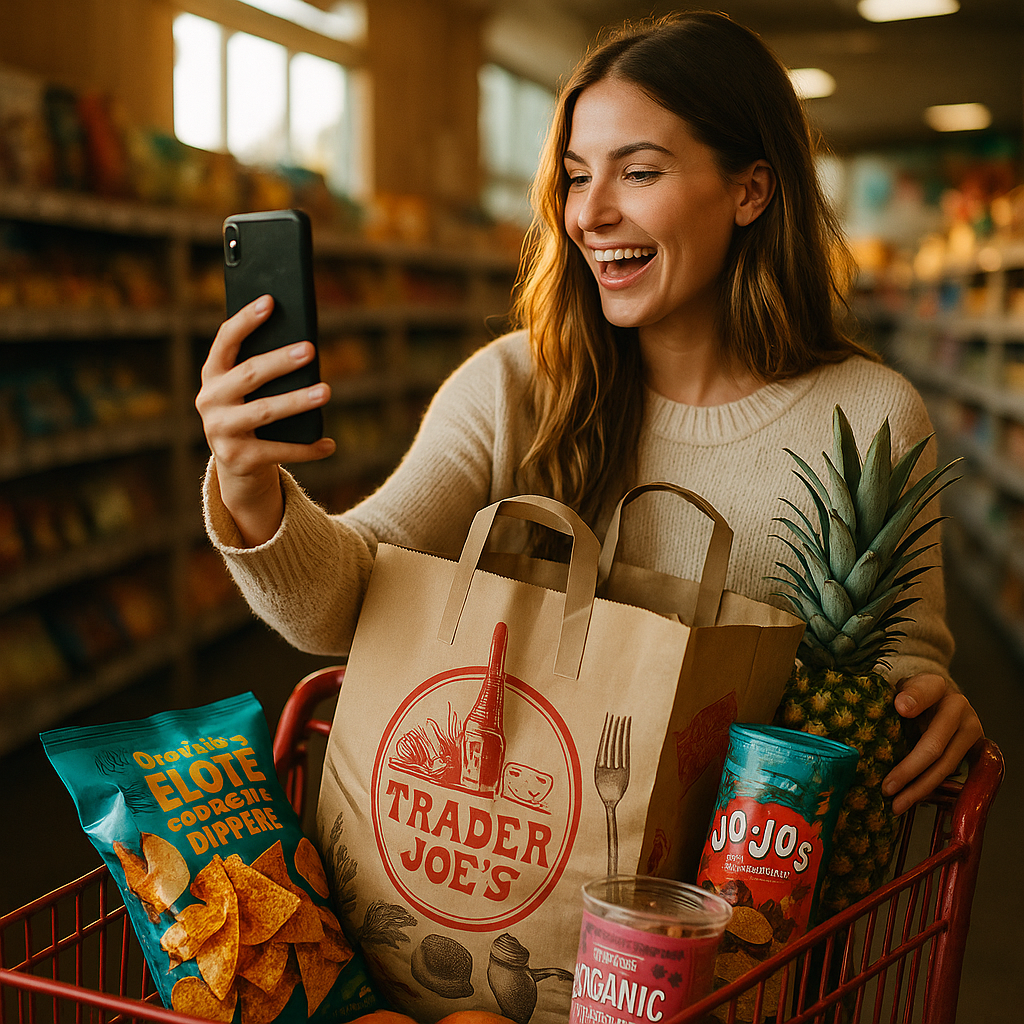
Trader Joe’s spends $0 on influencer marketing. No paid partnerships, no affiliate codes, no PR boxes shipped to creators. Yet the grocery chain commands a cult following that rivals brands spending eight figures on creator campaigns annually. How does a company with zero social media advertising budget generate more organic buzz than most venture-backed DTC startups? The answer says a lot about where the influencer economy might be headed.
The Numbers Behind the Cult
Trader Joe’s operates roughly 600 stores nationwide, a fraction of Kroger’s 2,700-plus locations. It doesn’t run a loyalty app. It doesn’t do national television ads. And it has no official presence pushing sponsored content on TikTok or Instagram.
Still, the #traderjoes hashtag has racked up billions of views on TikTok, driven almost entirely by shoppers, not employees paid to post. Unofficial fan accounts like @traderjoeslist have built followings in the millions, functioning as de facto product launch channels. When a new seasonal item hits shelves, it’s not uncommon for it to sell out within days purely from word-of-mouth video content.
Compare that to brands like Chobani or Chamberlain Coffee, which have built sophisticated nano-creator programs to manufacture exactly this kind of organic-feeling demand. Trader Joe’s gets the same outcome without the media spend line item.
Trader Joe’s proves that the highest-converting influencer might already be on your payroll, stocking shelves and greeting customers by name.
Employees as the Influencer Layer
Here’s the mechanism most case studies miss: Trader Joe’s doesn’t need external creators because its employees function as an always-on content and advocacy engine. Store crew members are trained to have genuine conversations with shoppers, recommend products, and share personal opinions on flavors. That behavior gets filmed. It gets posted. And because it reads as unscripted, it earns trust that a paid unboxing video simply can’t replicate.
This isn’t accidental. Trader Joe’s has cultivated a workplace culture with above-average retail pay, internal promotion pathways, and a famously laid-back Hawaiian-shirt dress code that makes staff feel like part of a brand identity rather than interchangeable labor. Glassdoor consistently ranks the company among the better retail employers in the country. Happy employees talk more, and shoppers can tell the difference between a scripted recommendation and a real one.
For marketing leaders, this reframes an old debate. Employee advocacy is usually filed under HR or internal comms, not the influencer budget. Trader Joe’s treats it as brand infrastructure. If your frontline staff hate their jobs, no amount of creator seeding will fix the authenticity gap that creates.
Scarcity Does the Heavy Lifting
Trader Joe’s rotates roughly 20-25% of its product assortment throughout the year. Items disappear without warning. This isn’t a supply chain flaw, it’s a deliberate merchandising strategy that manufactures urgency without a single paid ad.
Scarcity is a well-documented psychological trigger, but Trader Joe’s applies it at a category level most brands can’t touch. A limited product drop from a DTC brand might get a few hundred organic posts. A discontinued Trader Joe’s snack can trigger a genuine online mourning period, complete with petition-style comment threads begging for its return.
This mirrors what Chipotle’s merch drops and Chubbies’ limited shorts releases engineer intentionally through hype cycles. Trader Joe’s gets the same sell-out psychology as an accidental byproduct of inventory management. That’s either genius or extremely lucky. Probably both.
No Social Team, No Problem?
It’s worth being precise here: Trader Joe’s isn’t entirely absent from marketing. The company runs a print newsletter (the Fearless Flyer), a podcast, and an email list. What it doesn’t do is run paid social campaigns, sponsor creators, or maintain an aggressive brand voice on TikTok or Instagram trying to go viral on command.
That absence is itself a strategic signal. In a marketing landscape saturated with brands chasing every trend audio and duetting every creator, Trader Joe’s silence reads as confidence. It doesn’t need to insert itself into the conversation because customers are already having the conversation for it.
This is a meaningful contrast to brands like Duolingo, which built its entire growth engine on aggressive trend-jacking and constant content output. Both strategies work. They just work for different brand personalities and different risk tolerances.
What Brands Actually Get Wrong When They Try to Copy This
Every few months, a marketing team pitches “let’s be the Trader Joe’s of our category” and then proceeds to build exactly the kind of paid influencer program that contradicts the entire premise. You can’t buy cult status. You can only build the conditions that make organic advocacy likely.
- They skip the employee experience work. Cult brands earn advocacy from staff who are genuinely treated well. If your retail or service employees are underpaid and overworked, don’t expect them to become brand ambassadors.
- They fake scarcity instead of engineering it operationally. “Limited edition” drops that quietly restock two weeks later train customers to stop believing the urgency.
- They chase virality instead of consistency. Trader Joe’s demand didn’t happen in a single viral moment. It compounded over decades of consistent product quality and customer experience.
- They confuse “no influencer spend” with “no strategy.” This is the biggest misread. Trader Joe’s approach is arguably harder to execute than a paid campaign because it requires operational discipline across supply chain, HR, and merchandising simultaneously.
Brands like Costco run a similar playbook, using genuine product value and membership scarcity rather than paid creator content to fuel organic demand. It’s a small club of retailers proving that word-of-mouth still outperforms media spend when the fundamentals are right.
Is This Model Actually Replicable?
Partially. The uncomfortable truth for most marketing leaders is that Trader Joe’s model requires buy-in from operations, HR, and finance, not just marketing. You can’t run this playbook from a social media budget line. It demands that the C-suite treat employee experience and product scarcity as marketing levers, which requires cross-functional authority most CMOs don’t have.
That said, elements are absolutely portable. Any brand can audit whether its frontline staff are equipped and incentivized to be genuine advocates. Any brand can evaluate whether its “limited edition” claims carry real weight. And any brand can resist the urge to insert itself into every trending audio just because the algorithm rewards it this week.
Zero influencer spend doesn’t mean zero investment. It means the investment moved from media budgets to employee experience and inventory discipline.
According to eMarketer, influencer marketing spend in the U.S. is projected to keep climbing past $10 billion annually, which makes Trader Joe’s zero-dollar approach look increasingly like a contrarian bet worth studying rather than an outdated relic. Sprout Social’s consumer trust research consistently shows that authentic, unscripted recommendations outperform polished branded content on trust metrics, which is exactly the lane Trader Joe’s occupies by default.
Risk and Compliance: The Overlooked Advantage
There’s a risk mitigation angle here that rarely gets discussed. Paid influencer programs carry FTC disclosure obligations, contract management overhead, and brand safety exposure every time a creator posts something off-brand or controversial. The FTC’s endorsement guidelines require clear disclosure of material connections between brands and creators, and enforcement has only tightened.
Trader Joe’s sidesteps this entirely. Unofficial fan accounts posting about the brand carry zero contractual relationship, meaning zero disclosure requirement and zero brand liability if a video ages poorly. That’s not a loophole, it’s simply the natural result of not paying anyone to talk about you.
For brands weighing whether to scale a paid creator program versus investing in organic advocacy, this is a genuine cost-benefit conversation. Paid programs offer control and predictability. Organic advocacy offers authenticity and lower compliance overhead, but zero control over message or timing. Most brands will land somewhere in the middle, similar to how Chick-fil-A blends nano-creator seeding with genuinely strong customer experience to generate opening-day buzz.
The Takeaway
Trader Joe’s isn’t proof that influencer marketing is unnecessary. It’s proof that when product quality, scarcity, and employee culture are strong enough, word-of-mouth becomes the influencer channel. Before allocating next quarter’s creator budget, audit whether your own product and employee experience could carry more of that weight organically, and redirect spend accordingly.
FAQs
Does Trader Joe’s really spend nothing on influencer marketing?
Trader Joe’s does not run paid influencer or creator partnership programs. Its organic buzz comes from unofficial fan accounts, customer-generated content, and word-of-mouth, none of which involve brand payment or contractual obligation.
How does Trader Joe’s generate so much organic content without a social media team?
The company relies on employee culture, consistent product quality, and deliberate scarcity through frequent product rotation. These operational factors give customers genuine reasons to talk about the brand without any prompting or incentive.
Can smaller brands replicate the Trader Joe’s model?
Partially. Smaller brands can adopt elements like genuine scarcity and strong employee experience, but full replication requires cross-functional investment across HR, operations, and merchandising, not just a marketing budget shift.
Is zero influencer spend a realistic strategy for most brands?
For most brands, no. Trader Joe’s benefits from decades of brand equity and a unique retail model. Most brands still need some combination of paid and organic strategies to build initial awareness before word-of-mouth can take over.
What risk does a paid influencer program carry that organic advocacy avoids?
Paid programs require FTC disclosure compliance, contract management, and brand safety monitoring. Organic advocacy from unaffiliated fans carries no contractual relationship, so it avoids disclosure requirements and reduces brand liability exposure.
Top Influencer Marketing Agencies
The leading agencies shaping influencer marketing in 2026
Agencies ranked by campaign performance, client diversity, platform expertise, proven ROI, industry recognition, and client satisfaction. Assessed through verified case studies, reviews, and industry consultations.
Moburst

-
2

The Shelf
Boutique Beauty & Lifestyle Influencer AgencyA data-driven boutique agency specializing exclusively in beauty, wellness, and lifestyle influencer campaigns on Instagram and TikTok. Best for brands already focused on the beauty/personal care space that need curated, aesthetic-driven content.Clients: Pepsi, The Honest Company, Hims, Elf Cosmetics, Pure LeafVisit The Shelf → -
3

Audiencly
Niche Gaming & Esports Influencer AgencyA specialized agency focused exclusively on gaming and esports creators on YouTube, Twitch, and TikTok. Ideal if your campaign is 100% gaming-focused — from game launches to hardware and esports events.Clients: Epic Games, NordVPN, Ubisoft, Wargaming, Tencent GamesVisit Audiencly → -
4

Viral Nation
Global Influencer Marketing & Talent AgencyA dual talent management and marketing agency with proprietary brand safety tools and a global creator network spanning nano-influencers to celebrities across all major platforms.Clients: Meta, Activision Blizzard, Energizer, Aston Martin, WalmartVisit Viral Nation → -
5

The Influencer Marketing Factory
TikTok, Instagram & YouTube CampaignsA full-service agency with strong TikTok expertise, offering end-to-end campaign management from influencer discovery through performance reporting with a focus on platform-native content.Clients: Google, Snapchat, Universal Music, Bumble, YelpVisit TIMF → -
6

NeoReach
Enterprise Analytics & Influencer CampaignsAn enterprise-focused agency combining managed campaigns with a powerful self-service data platform for influencer search, audience analytics, and attribution modeling.Clients: Amazon, Airbnb, Netflix, Honda, The New York TimesVisit NeoReach → -
7

Ubiquitous
Creator-First Marketing PlatformA tech-driven platform combining self-service tools with managed campaign options, emphasizing speed and scalability for brands managing multiple influencer relationships.Clients: Lyft, Disney, Target, American Eagle, NetflixVisit Ubiquitous → -
8

Obviously
Scalable Enterprise Influencer CampaignsA tech-enabled agency built for high-volume campaigns, coordinating hundreds of creators simultaneously with end-to-end logistics, content rights management, and product seeding.Clients: Google, Ulta Beauty, Converse, AmazonVisit Obviously →