


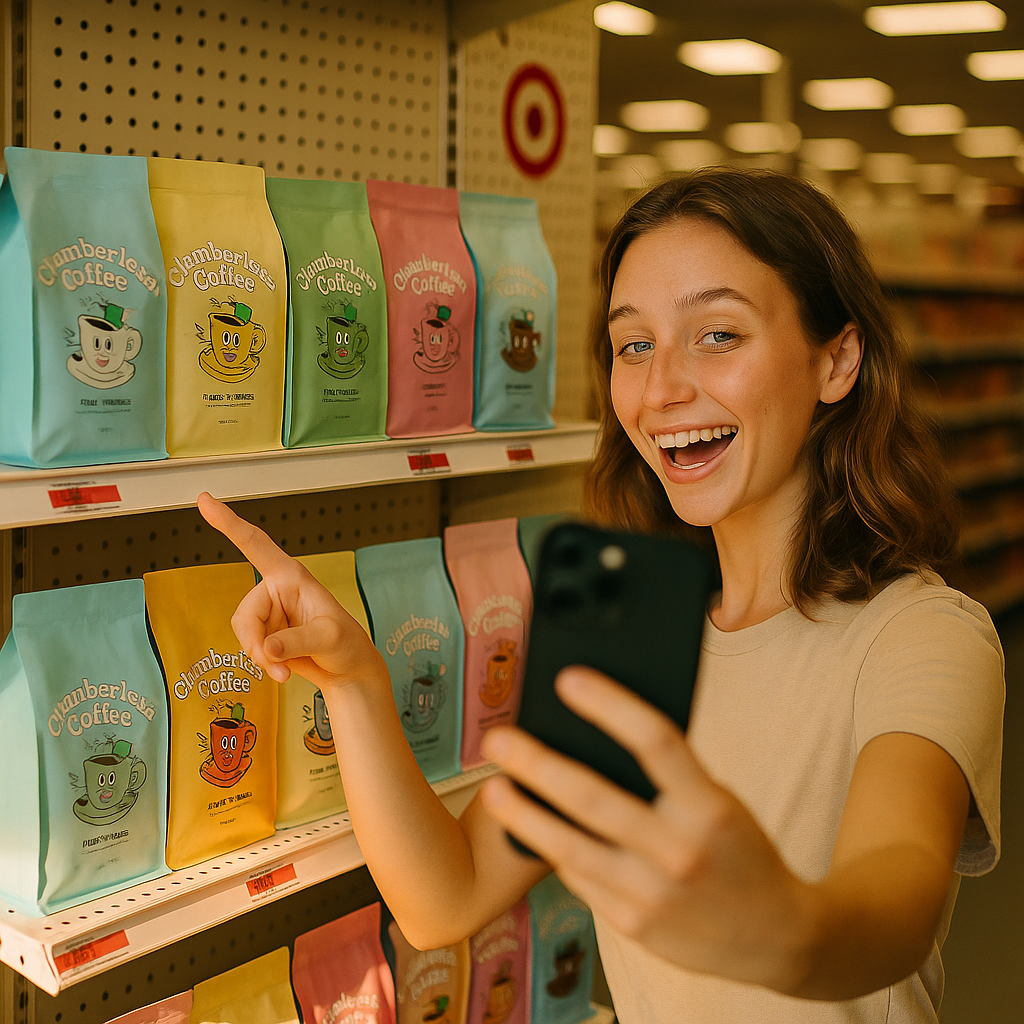
One TikTok Shop Live event, staffed by a creator with 4,000 followers, moved more units in ninety minutes than most brands sell through a paid influencer campaign in a month. That is the uncomfortable math behind Chamberlain Coffee’s TikTok Shop live-selling strategy, and it is why the brand is now sitting on shelves at Target instead of fighting for algorithmic scraps online.
Emma Chamberlain’s coffee brand didn’t buy its way onto retail shelves. It sold its way there, using live commerce data as leverage nobody expected a DTC coffee brand to have.
The Nano-Creator Bet Nobody Else Was Making
Most beverage brands chase reach. Chamberlain Coffee chased proof.
Instead of funding a handful of mid-tier influencers to post polished unboxings, the brand built a bench of nano-creators, typically accounts with 1,000 to 10,000 followers, and put them behind the camera for live shopping events on TikTok Shop. These aren’t creators with agency reps and rate cards. They’re coffee obsessives, campus baristas, and small-account foodies who genuinely use the product.
The logic is simple: nano-creators convert because they’re trusted, not because they’re famous. Chamberlain Coffee’s nano-creator strategy treated these smaller accounts as a distributed sales force rather than a brand awareness play, and the shift in framing changed everything about how the program was measured.
A single nano-creator Live can generate more verified, trackable purchase intent in one session than a month of static influencer posts — because TikTok Shop ties every sale directly back to the host.
That traceability is the whole game. Every Live event on TikTok Shop generates a clean data trail: units sold, watch time, add-to-cart rate, repeat purchase within the session window. Chamberlain didn’t just get sales. It got a live, itemized report on what actually moves product, creator by creator, SKU by SKU.
Why Live-Selling Beats Static Posts for Retail Proof
Here’s the part most DTC brands miss: retail buyers don’t care about follower counts. They care about velocity. A TikTok video with 500,000 views tells a buyer almost nothing about whether a product will move off a physical shelf. A TikTok Shop Live event, on the other hand, produces something close to a controlled sales experiment.
Chamberlain’s team ran dozens of nano-creator Lives across different formats: taste-test sessions, “brew with me” tutorials, side-by-side comparisons against bigger coffee brands. Each event generated real-time conversion data segmented by creator audience, price point, and bundle configuration. That’s not influencer marketing anymore. That’s market research with a revenue line attached.
Compare that to the traditional influencer seeding model, where a brand mails product to fifty creators and hopes for organic posts. There’s no way to isolate what drove a sale. TikTok Shop’s Live format removes that ambiguity almost entirely, which is precisely why brands like Grind Coffee’s TikTok Shop Live scripts and Chamberlain’s nano-creator events keep outperforming spend-heavy campaigns on a pure ROI basis.
Turning Live Commerce Data Into a Retail Pitch
Here’s where the story stops being about TikTok and starts being about Target.
Retail buyers are risk-averse by nature. Shelf space is finite, and every new SKU displaces something already selling. What convinced Target wasn’t a lookbook or a media kit. It was a stack of TikTok Shop performance data showing sustained, repeatable demand across dozens of independent creator audiences, not one influencer’s fanbase, but hundreds of small, overlapping ones.
That distinction matters enormously to a buyer. A brand that pops because one mega-influencer posted it is a fragile bet, the kind of spike that evaporates the moment the creator moves on. A brand that sells consistently across a hundred different nano-creator audiences looks like organic, durable demand. It looks like proof the product works regardless of who’s selling it.
Retail buyers increasingly treat TikTok Shop Live data the way they once treated regional test-market results: as a low-risk signal of national shelf viability.
Chamberlain effectively ran its own test market on TikTok Shop before ever walking into a retail negotiation. That’s a meaningfully different pitch than “we have a loyal Instagram following.” It’s closer to: “here’s twelve months of granular sell-through data across dozens of creator-led events, broken down by SKU.”
The Compliance Layer Brands Can’t Skip
None of this works if the disclosure and FTC compliance side is sloppy. Nano-creator programs at scale create real risk exposure precisely because there are so many individual posters to manage. Chamberlain’s team built disclosure requirements directly into creator onboarding: clear #ad tagging, verbal disclosures during Lives, and consistent messaging guardrails so that no single creator veers into unsubstantiated health or performance claims about caffeine content.
The FTC’s endorsement guidance applies just as strictly to a 3,000-follower TikTok Live host as it does to a celebrity spokesperson. Brands that scale nano-creator programs without a compliance framework are building a liability pile, not a growth engine. For a broader look at how brands are baking FTC guardrails into nano-creator drops from day one, see how Chubbies built FTC compliance into its creator program and how Ollie’s used credentialed nano-creators to reduce FTC risk.
What the Retail Playbook Actually Looks Like
Strip away the branding and the mechanics are replicable for any consumer goods company sitting on a DTC channel. The sequence looks roughly like this:
- Recruit volume, not reach. Chamberlain prioritized dozens of nano-creators over a handful of bigger names, betting on aggregate trust over individual reach.
- Run Lives as controlled tests. Each event isolated variables: price, bundle, format, time of day, so the resulting data could actually inform retail conversations.
- Track sell-through, not vanity metrics. Views and likes never entered the retail pitch deck. Units sold, repeat buyers, and average order value did.
- Build compliance into onboarding. Disclosure requirements were non-negotiable terms of the creator agreement, not an afterthought handled after content went live.
- Package the data as a retail case study. The pitch to Target wasn’t a brand story. It was a performance dossier.
This mirrors a pattern showing up across categories right now. Zara’s nano-creator store-fit strategy and Poppi’s nano-creator trust rebuild both lean on the same insight: small creators, aggregated at scale, produce a more defensible growth story than a few big names ever could.
Is TikTok Shop Live Actually Cheaper Than Traditional Seeding?
Usually, yes, and by a wide margin. Nano-creators command far lower fees than macro-influencers, and many participate for product plus a small commission on TikTok Shop sales rather than a flat rate. According to eMarketer, live commerce continues to post some of the highest engagement-to-conversion ratios of any social format, and TikTok Shop specifically has become the primary venue U.S. brands use to test that channel. HubSpot’s research on influencer marketing spend also consistently shows nano and micro tiers delivering stronger engagement rates than mega-influencer partnerships, even before accounting for cost.
The math gets even more favorable when you factor in what Chamberlain got beyond the sales themselves: a validated retail pitch, a repeatable testing framework, and a creator bench it can reactivate for future launches. That’s a return most seeding campaigns never touch.
Where This Goes Next
Live commerce is still underused by most CPG and beverage brands in the U.S., especially compared to its dominance in markets tracked by Statista. Chamberlain’s approach suggests a broader shift: TikTok Shop isn’t just a sales channel anymore. It’s becoming the cheapest, fastest way to prove retail viability before a single buyer meeting happens.
Brands still treating nano-creator seeding as a brand-awareness tactic are leaving the bigger prize on the table. The real asset isn’t the content. It’s the data trail that content leaves behind, and what you can do with it once a retail buyer asks, “why should we believe this will sell?”
Next step: if your brand has a TikTok Shop presence, start treating every Live event as a retail data point, not just a sales moment. Track it, package it, and use it as leverage in your next buyer conversation.
FAQs
What made Chamberlain Coffee’s TikTok Shop strategy different from typical influencer seeding?
Chamberlain focused on nano-creators (1,000 to 10,000 followers) running live-selling events rather than static posts, which generated trackable sales data instead of vanity metrics. That data became the basis for its retail pitch to buyers like Target.
Why do nano-creators convert better than larger influencers in live commerce?
Nano-creators tend to have higher trust with smaller, more engaged audiences, and TikTok Shop Live events let viewers ask questions and buy in real time. The result is often higher conversion rates per viewer than passive content from larger accounts, even though total reach is smaller.
How did TikTok Shop Live data help Chamberlain Coffee win retail shelf space?
The brand used sell-through data across dozens of independent creator-led Lives as proof of durable, repeatable demand. Retail buyers viewed that aggregated data as a lower-risk signal than a single influencer’s follower count or one viral moment.
What compliance risks come with scaling a nano-creator program?
The biggest risks involve FTC disclosure requirements across a large number of individual creators, since each Live host must clearly disclose the paid or gifted relationship. Brands need standardized disclosure language and monitoring built into onboarding to avoid regulatory exposure.
Can smaller brands replicate this TikTok Shop Live strategy without a large budget?
Yes. Nano-creator programs are typically far cheaper than macro-influencer deals, often running on product seeding plus commission rather than flat fees. The bigger investment is operational: building a system to track, compare, and package Live performance data for future business use.
Top Influencer Marketing Agencies
The leading agencies shaping influencer marketing in 2026
Agencies ranked by campaign performance, client diversity, platform expertise, proven ROI, industry recognition, and client satisfaction. Assessed through verified case studies, reviews, and industry consultations.
Moburst

-
2

The Shelf
Boutique Beauty & Lifestyle Influencer AgencyA data-driven boutique agency specializing exclusively in beauty, wellness, and lifestyle influencer campaigns on Instagram and TikTok. Best for brands already focused on the beauty/personal care space that need curated, aesthetic-driven content.Clients: Pepsi, The Honest Company, Hims, Elf Cosmetics, Pure LeafVisit The Shelf → -
3

Audiencly
Niche Gaming & Esports Influencer AgencyA specialized agency focused exclusively on gaming and esports creators on YouTube, Twitch, and TikTok. Ideal if your campaign is 100% gaming-focused — from game launches to hardware and esports events.Clients: Epic Games, NordVPN, Ubisoft, Wargaming, Tencent GamesVisit Audiencly → -
4

Viral Nation
Global Influencer Marketing & Talent AgencyA dual talent management and marketing agency with proprietary brand safety tools and a global creator network spanning nano-influencers to celebrities across all major platforms.Clients: Meta, Activision Blizzard, Energizer, Aston Martin, WalmartVisit Viral Nation → -
5

The Influencer Marketing Factory
TikTok, Instagram & YouTube CampaignsA full-service agency with strong TikTok expertise, offering end-to-end campaign management from influencer discovery through performance reporting with a focus on platform-native content.Clients: Google, Snapchat, Universal Music, Bumble, YelpVisit TIMF → -
6

NeoReach
Enterprise Analytics & Influencer CampaignsAn enterprise-focused agency combining managed campaigns with a powerful self-service data platform for influencer search, audience analytics, and attribution modeling.Clients: Amazon, Airbnb, Netflix, Honda, The New York TimesVisit NeoReach → -
7

Ubiquitous
Creator-First Marketing PlatformA tech-driven platform combining self-service tools with managed campaign options, emphasizing speed and scalability for brands managing multiple influencer relationships.Clients: Lyft, Disney, Target, American Eagle, NetflixVisit Ubiquitous → -
8

Obviously
Scalable Enterprise Influencer CampaignsA tech-enabled agency built for high-volume campaigns, coordinating hundreds of creators simultaneously with end-to-end logistics, content rights management, and product seeding.Clients: Google, Ulta Beauty, Converse, AmazonVisit Obviously →