


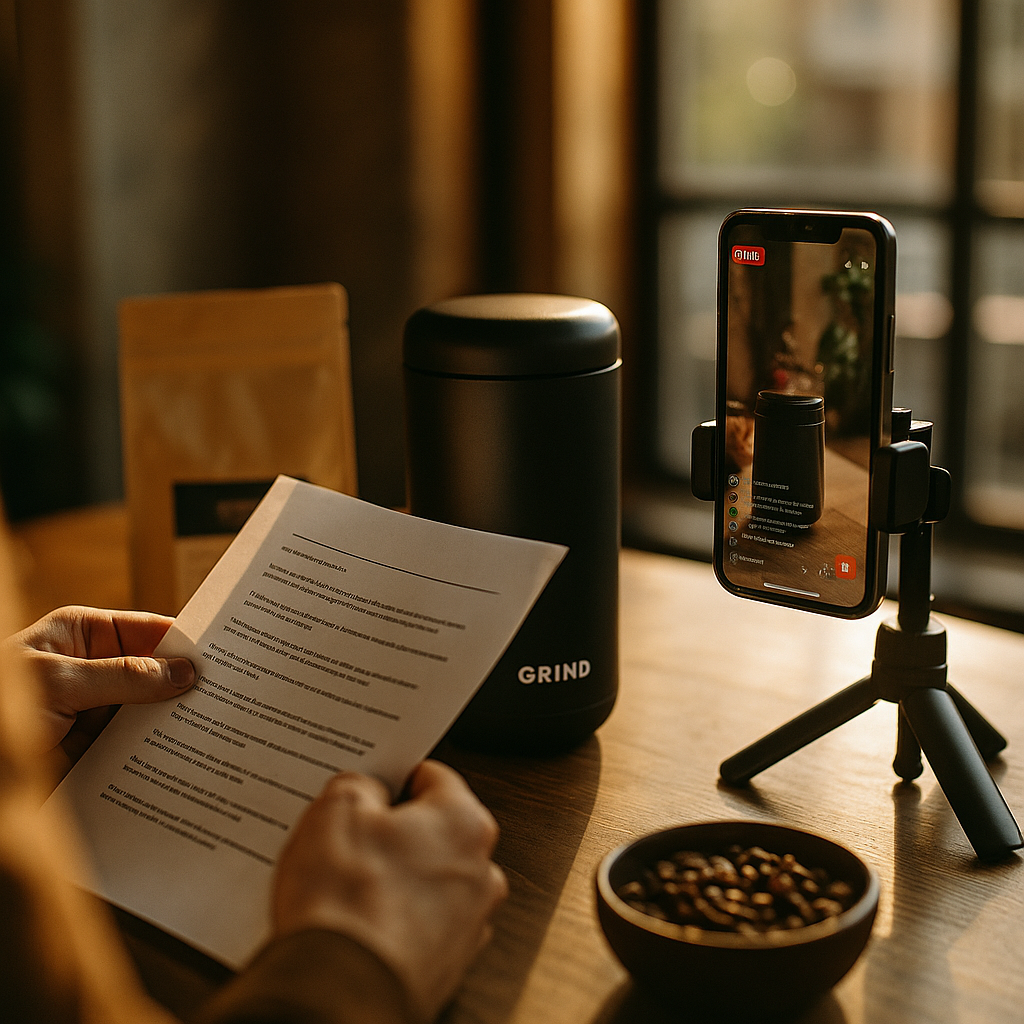
Thirty percent. That’s the conversion rate Grind Coffee pulled on a single TikTok Shop Live broadcast, in a category where most food and beverage streams struggle to clear 3 or 4 percent. The difference wasn’t the product. It wasn’t the discount code either. It was ninety seconds of scripting most brands skip entirely — the open.
Grind, the UK coffee brand known for its neon packaging and cheeky “coffee shop energy” positioning, didn’t stumble into this number. It reverse-engineered the first ninety seconds of its livestream like a direct-response ad, then layered in the rest of the broadcast around it. For brand teams watching TikTok Shop Live and wondering whether it’s worth the operational lift, Grind’s teardown is the clearest UK case study yet.
Why the First 90 Seconds Decides Everything
TikTok’s live shopping algorithm rewards retention hard. Viewers who bounce in the first minute get counted against the stream, which throttles distribution to new viewers for the rest of the broadcast. Miss the open, and you’re not just losing that viewer — you’re losing the algorithmic boost that would’ve brought you five more.
Grind’s team treated this as a math problem, not a vibes problem. They pulled data from three prior test streams and found the exact same pattern: viewers who stayed past 90 seconds converted at nearly 6x the rate of those who left before it. That single data point became the entire strategic brief for the relaunch.
Viewers who stayed past the 90-second mark converted at nearly six times the rate of early droppers — which meant the opening wasn’t an intro, it was the conversion event.
This mirrors what other TikTok Shop sellers have learned the hard way. A fashion retailer that rebuilt its livestream schedule using viewer-retention data found almost identical drop-off curves, which suggests this isn’t a coffee-category quirk. It’s a platform mechanic. Ignore it at your own risk.
The Four-Beat Script Grind Actually Used
Grind’s host, working from a script the marketing team refined across roughly a dozen test broadcasts, hit four distinct beats in the opening window. No ad-libbing, no “hey guys welcome to the stream” filler.
- Beat one (0–15 seconds): Pattern interrupt. The host opens mid-action, already brewing, already talking, not waiting for viewers to “settle in.” No welcome message. No name-check of the brand. Just immediate movement and a hook line like “this is the coffee that’s outselling Starbucks cans on Shop right now.”
- Beat two (15–40 seconds): Specific, provable claim. Grind leans on a hard number — a caffeine content stat, a sourcing detail, a limited-batch count — rather than generic quality language. Specificity signals credibility fast, and it gives late-arriving viewers a reason to stay rather than assume it’s another “amazing product guys” stream.
- Beat three (40–65 seconds): Social proof in real time. The host reads out live comments or recent purchase notifications on screen, name-checking a viewer who just bought. This does double duty: it rewards engagement and shows new viewers that other people are buying right now, not just watching.
- Beat four (65–90 seconds): The first CTA. Not a hard sell. A soft, specific prompt — “tap the yellow basket, the discount’s already applied for the next four minutes.” Urgency plus friction removal, delivered before the viewer has had time to get bored.
Notice what’s missing: no lengthy brand story, no “who we are” segment. That comes later, once the algorithm has already rewarded the stream with distribution and the early converters are locked in.
Why Specificity Beats Enthusiasm
Marketers love to over-index on energy. Grind’s team found the opposite: hosts who sounded excited but vague underperformed hosts who sounded calm but specific. A caffeine milligram count outperformed “this coffee hits different” almost every single test. That’s a useful gut-check for any brand scripting live content — enthusiasm reads as noise, specificity reads as signal.
This isn’t unique to coffee. Chagee’s approach to building a US tea category through livestreams leaned on similarly concrete claims — sourcing origin, brew method, exact steep times — instead of adjectives. Beverage categories seem to convert better on facts than on hype, probably because the product itself is a low-consideration, repeat-purchase item where trust matters more than excitement.
The Compliance Layer Nobody Talks About
Here’s where it gets interesting for brand and legal teams. Grind’s script wasn’t just optimized for conversion — it was built to survive scrutiny. UK livestream commerce sits under both ASA advertising standards and general consumer protection law, and TikTok Shop has its own content moderation layer on top.
The “discount already applied” language in beat four was deliberately vetted. Grind’s team avoided phrases implying artificial scarcity that couldn’t be substantiated (no “only 3 left!” unless inventory data backed it up in real time), and every health-adjacent claim about caffeine content was checked against actual lab figures before it went into script. This is the same discipline other DTC brands have had to build around FTC-style disclosure rules in the US market. Brands like the ones covered in Chubbies’ FTC-compliant nano-creator drops have shown that baking compliance into the script itself, rather than bolting it on afterward, is far cheaper than a retraction.
For UK brands specifically, this also means keeping an eye on ICO guidance where livestream data capture (comment scraping, purchase tracking shown on screen) touches personal data. Grind’s team anonymized any on-screen purchase call-outs — first name only, no location, no order value — a small detail that protects against both privacy complaints and the “that’s a fake plant” skepticism viewers throw at obviously staged social proof.
What Happens After the Hook
Ninety seconds is the opening act, not the whole show. Grind’s full broadcasts ran 45 to 60 minutes, structured in repeating 10-minute blocks: product demo, comment engagement, limited-time bundle offer, repeat. But the retention math meant every later block performed better because the algorithm had already classified the stream as high-retention early on.
This compounding effect is the part brands underestimate. A strong open doesn’t just convert the first wave of viewers — it changes the distribution curve for the entire broadcast. TikTok’s system pushes better-performing streams to more FYPs mid-broadcast, which is why Grind saw viewer counts climb rather than decay over the course of an hour, an unusual pattern for livestream retail.
The Bundle Strategy That Kept People Watching
Rather than discounting the core product, Grind used bundling to protect margin while still creating urgency — a tactic similar to what worked for Aritzia when it sold out a product line without discounts. Grind bundled a bestselling instant coffee tin with a limited-run mug or a sample pack of a newer flavor, framing it as an exclusive “live-only” pairing rather than a price cut. It’s a subtle but important distinction for brand health: price cuts train customers to wait for sales, bundles train them to watch live.
What This Means for Brands Weighing TikTok Shop Live
If you’re a mid-size CPG or beverage brand deciding whether to invest in TikTok Shop Live, Grind’s case offers a fairly blunt answer: the platform rewards preparation, not spontaneity. The brands treating live shopping as “just point a camera at the product” are the ones posting 2 percent conversion and wondering why. The brands scripting the open like a direct-response landing page are the ones posting 30 percent.
Operationally, this means investing in a few unglamorous things: a tested script (not a bullet-point outline), a host who can deliver it naturally after a dozen reps, and a legal review pass that catches compliance issues before they go live to an audience of thousands. None of this requires a huge budget. It requires discipline, and a willingness to treat the first ninety seconds as the most important ad you’ll run all quarter.
The brands still treating live shopping as “point a camera at the product” are the ones stuck at 2 percent conversion — scripting isn’t overkill, it’s the entire margin between failure and a 30 percent stream.
For context on scale, eMarketer’s research on social commerce continues to show livestream shopping growing fastest in exactly the categories Grind operates in: food, beverage, and low-cost repeat-purchase goods. That growth curve makes now the moment to get the format right, not after competitors have already claimed the algorithmic advantage of high-retention broadcasts.
FAQs
How long should the opening of a TikTok Shop Live broadcast be scripted?
Grind Coffee scripted the first 90 seconds precisely because that’s the window where TikTok’s algorithm decides whether to keep pushing the stream to new viewers. Beyond that window, hosts can work from a looser structure, but the open should be rehearsed word for word.
What made Grind Coffee’s TikTok Shop Live conversion rate so high?
A four-beat opening script combining a pattern-interrupt hook, a specific factual claim, real-time social proof, and an early low-friction call to action. The specificity of claims (exact caffeine content, batch numbers) outperformed generic enthusiasm in testing.
Do brands need legal review for livestream shopping scripts?
Yes, particularly for claims involving health, scarcity, or pricing. UK brands should check language against ASA advertising standards and ICO data guidance before broadcasting, especially when displaying real customer purchases or comments on screen.
Does discounting work better than bundling for livestream urgency?
Grind avoided direct discounts on its core product, using limited-run bundles instead to protect margin while still creating urgency. This approach avoids training regular customers to wait for future price cuts.
How many test broadcasts does it typically take to refine a script like this?
Grind’s team refined its opening across roughly a dozen test broadcasts before locking the final four-beat structure, using viewer retention data after each stream to adjust timing and wording.
Visible FAQ (HTML)
How long should the opening of a TikTok Shop Live broadcast be scripted?
Grind Coffee scripted the first 90 seconds precisely because that’s the window where TikTok’s algorithm decides whether to keep pushing the stream to new viewers. Beyond that window, hosts can work from a looser structure, but the open should be rehearsed word for word.
What made Grind Coffee’s TikTok Shop Live conversion rate so high?
A four-beat opening script combining a pattern-interrupt hook, a specific factual claim, real-time social proof, and an early low-friction call to action. The specificity of claims outperformed generic enthusiasm in testing.
Do brands need legal review for livestream shopping scripts?
Yes, particularly for claims involving health, scarcity, or pricing. UK brands should check language against ASA advertising standards and ICO data guidance before broadcasting.
Does discounting work better than bundling for livestream urgency?
Grind avoided direct discounts on its core product, using limited-run bundles instead to protect margin while still creating urgency.
How many test broadcasts does it typically take to refine a script like this?
Grind’s team refined its opening across roughly a dozen test broadcasts, using viewer retention data after each stream to adjust timing and wording.
The next livestream you plan shouldn’t open with “hey guys.” Script the first 90 seconds like a direct-response ad, test it across a handful of broadcasts, and let the retention data — not your gut — decide what stays in the final cut.
Top Influencer Marketing Agencies
The leading agencies shaping influencer marketing in 2026
Agencies ranked by campaign performance, client diversity, platform expertise, proven ROI, industry recognition, and client satisfaction. Assessed through verified case studies, reviews, and industry consultations.
Moburst

-
2

The Shelf
Boutique Beauty & Lifestyle Influencer AgencyA data-driven boutique agency specializing exclusively in beauty, wellness, and lifestyle influencer campaigns on Instagram and TikTok. Best for brands already focused on the beauty/personal care space that need curated, aesthetic-driven content.Clients: Pepsi, The Honest Company, Hims, Elf Cosmetics, Pure LeafVisit The Shelf → -
3

Audiencly
Niche Gaming & Esports Influencer AgencyA specialized agency focused exclusively on gaming and esports creators on YouTube, Twitch, and TikTok. Ideal if your campaign is 100% gaming-focused — from game launches to hardware and esports events.Clients: Epic Games, NordVPN, Ubisoft, Wargaming, Tencent GamesVisit Audiencly → -
4

Viral Nation
Global Influencer Marketing & Talent AgencyA dual talent management and marketing agency with proprietary brand safety tools and a global creator network spanning nano-influencers to celebrities across all major platforms.Clients: Meta, Activision Blizzard, Energizer, Aston Martin, WalmartVisit Viral Nation → -
5

The Influencer Marketing Factory
TikTok, Instagram & YouTube CampaignsA full-service agency with strong TikTok expertise, offering end-to-end campaign management from influencer discovery through performance reporting with a focus on platform-native content.Clients: Google, Snapchat, Universal Music, Bumble, YelpVisit TIMF → -
6

NeoReach
Enterprise Analytics & Influencer CampaignsAn enterprise-focused agency combining managed campaigns with a powerful self-service data platform for influencer search, audience analytics, and attribution modeling.Clients: Amazon, Airbnb, Netflix, Honda, The New York TimesVisit NeoReach → -
7

Ubiquitous
Creator-First Marketing PlatformA tech-driven platform combining self-service tools with managed campaign options, emphasizing speed and scalability for brands managing multiple influencer relationships.Clients: Lyft, Disney, Target, American Eagle, NetflixVisit Ubiquitous → -
8

Obviously
Scalable Enterprise Influencer CampaignsA tech-enabled agency built for high-volume campaigns, coordinating hundreds of creators simultaneously with end-to-end logistics, content rights management, and product seeding.Clients: Google, Ulta Beauty, Converse, AmazonVisit Obviously →