


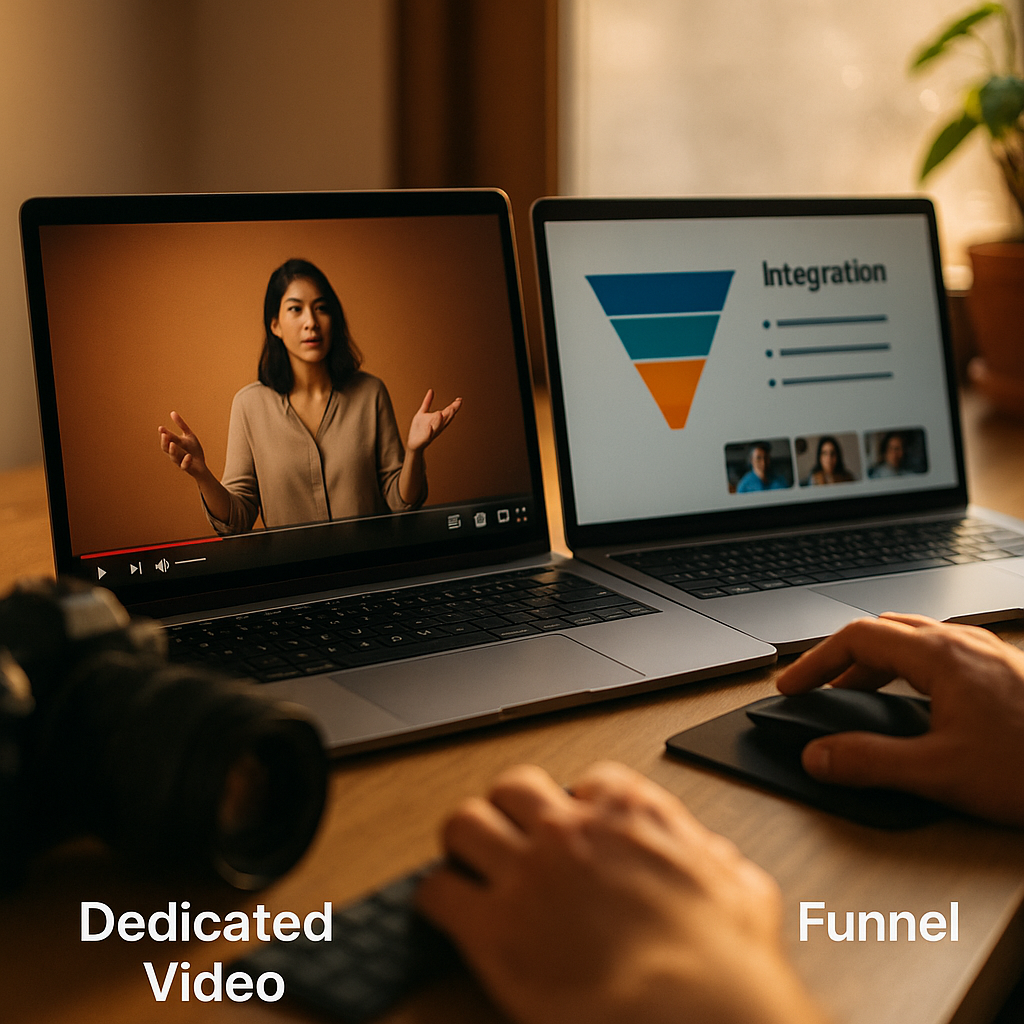
Seventy percent of YouTube watch time now happens on connected TVs, per eMarketer estimates, yet most brands still book creator content the same way they did five years ago: one deal type, applied everywhere. That’s the wrong default. The dedicated YouTube video decision versus integrated multi-creator content isn’t a style preference. It’s a funnel-stage question, and getting it wrong quietly burns budget at scale.
The Real Problem Isn’t Creative. It’s Sequencing.
Most brand teams pick between a dedicated video (one creator, full episode, your product as the subject) and an integration (a 60-90 second segment inside someone else’s content) based on gut feel, agency habit, or whatever the creator’s media kit recommends. Rarely does anyone map the choice back to where the buyer actually sits in the journey.
That’s a costly oversight. A dedicated video and an integration cost differently, convert differently, and decay differently. Treating them as interchangeable formats is like using the same ad copy for a cold prospecting campaign and a retargeting list. Technically possible. Financially wasteful.
Format choice should follow buyer intent, not creator availability or internal habit — yet most media plans still default to whatever worked last quarter.
What Each Format Actually Buys You
Strip away the creative dressing and you’re left with two distinct commercial instruments.
- Dedicated video: full narrative control, longer watch time, deeper product education, higher CPMs, and a much higher price tag — often 3-8x an integration slot with a comparable creator, depending on niche and production scope.
- Integrated multi-creator content: lower cost per placement, faster turnaround, broader reach across audience segments, but a compressed message window and less control over framing.
Neither is “better.” They solve different problems. The mistake is buying dedicated videos for awareness plays where reach matters more than depth, or buying scattered integrations when you actually need a considered-purchase narrative that only a full episode can carry.
Mapping Format to Funnel Stage
Here’s the framework we recommend brand and agency teams run before locking any YouTube creator brief.
Top of funnel: awareness and category education
At this stage, you’re fighting for attention share, not conversion. Integrations win here almost every time. A brand mention inside a creator’s existing format — a tech reviewer’s monthly roundup, a lifestyle vlogger’s “what I used this week” segment — reaches an audience already primed to trust the host’s judgment, without asking them to commit to a dedicated watch.
Run integrations across 8-15 creators in a niche rather than one dedicated video with a single creator. You’re buying frequency and social proof at this stage, not depth. This is the same logic behind zero-based budgeting for nano-creators: spread spend where marginal reach is cheapest, and save the expensive slots for later-funnel work.
Mid-funnel: consideration and comparison
This is where dedicated content starts earning its cost. Buyers comparing options want depth: unboxing, side-by-side testing, a walkthrough that answers the “but does it actually work” question. A 12-minute dedicated review does something an integration structurally cannot — it holds the viewer’s attention on your product exclusively, for long enough to work through objections.
Comparison content also has a longer shelf life. A well-produced dedicated review can keep generating qualified traffic for 12-18 months post-publish, especially if it ranks in YouTube search and Google’s video carousel. Integrations, by contrast, get buried in a creator’s upload history within weeks.
Bottom of funnel: conversion and retention
Here the calculus flips again. Bottom-funnel buyers already know the category and likely know your brand. What they need is a nudge: a discount code, a direct testimonial, a clear call to action. This is integration territory again — but with fewer, higher-fit creators rather than a broad spray.
Retargeting-style creator content (think: a creator who already reviewed you six months ago posting a quick “still using this” update) performs well here and costs a fraction of a new dedicated shoot. It’s the influencer-marketing equivalent of a retargeting ad, and it should be budgeted that way.
A Quick Gut-Check Table
If you need a fast heuristic for brief-writing sessions, use this:
- Need reach and low cost per impression? Integration.
- Need to overcome a specific objection or educate on a complex feature? Dedicated video.
- Need to refresh trust with an already-warm audience? Integration, ideally with a past-tested creator.
- Launching a new category or premium product? Dedicated video, paired with integration support for scale.
Most funnels aren’t linear anyway, so most real campaigns need both formats running simultaneously, weighted differently by stage. That’s the operational reality your budget model should reflect.
Budgeting the Mix, Not Just the Format
Once you accept that format is a funnel decision, the next question is allocation. How much of the YouTube budget goes to dedicated versus integrated content, and when?
A rough starting split for a mid-market brand running always-on creator programs: 60% integration spend at top-of-funnel, 25% dedicated video at mid-funnel, 15% integration refreshes at bottom-funnel. Adjust based on category complexity — SaaS and financial products typically need more dedicated depth; consumer goods and fashion lean harder into integration volume.
This isn’t just a media-planning exercise. It has real budget-governance implications. If your finance team is asking for sales-lift proof rather than reach metrics, you need to be able to show which format drove which stage of the funnel, and why the spend split makes sense. A dedicated video that never converts because it was aimed at cold awareness audiences isn’t a creative failure. It’s a briefing failure, and it’s the kind of thing CFOs increasingly want explained line by line.
A dedicated video that flops at the awareness stage usually isn’t a bad creative choice — it’s the wrong format for that point in the funnel, briefed by someone who didn’t map intent first.
Contract and Rights Implications
Format choice also changes what you should be negotiating in the contract. Dedicated videos typically warrant usage rights for repurposing (cutting the video into ads, embedding on landing pages, running paid amplification behind it). Integrations, being shorter and often less brand-controlled, need clearer boundaries on how the segment can be clipped and reused without the surrounding host content misrepresenting the creator’s independent voice.
This is where usage rights fee models matter. Budgeting for amplification rights on a dedicated video upfront is far cheaper than renegotiating after the fact once a clip starts performing in paid media. It’s also worth reviewing your creator pay structure to make sure CPV or flat-fee terms actually match the format’s expected lifespan, since a dedicated video with an 18-month shelf life shouldn’t be paid out the same way as a one-week integration slot.
Where Multi-Creator Integrations Introduce Risk
Spreading a message across a dozen creators sounds efficient until you consider the compliance surface area. Each creator integration is a separate disclosure event under FTC endorsement guidance, and inconsistent disclosure language across a large integration run is one of the most common audit findings agencies report. Centralize your disclosure templates before scaling integration volume, not after a creator gets flagged.
There’s also platform-dependency risk to weigh. If your integration strategy leans heavily on one or two YouTube channels for reach, you’re exposed the moment that channel’s algorithm reach dips or the creator has a controversy. It’s worth cross-referencing your creator mix against a platform dependency risk register so integration-heavy top-of-funnel plans don’t quietly concentrate risk in a handful of channels.
Measurement Differs Too
Don’t judge both formats by the same KPI. Dedicated videos should be measured on watch-through rate, branded search lift, and long-tail traffic (check YouTube Analytics for audience retention curves past the 3-minute mark — that’s usually where product education content either holds or loses viewers). Integrations should be measured on cost per thousand qualified impressions and short-window promo code redemption, since their value decays fast.
Trying to hold both formats to the same CPM or CPA benchmark will make dedicated video look artificially expensive and integrations look artificially efficient, when really you’re just comparing a marathon to a sprint.
Start your next YouTube brief by naming the funnel stage first, then choosing the format. If you can’t say whether you’re solving for reach, education, or conversion, you’re not ready to pick a creator yet.
FAQs
How do I decide between a dedicated video and an integration for a new product launch?
Use dedicated video for the core education piece aimed at mid-funnel buyers who need to understand the product, then layer integrations across multiple creators for top-of-funnel awareness running in parallel. Launches almost always need both, sequenced rather than run identically.
Are dedicated YouTube videos always more expensive than integrations?
Generally yes, often 3-8x the cost of a comparable integration slot with the same creator, due to production time and full-episode dedication. But cost per qualified lead can be lower if the video ranks and converts long-term, so raw price isn’t the full comparison.
Can integrations work at the bottom of the funnel?
Yes, especially retargeting-style integrations with creators who’ve previously covered your brand. A quick “still using this” mention from a trusted creator can outperform a full dedicated video for bottom-funnel nudges, at a fraction of the cost.
How many creators should I use for a top-of-funnel integration campaign?
Most brands see diminishing returns past 8-15 creators per campaign wave unless budget specifically supports broader reach. Focus on niche relevance over raw follower count for awareness-stage integrations.
What’s the biggest compliance risk with multi-creator integration campaigns?
Inconsistent FTC disclosure language across creators. Centralize disclosure templates before scaling integration volume, and audit periodically, since disclosure requirements apply per creator and per placement.
FAQs
How do I decide between a dedicated video and an integration for a new product launch?
Use dedicated video for the core education piece aimed at mid-funnel buyers who need to understand the product, then layer integrations across multiple creators for top-of-funnel awareness running in parallel. Launches almost always need both, sequenced rather than run identically.
Are dedicated YouTube videos always more expensive than integrations?
Generally yes, often 3-8x the cost of a comparable integration slot with the same creator, due to production time and full-episode dedication. But cost per qualified lead can be lower if the video ranks and converts long-term, so raw price isn’t the full comparison.
Can integrations work at the bottom of the funnel?
Yes, especially retargeting-style integrations with creators who’ve previously covered your brand. A quick “still using this” mention from a trusted creator can outperform a full dedicated video for bottom-funnel nudges, at a fraction of the cost.
How many creators should I use for a top-of-funnel integration campaign?
Most brands see diminishing returns past 8-15 creators per campaign wave unless budget specifically supports broader reach. Focus on niche relevance over raw follower count for awareness-stage integrations.
What’s the biggest compliance risk with multi-creator integration campaigns?
Inconsistent FTC disclosure language across creators. Centralize disclosure templates before scaling integration volume, and audit periodically, since disclosure requirements apply per creator and per placement.
Top Influencer Marketing Agencies
The leading agencies shaping influencer marketing in 2026
Agencies ranked by campaign performance, client diversity, platform expertise, proven ROI, industry recognition, and client satisfaction. Assessed through verified case studies, reviews, and industry consultations.
Moburst

-
2

The Shelf
Boutique Beauty & Lifestyle Influencer AgencyA data-driven boutique agency specializing exclusively in beauty, wellness, and lifestyle influencer campaigns on Instagram and TikTok. Best for brands already focused on the beauty/personal care space that need curated, aesthetic-driven content.Clients: Pepsi, The Honest Company, Hims, Elf Cosmetics, Pure LeafVisit The Shelf → -
3

Audiencly
Niche Gaming & Esports Influencer AgencyA specialized agency focused exclusively on gaming and esports creators on YouTube, Twitch, and TikTok. Ideal if your campaign is 100% gaming-focused — from game launches to hardware and esports events.Clients: Epic Games, NordVPN, Ubisoft, Wargaming, Tencent GamesVisit Audiencly → -
4

Viral Nation
Global Influencer Marketing & Talent AgencyA dual talent management and marketing agency with proprietary brand safety tools and a global creator network spanning nano-influencers to celebrities across all major platforms.Clients: Meta, Activision Blizzard, Energizer, Aston Martin, WalmartVisit Viral Nation → -
5

The Influencer Marketing Factory
TikTok, Instagram & YouTube CampaignsA full-service agency with strong TikTok expertise, offering end-to-end campaign management from influencer discovery through performance reporting with a focus on platform-native content.Clients: Google, Snapchat, Universal Music, Bumble, YelpVisit TIMF → -
6

NeoReach
Enterprise Analytics & Influencer CampaignsAn enterprise-focused agency combining managed campaigns with a powerful self-service data platform for influencer search, audience analytics, and attribution modeling.Clients: Amazon, Airbnb, Netflix, Honda, The New York TimesVisit NeoReach → -
7

Ubiquitous
Creator-First Marketing PlatformA tech-driven platform combining self-service tools with managed campaign options, emphasizing speed and scalability for brands managing multiple influencer relationships.Clients: Lyft, Disney, Target, American Eagle, NetflixVisit Ubiquitous → -
8

Obviously
Scalable Enterprise Influencer CampaignsA tech-enabled agency built for high-volume campaigns, coordinating hundreds of creators simultaneously with end-to-end logistics, content rights management, and product seeding.Clients: Google, Ulta Beauty, Converse, AmazonVisit Obviously →