


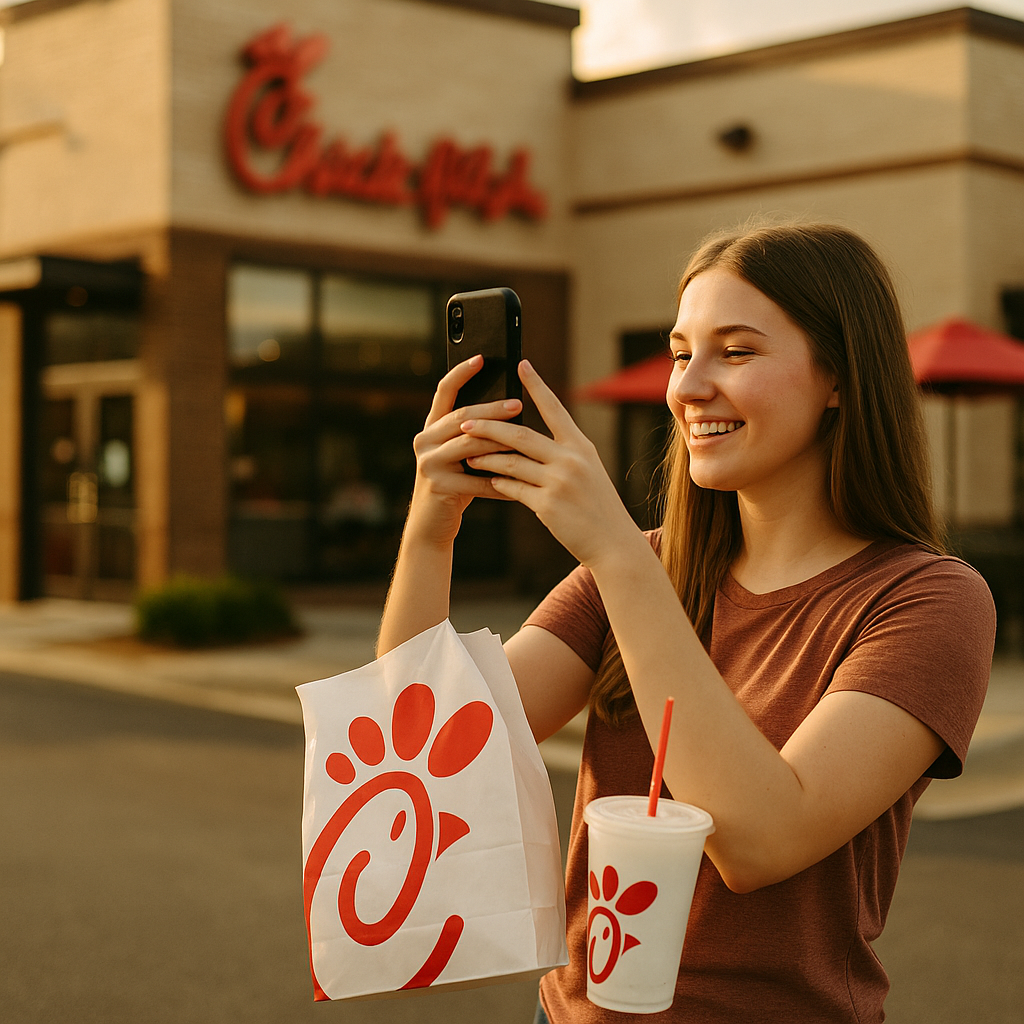
New Chick-fil-A locations routinely pull three-hour drive-thru lines and camping fans the night before doors open. No celebrity spend. No national TV buy. Just a nano-creator store opening strategy that treats every new address like a local event worth covering. If you’re still funneling budget toward one big regional splash, this case study should make you rethink the math.
The Problem With National Ad Budgets for Local Openings
Store openings are inherently local. A billboard in Dallas does nothing for a grand opening in Tulsa. Yet plenty of QSR chains still treat launches like mini national campaigns, dumping money into geo-targeted programmatic ads and hoping for foot traffic. It’s inefficient, and worse, it doesn’t feel authentic to the neighborhood being courted.
Chick-fil-A figured out something simpler years ago: local buzz beats broadcast reach when the goal is a single-day event with a hyperlocal radius. Their franchise model already forces decentralized thinking — each operator runs their store like a small business. Marketing had to follow that same logic.
A nano-creator with 3,000 local followers can move more foot traffic to a single-day opening than a regional radio spot costing 20x as much.
How the Nano-Creator Store Opening Model Actually Works
The mechanics are refreshingly unglamorous. When a new location is announced, local franchise marketing teams (often working with regional agencies) identify creators within a 15-20 mile radius — food bloggers, college students, local moms, high school athletes with modest but engaged followings. Typically 1,000 to 10,000 followers. Not influencers in the traditional sense. Neighbors with phones.
These creators get invited to a preview event, sometimes 24-48 hours before public opening. They get free food, a tour, maybe a branded tote bag. In exchange, they post: unboxing-style content, “first 100 customers” hype videos, POV content of the drive-thru experience. No scripted brand deck. No usage rights negotiation spanning six months. Just a flat, modest fee (often product-only or a few hundred dollars) and a request to tag the location.
- Recruit 15-40 local nano-creators per opening, sourced through local Instagram/TikTok search and franchise networks
- Host a “friends and family” preview night exclusively for content creation
- Provide loose creative guidelines, not scripts — authenticity over polish
- Time posts to drop 24-48 hours before doors open to seed anticipation
- Let the brand account and local news repost top-performing organic content
This isn’t dissimilar to how Zara turns nano-creators into free store-fit marketing for retail openings — same logic, different vertical. Local creators generate local proof, and local proof drives local lines.
Why Nano Beats Macro Here
Ask any regional marketing director why they don’t just hire a food influencer with 500K followers for the opening, and you’ll usually get the same answer: reach without relevance. A creator based three states away posting about a Chick-fil-A opening in a town they’ve never visited reads as an ad. A local nano-creator posting about the same opening reads as a recommendation from someone you might run into at the grocery store.
That distinction matters more than most brands admit. Sprout Social’s research on trust in social content consistently shows that audiences rate peer recommendations above branded or celebrity content, and nano-creators sit closest to that “peer” perception on the spectrum. Chick-fil-A isn’t buying reach. It’s renting credibility, store by store.
The Numbers Behind the Buzz
Chick-fil-A doesn’t publish granular ROI on these local activations, but the pattern is visible in the outcomes. New locations regularly report lines that stretch around the building on opening day, with some markets reporting sales multiples above a typical existing location’s daily average during the launch week. Local news picks up the “line around the block” story organically, which means earned media compounds on top of the creator content, at zero incremental cost.
Compare that to the cost structure of a traditional radio or OOH campaign for a single store launch. A 4-week local radio flight in a mid-size market can run $15,000-$40,000 depending on daypart and station reach, per eMarketer’s local media spend benchmarks. A nano-creator program covering the same launch, including free food and modest fees for 20-30 creators, often lands under $5,000 total.
The efficiency isn’t just about lower cost per creator — it’s that the content itself becomes the local media buy, replacing paid placements entirely.
What Brands Get Wrong When They Try to Copy This
Plenty of brands have attempted a similar playbook and gotten mediocre results. The failure points are predictable:
- Over-scripting the content. Nano-creators are chosen because they sound like real customers. Hand them a script and you’ve erased the entire value proposition.
- Skipping local vetting. Not every small-follower account is a genuine local voice. Some are engagement-pod accounts or bots. Vetting still matters, even at nano scale — a lesson Ollie’s vet-credentialed nano-creator program demonstrates well in a different category.
- Ignoring disclosure requirements. Free food plus a posting request is a material connection under FTC endorsement guidelines. Brands skipping #ad or #sponsored tags at the local level are taking on real regulatory risk, even if the program feels small and informal.
- Treating it as one-and-done. Chick-fil-A repeats this exact model at every new location, nationwide. Consistency, not novelty, is what makes it scalable.
That third point deserves more attention than it usually gets. Franchise marketing teams often assume FTC scrutiny only applies to big-name influencer deals. It doesn’t. A nano-creator getting a free meal in exchange for a post is still an endorsement relationship, and the disclosure bar is identical regardless of follower count.
Operationalizing This Without a Dedicated Team
Here’s the part most case study writeups skip: how do you actually run this at scale across dozens or hundreds of locations without hiring a national influencer team? Chick-fil-A’s franchise structure does a lot of the heavy lifting — local operators already have P&L ownership and marketing budget discretion, so recruiting a handful of local creators fits naturally into their existing playbook.
Brands without a franchise model can replicate the structure with a lightweight local activation toolkit:
- Build a repeatable creator outreach template (DM script, compensation tiers, content guidelines) that any regional marketer can execute without brand HQ approval on every post
- Maintain a rolling database of nano-creators by market, refreshed as store openings are scheduled
- Standardize a simple contract and disclosure checklist so legal risk doesn’t scale with creator count
- Set a modest per-market budget cap (compensation plus event costs) so local teams can move fast without waiting on national sign-off
This is functionally the same operational model that makes Chamberlain Coffee’s nano-creator retail push work at shelf level — a repeatable system beats a bespoke campaign every time you’re trying to scale across many small activations rather than one big one.
Where This Fits in a Broader Creator Strategy
Nano-creator store openings aren’t a replacement for national brand campaigns. They’re a complement, solving a problem that national media can’t: making a single physical location, on a single day, feel like the center of the neighborhood’s attention. It’s a tactic built for local commerce moments — openings, relaunches, anniversary events — not for building brand awareness at scale.
Brands evaluating whether this fits their model should ask a blunt question: does our business have a recurring local moment worth marketing? Retailers opening new locations, restaurants launching regional menus, gyms opening franchises — all of these have a natural fit. A pure e-commerce brand with no physical footprint, less so.
The Takeaway for Regional Marketing Teams
Skip the regional media buy for your next location launch and redirect that budget into 20-30 local nano-creator relationships instead — the content will outperform the ad on cost-per-impression and, more importantly, on the only metric that matters for an opening: people showing up.
FAQs
What counts as a nano-creator in this context?
Generally accounts with 1,000 to 10,000 followers on platforms like Instagram or TikTok, based within a tight geographic radius of the location being promoted. Follower count matters less than local relevance and engagement authenticity.
How much does a nano-creator store opening program typically cost?
Programs covering 20-30 creators for a single location launch often run under $5,000 total, including free product, event costs, and modest flat fees, far below traditional local media buys for the same market.
Do nano-creators need to disclose brand partnerships for a free meal?
Yes. Under FTC endorsement guidelines, any material connection, including free food or products in exchange for a post, requires clear disclosure such as #ad or #sponsored, regardless of the creator’s follower count.
Can this model work outside the restaurant industry?
Yes, particularly for brands with recurring local moments like store openings, franchise launches, or regional events. Retail and fitness brands have used similar nano-creator activations with strong results.
How is this different from a standard influencer marketing campaign?
Traditional influencer campaigns typically prioritize reach and follower count. This model prioritizes hyperlocal relevance and authenticity, treating creators as local sources rather than brand ambassadors with broad audiences.
Top Influencer Marketing Agencies
The leading agencies shaping influencer marketing in 2026
Agencies ranked by campaign performance, client diversity, platform expertise, proven ROI, industry recognition, and client satisfaction. Assessed through verified case studies, reviews, and industry consultations.
Moburst

-
2

The Shelf
Boutique Beauty & Lifestyle Influencer AgencyA data-driven boutique agency specializing exclusively in beauty, wellness, and lifestyle influencer campaigns on Instagram and TikTok. Best for brands already focused on the beauty/personal care space that need curated, aesthetic-driven content.Clients: Pepsi, The Honest Company, Hims, Elf Cosmetics, Pure LeafVisit The Shelf → -
3

Audiencly
Niche Gaming & Esports Influencer AgencyA specialized agency focused exclusively on gaming and esports creators on YouTube, Twitch, and TikTok. Ideal if your campaign is 100% gaming-focused — from game launches to hardware and esports events.Clients: Epic Games, NordVPN, Ubisoft, Wargaming, Tencent GamesVisit Audiencly → -
4

Viral Nation
Global Influencer Marketing & Talent AgencyA dual talent management and marketing agency with proprietary brand safety tools and a global creator network spanning nano-influencers to celebrities across all major platforms.Clients: Meta, Activision Blizzard, Energizer, Aston Martin, WalmartVisit Viral Nation → -
5

The Influencer Marketing Factory
TikTok, Instagram & YouTube CampaignsA full-service agency with strong TikTok expertise, offering end-to-end campaign management from influencer discovery through performance reporting with a focus on platform-native content.Clients: Google, Snapchat, Universal Music, Bumble, YelpVisit TIMF → -
6

NeoReach
Enterprise Analytics & Influencer CampaignsAn enterprise-focused agency combining managed campaigns with a powerful self-service data platform for influencer search, audience analytics, and attribution modeling.Clients: Amazon, Airbnb, Netflix, Honda, The New York TimesVisit NeoReach → -
7

Ubiquitous
Creator-First Marketing PlatformA tech-driven platform combining self-service tools with managed campaign options, emphasizing speed and scalability for brands managing multiple influencer relationships.Clients: Lyft, Disney, Target, American Eagle, NetflixVisit Ubiquitous → -
8

Obviously
Scalable Enterprise Influencer CampaignsA tech-enabled agency built for high-volume campaigns, coordinating hundreds of creators simultaneously with end-to-end logistics, content rights management, and product seeding.Clients: Google, Ulta Beauty, Converse, AmazonVisit Obviously →