


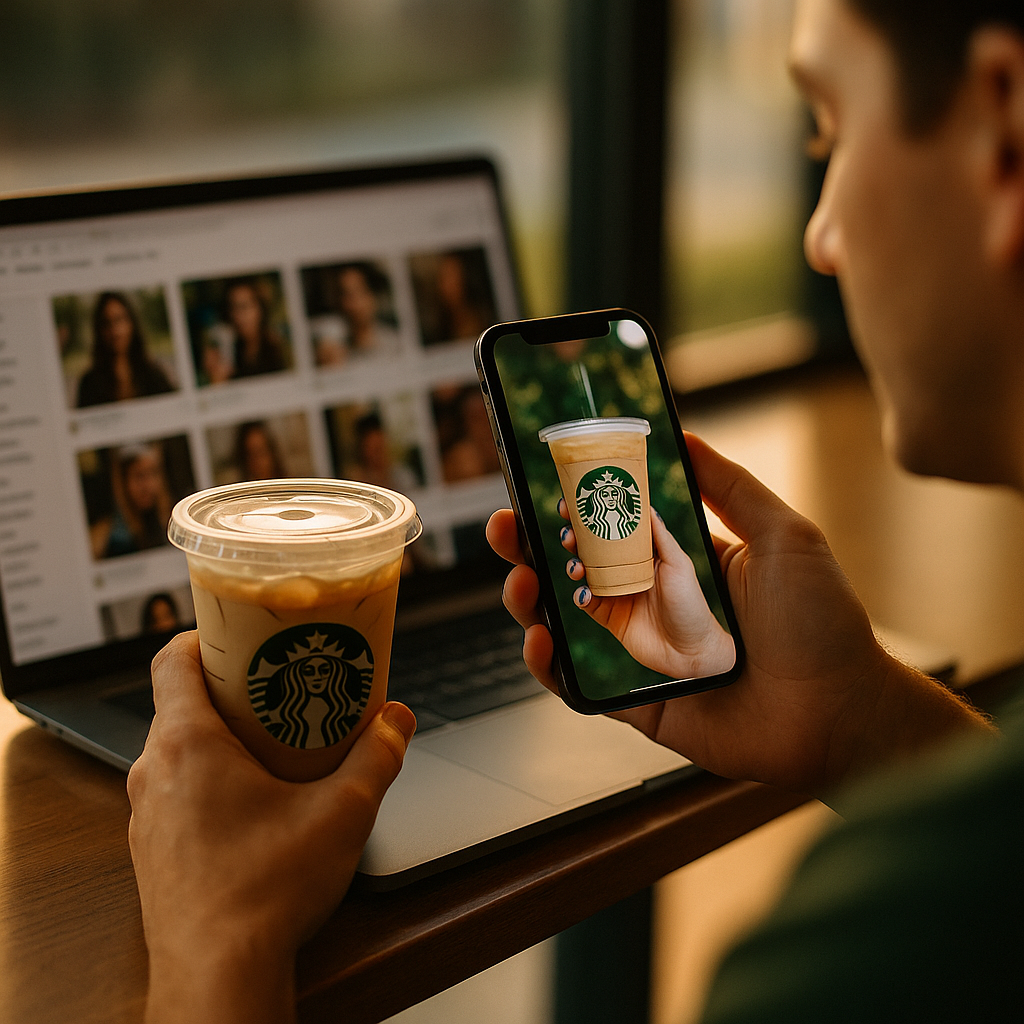
Starbucks reportedly reviews thousands of pieces of fan-made content every month, yet almost none of it gets paid, tracked, or repurposed at scale. That gap between organic love and operational capture is exactly what an in-house UGC commissioning team is built to close. As Starbucks moves creator content sourcing out of agency hands and into a dedicated internal function, it joins a growing list of enterprise brands betting that owning the pipeline beats renting it.
Why Brands Are Pulling UGC Commissioning In-House
For most of the last decade, user-generated content lived in a weird limbo. Marketing teams loved the authenticity. Legal teams hated the licensing ambiguity. And the actual sourcing, usually handled by an agency of record, moved too slowly to keep pace with what social platforms actually reward.
Starbucks isn’t alone in recognizing the problem. Brands like Best Buy have already rebuilt their content pipeline around speed and retail media integration, while Coty moved Calvin Klein’s creator advocacy work into standing internal teams rather than campaign-by-campaign agency briefs. The pattern is consistent: when UGC becomes a core revenue driver instead of a nice-to-have, brands want it owned, not outsourced.
The economics back this up. According to eMarketer, creator-driven content now influences a growing share of purchase decisions across categories that used to rely purely on brand advertising, coffee and quick-service included. When a channel starts moving revenue, finance teams ask why it’s still routed through a third party markup.
An in-house commissioning team doesn’t just cut agency fees. It compresses the time between a piece of content going viral organically and the brand having usage rights to run it as a paid ad.
What Starbucks Is Actually Building
Sources close to the company’s marketing organization describe a small, cross-functional pod sitting inside the brand and content team rather than inside performance marketing. That placement matters. It signals the team is being built to protect brand voice and legal cleanliness first, with paid amplification as a secondary function layered on top.
The structure reportedly includes:
- A commissioning lead who identifies high-performing organic content and initiates licensing conversations directly with creators.
- A rights and compliance coordinator who manages usage agreements, disclosure requirements, and renewal terms.
- A content ops manager who tags, stores, and routes approved UGC into paid, owned, and retail media channels.
- A data analyst who ties commissioned content back to engagement and, where possible, sales lift by store region or SKU.
This is not a creative studio churning out branded content from scratch. It’s a licensing and distribution engine that finds what’s already working organically and gets it under contract fast, before a competitor or a rights dispute complicates things. That’s a meaningfully different skill set than what most agencies were built to deliver, and it’s why brands increasingly hire specialists rather than retain generalist shops, a shift TP-Link made explicitly when it hired a specialist instead of an agency.
The Compliance Angle Nobody Talks About Enough
Here’s the part that should matter most to risk-averse marketing leaders: unlicensed UGC is a liability sitting in plain sight. Reposting a customer’s TikTok without a clear agreement, even with a friendly comment and a tag, doesn’t satisfy FTC disclosure requirements and doesn’t grant the brand durable usage rights. If that content later gets pulled into a paid ad set, the exposure compounds.
An in-house team closes that gap by design. Every piece of content that gets commissioned comes with a standardized agreement covering usage window, platform rights, and disclosure language. Compare that to the old workflow, where an agency might secure a one-off release for a single campaign, with no clean path to reuse the asset six months later without renegotiating from scratch.
This is also why compliance-forward categories, alcohol, finance, and yes, food and beverage brands operating across multiple regulatory jurisdictions, are among the first to build these teams internally. Molson Coors made a similar bet when it centralized its creator function and saw engagement quadruple, partly because centralization meant fewer inconsistent agreements floating around different regional agencies.
Speed Is the Real ROI Story
Ask any brand-side marketer what kills a UGC-to-paid pipeline and they’ll say the same thing: timing. Organic trends move in days. Agency approval chains move in weeks. By the time a brief goes out, gets creative-reviewed, and comes back with a signed release, the moment that made the content valuable has usually passed.
Starbucks’ internal team is reportedly targeting a commissioning turnaround measured in days, not weeks, for high-performing organic posts. That’s a meaningful competitive edge in quick-service and beverage, categories where seasonal drinks, limited releases, and viral customization trends (think the endless stream of “secret menu” Starbucks orders) create short windows of peak attention.
Canon EMEA followed a similar logic when it decided that owning short-form UGC internally, rather than routing it through an agency, was the only way to keep pace with how fast short-form content cycles turn over. The lesson generalizes well beyond photography gear or coffee: any brand whose category thrives on trend-jacking needs a commissioning function that can move at platform speed.
Not Every Brand Needs This, at Least Not Yet
It’s worth being honest about scale here. Building an in-house commissioning team only pencils out once UGC volume and licensing complexity justify the headcount. For a mid-size brand generating a few hundred pieces of organic content a month, an agency retainer or a specialist tool might still be the more efficient answer. Sprout Social and similar platforms now offer social listening and rights management features that can handle a lighter version of this workflow without a dedicated internal hire.
Starbucks operates at a volume most brands will never touch, tens of thousands of user posts monthly across TikTok, Instagram, and X. That volume is precisely what makes internal commissioning economical: the marginal cost of an in-house team drops fast once you’re processing content at that scale, while agency markups scale linearly (or worse) with volume.
Smaller brands looking at this model should ask a simpler question first: is our organic UGC volume growing faster than our agency’s ability to act on it? If yes, that’s the signal to start building internally, even in a lightweight, one-person version. Fabletics took a version of this approach by tightly integrating UGC into its membership flywheel, proving the model scales down to more specialized use cases too, not just mass-market retail.
What This Signals for the Next Wave of Brand-Side Hiring
Expect more job postings over the next few quarters for titles like “UGC commissioning manager,” “creator rights coordinator,” and “content licensing lead.” These aren’t influencer marketing manager roles wearing a new label. They’re closer to a hybrid of legal ops and social media management, and they require people fluent in both platform trends and contract language.
According to HubSpot’s ongoing research into marketing team structures, in-house specialization is accelerating across content functions generally, not just influencer marketing. Starbucks building a UGC commissioning team fits neatly into that broader trend: brands are pulling operational control back from agencies for the functions that touch revenue directly, while keeping agencies for the work that’s genuinely creative and strategic.
The brands that get ahead of this shift will have cleaner content libraries, faster paid-social turnaround, and fewer legal headaches by the time their competitors even start the conversation.
The Takeaway
If your UGC volume has outgrown your agency’s turnaround time, or if you’re still running organic reposts without clean usage rights, start scoping an internal commissioning function now, even a one-person pilot beats waiting for a compliance incident to force the issue.
FAQs
What is UGC commissioning, exactly?
UGC commissioning is the process of identifying user-generated content that’s already performing well organically, then formally licensing it from the creator for use in paid ads, owned channels, or retail media, complete with clear usage rights and disclosure terms.
Why would a brand build this team in-house instead of using an agency?
Speed and compliance. In-house teams can license high-performing content within days instead of weeks, and they can standardize usage agreements so content can be reused across multiple channels without renegotiating each time.
How big does a brand need to be before an in-house UGC team makes financial sense?
There’s no fixed threshold, but it generally becomes cost-effective once a brand is processing enough organic UGC monthly that agency markups on a per-asset basis start outweighing the cost of one or two dedicated internal hires.
What’s the biggest risk of not licensing UGC properly?
Reposting content without a clear usage agreement creates legal exposure, particularly if that content is later used in paid advertising, and it can violate FTC disclosure requirements if the relationship between the brand and creator isn’t transparently labeled.
Does an in-house UGC team replace the need for an influencer marketing agency?
Not entirely. Most brands keep agencies for strategic campaign work and larger creator partnerships while handling UGC sourcing, licensing, and rapid trend response internally.
Top Influencer Marketing Agencies
The leading agencies shaping influencer marketing in 2026
Agencies ranked by campaign performance, client diversity, platform expertise, proven ROI, industry recognition, and client satisfaction. Assessed through verified case studies, reviews, and industry consultations.
Moburst

-
2

The Shelf
Boutique Beauty & Lifestyle Influencer AgencyA data-driven boutique agency specializing exclusively in beauty, wellness, and lifestyle influencer campaigns on Instagram and TikTok. Best for brands already focused on the beauty/personal care space that need curated, aesthetic-driven content.Clients: Pepsi, The Honest Company, Hims, Elf Cosmetics, Pure LeafVisit The Shelf → -
3

Audiencly
Niche Gaming & Esports Influencer AgencyA specialized agency focused exclusively on gaming and esports creators on YouTube, Twitch, and TikTok. Ideal if your campaign is 100% gaming-focused — from game launches to hardware and esports events.Clients: Epic Games, NordVPN, Ubisoft, Wargaming, Tencent GamesVisit Audiencly → -
4

Viral Nation
Global Influencer Marketing & Talent AgencyA dual talent management and marketing agency with proprietary brand safety tools and a global creator network spanning nano-influencers to celebrities across all major platforms.Clients: Meta, Activision Blizzard, Energizer, Aston Martin, WalmartVisit Viral Nation → -
5

The Influencer Marketing Factory
TikTok, Instagram & YouTube CampaignsA full-service agency with strong TikTok expertise, offering end-to-end campaign management from influencer discovery through performance reporting with a focus on platform-native content.Clients: Google, Snapchat, Universal Music, Bumble, YelpVisit TIMF → -
6

NeoReach
Enterprise Analytics & Influencer CampaignsAn enterprise-focused agency combining managed campaigns with a powerful self-service data platform for influencer search, audience analytics, and attribution modeling.Clients: Amazon, Airbnb, Netflix, Honda, The New York TimesVisit NeoReach → -
7

Ubiquitous
Creator-First Marketing PlatformA tech-driven platform combining self-service tools with managed campaign options, emphasizing speed and scalability for brands managing multiple influencer relationships.Clients: Lyft, Disney, Target, American Eagle, NetflixVisit Ubiquitous → -
8

Obviously
Scalable Enterprise Influencer CampaignsA tech-enabled agency built for high-volume campaigns, coordinating hundreds of creators simultaneously with end-to-end logistics, content rights management, and product seeding.Clients: Google, Ulta Beauty, Converse, AmazonVisit Obviously →