


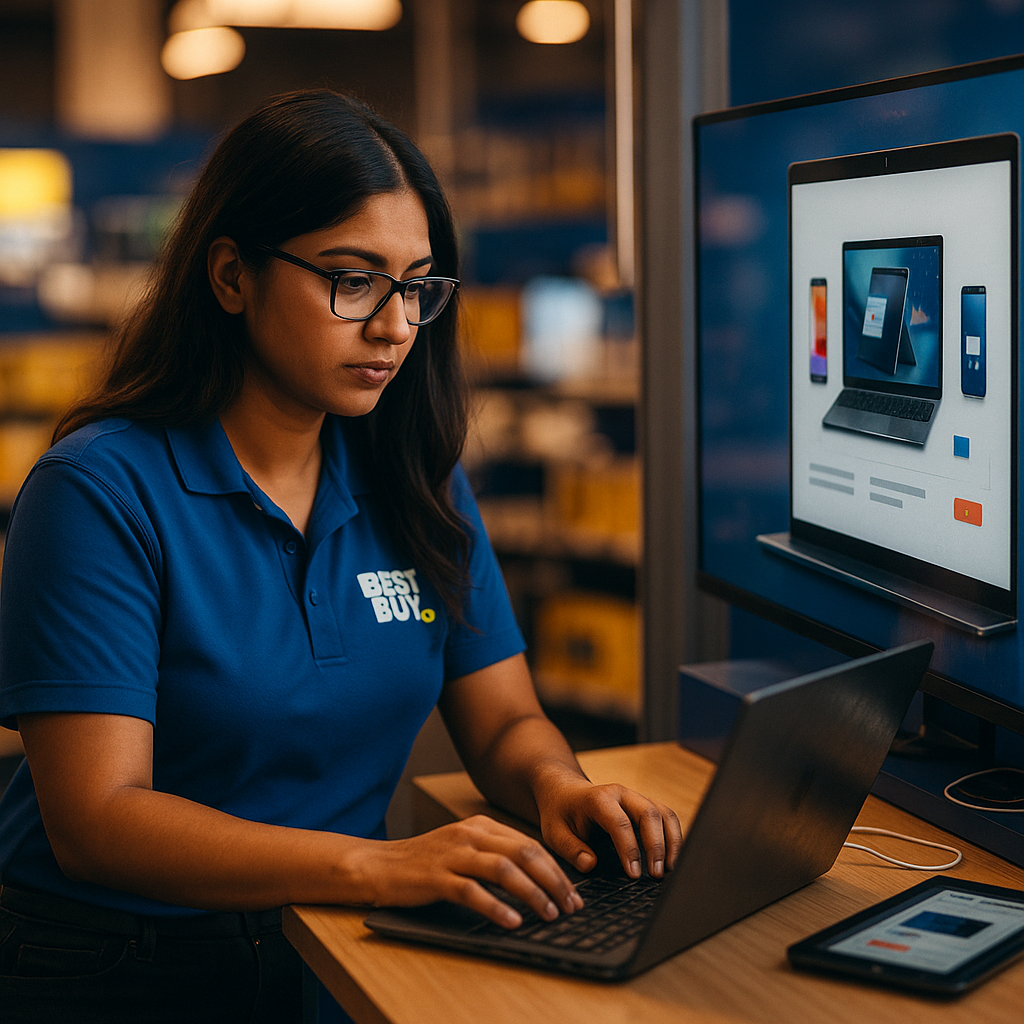
Best Buy now produces more branded content in a single quarter than its entire marketing team generated in a year five years ago. That’s not a typo. It’s the result of an AI-driven content supply chain overhaul that treats creative production less like a campaign and more like inventory management. For brands drowning in content demands across retail media, social, and creator partnerships, Best Buy’s approach offers a blueprint worth studying.
Why Retailers Can’t Brief Their Way Out of This Problem Anymore
Retail marketing teams used to operate on a campaign cadence. Plan a quarter out, brief agencies, wait for creative, launch, measure, repeat. That model breaks down when you’re running thousands of SKUs across TikTok Shop, Instagram Reels, YouTube Shorts, retail media networks, and in-store digital screens simultaneously.
Best Buy sells everything from $15 phone cases to $3,000 home theater systems. Each product category needs distinct creative treatment, tone, and platform formatting. Multiply that across seasonal pushes, price drops, and creator collaborations, and the old briefing-to-delivery pipeline simply can’t keep pace. Something had to give.
The Overhaul: From Agency Bottleneck to Automated Pipeline
Best Buy restructured its content operation around three pillars: AI-assisted ideation, automated asset variation, and creator-sourced raw footage fed into machine-driven editing tools. Instead of commissioning a single hero video and hoping it performs across every channel, the team now generates a base asset and lets AI tools handle format, aspect ratio, and messaging variants for each platform.
This isn’t full creative automation. Humans still write core scripts, approve brand voice, and sign off on final cuts. But the manual grunt work, resizing a video fifteen ways, generating captions in multiple tones, testing thumbnail variants, has been handed to automated workflows. That shift alone reportedly cut turnaround time on paid social assets by more than half, according to internal estimates shared by marketing leadership at industry conferences.
The real unlock isn’t producing more content faster. It’s producing content that’s already optimized for the platform, audience segment, and funnel stage before a human ever reviews it.
Creator Content as Raw Material, Not Finished Product
Here’s where it gets interesting for anyone running influencer programs. Best Buy treats creator-generated footage as raw supply, not finished creative. A creator submits a haul video or product demo, and AI tools extract usable clips, tag them by product category and sentiment, then route them into a library that in-house teams and retail media buyers can pull from for paid amplification.
This mirrors a pattern showing up across retail and CPG. Chipotle’s AI sorting system processed 200,000 TikTok submissions to find usable brand content at scale, and Chipotle later extended that logic to programmatic creator matching across 700-plus creator tiers. Best Buy’s system operates on a similar principle: don’t ask creators to deliver polished final assets. Ask them for raw, authentic footage, then let automation do the heavy production lifting.
Why does this matter for ROI? Because it decouples creator fees from production costs. You’re paying creators for authentic access and reach, not for editing skills. The editing gets absorbed into a scalable, largely fixed-cost technology layer.
What This Means for Whitelisting and Paid Amplification
Once creator footage enters Best Buy’s content library, it becomes eligible for whitelisting, essentially running creator content as paid ads from the brand’s own accounts. This isn’t a new tactic. e.l.f. Cosmetics has run this playbook for years, turning organic UGC into performance ad units. What’s different at Best Buy is the speed. Content that used to take a week to clear legal, resize, and traffic into ad platforms now moves in a matter of days because the tagging and rights management happen automatically at ingestion.
Rights management is the unglamorous part nobody wants to talk about, but it’s often the actual bottleneck. If your legal team can’t confirm usage rights fast, none of the AI production speed matters. Best Buy baked rights confirmation into the creator onboarding flow itself, so every piece of footage arrives pre-cleared for specified usage windows and channels.
Data Is the Other Half of This Story
Speed without measurement is just noise. Best Buy pairs its content pipeline with attribution modeling that ties specific asset variants to sales lift, return rates, and engagement by product category. This echoes what’s happening at Coty, which rebuilt its entire influencer spend model around sales attribution rather than vanity engagement metrics.
Best Buy’s team reportedly uses a data lakehouse architecture to unify content performance data with point-of-sale figures, similar to the approach detailed in how one skincare brand used a lakehouse to prove creator ROI. The goal is the same across industries: stop guessing which creative drives revenue and start knowing.
According to eMarketer, retail media ad spend continues to climb sharply as brands push more budget toward channels with closed-loop attribution. That trend puts pressure on every retailer to prove content performance in dollars, not impressions.
The AI Everywhere Playbook Isn’t Unique to Best Buy
Best Buy isn’t operating in isolation. Estee Lauder has been vocal about restructuring its entire creator operations around AI, from an AI everywhere strategy that rewires creator ops to an AI shopping bet signaling where ad budgets go next. QYOU Media has taken a similar route on the production side, with its production tech investment driving 27 percent revenue growth.
The pattern across these companies is consistent: AI isn’t replacing creative strategy, it’s absorbing the repetitive production tasks that used to eat budget and timeline. Brands that figure this out first get a structural cost advantage over competitors still paying agency rates for basic resizing and captioning work.
Brands still treating content production as a bespoke, per-asset cost center are going to lose the margin war to competitors running it as an automated supply chain.
Where This Gets Risky
None of this is risk-free. Automated content generation raises real questions around disclosure, brand voice consistency, and quality control at scale. The FTC’s endorsement guidelines still apply regardless of whether a human or an algorithm assembled the final creative asset. Brands need clear internal policies on what gets AI-generated captions versus human-reviewed copy, especially for regulated categories like electronics warranties or health claims.
There’s also a brand safety dimension. When you’re pulling thousands of creator clips into an automated pipeline, you need robust filtering to catch off-brand content, competitor mentions, or inappropriate context before it reaches a paid placement. Sprout Social’s research on brand safety in social content consistently flags this as a top concern for enterprise marketers scaling UGC programs.
Quality control can’t be an afterthought bolted on at the end. It has to be built into the pipeline architecture from day one, or you end up amplifying the wrong content at scale, which is far worse than not scaling at all.
Operational Lessons for Marketing Leaders
- Separate raw content sourcing from finished production. Pay creators for access and authenticity, let technology handle format variation.
- Build rights clearance into onboarding, not as a post-production checkpoint that slows everything down.
- Tie every asset variant to a performance metric that connects back to sales, not just engagement.
- Set clear disclosure and quality standards before scaling automated content, not after a compliance issue surfaces.
- Treat the content pipeline as infrastructure, something you invest in and maintain, not a one-off campaign expense.
For brands running multi-category catalogs like TP-Link’s direct creator channel strategy or Henkel’s approach to FMCG retail media, the underlying lesson is transferable even if the product categories differ wildly. The infrastructure matters more than the specific vertical.
Data from HubSpot’s marketing benchmarks shows content velocity increasingly correlates with paid media performance, reinforcing why retailers are racing to fix production bottlenecks rather than just increasing ad spend.
What Comes Next
Best Buy’s overhaul won’t be the last of its kind. Expect more retailers with sprawling catalogs and razor-thin margins to follow this exact structural logic: source raw creator content cheaply, automate the production layer, and pour saved budget into media spend and attribution tooling instead of agency fees.
If you’re a brand strategist evaluating your own content operation, the audit question isn’t “how much content are we producing.” It’s “how much of our production budget goes to repetitive tasks that a well-built pipeline could absorb.” Start there, and the case for restructuring writes itself.
Frequently Asked Questions
What exactly is an AI-driven content supply chain?
It’s a production system where AI tools handle repetitive creative tasks, resizing, captioning, tagging, and asset variation, while humans focus on strategy, brand voice, and final approval. It treats content like inventory moving through a pipeline rather than one-off campaign deliverables.
Does this replace the need for influencer and creator partnerships?
No. It changes what brands pay creators for. Instead of paying for polished, platform-ready final assets, brands increasingly pay creators for raw, authentic footage and reach, then let automated tools handle final production and formatting.
How does Best Buy measure whether the overhaul is working?
Through attribution modeling that connects specific content variants to sales lift, return rates, and engagement by product category, rather than relying on impressions or engagement alone.
What are the biggest risks with automated content pipelines?
Disclosure compliance, brand voice consistency, and brand safety filtering are the top concerns. Without built-in quality control, automated pipelines can amplify off-brand or non-compliant content at scale.
Is this approach only viable for large retailers with big budgets?
The core principles, separating raw sourcing from production, building rights clearance into onboarding, and tying assets to performance data, scale down to mid-sized brands too, even if the specific tools differ.
The Bottom Line
Best Buy’s content supply chain overhaul proves that speed and authenticity aren’t opposing forces when the pipeline is built correctly. Brands still treating creative production as a manual, per-project cost will keep losing ground to competitors who’ve turned it into infrastructure.
Frequently Asked Questions
What exactly is an AI-driven content supply chain?
It’s a production system where AI tools handle repetitive creative tasks, resizing, captioning, tagging, and asset variation, while humans focus on strategy, brand voice, and final approval. It treats content like inventory moving through a pipeline rather than one-off campaign deliverables.
Does this replace the need for influencer and creator partnerships?
No. It changes what brands pay creators for. Instead of paying for polished, platform-ready final assets, brands increasingly pay creators for raw, authentic footage and reach, then let automated tools handle final production and formatting.
How does Best Buy measure whether the overhaul is working?
Through attribution modeling that connects specific content variants to sales lift, return rates, and engagement by product category, rather than relying on impressions or engagement alone.
What are the biggest risks with automated content pipelines?
Disclosure compliance, brand voice consistency, and brand safety filtering are the top concerns. Without built-in quality control, automated pipelines can amplify off-brand or non-compliant content at scale.
Is this approach only viable for large retailers with big budgets?
The core principles, separating raw sourcing from production, building rights clearance into onboarding, and tying assets to performance data, scale down to mid-sized brands too, even if the specific tools differ.
Top Influencer Marketing Agencies
The leading agencies shaping influencer marketing in 2026
Agencies ranked by campaign performance, client diversity, platform expertise, proven ROI, industry recognition, and client satisfaction. Assessed through verified case studies, reviews, and industry consultations.
Moburst

-
2

The Shelf
Boutique Beauty & Lifestyle Influencer AgencyA data-driven boutique agency specializing exclusively in beauty, wellness, and lifestyle influencer campaigns on Instagram and TikTok. Best for brands already focused on the beauty/personal care space that need curated, aesthetic-driven content.Clients: Pepsi, The Honest Company, Hims, Elf Cosmetics, Pure LeafVisit The Shelf → -
3

Audiencly
Niche Gaming & Esports Influencer AgencyA specialized agency focused exclusively on gaming and esports creators on YouTube, Twitch, and TikTok. Ideal if your campaign is 100% gaming-focused — from game launches to hardware and esports events.Clients: Epic Games, NordVPN, Ubisoft, Wargaming, Tencent GamesVisit Audiencly → -
4

Viral Nation
Global Influencer Marketing & Talent AgencyA dual talent management and marketing agency with proprietary brand safety tools and a global creator network spanning nano-influencers to celebrities across all major platforms.Clients: Meta, Activision Blizzard, Energizer, Aston Martin, WalmartVisit Viral Nation → -
5

The Influencer Marketing Factory
TikTok, Instagram & YouTube CampaignsA full-service agency with strong TikTok expertise, offering end-to-end campaign management from influencer discovery through performance reporting with a focus on platform-native content.Clients: Google, Snapchat, Universal Music, Bumble, YelpVisit TIMF → -
6

NeoReach
Enterprise Analytics & Influencer CampaignsAn enterprise-focused agency combining managed campaigns with a powerful self-service data platform for influencer search, audience analytics, and attribution modeling.Clients: Amazon, Airbnb, Netflix, Honda, The New York TimesVisit NeoReach → -
7

Ubiquitous
Creator-First Marketing PlatformA tech-driven platform combining self-service tools with managed campaign options, emphasizing speed and scalability for brands managing multiple influencer relationships.Clients: Lyft, Disney, Target, American Eagle, NetflixVisit Ubiquitous → -
8

Obviously
Scalable Enterprise Influencer CampaignsA tech-enabled agency built for high-volume campaigns, coordinating hundreds of creators simultaneously with end-to-end logistics, content rights management, and product seeding.Clients: Google, Ulta Beauty, Converse, AmazonVisit Obviously →