


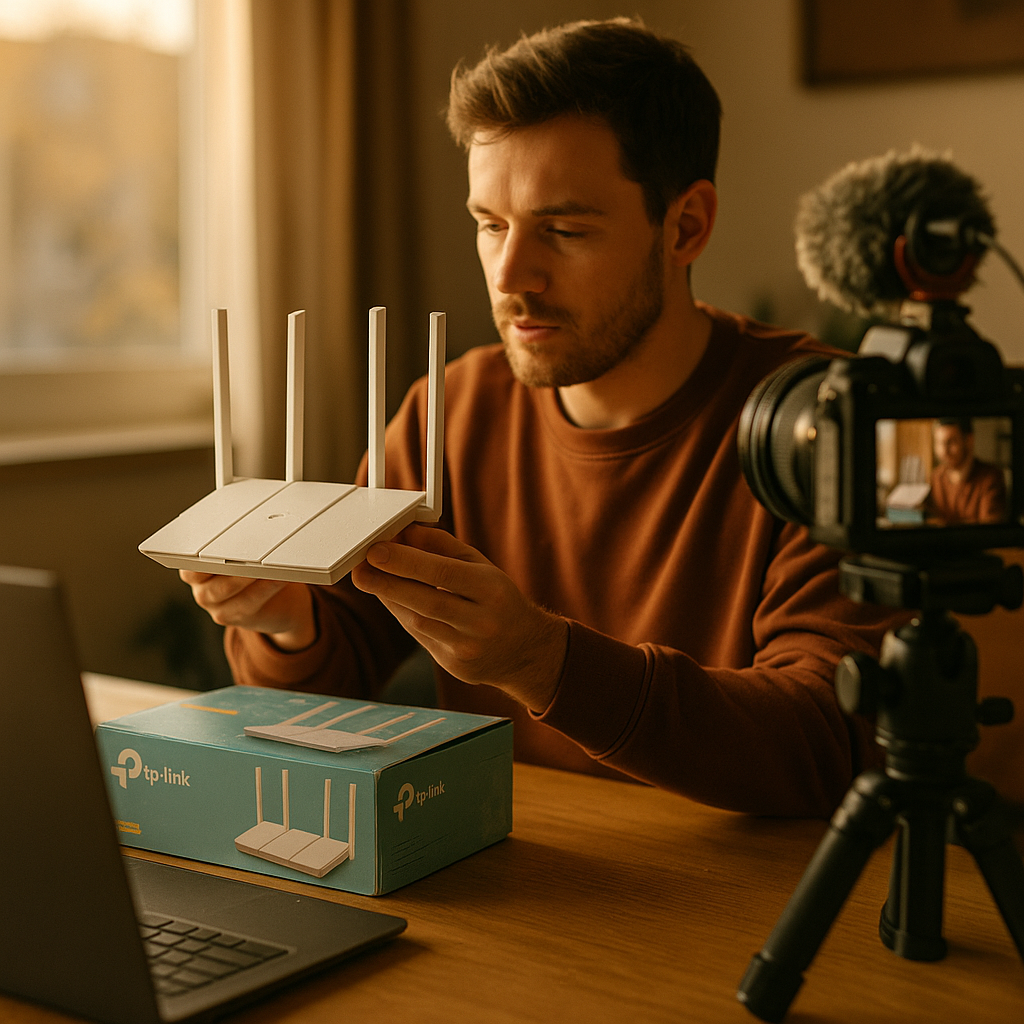
Router brands don’t usually make headlines in creator marketing circles. Yet TP-Link just built an influencer program from scratch that’s worth studying, not because it’s flashy, but because it solves a problem most CE and smart home brands are quietly panicking about: how do you acquire customers directly when Amazon takes its cut and paid social costs keep climbing? The answer, apparently, is creators.
Why a Router Company Needs Creators Now
TP-Link sells routers, mesh systems, smart plugs, and security cameras under brands like Deco, Archer, Kasa, and Tapo. It’s a category with brutal margins and a buying journey that increasingly starts on TikTok or YouTube rather than a Best Buy aisle. Search volume for “best mesh router” or “Wi-Fi 7 router review” spikes constantly, and the people answering those queries in video form aren’t TP-Link’s marketing team. They’re independent tech reviewers, home automation nerds, and smart home YouTubers who’ve been doing unboxings for years without a formal partnership.
That’s the gap TP-Link decided to close. Rather than keep funding a scattershot mix of one-off gifting and paid placements through agencies, the company built a structured influencer program designed to own the relationship, the data, and the acquisition funnel end to end.
The real shift isn’t that TP-Link started working with creators. It’s that TP-Link stopped renting attention and started building an owned channel it can measure, optimize, and scale independently of Amazon or Meta.
The Program Structure: Tiers, Categories, and Platforms
From what’s visible in the program’s public application flow and creator briefs circulating online, TP-Link organized its influencer effort around three tiers rather than the usual chaotic mix of ad hoc deals.
- Nano and micro tech creators (5,000 to 100,000 followers) get product seeding, affiliate commission structures, and access to a self-serve content brief library. This tier is volume play: hundreds of smart home setups, unboxings, and “is this router worth it” videos feeding top-of-funnel search and social discovery.
- Mid-tier specialists in home automation, gaming, and remote work niches receive flat fees plus performance bonuses tied to affiliate link conversions, mirroring the hybrid comp model that treats creators like partners rather than vendors.
- Macro and category authority creators get co-development input, early access to new hardware like Wi-Fi 7 mesh units, and longer contract terms that look more like ambassador deals than one-off sponsorships.
Platform-wise, the program leans hardest into YouTube for long-form reviews (where purchase intent runs highest for a considered CE purchase) and TikTok for discovery and comparison content. There’s also a direct tie-in to TikTok Shop and Amazon’s affiliate infrastructure, letting creators drive traffic to whichever checkout converts best for their audience.
From Zero to Pipeline: How TP-Link Built the Infrastructure
Building an influencer program “from zero” sounds simple until you’ve actually tried to stand one up inside a hardware company that’s historically sold through retail and distributor relationships. TP-Link had none of the usual creator marketing scaffolding: no CRM for creator relationships, no attribution stack tied to affiliate codes, no legal templates for usage rights or disclosure language.
Here’s roughly what the buildout looked like, based on job postings, vendor RFPs, and creator-facing documentation:
- Centralized creator CRM. TP-Link consolidated scattered spreadsheets and DM threads into a single influencer relationship management platform, similar to the consolidation approach detailed in how one martech company rolled up four acquisitions into a single creator platform.
- Unique tracking per creator. Every partner gets a dedicated discount code and affiliate link, feeding a dashboard that ties content directly to conversions instead of relying on vanity engagement metrics.
- Standardized briefs and usage rights. Contracts specify content usage windows for paid amplification, echoing the licensing clarity discussed in how brands are fixing UGC rights at scale.
- A vetted creator network instead of open applications only, cutting the vetting overhead that typically slows DTC-style launches, a model similar to what’s outlined in how a vetted creator network cuts launch costs.
None of this is revolutionary on its own. What’s notable is that a legacy hardware brand did it deliberately, as infrastructure, rather than bolting creators onto an existing PR or affiliate function and hoping it worked.
Compliance Is the Real Product Here
Ask any general counsel at a CE brand what keeps them up at night about influencer programs, and disclosure compliance tops the list. TP-Link operates in dozens of markets with different advertising standards, and a mislabeled #ad in one region can trigger regulatory scrutiny that costs far more than the campaign was worth.
The program’s brief templates reportedly include mandatory disclosure language aligned with FTC endorsement guidelines, plus region-specific variants for markets under stricter frameworks like the UK’s advertising standards, enforced by bodies working alongside the Information Commissioner’s Office on data handling. That’s not glamorous work, but it’s the operational backbone that lets a program scale past a handful of creators without a compliance incident derailing it.
This mirrors a broader trend across CPG and retail brands treating disclosure and attribution as core program infrastructure rather than an afterthought, something we’ve tracked in how one skincare brand built data infrastructure to prove creator ROI.
Does It Actually Move Product?
Early signals suggest yes, though TP-Link hasn’t published hard revenue figures publicly. Industry benchmarks help fill the gap. eMarketer data on creator-driven commerce consistently shows affiliate and shoppable content outperforming standard display ads on cost-per-acquisition for considered purchases like routers and smart home hardware. Sprout Social research also points to review and comparison content as a top driver of purchase intent in electronics categories specifically.
What matters more than any single stat is the structural shift: TP-Link now owns a direct line to customers that doesn’t route through a retailer’s algorithm or a platform’s ad auction. That’s a hedge against rising CPMs and Amazon’s fee creep, and it gives the brand first-party data on what messaging actually converts, something distributor relationships never provided.
What Other Hardware Brands Should Take From This
TP-Link isn’t the first CE brand to lean on creators, but the disciplined, tiered approach offers a repeatable template. Compare it to how a fashion retailer used micro-creator content to cut return rates, or how a restaurant chain scaled hundreds of creator tiers through programmatic matching. The category differs, but the operational logic is identical: segment creators by value delivered, automate the matching and attribution, and treat compliance as a launch requirement rather than a legal afterthought.
For brands still running influencer efforts through a single agency contact or an ad hoc gifting list, the gap is widening fast. Platforms like TikTok’s advertising ecosystem and tools referenced in HubSpot’s marketing resources make it easier than ever to build attribution into creator programs from day one. There’s no excuse left for treating influencer spend as unmeasurable.
Visible FAQs
Frequently Asked Questions
What makes TP-Link’s influencer program different from typical tech gifting campaigns?
It’s structured around tiers with distinct compensation models, dedicated tracking links per creator, and standardized compliance briefs, rather than one-off product seeding with no measurement attached.
How does TP-Link measure ROI from its creator partnerships?
Each creator receives a unique affiliate link and discount code, allowing TP-Link to attribute sales directly to specific content rather than relying on engagement metrics alone.
Why would a hardware brand prioritize a direct acquisition channel over retail partnerships?
Retail and marketplace fees erode margin, and paid social costs keep rising. A direct, creator-driven channel gives the brand first-party data and reduces dependence on third-party platforms.
What compliance risks do brands face when scaling influencer programs internationally?
Disclosure requirements vary by market, and inconsistent enforcement of endorsement guidelines can trigger regulatory scrutiny. Standardized, region-specific brief templates reduce that risk significantly.
Can smaller CE or DTC hardware brands replicate this model without TP-Link’s budget?
Yes. Vetted creator networks and existing affiliate infrastructure let smaller brands build tiered programs without the overhead of an in-house team, scaling up as attribution data proves the channel’s value.
The takeaway: if your brand still treats influencer marketing as PR-adjacent gifting, TP-Link’s buildout is a signal to move faster. Start with tiered creator segmentation and per-creator tracking links this quarter, not next year, because the CPM math on paid channels only gets worse from here.
Top Influencer Marketing Agencies
The leading agencies shaping influencer marketing in 2026
Agencies ranked by campaign performance, client diversity, platform expertise, proven ROI, industry recognition, and client satisfaction. Assessed through verified case studies, reviews, and industry consultations.
Moburst

-
2

The Shelf
Boutique Beauty & Lifestyle Influencer AgencyA data-driven boutique agency specializing exclusively in beauty, wellness, and lifestyle influencer campaigns on Instagram and TikTok. Best for brands already focused on the beauty/personal care space that need curated, aesthetic-driven content.Clients: Pepsi, The Honest Company, Hims, Elf Cosmetics, Pure LeafVisit The Shelf → -
3

Audiencly
Niche Gaming & Esports Influencer AgencyA specialized agency focused exclusively on gaming and esports creators on YouTube, Twitch, and TikTok. Ideal if your campaign is 100% gaming-focused — from game launches to hardware and esports events.Clients: Epic Games, NordVPN, Ubisoft, Wargaming, Tencent GamesVisit Audiencly → -
4

Viral Nation
Global Influencer Marketing & Talent AgencyA dual talent management and marketing agency with proprietary brand safety tools and a global creator network spanning nano-influencers to celebrities across all major platforms.Clients: Meta, Activision Blizzard, Energizer, Aston Martin, WalmartVisit Viral Nation → -
5

The Influencer Marketing Factory
TikTok, Instagram & YouTube CampaignsA full-service agency with strong TikTok expertise, offering end-to-end campaign management from influencer discovery through performance reporting with a focus on platform-native content.Clients: Google, Snapchat, Universal Music, Bumble, YelpVisit TIMF → -
6

NeoReach
Enterprise Analytics & Influencer CampaignsAn enterprise-focused agency combining managed campaigns with a powerful self-service data platform for influencer search, audience analytics, and attribution modeling.Clients: Amazon, Airbnb, Netflix, Honda, The New York TimesVisit NeoReach → -
7

Ubiquitous
Creator-First Marketing PlatformA tech-driven platform combining self-service tools with managed campaign options, emphasizing speed and scalability for brands managing multiple influencer relationships.Clients: Lyft, Disney, Target, American Eagle, NetflixVisit Ubiquitous → -
8

Obviously
Scalable Enterprise Influencer CampaignsA tech-enabled agency built for high-volume campaigns, coordinating hundreds of creators simultaneously with end-to-end logistics, content rights management, and product seeding.Clients: Google, Ulta Beauty, Converse, AmazonVisit Obviously →